|
Many countries of Western and Central Europe have a long tradition of church boys' choirs dating back to the early years of the church. Some of the first European schools after the fall of the Roman Empire were formed by the church at monestaries to educate young choristers. The choirs were primarily associated with the Catholic Church, but choirs were also formed by some Protestant churches. The Orthodox Church was less interested in boy choirs. The choral tradition was to a large part lost in the disorders and wars following the Reformation and relious wars of the 17th century. It was further weakened as a result of the anti-clerical direction of the French Revolution. Choirs survived in England and scattered other lications in Germany and Austria. The boy choral tradition was revived in the 20th century, especially in England, France, Germany, and America. Although there are now many girls' and mixed choirs, until recently the church choirs were all boy choirs.
The modern term choir meaning a group of singers has taken its name from the area of the church occupied by the singers. At different periods of church archetecture. It came to designate two distinct areas. There have also been differences assocaited with the type of church. The choir appeared as a result of the liturgical development which occurred once Constantine ended the Empire's persecutions of Christians. This mean that Christoian no longer had to find secluded sites and worship quietkly. Over time the choir migrated from its origina position east. The choir area of the church or cathedral mighjt be equipped with brenches or in some cases carved and decorated wooden seats known as choir stalls. Some of these stalls are finely carved masterpieces. Here the choristers are situated during the service.
The European boy choir was created to provide musical accompaniment to church services. Following scriptual references that women should remain silent in church, only boys were allowed to sing in the early choirs. HBC has at this time only limited information on church music, but hopes to obtain needed information. Choral music is music written in parts, usually for four different voices and performed by a chorus or choir. The coral service is the musical service celebrated by a full complement of clergymen, lay clerks, and choristers, and sung or intoned in the rubrics. The European boy choral tradition originated in the church and for a milenium was purely an eclesiartical function. Secular boy choirs have appeared in 20th century and now consitute a substantial number of choirs. Even cathedral choirs in turn have added a variety of secular music for their performaces outside of religious services.
Boy singers have been been making music such as antiquity. We have no information on the early River Valley civilizations. We know that early civilizations had choirs, We see Egyptian tomb paintings of choirs. We can not yet confirm, however, that they had boy choirs or any special apprciation for the music potentialof the boy voice. China had aarticularly rich music tradition and adetailed historical record, but we kno of no evidence of boy choirs. We do know that the boy choir tradution was firmly estblished in the musiclity and culture of classical Greece and Rome. Boys have also been involved with the Christian church from early in the church's history. They were an important pat of church services for centuries. New forms of music were developed as the choirs moved from Gregorian chant to polyphony. While the boy choir tradition was almost lost in the strife and warfare following the Reformation. The different Christian churches have viewd boy choir music differently. The tradition was further weakened by the anti-clerical direction of the Ennligtenment French Revolution as well as new secular musical tradition, including the reappearance of the female voice. Boy choirs survived in England and a few locations in Germany and Austria. American began to develop an intrest in boy choirs (late-19th century). At first this came out of the Episcopal (Anglican) Chutch, but subsequently we see many secular choirs forming (20th century). The boy choir tradition has been revived in the 20th century, by both church and secular choirs. Church figures began to revive the French boy choir tradition (early-20th century).
There are a wide range of training methods used by choir masters. Choir training schedules vary. Most of the children practice for a few hors afrr school a few days a week or even just once a week. This of course affects the quality of the music that the choir can achieve. Schedules are most intrensse at choir schools. The actual schedules vaay. We note some where the boys begin singing in the morning before regular casses. Others schools have the training program entirely in the afternoon after regular classes. Each invifidual choir masters have their owm techniques and training methods although traditions have built up over time which each new choir master tends to follow to vrying degress.. Of coourse the training program is most elaborate at choir schools, especially the few residential schools like the Vienna Cjhoir boys. Given the age of the boys, most choir maters employ breathing exrcizes to build up their ling capacity ad this strength of their voices. One choir master writes, "At that first rehearsal, I�ll do some exercises to warm up different parts of their voices. They might do arpeggios with funny words which appeal to the boys' sence of humor. Sucessful choir masters have to know how to intriduce alittlefun on the trainng program. This is especially true today where recruiting boys to the choir is a serious issue. And boys wjo are not happy and enjoying the program will not stay. Becoming a chorister require a huge commitment on the part of each boy. One choir mater says, "'My car has flat tires.' is one that we often do. At the more established choirs, the boys must learn to sight-read hundreds of pieces of music. The boys commonly in Christian choirs sing music right from the beginning of church music history. They sing a wide tnge of classical music classical music including pieces by Mozart and Hayden, Mass settings, Romantic music with motet (Bruckner, Mendelssohn) and finally modern church music as well. Choir schools required to learn to play an instruments, especially the piano. Several boys learn y\to play more than one instrument.
|
The history of boy choirs is rooted in the catholic church. Some of the oldest known European schools since the fall of Rome were schools opened at cathedrals and monestaries to train boys for choirs. The oldest exist choirs appear to be English and German/Austrian choirs and date to the 16th century. While France has one of the more active boy choral movements, all of the existing choirs are of very recent creation. The early choral tradition was broken by the anti-clericism of the French Revolution. The idea of secular boy choirs which are important in America is a relatively new idea, primarily a 20th century development. Interestingly two countries with the strongest catholic traditions (Italy and Spain) do not appear to have strong boy choral traditiions. None of the better known European choirs are Italian or Spanish. Another important catholic country has a few wellknown choirs, but they appear to be of realtively recent origin reflecting Poland's turbulent history.
The Western choral tradition is largely that of the Roman Catholic Church until the Reformation. The Eastern or Orthadox Church also had a Since the Reformation, but HBC has few details at this time. With the Reformation the choral tradition becomes much more complex. The wars and diorders commencing with re Reformation and then Frencgh Revolution greatlty affected the Church and its ability to support choir schools. Except for the Anglican choirs in England, the boy choir tadition was largely lost on the Continent and not revived until the 20th century by many different religious denominations. HBC at this time, however, has only limited information on the chotral traditions of differebnt denominations.
|
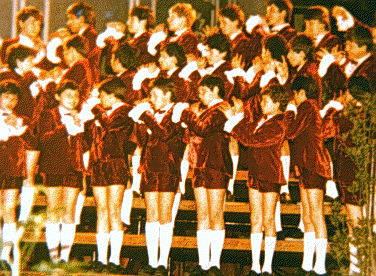
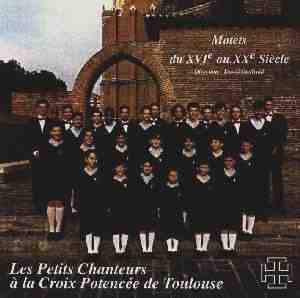
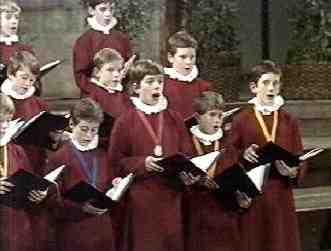
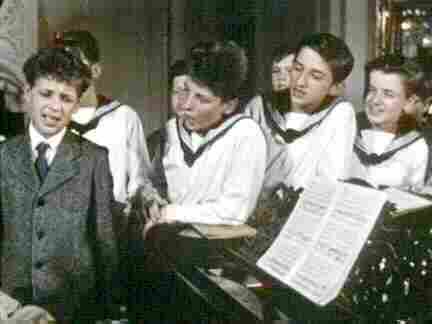
Boy choir costumes have vaired greatly over time and from country to country. We do not have much information on early costumes, but as they were organized by the Church, eclesistical styles were prevalent. e know much more bout modern costumes. In more recent times schools styles were popular. We also see sailor suits which sem popular in Germany, Austria, and neigbiring countries. Here there were both regular uniforms and performance costumes as well as secular and religious costumes. . Some choirs used both during concerts. Many choir directors believe that the costume is very important both for discipline and ppearance and have given great attention to it. Some want destinctive styles while others opt for a more standardize national style. Many French choirs have adopted similar styles. Other choirs directors attach less imporatnce to it, butalmost all have standard costumes. A variety of garments have become associated with boys choirs. Generally however choir costumes have reflected the boys' cclothing of the day, although choirs are odten conservative about making changes in the costume. Thus we see the boys wearing styles that hve passed out of fashion.
All of the best known children's choirs are boy choirs. This includes choirs like the Vienna Boys' Choir and the English cathedral choirs with rigorous choral instruction. This has changed somewhat with the organization of girl choirs at some English cathedrals. Still the best known choirs continue to be boy choirs. This is primarily because of the the tradotional male dominance in most Christian churches, especially those which sponsor choirs. Some argue there are difference in voices of boys and girls, but this is controversial. There are, however, mny mixed children's choirs around the world. Some countries only have mixed childrens's choirs. These mixed groups were much more common in Communist countries. There are cultural factors involved here that we do not fully understand. We also notice them in Meditteranean countries like Italy, apparently because of difficulties recruiting boys. We only seem to notice mixed choirs in Asia. (The only exception here is choirs organized at single gender schools.) Almost all of these mixed choirs have training programs much less rigorous than the European boys choirs.
Church goers througout Europe for centuries have gathered beneath the soaring arches of the great cathedrals to celebrate the mass and later the services of Protestant denomanations. The servoces would be enriched by the sweet soprano voices of generations of boy choristers. This tradition has begun to change. At several of England's great cathedrals, girl choirs have been formed. Girl and mixed choirs are not a new phenomenon. Theyt exist in many countries and individual churches often organize such choirs. But the new girl choirs in England are being organized for serious music. There is no though to creating a serious mixed choir as the great choral master woorks have been in fact written for boys' voices. But even the creation of girl choirs is proving extremely controversial.
The treble boy voice is considered by many to be a treasure of nature. HBC in collecting information for these choral pages, notes many references to boys' voices. We have been able to find, however, no definitive study. There are some clearly established facts. It is clear that some choral music was written for boy singers as old as 18 years. It is also clear that boys' voices now break sooner than they did even a few generations ago. Several accounts indicate that boys' voices before World War II were breaking at age 14-15 years. I'm not sure why this was, but presumanly improved diets are an important factor. This we can not, however, yet confirm. What seems much less likely is that earlier boys; voices may not have been breaking until age 18 years. We can not say definitively that this was not the case, but there are other explanations. Some observers believe that it is more likely that choir masters were teaching boys whose voices were breaking to adjust the register and manner of singing. [Beet]
|
Some interesting movies have been made in Europe about boys choirs. The movies have
been of uneven quality, but do show some details about the cotumes worn by choirs in the
various countries. The films reflect the various costumes worn by the choirs in the various
countries, including sailor suits, short pants, lederhosen and other outfits.
HBC has noted numerous drwings of choir boys. They are a popular subject for Christmas cards by often unidentified artists. We have noted many such American, English, French, and German drawings. These cards began to appear in the 19th century. There are also paintings of choir boys, but we have not noted modern paintings before the 19th century. This probably reflects the fact that many boy choral music became popular and that many chours were organized then. We have also noted some beautiful drawings by French illustrator Pierrer Joubert who is better known for his illustrations of French Scouting. Most of the drawings, especially the ones for Christmas Cards, show the choristers snging in eclesiastical robes.
HBC would like to suport the many choirs listed in this section. We would be pleased to update our web pages as ppropriate with the latest informnatioin on the choirs. We also will add a link from the choir pages to internet pages offering recordings of a choir's music for sale. Interested choirs need only provide HBC the appropriate link. We also plan to eventually add links to sites with choral music.
Many technical terms are used in association with choirs. This includes both terms used with the eclesiastical garments worn by many choirs and music terms associated with choral music, especially church music. The glossary might assist HBC readers better understand these pages.
Beet, Stephen. Sleeve notes to "Tis there, my child, the Better Land".

Navigate the Historic Boys' Clothing Web Site:
[Return to the Main children and fine arts: Specific diciplines]
[Introduction]
[Activities]
[Biographies]
[Chronologies]
[Countries]
[Style Index]
[Bibliographies]
[Contributions]
[FAQs]
[Glossaries]
[Images]
[Links]
[Registration]
[Tools]
[Boys' Clothing Home]