
English Boy Choirs: Choir Schools--St. Mary of the Angels Song School
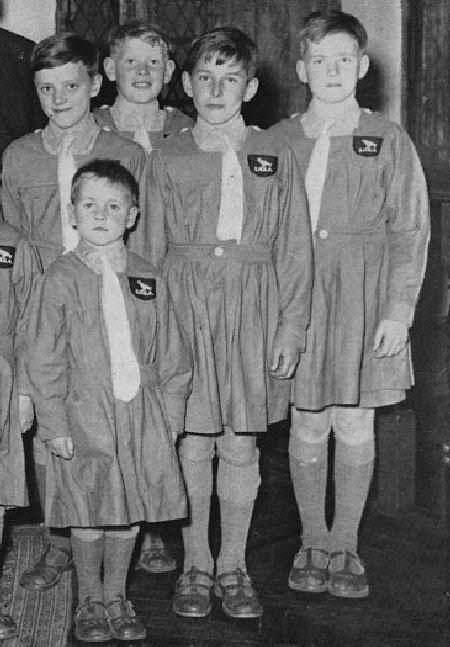
Figure 1.--The choristers at the St. Mary-of-the Angels song school wore a blue smock for every day school activities. The smocks had the school badge. This photograph is from the 1960s. Note that the boys wear their ties outside their smocks. The five boys in the photo are from left to right Nicolas Lockley (from
Ashford, Kent) Anthony Seamarks (from Kempston, Bedfordshire), Paul Dann (David King' cousin from Slough then in Bucks who now lives in Australia), and Timothy Edmonds (from Oxhey, Watford whose father was the vicar of St Matthews Church). David King whom has provided information on the Song School tells us, "I recorded the Mendelssohn piece 'I would that my love' with Tim and still have the record.
|
|
Desmond Morse-Boycott's wonderful book, A Pilgrimage of Song describes his experiences with a London boy choir. He was an Anglo-Catholic priest in Somers Town,
a slum area of London, before the war and set up the St Mary-of-the Angels song school to train local boys as choristers. I am not sure when the school was founded. The boys were outfitted in Eton suits on Sundays and wore a practical blue smock at other times. The back buttoning smocks had a front button for the waistband and the school badge worn on the left chest. There were also buttons on the shoulders of the smocks. The smocks had a cut away square collar so the shirt collar and ties showed. The smocks looked more like a French than an English school uniform. Under their smocks they wore grey shirts and short trousers with plain grey turn-over-top kneesocks and school sandals. They wore a solid light-colored yellow tie. The boys also wore a choristers robes with a ruff for formal events. Later the school acquired residential premises out of London. Note the smock from this period (picture from the 1960s) with the tie worn hanging outside. The school closed in 1972.
Recruitment
The christers were recruited by advertisements. One chorister tells us how he joined the Choir, "With me I was told by my priest at the church I was singing at that he thought I had a good voice and it was him
who wrote off to the school. Also he wrote to St Martins in the Fields and Westminster Abbey, but I was to old at 11 for those schools. The owner of the school Desmond Morse Boycott who was related to Geoff Boycott the
cricketer came down on a sunday and heard me sing and by Tuesday I was on a train to Buckinghamshire. My parents left the decision up to me." [Harding] One source suggests that many of the boys were recruited from some od the poorer sections of London.
St. Mary-of-the Angels Song School
Desmond Morse-Boycott's wonderful book, A Pilgrimage of Song: The Times and Chimes of St. Mary-of-the-Angels Song School 1919 - 1972 describes his experiences with a London boy choir and the Song Schoolm he founded. Father Desmond was an Anglo-Catholic priest in Somers Town, a slum area of London, before the war and set up the St Mary-of-the Angels Song School. Father Desmond’s main claims to fame apart from having two monarchs in his ancestry were to be related to Henry Morse the inventor of More Code and to be a 1st cousin of Sir Winston Churchill. His daughter was Mary and she was a member of the Royal Ballet at Covent Garden. Father Desmond eventually acquired residential premises out of London. Song school is a term used in the Medieval era to describe a choir school. The school was Founded in 1919 originally as a parochial Choir School. The Choir from 1935 to 1970 served the Church at large. A former chorister tells us, "The Choirmaster at the choir school was a Mr Robert Davies who was a baritone in the choir of St George’s Chapel Windsor, a delightful man to whom I owe a great personal debt. He travelled by bus from Windsor to Beaconsfield three nights a week during term time and again on Saturday mornings. Incidentally I am almost certain that the term Song School was chosen because of Father Desmond's admiration for the Vienna Song School in Austria." [King] The Song School closed in 1972 when Father Desmond retired to his home town of Worthing.
Father Desmond
Father Desmond besides his clerican duties was also a journalist and wrote regularly for among other papers the
Church Times. On of his choristers tells us, "He was extraordinarily proud of the fact that he had 144 words per minute in Pitman's shorthand which he attempted to teach us boys, in my case with very little success." [King]
Purpose
One source says the purpose of the Song School was to train local boys as choristers. A former chorister tells us, "The mission of the school was to train children of the clergy and if possible to prepare them for a life in Holy Orders." [King]
Funding
A Fund was established to support a choir at the churchn (1932). Running a school is of course a much more expensive proposition. St. Mary of the Angels was the only choir school in Britain which was not attached to a Cathedral. Thus earning some money was critical. The School was funded by largely by hiring the choir
out for society weddings and funerals, concerts and film scores and by constantly approaching his personal contacts for financial support. The Choir sold records sung by the choir or by the soloist at the time. A former chorister tells us, "The school was largely funded by Father Desmond personally and I remember the frequent reference by him to how tight finances were. The school earned it’s crust by singing society weddings and funerals mainly in London and the school had for reasons I do not know a close association to Crown Court Church, Covent Garden. We also used to be engaged to work on film soundtracks at the local film studios – Anvil Studios Beaconsfield and Shepperton Studios. I remember two films we were involved in – 'The French Mistress' starring Bridgette Bardot and 'The Victors' which was produced by Carl Foreman (a very depressing war film). We also had regular Christmas engagements in West London such as carols for the annual RAF Pathfinders Dinners at the Dorchester Hotel (with the men of St
Pauls Cathedral) in Park lane and Grace for the Chamber of Commerce Banquet at the Grosvenor House Hotel for which each boy was given a Crown piece. That was 25p in today's money, but a lot more at the time!)" [King]
The Morse-Boycott Bursary Fund (formerly St Mary-of-the-Angels Song School Trust) now takes the form of bursaries for boys at cathedral choir schools.
St. Mary's of the Angels Song School was fonded and operated by Father Desmond and other kndividuals connected with the Anglican Church. So iturgical music was a major part of their repotoire. We note the boys making tours and singing as part of the services in the great English cathedrals. So liturgical music seems to have been the music for which they were trained. A former chorister tells us, "The music was in the high Anglican tradition with some secular classical pieces. A former choristers tells up about some of the pieces he recalls.
Discipline
A former chorister tells us, "The discipline was very strict and good behaviour and good manners were considered very important. A Every day started with a cold shower - winter or summer and all the boys had to queue to use one shower! Soap was Green Signal soap which came in 12" bars and had to be cut up with a knife into useable pieces. [King]
The boys were outfitted in Eton suits on Sundays and wore a practical blue smock at other times. The back buttoning smocks had a front button for the waistband and the school badge worn on the left chest. There were also buttons on the shoulders of the smocks. The smocks had a cut away square collar so the shirt collar and ties showed. The smocks looked more like a French than an English school uniform. There do not appear any indication of seniority in this everyday uniform. All the boys from the youngest to the oldest dressed identically. Under their smocks they wore grey shirts and short trousers with plain grey turn-over-top knee socks and school sandals. All of the boyswear school sandals although we note that they wear both the "T" strap style and the double bar style. Either were acceptable. They wore a solid light-colored yellow tie. The boys also wore a choristers robes with a ruff for formal events. Note the smock from this period (picture from the 1960s) with the tie worn hanging outside.
Boarding
The Song School was operated rather like a boarding house. One chorister reports, "I was there for 6 years and left in 1968 when my voice broke. I was proud to be the soloist and head boy. When I was at the School, we lived in a house in Seer Green near Beaconsfield, and went to a Church of England School in the daytime at Beaconsfield. Obviously at first we were a bit homesick, but we got used to it. I can only think of one boy that went home and left the choir school." [Harding] Another former chorister comments, "A school like St Mary of the Angels Song School would probably not be allowed today because of the politically correct society which prefers to
think the worst of people. One elderly priest looking after 12-15 boys in a boarding school would most certainly be frowned upon." King]
Activities
The Song School was very demanding. Some wonder if these as well as boys at other choirs don't not miss all the activities that boys
with more free time are able to enjoy. A chorister tells us, "I never felt I was missing out on things. We practiced 3 nights a week with a choirmaster who came in from Windsor. (He was also a tenor in the
choir at Windsor Abbey and I was lucky to sing with the choir at the abbey on one occasion.) Then weekends we sang at weddings or in different churches on special occasions, but if we had the weekend off we could go into town or have tea at school with friends." [Harding]
Head Boy
As in many British schools, a headboy was selected by the headmaster. Sometimes it was the soloist, but not always. An oldboy tells us, "The headboy was not always the soloist. It depended on your voice." [Harding] Another former chorister tells us, "Being selected as Head Boy was not about singing by about having an ability
to positively influence the other boys in all aspects of school life." [King]
We note a popular tradition at the school during the Christmas reason was the selection and ceremonies associated with a Boy Bishop. This had been a very common traditioin in Midieval Europe, including England. The Church and Government authorities attempted to suppress the custom. We note, however, that is was a popular traditioin at the St. Mary of the Angles Song School. We are not sure to what extent it was practiced at other English schools.
Music Careers
I'm not sure to what extent choristers from the Song School persued careers in music. One chorister tells us, "I didn't, but get me on that kareoke .... As with the others I have not seen them since I left the school." [Harding]
Personal Experiences
One former chorister tells us, "The school suffered a temporary closure in 1958 when Father Desmond's wife,
Marguerite, sadly died. He decided to re-open it in 1960 and I was one of the first six boys auditioned in late 1959. My mother had long harboured ambitions for me to go to a choir school and after a failed audition for St
Paul's Cathedral my choir master at St Mark's Church in Reading saw an advertisement in the Church Times for St Mary of the Angels Song School. I went along for the audition and was accepted. As a boy from a normal working
family it was a huge step and once I settled down I thoroughly enjoyed it. The decision to go to the school was not mine it was made by my mother. Initially I resented it rather but once I got used to it I had a really good time and did things which I would never have done in any other environment. For me the whole experience was positive and looking back I think it shaped my views and my life. I retain a very keen interest in music, particularly Church music." [King]
Reader Comments
A French reader working with French choirs, "Very interresting information about this school. I was interested, was there was any distinctive sign concerning the uniform for the solist or the confirmed chorister? It's true that it is a bit fun to see English school boys wearing such a smock. This sort of smock look quite like a French school smock. Interestingly, our choirs never wore smocks. There are some differences with French school smocks. The French smocks had a real or more commonly a false colar. French mothers considered it nicer if the short pants did not show or at least just showed a little bit. About the tie, this ws considered an accesory more for adults. French boys did not wear ties with their smocks. French boys did commonly wear T-strap sandals ( sandalettes ) with their school smocks to about age 12, especialy during 1930-1960s. English boychoirs are some of the the best in the world. I hope that HBC can add some additional information about the music performed by the choir. I am interested in which classical chants taught at this choir."
Sources
Harding, Eddy. E-mail message, June 29, 2003.
King, David. E-mail message, January 12, 2014. David attended the Song School from January 2, 1960 to Christmas 1963. He was Head Boy during 1962-63. He tells us, "My pleasure to add to your web page. I remember the school with great affection."
Morse-Boycott, Desmond. A Pilgrimage of Song: The Times and Chimes of St. Mary-of-the-Angels Song School 1919 - 1972 (The Faith Press, 1972). Father Desmond also wrote an autobiography, A Tapestry of Toil.
HBC

Navigate the Historic Boys' Clothing Web Site:
[Introduction]
[Activities]
[Biographies]
[Chronologies]
[Countries]
[Style Index]
[Bibliographies]
[Contribution]
[FAQs]
[Biographies]
[Images]
[Links]
[Registration]
[Tools]
[Boys' Clothing Home]
Navigate the Historic Boys' Clothing Web choir costume pages:
[Return to the Main English choir school page]
[Australia]
[Austria]
[Belgium]
[Bulgaria]
[Canada]
[Denmark]
[England]
[France]
[Finland]
[Germany]
[Japan]
[Netherlands]
[Poland]
[South Africa]
[United States]
Navigate the Historic Boys' Clothing Web style pages:
[Short pants suits]
[Blazers]
[Collars]
[Lace collars]
[Ruffled collars]
[Eton collar]
[Fauntleroy suits]
[Sailor suits]
[Ring bearer/page costumes]
[First Communion suits]
Created: December 5, 2002
Last updated: 2:16 AM 1/13/2014