|
Religious celebrations vary widely in American, depending on the family's national and religious background. Buying a new Easter outfit is an American tradition. Children would often have their portraits taken in their new outfits. Palm fronds are blessed in some churches. Americans traditionally have an Easter "parade." Prople in towns and cities used to walk to church in their newest clothes. It became traditional to buy new spring clothes, including a new suit. Of course no parade was more famous than the parade down 5th Avenue in New York. We are archiving family Easter images ere to show how Americans celebrated the Easter season and the fashions involved over time. Men used to dress formally and women and girls traditionally had a brand new Easter bonnet. And of course parents wanted their children dressed up as well. Colorfulk eggs and candy have been an important part of Easter for the children.
Today pastic eggs are making inroads against real eggs. There are also loads of candy for easter, the two favorites are chocolate eggs and bunnies. Egg-rolling, coloring, and hunting are major Easter traditions. Much of this comes from Europe. Egg rolling seems to be a uniquely American tradition. Beginning with the presidency of Rutherford B. Hayes, an egg-rollilng contest has been held each year on the White House lawn in Washington.
Buying a new Easter outfit is an American tradition. Here we have an Easter portrait of an unidentified Detroit boy in his new all-white Easter suit. He looks to be 5-6 years old. It may be a tunic suit, but we are not sure. He has kneepants rather than the bloomer knickers that were more common ith tunic suits. He also wears white long stockings and strap shoes. Also notice the elegant white gloves. The portrait is undated, but we would guess was taken about 1910. He has rather severe cut bangs.
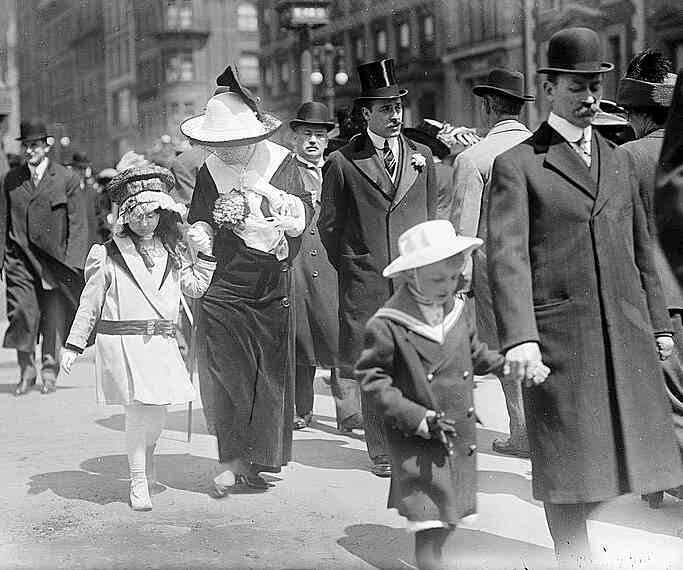
Here we see the New York City 5th Avenue Easter Parade in 1911 with people showing off their new clothes (figure 1). New York was and continues to be the fashion hub of the United States.
I think the children are probably brother and sister even though the parents are not walking tgether. The weather can still be quite chilly in New York at Easter hense the marchers are bundled up. (I don't tyhink it was all that common for father and son to march alone or for women to march without their husbands in the 1910s. Notice the girl's very elaborate outfit. The boy wears a wide-brimmed hat (notice the chin strap) with a sailor outfit and warm coat. Notice the gloves in his hand.
Here we have an unidentified family, we think after an Easter egg hunt. We don't know where the snapshot was taken. It is undated, but looks like the late 1910s to us. The children are wearing their best outfits. They have Easter bskets which presumably were used for a Easter egg hunt. They seem to be having a lottle picnic, although we can't make out just what they ave in their baskets. They wear quite a range of different outfits.
Here we see a unidentified group of boys and girls having an Easter portrait taken. The children look to be about 3-10 years old. We are not sure wht the grouo is, perhps the youngest children in a church congregatin. The Easter baskets identify it as an Easter portrait. For some reason, however, only two of the children have baskets. We are not sure where the photograph was taken. It looks somewhat like a park, but we believe it is some kind of well kept grounds. Perhaps it is churchb grounds. It looks like the trees are all out, but I think that is a magnolia in the background. The weather must sy=till be a little chilly as most of the chiuldren re wearing cots. The girls wear fabncy Ester bonets. Two boys wear sailor suits covered up with coats. nother boy erars a sailor suit without a ciat. And the oldest boy wears a suit with n Eton collsr. It is a short pants suit. Notice he wears knee socks while the other childrn wear three-quarter socks. The portrait is not dated, but we woukd guess it was taken in the early-1920s, but the late-1910s is possible.
Egg-rolling is another Easter pastime. The traditiin dates back to the mid-19th century when it was conducted on Capitol Hill. The Congressmen got upset with the comotion and mess and eventually banned it. President Rutherford B. Hayesinvited the children to the White House grounds. There was no impressive hill for the folling, but since that time an egg-rollilng contest has been held each year on the White House lawn in Washington. We note Warren Sonneman with his Easter basket on the White House Lawn in 1923.
Here we see the children at the Vine Street Orphanage in Chattanooga, Tennessee during the 1930s. The children all have their Easter baskets. I am guessing that they are about to have an Easter egg hunt. We know nothing about the orphanage at this time. Interestingly the children are all dressed quite differently.
We see two unidentified brothers here at the end of World War II (1945). They are in front of their home. It looks to be a new home in the expanding suburbs. The boys are on a rather basic door slab. Earlier homes would have had porches. The snapshot shows the boys withb their Easter baskets. Notice that their are four baskets. Either they are for their parents or the boys have sisters. The baskets may contain candy, but the main purpose was for an Easter Egg hunt in the family yard. The eggs would be brightly colored. I'm not sure if the boys helped color them, but in later years this was common. The boys look to be about 4-9 years old. The younger boy wears a short pants Eton suit, we think with a beret. His older brother wears an Argyle skeeveless sweater with knickers and knee socks. The knee socks seem to have a colored top. We do not have many examples of boys wearing knickers after the War.
This press photo was headed, "St. Patrick's pigeons find a friend". The caption read, "New York.. He's all dressed up and he knows it. 3 year old Lauri Stremm was one of the young fashionables who attended St. Patrick's Cathedral today for Palm Sunday services. Here he makes friends with some of the pigeons on the steps of the Cathedral, one of his feathered friends perching on Lauri's shoulder." New York was of course famous for a Easer Parade down 5th Avenue where everyone showed off their new oufits.
Elementary school children often celebrated major holidays. Easter and Christmas were commonly celebrated despite being religious holidays. In the post-Wold War II era these celebrations commonly focused on the secular aspects of these holidays. Here there were all kinds of secular traditions, especially the Easter bunny and of course all that candy. Here we see 1st graders preparing for a visit from the Easter bunny.
Here we have an unknown group of children. It can't be a family group. There are toio many yioung children. Perhaps a family and a few friends thrown in with them. There are six children. All look to be pre-school children except for the oldest girl who may be 7-8 years old. Most have their Easter baskets at the cready for a Easter Egg hunt. It looks to be the early-1950s although the late-40s is possible. They are in one of the new suburbs which spring up all around the country. Thechikldren are dressed up in their new Easter togs--spring frocks and short pants suits. Only the oldest girl, however, has headwear which was once an important aspect of dressing up. .
Here we see a boy and girl (brother and sister undoubtedly) dressed up for Easter. The boy
carries an Easter basket. He wears a single breasted short pants suit with shirt and tie and long black stockings. The long stockings are obviously worn for reasons of formality, not warmth, since it is spring and the girl has bare legs and white ankle socks. The children have probably just come from church. What is somewhat unusual for 1939 is the color of the long stockings--black rather than the much more popular beige or tan. Notice the short dress that the girl is wearing--typical of the shorter clothes children were wearing in the 1930s. The boy seems to be about 7 or 8 years old. His sister is about 4 years old. A reader writes, "The boy's suit reminds me of the kind of suits I wore from about age 6 to 12 or 13, but I wore tan or beige stockings, not black ones."
An example of a family all dressed up for Easter is a Pennsylvania family in 1966. Brightly colored eggs are important part of the celebration for the children. In some areas they are given out on Easter morning. Many families have a good time decorating the eggs. Commonly the eggs are then hidden--but not very well so they can easily bevfound. The children have an enjoyable time hunting for them.

Navigate the Boys' Historical Clothing Web holiday sites:
[Return to the Main country Easter page]
[Return to the Main American holiday page]
[Return to the Main holliday page]
[Return to the Main American family 1910s page]
[New Years]
[Valentine Day]
[St. Patrick's Day]
[Easter]
[Haloween]
[Valentine Day]
[Christmas]
Navigate the Boys' Historical Clothing Web Site:
[Introduction]
[Activities]
[Biographies]
[Chronology]
[Clothing styles]
[Countries]
[Families]
[Girls]
[Topics]
[Bibliographies]
[Contributions]
[FAQs]
[Glossaries]
[Images]
[Registration]
[Tools]
[Boys' Clothing Home]