|
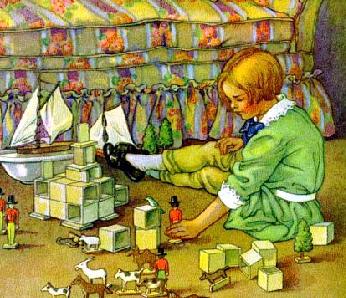
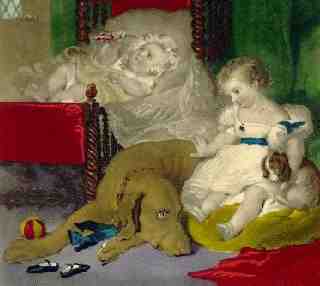
Victorian and Edwardian parents had a very different attitude toward child rearing than modern parents. The relationship was much more formal. Affluent parents would basically have hired staff raise the children. Small children would spend much of their early life in the nursery where they would be raised by a nannie. Many of the grown children had much founder memories of their nannies than their mothers. Some parents, such as Queen Victoria, would go for extended periods without visiting their children. Other parents would regularly visit the nursery or have the children brought to visit them. In many cases these could be rather formal visits. This formality, however, was not always the case.
|
Some information on nurseries is available on the British Royal
family which has been widely written about. (For details on the individual
Royals be sure to see the European royalty pages.)
Informaton on Royal nurseries includes:
Queen Victoria: The nursuries at Buckingham Palace were so far from the living rooms that Prince Albert used to drag the
children through the long passages in baskets. Prince Albert took an interest in the children from a very eralage--something that was very rare for a royal father. He had very definite idea about child care and educationotherwise Victoiria nproablky would have dealt witgh then in a traditiional manner.
Edward VII: Alexandra and Edward raised their children while
Victoria
still reigned. Princess Alexandra had a hole cut in the floor of the
children's nursery so that a sleeping child could be lowered and
kissed goodnight without being woken. This sounds very different than
the nursery of their son's children, George V.
George V: George V and Queen Mary before becoming King kept
David and Albert (the future Edward VIII and George VI securely
cloistered in their nursery at Sandringham. They complained of having more
difficulty keeping their younger chilren confined to their nursery.
George VI: Queen Elizabeth and Princess Matgaret's nursery of
the entire top floor of 145 Piccadilly, where they lived until their
father became King in 1936 and they moved to Buckingham
Palace.
Queen Elizabeth: The Queen had Prince Charles and Princess Anne's
nursery carefully recreated when they moved from Clarence House to
Buckingham Pallace in 1953. There were boxes of toy soldiers, the cuckoo
clock, and a 10 foot high Tudor doll house.
The nurseries of course depended on the parents circumstances. Wealthy parents could afford to hire the staff to raise their children. Less affluent parents had to be more involved. Wealthy parents often had two nurseries for their children, a day nursery for the day and a night nursery for the beds. Comfortable, but less affluent parents, would have one nursery with the beds and furniture for daily activities in a single room. Often foreign nannies were in demand in certain countries. In part this was due to the foreign lanuage training offered. In other cases it was the reputation, English nannies and governesses appeared to be have been particularly prised--even in far flung countries. We are all familiar with The King and I where even the King of Siam of all persons seeks an English governess--a story based on an event. Some times international politics dictated the chioces. Thus Russian royal family with families ties to Queen Victoria often chose English nannies. One would have thought that French nannies might be chosen given the importance of French culture and use of the French language in artistocratic Russian circles. But perhaps the memories of the Napoleonic Wars or the preceived permissivness of French nannies argued against them.
|
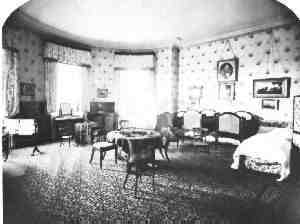
We note details avout the selection and charactristiucs of the room. One Edwardian parental advise source provided guisancve on wear in the hime to situate the nursery. Attitudes toward this changed evilved signifgicantly in the 19th century. By the tyrn of the 20th century the ficus was on fresh air and sunshine and ventialtion.
"Never mind which way the spare room faces, or how many steps lead up to it, but choose a south or south-west aspect for the children; for, no matter how costly and hygienic the fittings, a sunless room facing north will never make a healthy nursery. The excuse is made sometimes that a sunny room is too hot in summer, and makes its youthful inmates pale and listless. This is certainly the case. But our English summers are, alas! too short; and even if the nursery cannot be changed during the heat, at all events some other room can often be temporarily given up, or, best of all, the children kept in shade and shelter out in the open air.
If it can be managed, the nursery ought not to overlook the street – a quiet room is very necessary – and never be persuaded to ” sky the little ones. Have you ever noticed that in hundreds of homes the window-bars that denote the position of the nurseries are often on the highest story, in order to banish childish voices and restless feet as much as possible?
Now, rooms at the top of a house are often less lofty, have smaller windows, gain additional heat and cold from proximity to the roof, and last, but not least, receive all the used-up air from the lower rooms, because heated, impure air rises. Cramped nursery quarters are very undesirable." [ Every Woman's]
Here are some views of Victorian homes and floorplans. Usually the parlor looked out on the front of the home. The same is true of the modern living room whoch is why it is also called the front room. The bedrooms and nursery was commonly on an upsatirs floor. There were, however, many variations from home to home.
Here is the advise parents got on necesity of proper venilation.
"The size of a room for a nurse and one child should not be less than fourteen or fifteen feet square, and eleven or twelve feet high. Where this is quite unattainable, take extra precautions to ensure good ventilation. Pure air, fresh air, is as important for children as food. True, they may live in vitiated air that has been breathed in and out and contaminated by other human beings, but only at the expense of mental and physical health. Well-ventilated rooms are easily secured in quite simple ways.
Firstly, there must be an open chimney in the room, for this acts as a most efficient ventilating shaft. Therefore, the register must never be closed, or the chimney blocked in any way. Secondly, direct that the upper sashes of the windows are left open night and day – and see the order is carried out. If the weather is too inclement or there is any special reason against doing this, have ready for such an emergency a piece of wood the width of the window and about four inches deep.
Open the lower sash, fit in the piece of wood, shut the window down on to it, and a space will be left between the upper and lower sashes in the vicinity of the fasteners through which the outer air will rise without draught. Never imagine that fresh air means draughts through badly-fitting windows and ill-laid floors. If these exist, tack the india rubber tubing made for the purpose, and costing but a few pence per yard, under the doors, etc., and fill cracks in the floor with putty or cement.
Nursery windows should be protected by outside iron bars, for children simply love to look out, and in no other way can their safety be ensured. Supposing bars are not possible for some reason, hammer a strong nail into the window frame above the lower sash, so that it cannot be raised more than about six inches. The most hygienic plan is to have the nursery windows free from blinds, as, with the exception of the Venetian variety, they all exclude air, and the latter, alas! are veritable dust-traps unless constantly washed.
Still, it is convenient to be able to screen the windows at times, in order to soften the light or make the room cosy in winter; so soft casement cloth curtains, in tints to harmonise with the room, are often used, for they wash perfectly, and only need to be plainly ironed." [ Every Woman's]
I am not sure about the ages of release from the nursury. In Britain boys appear to have left the nursery when they were sent off to their boarding school. At the beginning of the 19th century this event varied from about 8-12 as schools had not yet developed uniform entry ages. By the end of the 19th century preparatory schools taking boys at about 8 years of age had become well established. And as a result this age appears to have been a common age for leaving the nursery. It was less common to sent girls to school so the ages spent in the nursery were more varied. I assume American parents more or less followed the British, but I'm less sure about the French and other European parents.
|
Pmve parents have selected a room, the nexy step as to equip it.
Here is adbise on the balls and floors. "A few years ago whitewashed ceilings were thought good enough for anybody, but baby nowadays has his painted in white or pale cream enamel, washable distemper, or covered with white washable paper. If, however, the old method is preferred, the whitewashing should be done every spring. Ceilings and walls give wide scope for artistic and original ideas, as long as the rule that ideal nurseries must be washable throughout is always remembered. Perhaps the greatest favourite for nursery-wall coverings is some form of washable distemper, or enamelled paint in pale tints, with decorative bands or friezes of paper made in designs of quaint figures, animals, birds, etc., affording the youngsters something bright and entertaining to look at during meals or rainy days.
If liked, washable papers illustrating nursery rhymes, etc., can be used instead of the self-coloured paint or distemper; but they do not make a restful background, and need to be purchased from good firms, or the designs and colourings injure, instead of educate, the children’s perception of colour and form. In some nurseries the dado is made of pretty oilcloth, fastened to the wall with a dado rail above of a darker contrasting colour. This scheme is simple, costs little, is very strong, and easily kept clean.
What shall our babies walk and crawl on is another absorbing question. Try a good cork carpet with a pattern (not self-coloured, as these show the dust too much). It is warm, wash-able, strong, and pretty, and affords no resting-place for the dust fiend. A few washable cotton rugs in blue and white or other colourings can be laid down here and there, but care must be taken that children do not trip over them." [ Every Woman's]
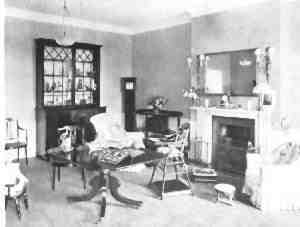
The next step was the furtniture, "There is still a tendency to relegate large, old, cumbersome pieces of furniture to the nursery, either because it is roomy and comfortable, or because it has become a sort of nursery heir-loom; but it is doubtful if either reason is sufficiently good to justify their presence in valuable space that ought to be occupied by air. So far as comfort goes, nothing can beat the modern nursery furniture now procurable from many good firms. Simplicity is the rule, and furniture of best quality is made in plain oak or stained wood, for painted and highly polished surfaces too soon show the wear and tear of nursery customs. Rounded corners to everything are necessary for sharp-pointed edges have resulted in many a serious cut and scar. Supposing the furniture now in use is of the latter description, a cabinet-maker will very soon remedy the danger. Miniature nursery tables, chairs, etc., are very popular. They are made in wood or cane, and are more comfortable and safer than high tables and chairs. A cosy, broad sofa is an invaluable possession in the nursery. An aching head or bruised limb can be petted on it so well without keeping the child in bed, and it provides a too quickly-growing boy or girl with means of obtaining the necessary rest, not to mention its Splendid capacity for acting as a “ship,” “train, “desert island,” etc. A toy cupboard of some description is essential, or the nursery can never be called ideal. The shelves ought to be low enough to be within easy reach of the children. Not only does it help to keep the nursery tidy, but it is also a never-ending source of delight to the chicks; for is it not their very own, in which they can hoard unchecked the hundred and one treasures that unfeeling nurses are apt to catalogue as rubbish? A toy table is considered a very great treasure. It may easily be fashioned at home. There must be an edge round to prevent marbles, etc., rolling off; it must be low enough for the children to be able to sit at it on the floor with their feet under it. It should have castors, so that it can be easily pushed about, and it must be sufficiently strong to bear the child, who will inevitably use it as a seat. One of the latest and most successful additions to the nursery is a sort of sheep-fold, in which baby can crawl about without injury to himself or worry to a busy nurse or mother. A crawling-mat made of thick, soft material, on to which are appliqued animals and birds cut out of some bright-hued scraps, is also very useful. Babies simply love to roll and crawl on these mats, and hold contented converse with the zoological specimens adorning their surface. Nurse, on her part, will demand a big cosy chair, in which she can cuddle and pet her small charges, a lock-up medicine cupboard to fix on the wall, far from the reach of any inquisitive fingers, and a reliable clock, but not one that strikes or has one of those aggravatingly aggressive ticks. A very high fireguard is an absolute necessity, and one that covers the grate right over is excellent, for children seem to find anything to do with fire irresistibly attractive. If liked, an outside rail may be affixed to the guard, on which a few little garments may be warmed; but on no account allow the nursery to be used as a laundry or drying-room, for this practice, beloved by inexperienced nurses, renders the air steamy and unwholesome. Besides this there is the danger from fire. Food should never be stored in the nursery, but the nurse will want a simple dresser-like cupboard in which to keep a tin of biscuits and a few other items, as well as the children’s own special cups, plates, table-linen, and so forth. Unless a place is provided for these, it is unreasonable to expect an orderly nursery. A few good pictures on the walls have a real educational value. Crudely-coloured and badly-drawn prints, etc., should never be permitted, for they do untold harm by wrongly forming the child’s idea of art and beauty." [ Every Woman's]
|
Lightt of course was ikmportant. This was affected by aspect. Parental guidance involved, "In conclusion, the ideal artificial light for the ideal nursery is electric light; but if this is unattainable, provide wall-lamps with metal reservoirs – not glass or china – and a safety apparatus for extinguishing the flame if the lamp overturns. Use the best oil, and have the lamp fixed in a strong holder on the wall out of the children’s reach. Gas, though clean and most convenient, vitiates the atmosphere, and is therefore most harmful for the children’s room." [ Every Woman's]
The Victorians and Ewardians loved plants. We see all kinds of indoor plants in period photography. Ome source did not think that they weere duitabloe for thr nursery. "Do not allow many plants or flowers in the nursery. Above all, they should not be placed in the window where they obstruct the light and air. A few geranium cuttings or a pot of musk provide interest and amusement, and the unfolding of a new leaf or a blossom gives instruction in simple plant life, but a nursery should never be crowded with growing things. The children’s health is the most important consideration of all, and anything which prevents free circulation of the air is deleterious. Never allow anything in the way of rubbish to accumulate." [ Every Woman's]
Authorities of the day provided advise and in some cases detailed
instructions for nursery organisation. One interesting source, was The
Housewife's Reason Why wih provided all kinds of instructions,
in many cases of dubevious value. In many instances the child's health
would seem to have taken precedence over aesthetic considerations.
Q: Why are lights from wax or spermaceti (sperm whale oil) most desirable
for a nursery?
A: Because animal oils and tallow throw out, in their burning, poisonous
vapours that vitiate the air, and render it peculiarly hurtful for
children to breathe.
Q: Why should nurseries have a south-eastern aspect?
A: Because it has the advantage of receiving the morning rays of the
sun, without the drawback of the sultriness of an afternoon thus
materially conducive to the health and cheerfulness of children.
Q: Why should nurseries not be situated at the top of the house?
A: Because children are liable to accidents from falling over the
bannisters, or down the stairs; and also because in cases of fire
in the night, the remote distance in which they are placed beyond the
reach of assistance, renders it difficult to save them.
Q: Why should the foot of a child's bed or cot be turned towards the
window?
A: Because a child naturally turns its eyes to the light, and if
that be on either side, it may induce a habit of squinting. The same rule
also applies to the position of an infant in the lap.
Q: Why should a nursery have an extensive prospect from its windows?
A: Because the eyes of the children will become habituated to looking at objects from a long distance, for want of which children frequently become short sighted.
The Author adds that nurseries should be carpeted to protect children from 'the force of the blow upon their heads and limbs' should they fall.
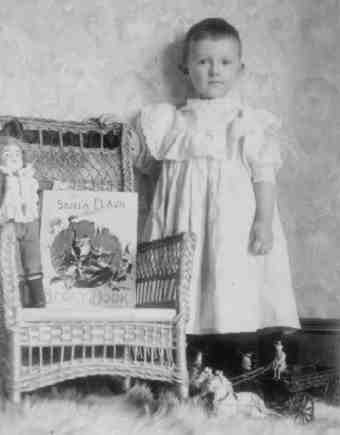
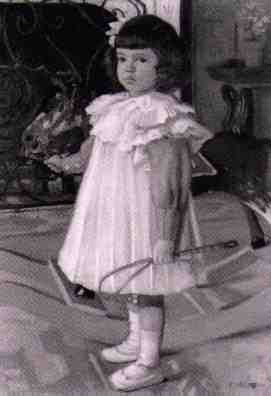
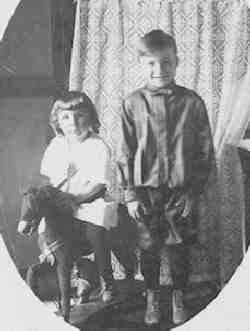
One interesting aspect of the available images of nurseries is that the children loved to be photographed with their toys and prised possessions. One common prop were elaborate hobby horses, a favorite with the boys. Interestingly, the children are rarely photographed with pets in the nurseries. Apparently the Victorians and Edwardians did not think it desirable to keep pets in the nursery. The children often had quite a personal relationship with therir hobby horse, giving them names and talking to them.
|
I have little information on how the children were dressed in the nursery. I have received a variety of submissions describing nursery attire. The varying estimates as to when boys stopped wearing dresses and begun wearing knee pants probably reflects just how fluid the age could be. One contributor suggests that infants were dressed basically alike in long dress. Young boys wore dresses of various styles and were put in knee pants at about age 4. After that boys and girls were dressed like adults--including corsets for the girls. I believe that smocks and pinafores were standard wear in many nurseries. This is obviously true for girls, but younger boys might also wear pinafores and smocks--especially in France. Smocks were more common for boys than pinafores. I do not know how common they were in Britain and America, but the available photographic record suggests boys as old as 7 or 8 years might commonly wear them. Based on available evidence, younger boys wore dresses. Even after they began wearing knee pants, smocks were probably quite common. Less formal sailor suits were certainly worn. After the turn of the century, romper suits or in America Buster Brown outfits were probably common. The girls commonly wore pinafores, but tnis was less common for the boys, especially after the turn of the century. Some mothers and nannies continued to find smocks a very useful garmet for nursery wear.
|
Dressing properley was very important for te Victorians and Edwardians.
Parents felt it jy\ust as important to dress the children well as how
they were outfitted was a reflection on the ebntire family. This generally meant that
the children were dressed in very complicated, often restrictive clothes--
quite a departure from the comfortable unrestrictive clothes popular at the beginning of the
19th Century. Dressing in
the nursery could be a very complicated process. This varied
somewhat, depending on just how the child was being dressed. Clothes
in both the Victorian and Edwardian era were more compicated than
today and a child would have required more assistance dressing himself.
Some of the informal outfits like smocks were simplier than others outfits. But even with smocks a child would have
needed help as 19th and early 20th Century smocks were back buttoning. Even informal styles were not as simple as the "T" shirt and jeans worn by the modern child. All the bows and buttons caused all kinds of problems. Also the child would have to be helped with his pantalettes or stocking suportes and stickings as well as whatever he wore under his smock which
I am not sure of at this time. Pinafores were also worn, but usually to protect a formal dress or suit underneath.
Like smocks, pinafores were back buttoning ad usually had strings to tie in a bow at the back.
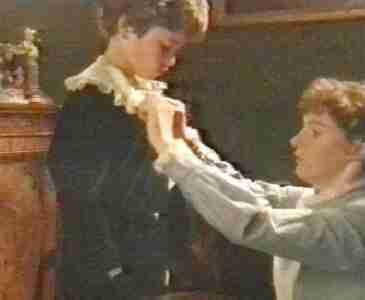
As complicated as informal clothes were, formal clothese were, of course, much more compicated. Formal clothes like Little Lord Fauntleroy suits could be quite complicated and a child might have required quit a bit of assistance. The bows in particular were very difficult to tie. The collar bow was so important in the boy's final look, that even for older boys it was tied by his nanny or maid. The sash bow would have been especially difficult for a bow to tie. An older boy would have had trouble with the sash bow, it would have been impossible for a younger boy. There were many other complications like getting the stockings on and the stocking supporter attached. Gering the lace or ruffled collar to fall just right was important, as swell as countless other details.
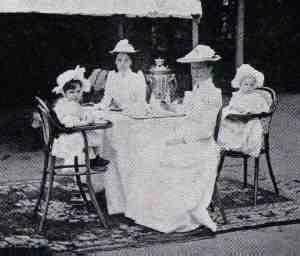
Children in the nursery were cared for by nannies. In the 19th and early 20th century, help was less expensive than it is now. And thus not only available to the wealthy. Many middle-class families could afford a nanny. A nanny did not require an education of any importance. Thus virtually any woman could ityh a basic fondness for children could be a nanny. We see quite a few photographic images of nannies and their chxarges. We have a good, but unidentified image. A rich families might have a head nanny who would have a staff to assist her, especially if there was more than one child. Less affluent families might have only one nanny. Often very close bonds developed between the children and theur nannies. This was especially true when the parents took little interes in their children which was not uncommony the case of rich familes caught in the social swirl of the day. As the children got older they might have a governess. The governess was very differentthan a nanny with a different social status. Here a good basic education was requird. And this meant more expense was reuired. Thus we tendto betakingabouthigherv income fmilies. This cwas after the children had left the nursery. Governesses were more common for girls as it was more common to spend the boys off to boarding school, at least in England. Boys tended to be more unruky and thus harder to control by a yung woman. By the late Victoirian period sending a boy offv to boarding school was commonly done at about 8 years of age. Really wealthy families might employ a giovernor, but here aealexpens was involved as goverrnors commanded much higher salaries than governesses. We note some interesting images of governesses. There is a painting by Rebecca Solomon. We also notice film depictions.
|
There appear to have been substantial differences in nursury life
and dress in different countries. I don't know a lot written on nursery
wear, but the photographic ans artistic record offers some glimpses.
A note should be made that for the most part only the wealthy had thier
children's picture painted or photograph taken, and that the children
usually were dressed up in their best clothes for the picture. Everyday
wear may have been quite different.
The nursery was the center of a child's life in upper class English families. Parental rlations as described above could be quite formal. Nursery dress appears to have followed standard dress conventions of the day. Some parents and nannies appeared to hav e used smocks as convenient nursey wear. Pinafores were used for the girls, but less comminly for the boys.
We have so far been able to survey few French photographs and paintings, but smocks and pinafores appear more common than in Britain and the United States (figure 5). French family life appears to have been more fluid than in Britain with the children less likely to have been isolated in the nursery.
|
Available nursery photographs show girls of all ages wearing full decorative dresses or smocks, but decorative apron or pinafores are rare. The dresses are not very fitted and often blousy to the waist with a full round skirt attached. Decorations vary from elaborate to the very plain. The boys seem to be wearing simple gowns, skirt suits, or long or short pants suits. Many of the dresses for both boys and girls are off the shoulder, especially in the 1840's-60's. A bolero style jacket and shirt was also common. Many of the photographs have pantaloons or pantalettes and stockings showing below the
skirts. It is sometimes
hard to tell if the child is a boy or a girl. One picture (1860's) shows
four boys ranges in age from about about 3-8 years. Knee pants in the
the 1860s were not as widespread as in the
later 19th century. The oldest boy wears a long
pant 3 piece suit. The next youngest in in a
short pant 3 piece suit, the next in a long pants and matching shirt with
braided trim. The youngest wears a skirt with loose shirt and jacket, and
pantaloons. In the 1880s Little Lord Fauntleroy
suits became popular for party clothes, with lots of lace and ruffles,
but they probably were not worn for everyday in the nursery.
The books I have are of American styles, however, they were not so nursury
minded as the English. I recommend Pricilla Haris Darymple's American
Victorian Costume in Early Photographs.
Some fascinating descriptions of nursery life are available. What I
would
especially like here is a description of the clothes the children wore
in the nursery. General descriptions of nursery life are also of some
interest. Some of the most detailed accounts are from royal nurseries
are those of other wealthy, important families of the day. But some information is also available on other, less famous families.
Every Woman's Encyclopaedia Vol. I.
The Housewife's Reason Why (London, 1857).

Navigate the Boys' Historical Clothing Web Site:
[Return to the Home: Rooms]
[About Us]
[Introduction]
[Activities]
[Biographies]
[Chronology]
[Clothing styles]
[Countries]
[Essay]
[Girls]
[Literary]
[Royal]
[Theatricals]
[Bibliographies]
[Contributions]
[FAQs]
[Glossaries]
[Images]
[Index]
[Links]
[Registration]
[Tools]
[Main HBC Topic page]
[Boys' Historical Clothing Home]