|
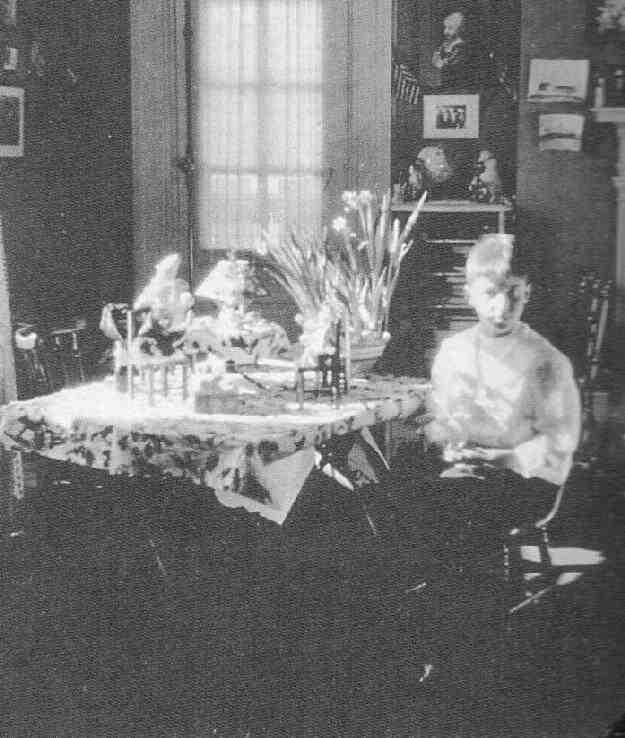
Many activities are associated with specific rooms. Of course thus was affected by social clss and the familily's income level. Younger children in the 19th century, a least chilfren from affluent families, were often cared for in a nursery. There might even be a school room for wealthy children tutored at home. The center of family life was the Victorian parlor. Well to do families might hav a play room which as similar to the nursery, but didnot double as a play room. Families today gravitate to a activities room where the electronic marvels of the fday are often located. The front porch was very important to American families until the move to suburbia following World War II. The bedroom has changed drastically. Once it was a place for sleep. The bedroom for the modern boy has become an entertainment center with a host of high-tech toys, often including a computer.
Affluent 19th and early 20th century families cared for their children in nurseries. Nurseries varied greatly from family to family. Affluent families might have day and night nurseries.
We are not yet sure about the developmemnt of the modern play room. We think it has its origins in the Victorian nursery. Many Victorian homes had a nursery, but we do not think they commonly had play rooms where they spent their times and had hobby horses, gamesm, balls, and other toys. The reason for this is tghat the modern concept of childhood only developed in the Victorian era. This was the conflusion of two different social and econonomic trends. Fiest phiolosphers, especially the French phiolosophs (men like Rosseau), began to understand that chuikldrten were different than adults and needed tio be treated differently. At the time the prevailing attitude was that chikdren were essentuially small adults. These idea were first proposed (18th century) and had by the Victorian era began to affect parent's thinking. The second trend was econoomic. The Industrail Revolution created great wealth throughout Europe and North America. This meant that even people of humble prigins could acquire grand homes and indulge their chuldren. and many children no longer had to work, they could both go to school and had more time to play. The fly in the ointment was that many Victorian parents were a little suspicious of play and had been the case in the 18th centyry. The old precept that 'Idle hands are the devil's worlshop.' Was still a widely accepted maxim. Thus play romms we believe are a largely 20th century creation. This meeds to be comformed. A good example is the playroom of two unidentified Amnerican children about 1940.
Affluent children were mostly schooled at home. Patterns varied from country to country. Boarding was more important in Britain than elsewhere. British parents in the second half of the 19tt century began sending boys to prparatory schools at about age eight. American and French boys were more liked to be schooled at home in especiallhy prepared school rooms--an early version of today's home schooling for many of the same reasons.
The parlor was often at the center of the 19th century home. Families varied on how the palor was used. Some used it for company and the children often did not have free access to it. In other families it was used more of a family room. In such cases the children were more welcome--but on their best behavior. Interesting features of many Victorian parlors were screens where "scraps" (cutouts), greening cvards, and postcards might be used to decoratte. The Victorians, both children and mothers also loved to keep scrapbooks in their parlors. A variety of items might be included in these scrapbooks, including photographs, 'scraps', lettters, postcards, clippings. pressed flowers, and much more. The formal 19th century parlor is the fore-runner of the more relaxed 20th century living room. The primary difference is formality. The modern living room is in addition to wear guests are entertained also an entertaiment center, where the television is commonly locted. Anhd the children tend to have much more access to the living room than they duid the 19th century parlor.
The front porch in the days before air conditioning were an integral part of the American home during the warm summer months. A front porch might run all the way along the front of a house and even around the side. They always had rooms. Some were even screened in. The family might adjourn to the front porch after dinner. The adults might chat while they watch the little ones hunting fireflys. It was also a place for the older youngsters to get away from their partents. Boys might visit their girls. The porch faced the street and thus were the site of many neighborly exchanges.
We have not yet worked up information on kitches. We have archived a German kitchen scene. We see children helping mther with the kitchen clean-up.
While the topic of familily dining practices and how the children were dressed for meals is an interesting one, it is a topic that HBC has not yet been able to address.
Modern American children often have their own rooms or at least brothers and sisters each separated in different rooms. Ceratinly the desire of every teenager is to have his own room. Sleeping arrangements have varied greatly over time, in general reflecting the rising affluence of American and European life. This is somewhat different in Japan where housing and thus living space is enormously expensive. Likewise bed clothes have also changed iver time from the once universal nightdress or gown to today's modern pajamas. The bedroom has changed drastically. Once it was a place for sleep. The bedroom for the modern boy has become an entertainment center with a host of high-tech toys, often including a computer.
The history of the bathroom is perhaps the most interesting of any room in the home. The story begins in ancient time. Romand were great managers of water and in fact the very word "plumbing" is derived from the Latin word for lead--"plumbum". And of course plumbing is the key go the bathroom. Pluming is the tubing needed to move water. Aflluent Romans had bathrooms in the sence of toilets, but only the very wealthy had bathrooms in the sence of bathing. Here the Romans used municiplal baths which had hot water and were an important way of socializing. After the fall of Rome, bathrooms and toilets disappared from the individual family home. Actually bthing itself not only virtually disappeared and came to be seen as unhealtful. Incredably it took 1 1/2 milleania for the bathroom to reappear in the fa,ily home. Here both technological advances as well as the wealth created by the Indistrial Revolution brought the bathroom back inside the home. We first see bathrooms in the Victorian Era, esecially in the late 19th century. The first bath rooms appeared in wealthy homes. Only gradually did the working-class acquire them. As late as World war II many working-class families in Britain and Europe did not have indoor pluming and bathrooms. One ngative aspect of bathrooms and improved sanitation was the dreadful outbreak of Polio epidemics anong children.

Navigate the Boys' Historical Clothing Web Site:
[Return to the Main home page]
[Return to the Main activities page]
[Introduction]
[Biographies]
[Chronology]
[Clothing styles]
[Countries]
[Photography]
[Bibliographies]
[Contributions]
[FAQs]
[Glossaries]
[Images]
[Links]
[Registration]
[Tools]
[Boys' Clothing Home]