|
Most religions or shared by mamy differnt countries. Christianity, Islam, Judism,and Budhism are practiced in many diffeent counties. While the same religion, practices often vary among different coutries. One factor is the devlopment of competing denominations of the same religion. The importance of these different denominaions often varies from country to country. Some religions are more associated with one or a small number of countries like Hibuism (India) and Judiism (Israel). Many religions are practiced as minority religions, although there are differences in religious toleration for minority religions from country to country. These differences arrise from both civil authorities and majority religious leaders. Christianity has been generally intolerannt of other religions. Riots and pogroms as well as organized supression like the Spanish inquisition or expelling the adherents of different faiths mar the history of Christianity. In the 20th century became more tolerant. Islam on the other hand, once relatively tolerant of other religion, has become increasing less tolerant in the 20th century.
African religions were largely animistic and varied folk cults. The first religion of any complexity was the Egyptian religon of the Nile Valley, but it does not seem to have had any significant influence beyonfd the Nile Valley of northeastern Africa. Rome conquered the Mediterranean coast of northern Africa (@nd-1st century BC) and introduced its pagan religion, but it did noy spread beyond the Mediterranean coast or was adopted by the indigenous popultion. Christian spread throughout the Roman Empire and was adopted as the state religion Empire (4th century AD). Christianity continued to domonate northern Africa after the fall of Romem but except in the East did not pentrate further south. Axum (modern Ethipopia) became a powerful Christian state. Arab warriors spread Islam throuhout northern Africa (7th century AD) and over time the region became largely Islamicized with importan Christian comminities especally in Egypt. There erre also smaller Jewish communities which had developed during the Roman era. Arab traders also spread Islam along the coast of East Africa. Arabs began the Africa slave trade, both in the Sahel and East Africa. Christinity did not reach Subsaharan Africa until the Portuguese behan moving south along the Atlantic coast searching for a trade route to the East (15th century). Unlike the actions in the Americas, neither the Portuguesor Soanisg=h and subsequently the Dutch, English, and French made an attempt to Chistinize the Africans or move inland. Like the Arabs, they began a very luctarive slave trade (16th century). It is unclar the dimension of the arab slave trade, but the European Atlantic slave trade compressed into three centuries was the largest forced movement of people in history. and many of enslaved Africans, especially in the Caribbean were consumed in what were essentially death camps. Only with the Scramble for Africa did the Europeans begin to move inland and begin a major effort to convert the African people. Along with conversion and colonization came an effort to end the slave trade, resisted by Islamic groups. Today Africa is split between and Islamic north and Christian south. There is also aliver Islam that goes south long the coast of eastern Africa. In Christian and Islamic communities, religious beliefs are often affected by the beliefs and practices of traditional religions which continue to be important in several countries. Across the central band along the Islamic/Christian divide, Islamic militants have become increasingly violent, attacking Christians including little girls they can enslave. There is no comparable violence from Christians.
Fierce pagan religuoins practicing human sacrifice developed in South America and Meso-America. These and oher more primitive religions were extunguished by Spanish and Portuguese conquitadores and priests who imposed Catholic Christianity. Their success was in pat due to the epidemics who wiped out much of the Native American population. The Inquisitiion which turned Iberia into a backward corner of Europe did the sane in Latin America. As aesult, the progress and prosperity of Enhlish North America never develooed in Latin Ametica. The Liberal revolutions that achieved independence for uch of the region broke the hold of the Church in the 19th century, but orogress was slow in coming. After World War II, liberation thgeology appeared whiuch promoted social change. Only the socialist policie promoted only limited real develoopment. Countries where tge Revolution occurred (Cuba, Nicaraguia, and Venezuela) are among the least successful in thec region. In recent years, new more dynamic Protestant and Mormon churches have for the first time made inroads in thie overwealmingly Catholic region.
Spanish Conquistadores brought Christianity to Buenos Aires which became the modern country of Argentiuna. Much of the Native American population was wiped out through mistreatment and divirce. Thus most Argentines trace their abcestry to Europeans, mostly Catholic southern Europe. In addition to the original Spanish settlers, large numbers of Catholic Italians emigrated to Italy in the late-19th and early-20th century. Argentine as a result is a largely Catholic country. First Communion has traditionally been an important event in the lives of Argetine children. As in much of Latin America, religion has declined in importance in Argentina in recent years. The Inquisition kept Protestants out of its American empire. This ended with independence (1811). As a result, there is now a small Protestant minority. There is also a small Jewish minority. Although prohbited by the Royal officials and the Church, a few Jews managed to avoid the Inquisition and settle in Europ. A small number of European \Jews emograted in the 19th and 20th century. Since World war II some Muslims have emograted to Argentina, many from Lebanon.
The Catholic Church has also been an important influence on Brazil. As with the Spnish, the Portuguese made the creation of Catholic colonies a goal of the conquest. Colonial Brazil was thoroughly Catholic. The Inquisition operated there and Protestants were not permitted. The many Africans imported as slaves brought with them their own religions. The slaves were prohobited from practicing their religions, but many maintained their beliefs and tradictions. The Africans not only affected Brazilian Ctholocism, but eventually founded actual religions. Slaves from Nigeraia founded Candomble. Slave masters and the Church forbid slaves from practicing Candomble. The slaves got around the prohibitions by coupling their deities with Jesus important Catholic saints. This apeased both the slave masters and the Church. The slaves while outwardly celebrating Catholic saints were actually worshiping their own traditonal dieties. The slaves identified Oxala, the god of procreation and harvest with Jesus. The masters and Church believesd that the old African traditions would eventually die out, but they have not. The overthrow of the monarchy brought a new republic (1889). This brought a new constitution which guaranteed religious freedom. As a result, Catholocism is no longer the only religion in Brazil. This meant it was possible for Protestants to operate in Brazil. Other churches, including Pentecostal, Episcopal, Methodist, Lutheran, and Baptist, exist in Brazil, but are relatively small. There are over a million and a half Spiritists or Kardescists who follow the doctrines of Allan Kardec. These Spiritists believe in reincarnation. There are followers of the Church of Jesus Christ of Latter Day Saints. There are also small numbers of Jews, Muslims, Buddhists. More numerous are followers of Candomble and Umbanda. Umbanda is Kardescism and related to Candomble, but with an admixture of Christianity and Spiritist (animistic) beliefs. The great proprtion of the population, however, has remained Catholic and continue to be so today. The population is culturally Catholic, but actual church attendance is relatively low. As in other Catholic countries, a child's First Communion was an important event in their childhood. Families that could aford to do so commonly bought the child a new suit or special costume.
Costa Rica since the conquest has been a largely Catholic country. As in other parts of the Spanish Empire, Catholocism was imposed upon the inigenous population. Unlike other prts of Central merica, there was not an advanced Native American civilizations. The Maya trades with tribes in what is now modern Costa Rica, but did not control it. As a result, religion like society was primitive. Both secular authorities and the Inquisition prevented Protestants and Jews from entering the proivince. We do not have much information specifically about the role of the Church in Spanish colonial Costa Rica. The Church was part of an essentially feudal social structure. The landowners supoported the Church which established considerable influence over the mostly Native American peasantry, often tied to the land. The fact that Costa Rica did not have a large Native American peasantry, meant thsat the Church's grip on society was weaker than in other countries. Independence brought many change. The Catholic Church no longer had the unquestioning support of Spanish colonial authorities. As elsewhere in South and Central America, independence opened a struggle between the secular beliefs of liberal revolutionaries and the conservative Church authorities. The liberal secularists were more successful in Coista Rica than many other countries. As a result, Liberal revolutionaries were able to more easily contruct a secular society than in many other former Spanish colonies. Costa Rica as a country has, as a result, since independence been remarkably secular. More than 90 percent of the population is still Catholic, but religion is not a major issue in Costa Rica today. Religious freedom is lergally granted by the Constitution and practically supported by the tolerant nature of Costa Rican people. Church attenance is generally weak, except for special days like Easter and Christmas. Holy Week (the week before Easter) is an important national holiday. In relgious terms it is meant to be a time for prayers ahdcrelectioin as well as and good behavior. It has, however, become highly scularized. Many Costa Ricans use Easter for trips and vacations. Every village, even the smaller ones, has a church, always built to face east on to a central plaza. Each church is dedicated to aaint and there is a special village celebration on the saint's day. The statues in the church are taken out and paraded through the village. This is commonly accompanied by secular celebrations as well.
Paraguay is ovewealmingly Catholic. The Native American population was Christianized early in the colonial period. The Pope created the Bishopric of Asunci�n (1547). The first bishop arrived in Asuncion (1556). Three Jesuits came to pacify and convert the Guarani who were resisting Spanish control as they had earlier resisted the Inca (1588). The Jesuits soon realized the Spanish and Portuguese settkers were enslaving the Guarani in violstion to royal decrees. They thus set out both to convert and protect the Guarani. They proceeded to settle the Native Americans in reducciones (townships) under Jesuit control. At the peak of this approach, an estimsted 0.1 million Native Americans were libing in these reducciones. After 150 years the Jesuits were expelled and the Native Americans lost their protectors (1767). Some of the reducci�n Native Americans were over time absorbed into mestizo society, Others returned to indigenous communities. Eventually additional Jesuits and Franciscans arrived, working primarily n the southeastern area of modern Paraguay and along the shores of the R�o Paran� in what is now Argentina and Brazil. Church state relations have varied. The country in the 19th century was caught up in the liberal movement to develop a more secular nation. Religion has been a unifying force. The Church was virtually the only institution that is not caught up in traditional kinship patterns. As in the rest of Latin Anerica, the Church has largely influenced fiestas and other celebrations. In rural indigenous areas, Catholic religious dogma has not penetrated as deeply. Catholic saints are often basically revered figures devoid of religious content. The country is overwealmingly Catholic. The Catholic Church has been a fundamentally conservative institution. After World War II, especially by the 1960s we begin to see lineral thought emnerging in the Church. Children in ueban areas do First Communions, especially the well-to-do and middle class. We are not sure about the rural poor. There is also a small Protestant minority as a result of the work of Anerican and European missionary work. Paraguay also has a small, but active Mennoite community.
The nations of Europe contested North America, but eventually it came down to a struggle between Anglican Britain and Catholic France, part of a centurie old struggle. The issue was finally decided by the French and Indian War, part iof the wider Seven Years War often seen as the first world war. In North America the larger English populrion and the Royal Navy proved decisive. This did not men, however, the victory of Anglicanism. Certainly Catholicism lost out except for isolated pockets like Quebec, but much of the English settlement was by disenting Protestant churches and even some Catholics. The organized Church was weal=k, but America was moved by the Great Awakening. The staunchly Protestant Scotts-Irish woukd play a key role in overthrowing the pro-Btitish anglican establishment during the Revolution. ih- The United States would emerge as a Protestant country and one that prohibited church establishmnt. The Proitestant ethic played a major role in urning the United states into an economic powerhouse that would eventually play a major role in Europe. Catholic immigration first from Ireland and then southern Europe would createca more ethnically and religiously diversified America, including Jews from Eastern Europe. Contrary to expectatuibs, the lack of an estanlidhed church in America led to a much more vibrant religious community while after World war I the established churches in Europe began a long decline. In recentyears the Amerucan religiius picture was further diversified. Muslims in America seem somewhat more willing to assimilate, but it is still unclear if Islam is compatable with liberal democracy and religious tolerance.
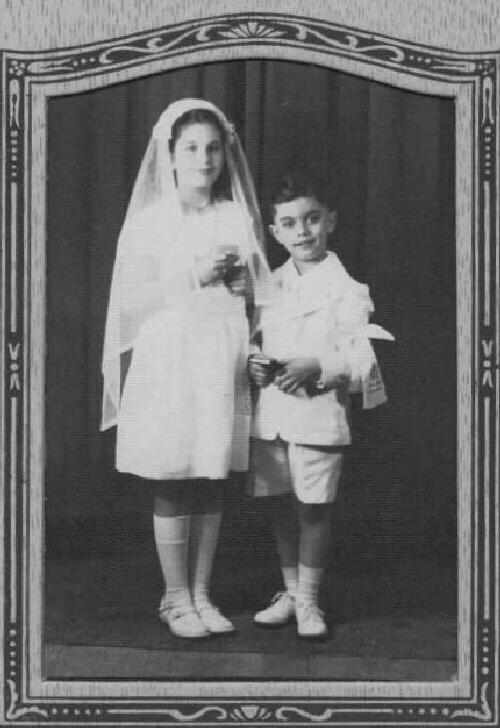
First Communion was a particularly important event in the lives of many immigrant American families, especially Irish and Italian communities. New suits were often purchased for the occasion. Sometimes but not always the suits were white symbolizing the purity of the children. It was much more common to buy white dresses for the girls than white suits for the boys. Irish and Italian mothers were more likely to insist on white suits. The suits through the 1940s were often short pants suits, but since the 1940s they are more likely to be white. The purchase of a new suit, especially a white suit, just for first communion has gradually passed out of fashion, cost being the primary factor especially as a white suit has few other uses. Now boys in many places simply wear white shirts. Girls still often are outfitted in dresses purchased just for the occassion. A Maerican reader has des described his experiences as an altar boy. We note a candle compamy in 1915 that pit altar boys on their promptional calandars.
Canada has a varied religious heritage, both Catholic and Protestant. The country was founded by Catholic France. It was then conquered by the English with their Anglican religion. The Scoots with their own Prtotestant religious tradition played an important part in the early history of British Canada, both in Montreal and Nova Scotia. The Catholic Church became more diverse in the 19th century with the arrival of Irish Catholics beginning in the 1840s as a result of the Potato Famine. We are just begining our assessment of religion in Canada, but have some information on Canadian First Communions.
The continent of Asia is the world's largest land mass and includes condiderably more than half of the world's population. Billions of different peoples following a wide diversity of religious traditions. Asia was the birthplace of most of the world's mainstream religions, including Buddhism, Confucianism, the Abrahamic religions (Judaism, Chritinity, and Islam),Hinduism, Lingayatism, Jainism, Sikhism, Taoism, Islam, Zoroastranism, and mny others. It is not surprising that the continent is the birthplace of many of the world's major religions. China has been particularly important, although the two major Chinese religions (Confucianism and Daoism) seem more like philoophies than religins, eoecially the western construct of methaphyical religion. Neither are living religins, although they are enormously influentialmin Chinese cultural life. India produced two great religions (Hinduism and Buddhism), although Buddhism was largeky displaced before the arrivalof the Europens. The Abrahamic religions (Judaism, Christianity, and Islam) developed on the perifery of Asia at the crossroads of trade routes linkinh Asia, Africa, and Europe. Confuscianism and Daoism are tremendisuly important religions although they are not actively prcticed as a religion. The three major Asian religions in terms of practicing individuals are Islam, Hinduism, and Buddhism. Islam and Hinduism each have about 1 billion adherents in Asia, although Muslims are divided into many separate national communities. South Asia and Southeast Asia are the location of the most populous Muslim countries (Indonesia, Pakistan, India, and Bangladesh). India has the largest Muslim population, but it is the only country with a large muslim popultion where Muslims are not a majority. The countries in the traditional Islamic heartland of the Middle East have smaller populations. Islan is the newest of the world's great religions. Muslims see it as a refinement of the earlier Abrahamic religions (Judaism and Christianity). It involves following the precepts of the faith as revealed to the orophet Mohammed and set down in the Koran. There are also about 1 billion Hindus, mostly concertrated in India and the Asian subcontinent. Hinduism is an ancient religion of uncertain origins and is the oldest major religion still practiced. It involves following a way of life following the principles of Vedas and Upanishads. Veda is revealed knowledge rather like gravity was revealed by Newton. Unlike Buddhism which akso originted in Inf=dua, Hinuism had has only limited appealoutsude if Asia. Buddhism is the third largest religion. It oruginated in India, but is now practuced in other Adian countrie to the east. Histirically the most importabtvcountries were China and Japan, although mjority communitie are limited to southeast Aia. Buddhism was founded by Siddartha Gautama, known to history as Buddha. Buddha is referred to by Hindus in Indiahere it originated as as the ninth incarnation of Lord Vishnu in the Dashavatar. There are many schools of Buddhism. One of the most important is Zen because of its significance in China and Japan.
Europe was dominated by oagan religion during the classical era. The various gods are familiar to those who have read Greek and Roman mythology. Monotheism arrived with Jews and Christians at about the same time. Judaism was an established religion accepted by the Romans while Christianity was not. Thanks to St.Peter and St.Psul,Christins began prosrelizing among the Roman while the Jews did not. As a result, Christianity grew rapidly despite persecution while Judaism did not. Christianity became the officuial religion of the Empire (4th century AD). Early Christians argued about the nature of Jesus. This and other issues wre settled by Church councils. Gradually the papcy gew in influence. Christians than moved to suppress pagan reliogion, but at first generally tolerated the Jews. The Germanic tribes overwealmed the Roman Empire (5th century AD), Isolated Ireland helped preserve the Christian tradition. The Roman Church preserved the classical tradition and gradually Christinized the Germanic tribes which becamne the new ruling class. ThecGermans then led the assult on the pagan ribes of the East. The Rus were, however, Christianized by Byzantium. The Arabs fired by Islam conquered large areas of the former Roman Empire, but made only limited inroads into Europe. Christian rulers and clerics were intolerant of Islam and a kind of world war developed between the two religions. The Islamic conquest in the West was stoped by the French and the Spanish gradually defeated the Moors in Spain. Byzantium lost the Levant and Antolia, but for a time stopped the Ottoman Turk invasion of Europe in the East. After three centuries of unrelenting Muslim attacks, Christian Europe finally struck back with the Crusades to retake the Hollyland. Despite some successes, the Mudlims eventually won back the Holy Land. After the Mongol destrutio of the Caliphte,the Ottoman Turks renewed the assult on Christian Europe. The Islamic world, however, descended into religious orthodoxy just as the Christian West was propelled forward by the Renaissance (13-14th century). As a result, even the Ottomons failed to expand byond the Balkans. Arab countries entered the modern age little changed from the medueval era. The Christian world was split by first the Great Schism (11th cntury) and then the Reformation (16th century). Europe was torn by terrible religious wars (17th century). The Europeans learned to tolerate religious diversity, but varuous Christian denominations became established religions in most countries. The Enlightenment changed European views toward religion and helped propel Christian Europe into a new era of science and innovation,experiences that the Myslim world did not have. The campaign to end the slave trade was lsaunched by Christian Europe with Muslim principalities resisting the effott. European countries in part to end Barbsry plundering of shipping began to colonize North Africa. The Muslim societies because of the failure to promote science were powerless to resist. More Aran countries were colonized after World war I. As a result of these associations, Muslim peoples have immigrated to Europe. While Islam has little appeal toi Europeans,these immigrant populations have remained Muslim,in some cases fervently Islamic. At the samne time the religious devotion of Christian Europe has significantly declined. This is in sharp contrast to America where Christianity with governmental establishment has remained a vital force. Chriitinity did play a major role in breaking the Communist hold on Poland which led to the fall of the Berlin Wall and the collapse of the Soviet Union. Today many Europeans are asking themselves if Islam is compatable to Western Civilization anhd their national traditions.
Aboriginal communities from time immemorial have had animitic beliefs as is the case of other primitive people around the world. These beliefs have been retrained and often mixed with Christianity. Australian aboriginies are a highly spiritual people without a formal religious structure. Britain began the European settlement of Australia, introducing Christianity (late-18th century). This meant the Anglican Church. The pattern of immigration has basically determined religious patterns. Using convicts to populate the country meant that Brirain introduced large numbers of people who were culturally Christian, but with a heathy scepticism for organized religion. While the Anglican Church was the established Church, there wre many other demominations in England. The Scotts brought the Pgresbeterian church. And the English brought the many other Protestant sects like Methodists. And the Irish brought Roman Catholocism with them. Emigration from other countries, for many years limited to Europe, introduced other religions over time. The Anglocan Church re,ained the ;argest until being overtaken by the Catholics (1980s). At the end of the 20th century about two-thirds of Australians identified themselves as Christians: Roman Catholic (25 percent), Anglican (20 percent), Protestant (20 percent). The principa; Protestant denominations are the Uniting Church, Methodist, and Presbyterians. There are also Orthodox Christians centered in the Greek community. As Australian reformed its immigration laws, there are now Muslims and Buddhists as well as smaller numbers of Jews and Hindus. About one-third of Australians have no religious affiliation or decline to reveal it.
Religion as in most Muslim majority countries is an important part of Indonesian life. Religion influence political, cultural and economical trends in the country. The great monotheistic religions (Islam, Christianity, Hinduism, and Buddhism) are practiced in Indonesia, although Islam is dominant. Indonesia is a very diverse country. And along with the great religious traditions, there are also primitive cultures that practice animest believes in Kalimantan, Irian Jaya, and other locations. There are several unique religious beliefs among some communities in Java, Bali, and Sumatra. Some areas have a very mixed religious pattern: parts of Sumatra, Celebes, the Moluccas, have a Christian majority or large Christian minorities even among the non-Chinese population. Even on Java, which is predominantly Muslim, Roman Catholics may amount to up to 10 prcent in some areas. Religion among other important influenced affecting fashion. Islam, though requiring modesty, has never set rules as to the actual length of trousers, certainly not for men.
New Guinea until the colonial period was still essentially a stone age society. There was no one dominant faith, but a wide range of highly variable animist beliefs and destinctive rituals. These wereneliefs held on New Guiea for thousands of years. These beliefs are not only colorful, but have an important compac on Papuan culture, The Europeans arrived and began to introduce Christioanity (late-19th century). Traditional tribal beliefs, however, continue to be important. Not only do these beliefs remain important, but they also increase Papuan Christianity as well. On estimate suggests that about one-third of Papuan continue to retain traditional beliefs orthise beliefs strongly color their commitment to the organized religions introduced by western missionaries. Much of the rest of the couhtry is at least nominally Christian. The largest single denomination is Catholic (25 percent). The most important Protestant denomination is Lutheran (15 percent), presumably reflecting Germany's brief colonial control until World war I. Other Protestant denominations include: Presbyterian (10 percent), Methodist/London Missionary Society (5 percent), Anglican (5 percent), Evangelical Alliance (5 percent). There are also a small number of Seventh-Day Adventist. There are a number of other Protestant denominations active (10 percent). Baha'ism also has a small following. Islam has obly a small number of adgherents, but there is mosque in Port Moresby.
The indigenous Filipinos were mostly Animists. Trade contacts brought Islsm to the southern Islands and there were some Chinese influences, both Budhism and Taoism. The Spanish first reached the Philippines under Magellan who was killed there (1521). The islands were named Spain's aggressively Catholic monsarch, Phillip II. Spanish rule was over the following century gradually spread over the Philippines and a major aspect of Spanish rule was savibng souls. Spain proceeded to colonize and Christiasnize most of the various islands. Thus both Christianity and Islam were superimposed on the animism of tribal communities. The Spanish political control and military force proved to be the deciding factor in making the Philippines a largely Catholic country. The Muslims inhabitants in the south, especially Mindanao, resisted Christianity. The Spanish faced insurgent efforts throughout the colonial period, but Christianity was widely accepted and is today the principal religion, mostlt Roman Catholics. Many Filipino children do a First Communion. The Philippines is thus the only Christian country in Asia. An estimsated 90 percent of the population are Christians. Other religions include: Muslims (5 percent), Buddhists, Daoists, animism, and other religions. Buddhists and Taoists are mostly part of the Chinese ethnic community, although even the Chinese are mostly Catholic. Although small in number, the Daoists have built a spectacular temple on the outskirts of Cebu. Muslims remain less integrated than other religious minorities into Philippine culture and society, presumably because of the Western and secular nature of the wider Philippines society. Today there is some support for independence among Muslims in the south.

Navigate the Boys' Historical Clothing Web Site:
[Return to the Main religious page]
[Introduction]
[Activities]
[Biographies]
[Chronology]
[Clothing styles]
[Countries]
[Bibliographies]
[Contributions]
[FAQs]
[Glossaries]
[Images]
[Links]
[Registration]
`[Tools]
[Boys' Clothing Home]