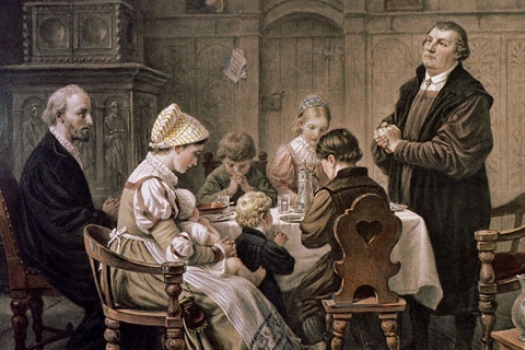
Figure 1.--Here Luther is giving grace (Tischgebet) to his family. One of the Protestant reforms was to permit the clery to marry. (This had been allowed by the early Church.) We are not sure who the illustrator was, but it was done in 1903. |

|
The Reformation began in Germany. This was no accident. Church state issues had reached serious levels in Germany with the Ivestiture Controversy. This played a major role in Germany's failure to develop a strong national government. Thus the Germans were not like the French able to negotiate withthe papacy om a position of strength. There were many doctrinal issues involved in the Reformation and the Church showed with the supression of Huss and his followers that within the Holy Roman Empire that it was willing to use the Inquisition to limit debate. Financial concerns and the disposition of the Church's wealth and income should not be minimized as a major cause of the Reformation. Almost independent of the German Refomation was the Reformation in England, but this proved to be crucial because of the future imperial role of England.
The heart and soul of the Protestant Revolution was in Germany. In began when Martin Luther posted his 95 thesis on the church door in Witenberg. He was offended by the sale of indulgences which struck at all the major themes of the Reformation. Luther was offened that an agent of the pope was selling indulgences forgiving future sins. Here initially it was a doctrinal matter, but it also it affected the pope's use of German Church income and the naionalistic concerns of foreign control over the German Church. Matters escalated when the Reformation became associated with the struggle between the emperor and German princes over political power. It should be stressed that the German Reformation was not a struugle for religious freedom, but rather a struggle over whose faith would prevail.
The Swiss Reformation occurred largely independently of the developments in Germany, but for much the same reason. A Swiss pastor Huldreich Zwingli like Luther began annoucing the sale of indulgences (1518). He was apponted rector of the Great Minister of Zurich and began criticising abuses of eclesiastical authority (1519). He would speak whereever he could find an audience, sermons, market place conversatioins, and even in front of the town council. Like Luther hec stressed the Bible as the sole source of religious authority. In Zurich the decissions to break from Roman Cathloic traditions and ultimately the Church itsrelf were taklen by voyes of the townncouncil (1523-25). Under Zwingli's leadership, relics were destroyed, ceremonial processiins and the adoratuion of saints ceased, vows of celibacy were revoked, and the elaborate Catholic Mass replaced with a simpler ceremony. The commercial class was Zewingli's strongest source of support and their interest was not only religous, but also a poliitical desire for independence from both Rome and the (German) Holyb Roman Empire. Other Swiss towns (Basel and Bern) followed Zurich, but the more conservative peasantry of the forrest cantons remained Catholic. The Swiss central government did not have the strength to enforce religious coinformity. There were two short conflicts between the Protestant and Catholic factions (1529 and 31). Zwingli was killed during the fighting (1531). Neither side prevailed in the fighting. Under the terms of the resulting peace, each canton was allowed to choose its religion. For the most part the Catholics were entrenched in the mountaneous areas of the country and the OProtestants in the heavily pipulated valleus and towns. This basic division basically persists in Switzerland today.
The Protestan Revolution was the religious struggle during the 16th and 17th century which began as an effort to reform the Catholic Church and ended with the splintering of the Western Christendom into the Catholic and Protestant churches. While the Reformation began in Germany, Sweden would play an important role. Protestantism moved north into Scandinavia from northern Germany. Here the process was much more peaceful than in Germany and more parlitarian. Luther's ideas reached Sweden almost immediately (1520). The advent of the printing press (15th century) mean that ideas could be rapidly spread. The monarchies in both Denmark and Sweden came to support the Reformation. These were the only states outside Germany where Lutheranism became the state religion. Olaus and Laurentius Petri helped spread the Lutheran faith in Sweden. The Swedish Diet at an early stage of the Refotrmation adopted Luthernism with the support of King Gustavuis I (1527). The Reformation in Sweden was closely associated with the moce toward independence. A full translation of the Bible into Swedish soon folowed (1541). The process was much the same in Denmark. A Danish national assembly revoked the authority of Catholic bishops (1536). As Denmark at the time controlled Iceland and Norway, they were also affected. King Christian III requested that Johann Bugenhagen, a friend of Luther, organize a Danish Lutheran Church on the basis of the Augsburg Confession. The conversion of Svandinavia was important to the success of the Reformatuion in Germany. Not only were the northern German princes not surrounded by Catholics, but they now had potential northerm allies. The Reformation also made inroads in Estonia. Parts of Estonia requested protection from Sweden. After a war with Poland, Sweden acquired all of Estonia.
The Reformation which began in Germany (1519) soon converted many Czechs. The Hungarian monrchy which controlled Bohemia was rather weak and was unable to impede the spread of Protestantism. The Ottomans defeated and killed Hungarian King Ludwig Jagellon (1526). As a result, the Hapsburgs inherited Hungary as well as Bohemia and the Czech lands. The Hapsburg led the Counter Reformation's forces. Ferdinand I strengthened the position of the monarchy and moved to support Catholocism in Bohemia, although Protestatism continued to have wide appeal among the Czechs. He invited the Jesuits to Bihemia. Hapsburg Emperor Rudolf II's successor Matthias moved against the Protestants in Bohemia. This resulted in another Protestant uprising. This began with the Second Defenestration of Prague (1618). Another Prague mob threw several Matthias' governors out of a window of the Prague Castle. They famously landed in a dung and garbage heap and survived). The Protestant protests led to the Battle of the White Mountain (bitva na Bílé hoře) (1620). The Protestants were severely defeated by the Habsburgs. Warfare spread to Germany, esebntially sparking the decestating Thirty Years' War. Hpsburg officials executed 27 Protestant leaders on the Old Town Square (1621). Authorities banned all religions except the Catholic faith. They also supressed the Czech language in an effort to destroy national consciousness. This period in Czech history is coomonly referred to as the Dark Age (doba temna).
The Reformation began in Germany when Martin Luther nailed the 95 Thesis to the Castle Church in Wittenberg,. He had no intenrion iof dividing the Church, but rather to innitiate a scholsrly debate to reform the Church. The Reformation as it developed of course did split the Church. It soon spread in northern and central Europe including Poland. The Refornation made notable progress in Poland (mid- and late-16th century). Students from Wittenberg were the first to bring Luther's reforming message to Poland, initially to German communities in Danzig and Cracow. The Poles themselves, however, were more attracted to French Calvanist teachings than the German Lutherans. A variety of factors were involved, including Polish political traditions, historical ties with France, and increasing animosity toward Germans. The Hussites in western Poland had suffered at the hands of Catholic clerical intolerance. And the Poles as with the Germans were disastisfied weith the clergy and the drain on national trasury to finance the opulnce of the papacy. And in Poland there was a tradition of religious tolerance which would seem to offer fertile ground fior the spread of Protestrantism. Reform churches began to become established in Poland. Protestantism flourished in various regions of Poland, as in Germany, protected by sympathetic local nobels. The Emperor in Germany couild not contain the Refornmation. The same proved true in Poland, although the Polish monarchy did not attempt to contain the Reformation as the Emperir did in Germany. The Polish kings were either indifferent or believed it was not the role of a king to interfere in religious disputation--a very different attitudec than iotherf 16th century European rulers. And the monarchy did not have the power to interfere. Here obkly the Polish Diet (Sjem) could authorize such actuion. And the Diet included nobels of various religious persuasions. In fact the reformist nobels had considerable influence, The Diet even passed laws excluding the Catholic Church from important public responsibilities (1550s). Poland did not, however, become Protestant. Thec reasons seem to be that the Polish Protestants never unified in one principal denomination, but were divivided into many devisisive churches. And within Poland the Catholic Church found renewed vigor. In particular, Protestantism never captured the alergiance of the Polish peasantry, the backbone of the country. Many saw the Protestants as agely foreign sect and while willing to tolerate the Protestants along wsith other faiths, it was the Catholic faith that continued to be associated with Polish nationalism.
The Battle of Mohács was fought only a few years after the beginning of the Reformation in Germany (1526). The battle was a clamity for the Hungarian nation. The king was killed and the the dynasty ended. The Ottoman Turkish victory resulted in the partition of the the kingdom. Royal Hungary continued in the west. Transylvania and the rest of the kingdom (more than half of pre-Mohács Hungary) including Buda and Pest (still two separate towns) was seized by the Ottomans. As a result, Hungary no longer had a powerful, centralized monarchy to support the Catholic Church. And the Ottomons as in other areas did not generally interfere in Christian doctrinal squables. The Reformation thus spread rapidly in Hungary. Many Hungarian barons were attracted by the idea of a local church thast they could if not control, at least strongly influence, including the finances. The Hungarian crown passed to the Hapsburgs and Ferdinand I absorbed with the Ottoman threat while supporting the Catholic party was disposed toward a degree of toleration as was Maximilian II. As a result, some radical Protestant sects took root in Hungary. There was even a an Antitrinitarian sect--Socinianism. It became rooted in Transylvania where under Ottoman control it was not persecuted as it was under Christian control. In Royal Hungary controlled by the Hapsburgs, the Lutheran and the Reformed churches became the dominant Protestant sects. The Helvetian Confession was adopted (1567) and the Lutheran confession (1545). The Priotestants largely f\divided along ethnic lines. The etnic Germans in Hungary largely held to Lutheranism. The Magyars generally preferred the Helvetic Confission (Zwinglianism). Gaspar Karoly published the first Bible in Hungarian (1590). The Vizsoly Bible followed (1607). It is often described as the King James Bible for the Hungarian Reformed Church. Protestantism became entrnched in Hungary. Historiand estimate that Catholicism declined to only about 10-20 percent of the population. The Conter-reformation was gaining strength in Europe leading to the Europeamn religious wars (17th century). Emperor Ferdinand II set out to destroy the Protestant churches in Germany and his other possessions, including Hungary. The Thirty Years War began in Bohemia with the Defenestration of Prague (1619). Like Hungary, Bohemia had become largely Protestant. Gabor Bethlen, the Protestant prince of Transylvania, who claimed the Hungarian crown invaded Hungary seeking to defend the Bohemian Protestant rebels and to expand his Hungarian lands beyond Transylvania (August 1619). The Imperial Catholic League forces led by Count Johan Tserclaus von Tilly defeat the Bohemian rebel army led by Christian of Anhalt at the Battle of the White Mountain outside Prague (November 1620). Ferdinand regains control of Bohemian throne. He has the leading rebels executed and proceeds to expel the Protestant clergy,
The fate of much of south central Europe is decided at Stadtlohn (August 1623). The Protestant Army of
Christian of Brunswick is destroyed by Tilly. This gives Ferdinand II complete control of Austria and Bohemia and still Protestant Hungary is isolated from Protestant northern Europe. Gabor Bethlen, Prince of Transylvania, invasion of Royal Hungary is doomed. By huimself he can not stand against the Catholic KLeague and Imperial firces. Ferdiunand is thus free to stamp out Protestantism in Hungary. He began by pressuring the ruling families and suceeded in convincing many to convert to Catholocism. They wwre then expected to force their subjects to convert. This was left up to the individual nobel. It was generally acconplished by the baron casaing to support Protestant preachers. Instead they supported Catholic priests and churches as well as promoting monasteries. They also supported the Jesuites whp conducted Catholic evangelical activities. Eventually all public practice of non-Catholic services were banned. The final step was require Protestant ministers still resisting to appear in court (1673). Only 33 ministers appeared. They were pardoned or allowed to resign their ministry. State authorities arrested those who did not respond and sold them into slavery as galley slaves. This was widely publicized in Protestant states. Most were eventually released by Dutch shipmasters.
Spain was a great power (15th and 16th centuties). This of course was the period which generated the Reformation and in which the Reformation unfolded. Thus developments in Spain would play a major role in the Reformation. Three powerful developments came together at roughly the same time in Spain. The fall of Granada and thus the completion of the Reconquista as well as Columbus' first voyage both occured in the same year (1492). The outcome of victory in the Reconquista was to expel non-Catholics from Spain (Muslims and Jews) and use the Inquisition to attack free thinking. In addition, Archbisip Jimenez de Cisneros who also served as the Grand Inquisitor of the Spanish Inquisition oversaw a wide-ranging reforms of Spanish religious life attacking many of the clerical abuses tht had so offended Luther and other early Protestants (late 15th century). As a result, Protestants ideas would not surface in Spain after Luther nailed his 95 Thesis on the church door, unitentionally launching the Reformation iun Germany (1517). At the time the Hapsburgs in the person of Charles V oversaw a vast European realm, including both German and other central European provinces as well as Spain. The Spanish army as a result of the Reconquista was the strongest in Europe and as gold and silver began pouring in from the the Indies, Charles and then his son Philip II who woiuld inherit the Spanish part of Charles' vast empire. Charles and then Philip had at their command vast power. Much of the strength and wealth of the their empires was devoted to supporting the Catholic Church and the Catholic Counter Reformation effort to supress the Protestants. Great efforts wre made to keep Protstants out of their American colonies. (In shrap contrast to what occurred in the English colonies. This would have an impact on the future history of Latin America) Two of the major and most costly Spanish efforts were the campaigns to destroy Protestantism in the Netherland and England. Both poved proved enormously expensive. The hugely expensive effort to build the Spanish Armada was a total failure. And the tiny Netherlabds fought the Spanish armies to a standstill in the Dutch War for Independence. The Spanish and German Hapsburg as well as the Spanish Bourbons undeniably suceeded in steming the Protestant advance and reqconquered the sother Netherlands (modern Belgium), but at the cost of bankrupting the realm. And they failed to destroy the Protestant stronghold on northern Europe. The Spanish would ultimately squandor much of the wealth of the indies. This and the Spanish Inquisition would in a short period turn the country into a militry, economic, and intellectual backwater. The Spanish Inquisition not only had theological consequences. The 16th century was an embriomic period in the history of science. Galileo and others invented the scientific method. Spain with its great wealth might have been thought to have been an important center of learming and science. It was not. Spainards were absent from the los of imprtant sciebtists during the era. The one important Spanish scientst, Michael Servetus, pursued his career outside of Spain, mostly in France.
John Calvin (1509-64) represented a new genreration of Protestants and became a dominant figure of that Reformation. Only a child when the Reformation began, he became an ardent Protestant. As a theologian, he was forced to flee France after his conversion to Protestanism and settled in Geneva (1536). Geneva at the time was a crossroads for exiles and expatriates from both France and Geramny as well as other parts of Switzerland. His semons and public discourse were effective and he soon became the most influential preacher in the city. He wrote an influential explanation of Christian doctrine and life that the layman could read and understand, The Institutes (1536-59). Calvin's most important Institutes was obedience to God's will as elucidated in the Holy Scriptures. Salvation, he maintained was entirely a matter of faith in God's grace which was mediated through word and sacrament by the force of the Holy Spirit. Echoing the Protestant condemnation of indulgences, he wrote that good works were the inebvitable consequences of union with Christ, bit not the means of achieving personal salvation.
The French monarchy had a special relationship with the Church. French kings had generally avoided the kind of open split with the papacy like the Investiture Controversy that so divided Germany. The Pope gave the kings of France the title of "Most Christian King." Each French King took an oath to "extirpate" heresy in his realm. The French Church despite the close relationship between th moinarch an papacy had evolved considerable independence from the papacy. The French monarchy had perhaps more authority over the Church in his country than any other prince in Western Christendom. This was further recognized on the eve of the Reformation by the Concordat of Bologna which confirmed Francis I's authority to make appointments to benefices. As a result, many of the conditions which led to the Reformation in Germany were less apparent than in Germany. The Concordot provided for the rights of both pope anf king, but made the king clearly dominant over the French Church. While religious issues are most commonly discussed in connection with the Feformation, financial matters were a major concern at the time. The monarchy in France had enormous control over the disposition of the wealth and income of the French Church and routinely used the authority to appoint bishops, abbots, and other church officers to reward faithful followers because there was considerable income associated with many of these offices. As a result, the princes of the French Church included many worldly people, often uninterestred in spiritual or doctrinal matters, but often quite nationalistic. The Pope had a veto on such appointments, but out of defference to the monarch, rarely exercized it. Thus there was a considerable fusion of church and state in France very diffeent than the situation in Germany. The University of Paris (the Sorbonne) during the late Medieval era served as a kind of scholastic think-tank for both Church and state.
Erasmus strongly promoted reform of the Catholic church during the years leading to the Reformation. The Netherlands was by the early 16th century a non-German possession of German Hapsburg Emperor Charles V. The Emperor within the Holy Roman Empire (Germany) attempted to resolve the dispute with Luther and his followers diplomatically. His approach outside the Empire in the provinces where he ruled directly, he was not prepared to compromise and invoked the full force of the Inquisition. he University of Leuven (Louvain) condemned Luther's theses (1519). Emperor Charles appointed van der Hulst as
the Inquisitor General to supress the Protestants in the Netherlands (1522). He applied the full force of the Inquisition and within a year there were executions. Count Alva's brutal methods in the southern Netherlands appered for a time to have succeded in destroying the Reformation in the Netherlands. Imperial forces were in control in the south. Alva when he left the Netherlands, however, was a hated man as was the emperor (1573). The Count was, however, was unable to completely eliminate Protestantism. To many people in the Netherlands had cinverted. Despite supression in the south, rebellion flared in the north. The provinces of Holland and Zeeland rose in revolt (1572). The most repected nobleman in the Netherlands, William of Orange-Nassau, had serious differences ith the Imperial government (1568). The fighting became a bitterly fought war and excesses and atricities were committed by both sides. The creation of Union of Utrecht brought on one of the longest struggles in European history--the Dutch War of Independence. It was foiught by the Dutch againt local Catholic forces and the Spanih. (Upon the death of Emperor Charles V, the Netherlands became a Spanish territory.) Fighting continued until the Peace of Utrecht (1648). The Dutch made Calvinim the sate religion or confession. They looked on Catholics with great suspission, although they were not arrested for their faith. Other religioins were tolerated, this included not only other Protestants, but the Jews as well. This made the Dutch the most tolerant people in Europe and the Netherlnds a refuge for those facing religious persecution. This was an element in the Dutch become the most prosperous people in Europe.
While the Reformation in England was initaited by the monarchy, in Scotland in occurred in spite of the opposition of the monarchy, although supported by the English.The Reformation was preceeded by a rising sence of popular disatisgaction with the Catholic clergy. Both Lollardy and Wycliffe in England had influenced some. Merchants and the minor nobility were the first to embrace the Reformation, not only for religius reasons, but as a vehicle for independe from both England and France. Protestant teaching reached Scotland only a few years after Martin Lurther launched tghe Reformation. As early as 1522 the Royal Government was attempting to stop the circulation of Luthern books. Early Reformation leaders like Patrick Hamilton were adherents of Luther, but John Knox led the Scottish Reformation to a Calvinist confession. John Knox lived for a time in Geneva and was influenced by John Calvin. He became the driving force of the Reformation in Scotland. Knox was the first spokesman for Presbyterianism. Knox persuaded the Scottish Parliament to adopt a confession and book of discipline modeled on those develooped by Calvin in Geneva (1560). Parliament created the Scottish Presbyterian Church governed by local kirks. Mary Queen of Scotts attempted to attempted to reinstate the Catholic Church, but was driven to exile in England (1568). Her claim to the throne and Catholcism made her a dangerous figure. Her infant son James, the future James I of England, was kept in Scotland and eventually tutored by Presbyterian scholars. The Catholic Church was reduced to minor importance in Scotland, except for a few disticts in the remote Highlands. James and his son Charles I attempted to unite the Church of England and Scotland, but were resisted by the Scotts zealously defending the kirk. Charles was suspected of harboring Catholic sentiment. While not intending to do so, the Scotts' defense of their kirk from Charle's invading English Army resulted in the Bishops Wars (1639-40) which led directly to the English Civil War (1642-46)
Almost independent of the German Refomation was the Reformation in England, but this proved to be crucial because of the future imperial role of England. Political rather than relogious issues were to drive the Renaissance in England. It was a Defender of the Faith, Henry VIII that set the Reformation in motion in England. Henry VIII decided to divorce his wide, the Spanish princess Catherine. He was furious when Pope Clement VII refused to approve the divorce. In response he rejected papal authority over the Church in England. He founded the Anglican Church and set himself up as head of the new church (1534). While sparked by his personal life, the break with Rome had many advantages for Henry. One of the most important was the wealth of the Church was now at his disposal. Much of this he seized by closing the monestarires. Huge quantities of land were in 6the hands of the monestaries. The first tentative steps toward actual reformation was a liturgy in English and The Book of Common Prayer. Henry's lesser known and very devout Protestant son Edward VI played a major role in the success of the Reformation in England.

Navigate the Boys' Historical Clothing chronology pages
[Return to the Main Medieval chronology page]
[The 9th century]
[The 10th century]
[The 11th century]
[The 12th century]
[The 13th century]
[The 14th century]
[The 15th century]
[The 16th century]
[The 17th century]
[The 18th century]
Navigate the Children in History Website:
[Return to the Main Reformation page]
[Return to the Main Christianity page]
[Introduction]
[Animals]
[Biographies]
[Chronology]
[Climatology]
[Clothing]
[Disease and Health]
[Economics]
[Ethnicity]
[Geography]
[History]
[Human Nature]
[Law]
[Nationalism]
[Presidents]
[Religion]
[Royalty]
[Science]
[Social Class]
[Bibliographies]
[Contributions]
[FAQs]
[Glossaries]
[Images]
[Links]
[Registration]
[Tools]
[Children in History Home]