|
Judaism is the religion of the semi-nomadic Hebrew people. It is widely regarded as the first Monotheistic religion and the progenator of the other Abrahamic religions. Its relationship to the monotheism of Phraroh Akhenaten is a matter of considerable controversy. T he primitive religion of the Hebrews developed as a sophisticated religion which played a major force is Isrealite society as part of a theocratic state ruled by priest-kings. Judaism is the religious system that developed, including doctries and rites of the Jews. Judiasm developed as the theocratic state religion of a national group, the Israelites. In modern times this has meant a separate, often small religious community living among Gentiles--for the most part, Christian and Islamic majorities. That community over tume experienced periods of benign toleration followed by rulthless suppression. Anti Semitism became a prominent aspect of European life during the medieval Era. Many states expelled the Jews entirely. The most cataclysmic action against the Jews was of course the Holocaust during World War II. This situation changed somewhat after the War in 1948 with the recognitionn by the United Nations of Israel, although most Jew cintinue to live outside Israel. Modern rabbinical Judaism was crafted by scholars and teachers known as rabbis just before and after the destructioin of the Jewish national state by the Romans at the beginning of the Christian (Common) Era.
Judaism is the religion of the semi-nomadic Hebrew people. It is widely regarded as the first Monotheistic religion. Here its relationship to the monotheism of Phraroh Akhenaten is a matter of considerable controversy. The primitive religion of the Hebrews developed as a sophisticated religion which played a major force is Isrealite society as part of a theocratic state ruled by priest-kings. Judaism is the religious system that developed, including doctries and rites of the Jews. Judiasm developed as the theocratic state religion of a national group, the Israelites. Jews as a people make up less thn 0.2 percent of the world's population. There influence om both history and all fild of human endevor (academia, art, commerce, music, medicine, philosophy, science, theology, etc.) has been out of all proportion to their numbers. Jews with the diasporah made important contribuions to the many cultures and countries in which they found themselves. Despite or perhps because of their accomplishments, they experienced great prejudice and in some cases terible oppression. [Golberg] Incredibly, no other ancient people havemanaged not only to survive into modern times, but vto make major contribution to modern society.
The history of the Hebrew people extends more than 4,000 years and after the Roman supression of the Jewish revolt becomes extroidinarily complex as Jewish communities were established and to varying degree mixed with populations throughout Europe and eventually European colonies. Very little is know about the early Hebrews, but a good deal is known Hebrew history by the 1st millenium BC. Hebrew history in large measure was determined by geograph, their placement between the two-great river valley civilozations--Mesopotamia and Egypt. Much the Old Testmant deals with the struggle of the Herews to maintain their independence from Mesopotamia (Assyria and Babylon) to the northeast and Egypt to the west. What is remarkable is that while other small kingdoms in the area are now lost to history, the Jews survived as a people and a people who played a major role on Western civilization. With the rise of Rome the Jews became a part of the Empire. The revolt against Rome resulted in the end of the Jewish state and the Diasporah of the Hebrew people throughout the Westetn world. After the NAZI World war II Holocaust the Zionist movement created a new Jewish state--Israel.
Modern rabbinical Judaism was crafted by scholars and teachers known as rabbis just before and after the destructioin of the Jewish national state by the Romans at the beginning of the Christian (Common) Era.
The Romans in the 1st century AD suppressed Jewish revolts and destroyed the Temple in Jewrusalem. Jews we slauhtered and enslaved. Survivors spread throughout the Roman world, the Middle East, North Africa, and Europe. This is today known as the Disapora. The Diaspora began with th Babylonian Captivity. This spread the Jews east. The Roman supresion of the Jews spread them west. While dispersed, the Jews refused to abandon their faith and assimilate. Jews since the Diaspora have lived in separate, often small religious community living among Gentiles--for the most part, Christian and Islamic majorities. Thre are two great traditions of European Jews. The Ashkenazi oe Eastern European Jews with traditions in some cases daring back to Roman times. The Sephardic Jews are Western European Jews with roots to the tolerant Omayyid Caliph of southern Spain. Their intelectual tradition was developed in an atmosogere of toleration of the People of the Book. This was the Sephardic Golden Age and when King Ferdinand after the fall of Granada expelled the Jews, the Sephardi carried this tradition with them to the other areas of Western Europe which accepted them. [Perera]
Judiasm has played a major role in the development of both the Christian and Islamic religions. The three religious groups are known by Muslims as the people of the book. Christainity develooed from a small Jewish sect. Jesus was of course himself a Jew as were all the appolstles. The Old Testament of the Bible is made up of the Penetuch and other Jewish religious writings. Mohammed in the Koran revers many Jewish religious figures from the Old Tesrament. Basic preceopts of rabbinical Judiaism are present in both Christianity and Islam.
We have begun to collect information on Jewisj religious celebrations. Two of the best known Jewish celebrations are Passover and Hannuka. These two traditional holidays perhaps represent the essential Jewish spirit. Passover is especially important as one of the most critical cultural vehicles that assistedthe the Jewish people in the Diaspora to maintain their national identity over more than 2,000 years.
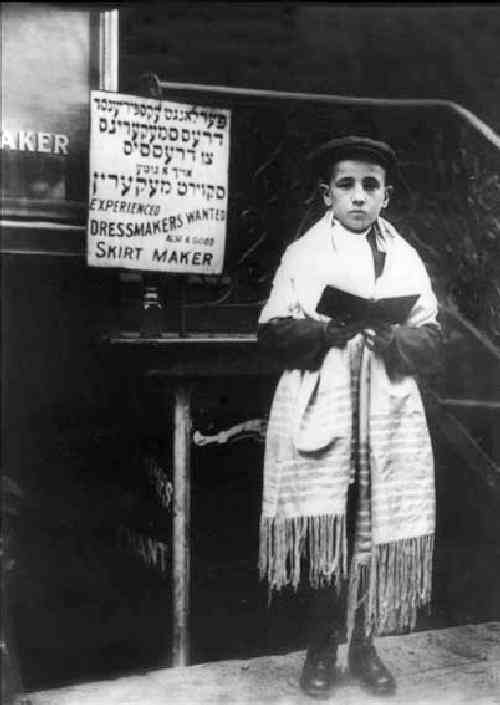
The Bar and Bat Mitzah is the major rite of passage for Jewish children. It is the point at which Jewish children formally come of age and join the religious community. "Bar Mitzvah" means "son of the commandment" in Hebrew and "Bat Mitzvah". "Bar" also "son" in Aramaic which became the vernacular of the Jewish people. " Mitzvah" means "commandment" in both Hebrew and Aramaic. In modern usasge the term has come to mean not the child coming of age, but the ceremony associated with it. Children under Jewish law are now seen as obligated to obey the commandments and other provisions of Mosaic law. Their parents are legally responsible for their behavior and for teaching them the religious law and for guiding them to observe it as far as possible. Boys at age 13 years and girls at 12 years become adults and are thus obligated to observe the commandments and Mosaic Law. The Torah does not explain why these ages were chosen. But surely it much havebeen timed with the onset of adolescene. This would have been especially important for girls and the need to ensure that they would abide by Mosaic Law. The Bar/Bat Mitzvah formally marks this trasition, but in fact the obligation occurs automatically. The child at the appropriate age is no longer a child in the eyes of the Jewish religious community. And is thus responsible for his own behavior, spiritually, ethically, and morally. Other changes take place. The individual has the right to take participate in leading religious services as well to be counted in a minyan (the minimum number of participants required to perform certain elements of religious services), to make binding contracts, to testify in religious courts, and to marry.
There are several different braches of Judaism. Actually there are two different ways of looking at the term branches. The first is a a cultural approach, with ethnic and geographic connotations. The principal ethnic/geographic branches are Sephsrdic (Western) and Ashkenazic (Eastern) branches. Of course over time there have been various theological movements, but primarily in the East. The other type of Jewish branches is based more on theology. Here the branches are much more complicated and varied, although there are only a few main branches or movements.
Traditionally Jews did not have family (surnames/last names) in the modern European tradition. Like the Vikings, Saxons, and others, they used patronymics, such as David ben (son of) Issac or Sarah bat (daughter of) Abraham. Of course every one recalls the literary Judah bin Hur. Jew still have Hebraic names that used in synagogue for rituals and in Jewish Jewish legal documents, especially the ketubah (marriage contract). Jewish family names began to develop among Sephardic Jews in Spain, Portugal, and Italy (10th-11th centuries). This probably reflects the degree to which Jews were involved with Iberian culture during the Islamic and early Reconquista era. That tradition, however, was impaired when the Spanish and Portuguese expelled Jews (late-15th century). The Ashkenazic Jews in Germany and Eastern Europe did not develop a similar practice on their own. The tradition of Jewish family names in Eastern Europe began when Austria issued a law requiring that Jews to register a permanent family name (1787). Audtria at the time in addition to its German provinces, controlled northern Italy, Bohemia, Hungary and other areas of central Europe. Because most Jews spoke Yidish and lived in cities where Germans were also an important presence, most Jews chose German names, both actual German surnames or a range of German nouns. We do not entirely understahnd the selection process. Some of the names selected were precious metals and stones (Silbermann, Goldstein, and Bernstein--Amber), amimals (Wolf and Baer), colors (Schwar(t)z, Weiss, Roth). and cities (Frankfurter and Berlin(er). We believe that other countries passed similar laws, but the law in Austria probably helped promote the practice in Prussia and the Russian Empire (especially Poland). The fact that Yidish was widely soken by Jews in Eastern Europe probably explains why German names were so widely adopted even though the number of Jews in the German states at the time was realtively limited. Some Jews seemed to have poked fun of the process and selected names that seem ridiculous like Perlmutter (Mother of Pearl) or Gernreich (Loves to be Rich). In other cases they may have been named by the Austrian administrators, who also came up with some funny names. Many Jews changed or anglicized their names when they came to America. The famous movie stars Paul Muni and Edward G. Robinson. Muni was born in Poland as Muni Weisenfreund while Robinson originally was Emanuel Goldenberg. The meaning of Weisenfreund (the way it is spelled) is Friend of the Wise, but I suspect that the real meaning is Friend of Orphans, because the German word for Orphan is Waise, while Weise means Wise. The pronunciation of both words is the same. That's why we think that Muni's family name was "Friend of Orphans". Edward G. Robinson was born in Romania. Goldenberg obviously is mountain of gold.
The Jewish people over tume experienced periods of benign toleration followed by rulthless suppression. Anti Semitism became a prominent aspect of European life during the Medieval Era. Throughout the Medieval era Jews were the target of persecution by the Catholic Church. The history of the Jews and the extent of perscution has varied widely from country to country. Many states expelled the Jews entirely. The most famous such event was Spain's expulsion of the Jews (1492). Other countries also expelled the Jews, including England. There were a few islands of toleration, the most prominent being the Netherlands. Historically Islam was more tolerant to Jews and other Christian sects than the Cathloic Church. In the late Medieval era, Jews in Poland andRussia were the target of hrific pogroms. Only in the 19thcentury did Jews begin to gain full civil rights in Western Europe. The most horific explosion of anti-Semitism was the NAZI attemp to eradicate European Jewery during World war II. After the War anti-Semitism declined, a trend based on having witnessed what anti-Semitism can lead to.
One of the major historical questions about Judaism is how this small group of people survived with their religion not only in the Levant facing poweful terifying enemies like Egypt, Assyria, and Babylon for a millenium, but then in often highly hostile Christian Europe for two millenia. Many factors are invlvd, but high up the list has to be education and the value Jews placed on education. Judaism was different not only beccaue it wa the first great monohesistic rligion, but becaue every Jew no matter how humble had a personal relationship with God. And the convenrnt was not between God and rulers or priests, but btween God and every Jew. The Jewish law was the core of Judaism, and Jews like later day Protestants believe that every Jew mot only hould, but had an obligaion to understand the convenent with God. And this meant reading and sudying the Torah. The tradition of Jewish education thus goes back to the earliest days of Judaism and is clearly stated in the Torah (Pentateuch). A primary duty of Jewish parents is to instruct or provide for the instruction of their children. This is not only a tradituon, but is specifically set out in the first paragraph of the Shema Yisrael prayer: �Take to heart these instructions with which I charge you this day. Impress them upon your children. Recite them when you stay at home and when you are away, when you lie down and when you get up. Bind them as sign on your hand and let them serve as a symbol on your forehead; inscribe them on the doorposts of your house and your gates.� [Deuteronomy 6:6-9. Deut 32:7.] And reverences to education also appear in the Book of Proverbs We read, "My son, do not forget my teaching, but let your mind retain my commandments; For they will bestow on you length of days, years of life and well-being.� [Proverbs 3:1-2).]
For centuries fter the Diaspora, Hew taught their children to read at a time whn even princes and the nobility were commomly iliterate. The Church was the respository of learning in Europe, but until Luthrr and the Reformation, there was no interest in educating the common people. The samedynamic was at play in Muslim lands.
Hasidic Jews have maintained their identity in many countries, although they have been influenced by local clothing styles. One HBC reader mentions the Hasidic boys of Antwerp. Their clothes are dark/black. They are the only religious/ethnic group in Belgium/Holland whose boys stand out and are immediately recognizable by their clothes. Of course also by their 'peyes'. HBC has a fascinating early image of Hasidic boys in central Asia during the early 20th century.
Zionism is the Jewish national movement seeeking the return of the Jewish people to their Biblical homeland. This involved both political and spiritual aims. Jews of all persuasions, left and right, religious and secular, orthodox and reform, joined the Zionist movement and worked for the creation of the homeland thast was to become Israel. The term "Zionism" was coined in 1893 by Nathan Birnbaum. Only a small minoriy of European Jews supported Zionism. A much larger number turned to socia;ism as the route toward the creation of an egalitarian society. Wesern Jews were generally satisfied with the improvements in their condition and the progress toward empancipation. More resonance ocurred among the huge, largely assimilatec Jewish population in Tsarist Russia--the Pale of Settlement. Not all Zionits were wed to Palestine, but the emotional ties eventually made Palestine the focus od the movement. Small scale settlement began in the 1880s. This becae more organized after te foundation of the World Zionist Orgamization. The British made an ambiguou commitment to a Jewisg homelad with the World War I Balfour Declaration. The Russian Revolution and the development of the Stalinist state isolated the Russian Jewish community. Zionism was a fringe movement n Europe after World War I, but with the rise of Hitler and the NAZIs Jews began to turn to any way of leaving Germany. For most European Jews there were few opportuniies to reach Palestine before bding engulfed in the NAZI holocaust. After the War with the surviving Jews of Europe, Zionism was no longer a fringe movement. The British even after the Wr attempted to limit Jewish immigration. Rising communal conflict forced the Brigish to withdraw. Israel decaled its independentce (1947) promting an invasion by the neigboring Aran states. The first in a series of Middle-East wars.
The most cataclysmic action against the Jews was of course the Holocaust during World War II. The Holocaust was a crime without presidence in modern history. The NAZIs targeted the Jews for death camps. Many were killed by SS Einsatzgruppen in large-scale actions at first in Poland and than on a larger scale in the Soviet Union. Others Jews were concentrated in Ghettos for slave labor and eventual dispatch to the death camps. Tragically it was not just the Germans involved, but in many countries the local population led by Fascist groups were all to willing to participate in the robbery and killing. Jewish children were among the first to be killed by the NAZIs. They had no economic value which could be exploited. They also were the seed for the future of the Jewish people. The NAZIs also saw them as a force for future retribution if they were not killed. The NAZIs are estimated to have murdered over a million Jewish children. One can not forget the images of the starving Jewish children on the Warsaw Ghetto whose parents had been killed. A great body of litterature exists on the Holocaust including the experiences of the children.
The demographics of the Jewish population changed with the Holocaust and the creation of Israel (1948). The Holocaut involved the murder of half the Jewish population of Europe. The large Jewish population in Eastern Europe, especially Poland and the Ukraine was largely destroyed. The Jewish population in many other countries was desimated. And in several countries, especially Poland, the Jews were not welcome after the War. Few German Jews wanted to return to Germany. Large numbers of European survivors emigrated to the United States. Others went to Palestine/Israel, although the British attempted to restrict Jewish immigration while they controlled Palestine. Many Jews survived the Holocaust in the unoccupied areas of the Soviet Union, but because of descrimination, a substantial number subsequently emigrated. The demographics of the Middle East also changed after World War II. Increasing Arab hostility toward Jews drove many to Europe or Israel. Some countries suchb as Egypt deported their Jews. As a result, most immigrants to Israel have Middle Eastern rather than Europeab origins. Most Jews today continue to live outside Israel. The two most important countries are Russia and the United States. Relatively few American Jews have chosen to emigrate to Israel.
One of the most amazing aspects of Jewish life has been the ability of the Jews to live in Gentile society and resist assimilation for two millenia. This occurred despite the most vicious instances of supression on the part of Christian Europeans and a somewhat more tolerant Muslim Middle-East and North Africa. One factor was that until the 19th century in Europe, was that it was virtually impossible to assimilate without converting to Christinity. The spread of democratic institutiions and secular law in Europe during the 19th century made assimilation increasingly popular in Europe, but not in the Muslim world because of Sharia Law. The largest number of unassimilated Jews in the 19tyh century were located in Eastern Europe, within the Russian Empire, primarily Poland and the Ukraine. They became the target of a vicious Tsarist pogroms as part of the late-19th century Russification effort. This sparked the massive emmigration to the United States and a smaller movement west to Germany and other European countries. After World war I in the early-20th century, much of this unassimilated population fell within the new Polish state. Jews in the Soviet Union were forced to assimilate as part of the atheist campaign. Ironically when viewed with what happened in Germany, the German Jews were among the most assimilated in Europe. Today Jews outside Isreal, especially in America, appear to be assimilating in record numbers. This is especially the case of secular Jews who are increasingly struggling with the question one American Jew asks himself, "What is left of the Jew when he has abandoned Judaism, its religion and language?" Goodheart] Unfortunately it is a question he never really answers and is a question faced by many other secular Jews in America. He explains that a son and daughter have married a Catholic and Protestant, but he hopes that they will retain some minimal Jewish identity.
Anti-Semitism was of course not just a German phenonemon, although the NAZIs took it to horific levels. There ws considerable informal abti-Semitism in America even after World War II, but for a time the NAZI phenomenom made anti-Semitism and other forms of hatred and prejudice unacceptable to most people in America and Europe. Many are concerned that today there is a resurgence of anti-Semitism. This is certainly true in the Muslim world, but it also appears to be true even in Europe. Here both a growing Muslim population and right-wing nationalists continue to embrace anti-Semitism.
We have noted estimates that approximately one-third of all Nobel prize laureates in science have been of Jewish ancestry, meaning not necesarily practicing Jews. We can not yet confirm the precise number, but it clearly would be extrodinarily high. The ratio is startling. One-third of the winners coming from only about 15 millions Jews world-wide. And the remaining two-thirds from the much larger pool of 6 billion-plus people. It is virtually mind boggeling. Even more startling, Arabs (mostly Egyptians) have only two or three Nobel Peace and Literature Prizes, from a pool of 350 million people (more than 20 times the Jewish population). But no Arab from the Middle East has ever won a Nobel in sciences, either the hard sciences or medicine. (Egyptian-American Ahmed Hassan Zewail from Egypt won the Chemistry prize in 1999.) A Pakistani reader took me to tak for this statement. He wrote that there is a long list of notable Arab and other Muslim scientists. When I asked him to list them, he did send me a long list, but the most recent was active in the 12th century! When I pointed this out to him, he insisted with great sincerity that this is because Muslims have fallen too far from true Islam. But of course have they fallen further from Islsm than the Jews winning all these Nobel prizes? He declined to answer that question.
Goldberg, David J. The Story of the Jews (2014), 96p.
Goodheart, Eugene. Confessions of a Secular Jew: A Memoir (Overlook, 2001), 262p.
Parfait, Tutor. The Thirteenth Gate. University College in London.
Perera, Victor. The Cross and the Pear Tree.
Timmerman, Kenneth R. Preachers of Hate: Islam and the War on America (Crown Forum, 2003), 370p.

Navigate the Children in History Website:
[Teturn to the Main religious tradition page]
[Teturn to the Main religion page]
[Introduction]
[Animals]
[Biographies]
[Chronology]
[Climatology]
[Clothing]
[Disease and Health]
[Economics]
[Ethnicity]
[Geography]
[History]
[Human Nature]
[Law]
[Nationalism]
[Presidents]
[Religion]
[Royalty]
[Science]
[Social Class]
[Bibliographies]
[Contributions]
[FAQs]
[Glossaries]
[Images]
[Links]
[Registration]
[Tools]
[Children in History Home]