|
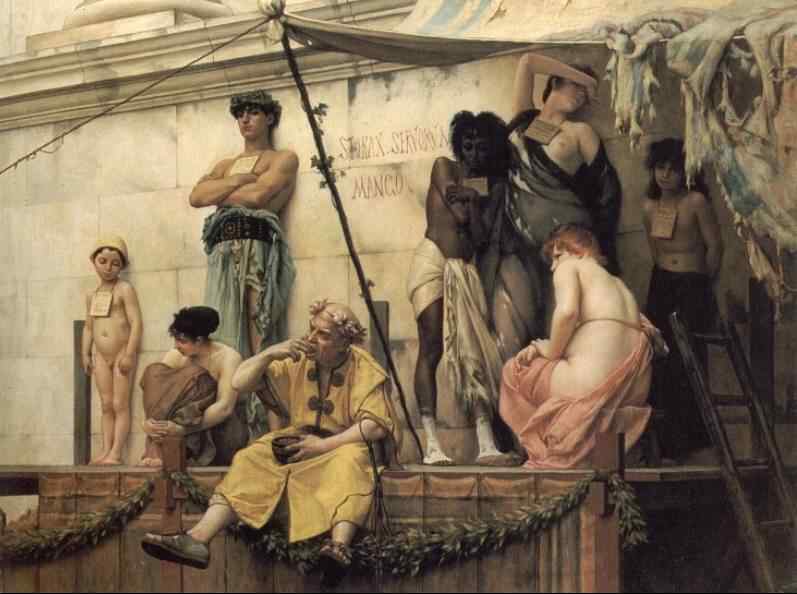
Slavery was central to the Roman economy, perhaps more so than any other ancient civilization. Slavery was a minor institution in the early years of the Republic. This gradually changed as Rome expanded through conquest. Slaves were were primarily war captives, both captured wariors and the women and children of conquered populations. The offspring of these enslaved people provided a vast slave work force. The victors in battle might enslave the losers rather than killing them. Slavery in Rome were major components of the work force. The performed virtually every occupation required in the Romn economy. The citize farmer was the bed-rock of the early Republic. Gradually farming with the influx of slaves shifted to estate slavery which relied on chain gangs to work the fields. Large numbers of slaves were also used to work the mines, commonly under atrocious conditions under brutal overloads. Slaves were also employed as servants and artisans in the cities.
Slaves working as domestics in private houshold had the best opportunity to engratiate themselves with their masters and perhap earn their freedom. Slaves were drawn from widly differing peoples and there was no association with race. Slaves might be blond, blue eyed Anglo-Saxons from Britania or blacks from Sahara as well as evry other racial type. Slavery in Rome had no racial basis. Even those of Italian stock were enslaved. It was thus impossible to tell from one's physical appearance if one was a slave. This complicated control. The Romn Senate debated establishiung a destinctive dress for slaves. In the end, the Senate decided against a slave attire, partly because they decided it was dangerous because it would show the slaves just how numerous they were. As in the Americn South, slavery was justified on the basis of the natural inferiority of certain individuals. There were three Servile Wars or slave revolts in the 2nd and 1st century BC. Rome is noted for the barbarity with which slaves were treated. This may in part be due to the martial tradition of Rome and contempt for defeated peoples. It may also reflect the trails of the Servile Wars and need to subject such a large part of the population.
Slavery was central to the Roman economy, perhaps more so than any other ancient civilization. We known that slavery was a common practice in the Middle East and throughout the Mediterranean. Although information is limited on slavery in many other civilizations. The number of slaves was never calculted with any precission. Some estimates polace the slave population as high as 40 percent of the population, other estimates are lower down to about 25 percent. The slave populations of other Italian cities were lower, some authorities believe sustantially lower although actual date on individual cities is very limited. The same is true of other provinces. Presumably the slave population of North Africa was relatively high as these were important agricultural areas. In some outlying provinces, the slave populations my have been very low. Some estimates are as low as 2-10 percent. Some information is available on individual cities. There was an important slave market located at Pergamum in modern Turkey. Estimates suggest a slave population of over 30 percent. One estimate of the slave population in the mid-2nd century when the Empire was at its peak was over 15 percent. Slavery was thus of emense economic importance. Ome impact of slavery was on technology. Greek and Roman inventors made discoveries that could have led to the industrial revolution more than a century before it really occurred. This may well have been slavery made labor so cheap. Machinery thus did not provide the economic benefits that made it so important in the 18th century.
Slavery was a minor institution in the early years of the Republic. This gradually changed as Rome expanded through conquest. As Rome consolidated its control of the Italian peninsula and began to conquer other areas of the Mediterranean, huge numbers of slves flowed into Rome and Italin provinces. The Roman victories over Carthage in the Punic Wars in the 3rd and 2nd centuries BC removed the principal power capable of resisting Rome. Victories over Macedonia and Greece soon followed. Rome became the major power in the Mediterranean, it also fundamentally changed the social structure of Republican Rome. The Roman elite was exposed to luxury and privilege beyond their belief. The persuit of wealth, new conquests, and more slaves became the driving force behind Republican social and economic policies, but this destabalized the Republic's social structure. The Roman soial structure was first based on family farms or smll estates. These farms could, however, not compete with large estates run with cheap slave labor. This caused farms to fail or be sold to large landowners. Work for free labor dried up in the countrside. Unemployed rural workers drifted to Rome and other Italian cities. This eventully led to the fall of the Republic. Senatorial factions especially the elite (optimates) and social reformers (populares) competed for control of the Roman mob or lrgely unemployed free citizens. Julius Ceasar proved paticularly adept at appealing to the Roman mob.
After Constantine as the rise of Christianity to a state relgion, slavery became subject to regulation and humanitarian measures were implemented. Slavery in the Roman Empire never really ended.
In the last year of the Empire new economic forces were at work. As the economy turned down, the value od slaves declined. Farmers and entrpreneurs hesitated to make major investments thar might not pay off. Actually the fall of the Empire created may new slaves as German barabrian rulers enslaved many. Town economies with wage earners declined. New Germanic lords tied slaves to the land and large numbers became serfs in the Feudal system which emerged in Europe. This meant that that there was a ready labor source without costly investments in slaves.
Slavery was common in the ancient world, although not universal. Many countries like Egypt had relatively few slaves. In Egypt and much of Mesoptamia, however, the peasantry lived in a condition little removed from slavery. Most Egyptian peasants did not own their land, but worked on land owned by others, including the Pharoah, nobels, and temples. They thus received only a limited share of the harvest. They had no say in their goverenment and laws. Nor did they participate in religious rites. They for the most part could not even read the inscriptions on the monuments and temples. Laws were mandated by the Pharoah and coulkd not be questions. Rome was different, more based on the Greek city state model. It was a republic. The Roman peasantry was a free peasantry. Many owned their oiwn land. As free citizens they participated in the governing of Rome to varying degrees as Rome also had a powerful aristocracy. It is somewhat ironical in this republican structure that slavery became such an important part of the economic and social structure.
Rome had many sources for slaves. The primary agent fot ontaining slaves were the feared Roman Legions. Slaves were were primarily one of the bouties of ancient war. And this included war captives. And the civilian men, women, and children of conquered populations might be enslaved. This began from a very early point in Roman history. The first such people were the neigboring Latin tribes and the Etruscans to the north of Rome. Perhaps the best known example comes at the Punic Wars which finally ended with fall of Carthage (149 BC). The entire population that survived was sold into slavery. Enslaving a people was particularly the case of a conquered province or people which rose in rebellion. Anpther example of the enslavement of a people was the supression of the Jewsish Revolt. Jews who were not killed were enslaved in large numbers. This of course was the case of the Jewish Great Revolt (66-73 AD) and subsequent smaller actions. This resulted in the great Dispora. When Rome conquered Gaul (58-51 BC) and then Britain (43 AD), large numbers of captured Celts flowed into Roman slave markets. Rome was constantly at war throughout its history as it expanded and thus a steady supply of slaves poured unto Roman slave markets. The ethnicity of the slaves available thus varied over time, depending on where Rome was waging war. Slavery was not as in America, ethnically based. Even Roimans citizens might be enslaved. Criminals who were not executed were commonly enslaved. Abandoned children might be brought up as slaves. This depended on the generosity of who took them in their home. Fathers had the legal right to sell their children as slaves during hard times. As desperate people could even sell themselves into slavery. All these different sources resulted in a vast slave work force. And the children of slaves automatically became slaves meaning that the slave work force was self perpetuating. There are reports of slaves killing their young children to save them from a life of slavehood. Most slave parents did not. And the children of slaves were very valuable to slave owners. They would be given tasks as they grew older or sold i the market for cash.
The legal status of Roman slaves was very definite. Roman law simply considered slaves as private property. As such their owner was free to dispose of them as he or she so desired. There was until the Christian error no limits on how a slave was treated. The owner had the choice of life and death. A slave could be put to death for the most trivial matter, it was entirely up to the owners discression. Some owners devised the most hideous methods of execution, such as feeding a troublesome slave to eels. Strangely a slave could serve as a witness in legal proceedings.
Slaves varied greatly un value. Talent, skill, and beauty were all important factors. Others fators were age and health. Talented slaves could serve as actors, singers, or other entrtainers. A wide range of skills could increase a slave's value and prospects for resonable conditions of servitude. Slaves might serve as accountants, artisans, bartenders, cooks, jewelers, medical doctors, scribes, and many other skilled occupations. These skilled slaves might command a price much higher than thevast number of agricultural and mining slaves destined to performed mannual labor.
Roman slaves could gain their freedom and become Roman citizens. A grateful master might free a particularly loyal slave. Some slaves earned money to purchase their freedom.
Slaves performed virtually every occupation required in the Roman economy. The citize farmer was the bed-rock of the early Republic. Gradually farming with the influx of slaves shifted to estate slavery which relied on chain gangs to work the fields. Large numbers of slaves were also used to work the mines, commonly under atrocious conditions under brutal overloads. Slaves were also employed as servants and artisans in the cities.
Slaves working as domestics in private houshold had the best opportunity to engratiate themselves with their masters and perhap earn their freedom. Although this all depended on the master. Conditions were the worst in mines and on the large country estates. An old Romam proverb said, "Every slave is an enemy." This some masters thoughonly harshness could keep slaves in line. Like the Stoic philosophers, Christians taught the brotherhood of humanity and urged kindness towards slaves, but they did not consider slaves equals in status. Gradually conditions improved, especially dueing the Christian era. Laws were implemented prohibiting mutilation and killing, but these laws were variously enforced.
Roman slaves were drawn from widly differing peoples and there was no association with race. Slaves might be blond, blue eyed Anglo-Saxons from Britania or blacks from Sahara as well as evry other racial type. Slavery in Rome had no racial basis. Even those of Italian stock were enslaved. It was thus impossible to tell from one's physical appearance if one was a slave. This complicated control. The Roman Senate debated establishiung a destinctive dress for slaves. In the end, the Senate decided against a slave attire, partly because they decided it was dangerous because it would show the slaves just how numerous they were.
As in the American South, slavery was justified on the basis of the natural inferiority of certain individuals.
Roman experienced three major slave revolts which are known colectively as the Servile Wars. The Servile Wars or slave revolts occurred in the 2nd and 1st century BC as he Roman Republic had gained major military victories anf huge numbers of slaves. The first two occurred in Sicily, but documentation is limited. They were supresed with considerable brutality. The third occurred in southern Italy and was kled by the gladiator Spatacus. It was eventually supresed by Crassus and Pompey with great cruety. The Spatacus Revolt was much larger and posed a real danger to Rome. It is better document than the other two slave revolts.
Rome is noted for the barbarity with which slaves were treated. This may in part be due to the martial tradition of Rome and contempt for defeated peoples. It may also reflect the trails of the Servile Wars and need to subject such a large part of the population.
Christianity has a major impact in bringing about th more humanitarian treatment of slaves. A factor here was Christian theology which taught the value of all human life. The Church never, however, questioned the institution of slavery itself.
The most important Christian philosopher of the afe, Saint Augustine, personally opposed slavery, but did not advocate abolition. Augustine did not think slavery could be abolished without threatening the Empire's social order. Augustine saw slavery as one of many evils flowing from man's original fall from grace. Not all bishops saw slavery as an evil and the Church held slaves of its own.
A British teacher writes, "This is very interesting reading. Rome is not having my lot for the Slave market though. Thanks for putting this together. I like what you do with history on your site. Some of my students are interested in history, but quite a few are not. Developing information on how history affected children (or in some cases how children actually affected history) make our history lessons and discusssions more meaningful to many of my students. And this is information that is not always easy to find. The painting is a romantic point of view. Having said that TV programmes about Rome aimed at children often have at least one slave child in the story. Sometimes an older child has bought the slave child and then given it its Freedom thus becoming part of an Ancient Rome 'Famous Five'." That is good to hear. That is the same experience I had when suring pre-Internt days I also taught. HBC address a lot of historical topics. Often there are many sites that address the topics in greater detail (but not always). But our goal is to address how children either were affected or in some cases affected the topics. To be able to do this we have to address the topic in general first and then add info on children as it becomes available. And as you know by adding related images in which children appear can also provide insights on children.

Navigate the Children in History WebsSite:
[Return to the Main ancient slavery page]
[Return to the Main slavery page]
[Return to the Main Rome page]
[About Us]
[Introduction]
[Biographies]
[Chronology]
[Clothing]
[Disease and Health]
[Economics]
[Environmental issues]
[Feminism]
[Geography]
[History]
[Human Nature]
[Law]
[Nationalism]
[Presidents]
[Religion]
[Royalty]
[Science]
[Social Class]
[Bibliographies]
[Contributions]
[FAQs]
[Glossaries]
[Images]
[Index]
[Links]
[Registration]
[Search]
[Tools]
[Children in History Home]