|
All of the great early river valley civilizations developed in contact with each other, except for China. Even so we see many of the same human institutions developing in China and the other great civilizations from earliest times. One of those institutions is slavery. Slavery seems similar in China and the other great river valley civilizations Mesopotamia and Egypt). As far as we can tell, it was a relatively minor institution in these early civilizations , in part because the rural peasantry, the great bulk of the population, was reduced to a status close to slavery, often working land they did not own. Slavery may have been more important in China, but only marginally so. This varied somewhat from dynasty to dynasty. It certainly was much less important than in the classical Western societies like Greece and Rome. It never took a racial turn as in the antebellum South in America or a religious turn as in the Islamic world. The nature and extent of slavery has varied over time through the various dynasties. Chinese slaves came to be viewed as objects, kind of 'half-man, half-thing' (半人, 半物). 【Hallet】 Slavery in China dates back at least to the Shang dynasty in China (18th-12th century BC). One estimate suggests that about 5 percent of Shang China's population was enslaved. This relatively small proportion appears to have been the case is subsequent Chinese civilizations. People became slaves through the same mechanisms as in the West, through slave raiding and military captives and debtors. Impoverished individuals could sell themselves or their wives and children into debt. China never develop into a slave society largely because of its large population which offered ample labor which could be exploited through serfdom. Affluent Chinese families may have slaves to do menial labor, both field work and house servants. The Emperor and his nobles were the largest slave holders. The Emperor's slaves might be castrated to become court eunuchs. We are not sure when this practice began. The Republic of China abolished slavery (March 10, 1910). The practice, however, continued in China, especially in remote areas. We note captives being turned into slaves by Lolo tribesmen. Slavery was repeatedly abolished as a legally-established. An abolition law was passed (1909) and fully enacted (1910), The practice continued on a limited scale until the Communist Revolution (1949). While the Communists ended traditional slavery, they initiated a slave system of their own, setting up slave labor camps. Even after the free market reforms (1980s), forced labor has been reported in modern China, both in prison camps and employers paying bribes to local officials.
All of the great early river valley civilizations developed in contact with each other, except for China. Even so we see many of the same human institutions developing in China and the other great civilizations from earliest times. One of those institutions is slavery. Slavery seems similar in China and the other great river valley civilizations Mesopotamia and Egypt). As far as we can tell, it was a relatively minor institution in these early civilizations , in part because the rural peasantry, the great bulk of the population as a result of the Neolithic Revolution was reduced to a status close to slavery, largely working land that they dd not own. Slavery may have been more important in China, but only marginally so. This varied somewhat from dynasty to dynasty. It certainly was much less important than in the classical Western societies of Greece and Rome. It never took a racial dimension as in Europe and America or a religious turn as in the Islamic world.
The nature and extent of slavery has varied over time through the various dynasties. Chinese slaves came to be viewed as objects, kind of 'half-man, half-thing' (半人, 半物). 【Hallet】 Slavery in China dates back at least to the Shang dynasty in China (18th-12th century BC). One estimate suggests that about 5 percent of Shang China's population was enslaved. This appears to have been a relatively base figure for ancient China, although the Qin Dynasty may have had a higher level. We see no evidence of a much higher level in other dynasties. This relatively small proportion appears to have been the case is subsequent Chinese civilizations. People became slaves through the same mechanisms as in the West, through slave raiding and military captives and debtors. The Chinese term for slave ('nuli') can be translated into 'debtor', 'dependent', or 'subject'. Chinese society included slaves as part of a grouped identified as 'jianmin', meaning 'base' or 'mean'. Impoverished individuals could sell themselves or their wives and children into debt. China never develop into a slave society largely because of its large population which offered ample labor which could be exploited through serfdom. Affluent Chinese families may have slaves to do menial labor, both field work and house servants. The Emperor and his nobles were the largest slave holders. The Emperor's slaves might be castrated to become court eunuchs. There were changes over time from dynasty to dynasty. During the Shang dynasty and Zhou dynasties, slaves were mostly prisoners taken in war or criminals, It should be noted that peasants lived in comparable circumstances--perpetual servitude. The peasantry was for the most part landless and tied to the land like medieval Feudal Europe. Beginning with the in Qin Dynasty (3rd century BC) we begin seeing the source of slaves expanding beyond war captives and criminals. The Qin resorted to large scale slave labor for public work infrastructure projects such as land reclamation, road creation, and canal construction.
The Tang dynasty (7th century) more or less corresponded with the rise of medieval Europe. And by this time the transition from slaves being primarily war captives and criminals. The Song Dynasty (10th century), especially the later years experienced an economic boom. This was in large part because of advances in agricultural technology, technologies which would be eventually flow to the West. These included advances in fertilizer, plowing, and hydraulics. One source believes that the resulting prosperity resulted in slaves running away to improve their condition. 【Historical Encyclopedia, p.5.】 During the Mongol Yuan dynasty slavery increased. The Mongols were an invading people, thus facilitating enslaving Chinese more culturally acceptable. The Mongol Empire/Yuan Dynasty (13th century) used the term 'bondsmen'. Some of the more fortunate became personal retainers of the emperor. Their loyalty could not be questioned. This was especially true with eunuchs who had no clan or family loyalties. Some attained very high positions. It was during the medieval era that China participated in the African slave trade. The first Africans reached as gifts from the King of Kalinga in Java to the Tang emperor (813 AD). They were young boys and girls and became exotic ornaments. These children must have reached Kalinga as part of the Arab slave trade and maritime trade network. The same is true of subsequent African slaves that reached China. The numbers are unknown, but quickly became called 'devil slaves', used for both security by wealthy Chinese or for hard labor because of their perceived great strength. The numbers are unknown, but their importance is in how they helped form Chinese attitudes toward dark skinned people. This as a prevalent negative attitude as China expanded south into Malay areas. The Chinese term was 'Kunlun'. African slaves ceased to arrive after Adm. Zheng great Treasure Fleet (early 15th century). Chinese emperors issued orders to restrict maritime commerce, cutting ties with Africa. While shipments of captive Africans ceased, attitudes toward Africans persisted to this day. One author writes, "While the slaves became a forgotten footnote to Chinese history, antipathy towards foreigners—especially those of a darker skin tone—remained, as did the association of blackness with inferiority." 【Lim】 While the Chinese Communist Party (CCP) attempts to cover it up, people of African descent are often attacked and discriminated against in modern China. This was especially the case during the COVID crisis. Importantly, the author adds, "China's historical experiences with slavery and racism demonstrate that non-western cultures have their own legacies of cruel treatment and subjugation of people based on skin colour. The “original sin” of slavery is not unique to a specific culture or historical epoch but is an unfortunate constant in every human civilization." 【Lim】
The Manchu-led Qing dynasty was establish (17th century). The Manchus like the Mongols were another invading people. The level of slavery and their condition changed little from the Mongol era. The British Royal Navy began a campaign to end the African slave trade (early-19th century). The progress in doing this as well as Parliament emancipating slaves (1833) resulted in large numbers of Indian, Indonesian, and Chinese laborers being contracted as indentured workers to replace the emancipated African slaves working on sugar plantations in South America and the Caribbean. They became known as coolies who were exported to replace slave labor. They were transported in cargo ships under the dreadful conditions similar to what African captives experienced during the slave trade. Working conditions were not as severe as for African slaves, but were still intolerable in many ways. The primary difference was that the term servitude was specified. and practices nearly identical to the former African slave trade. 【Rodriguez】 Coolies mostly went to British colonies, but some came to America, primarily California. President Lincoln convinced Congress to pass the Coolie Trade Act (1862) to end this practice--part of his campaign against slavery. The term, however, persisted. Largely Chinese labor constructed the western portion of the Trans-Continental Railway. (Irish labor diminatred the eastern portion.) Some Europeans doing business in China commented on slavery (late-19th century). They report noticing no great difference between the condition of slaves and poor workers. 【Historical Encyclopedia, p.5.】
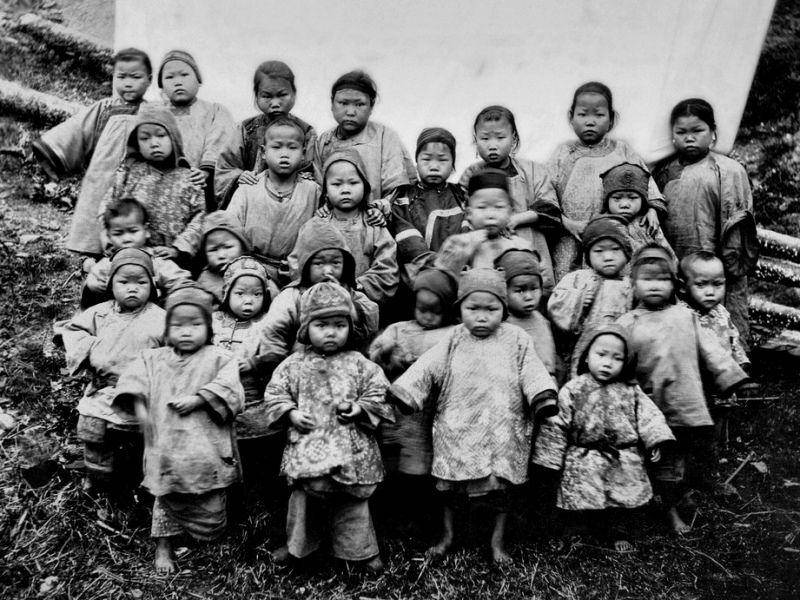
The Manchu/Qing Dynasty and slavery continued into the 20th century. The Qing Dynasty did move against slavery. Slavery was repeatedly abolished as a legally-established institution An abolition law was passed (1909) and fully enacted (1910). The Republic of China was establish (!912). The Republic also abolished slavery. The practice, however, continued in China, especially in remote areas as a matter of custom. We note captives being turned into slaves by Lolo tribesmen. China was a huge country and the Republican Government had only nominal control over large areas. The KMT Republican Government faced a wide array of enormous issues and slavery was the least of their huge problems. Solving gthese problems were complicated by the war lords, Communists, and finally the Japanese. Thus slavery persisted, albeit at a declining level. The practice continued on a limited scale until the Communist Revolution (1949). While the Communists ended traditional slavery, they initiated a slave system of their own, setting up slave labor camps. Even after the free market reforms (1980s), forced labor has been reported in modern China, both in prison camps and employers paying bribes to local officials. This is a development that is notable in many Communist countries. This seems to be one of the measures along with sterilization that CCP authorities have used in its massive campaign against the Muslim Uighur people. 【Maizland】
The fact that slavery impacted a relatively small percentage of the population can be seen as a positive matter in assessing China. But this requiresc a much more nuanced assessment. The reason that slavery was so limited in China is that most of the population was a landless peasantry with few rights and life prospects. Essentially there wes no need for a slave population to power the economy, they had another type of forced labor--a landless peasantry. The emperor and his nobles who owned most of the land had a ready supply of low-cost labor. This would also be a factor in the 19th century decline of China. hina had once been a major military power, but in the Opium Wars (1840-60) found itself ineffectualm against European powers armed with modern weaponry. Unlike in the West where the cost of labor was a factor in driving the Industrial Revolution, just as in the American antebellum South, China because of the availability of inexpensive labor had no need to innovate and mechanize--thus limiting industrialization. This would soon be reflected in the power dynamic between East and West. This contrasts with the United States from its inception making land ownership possible to the average person--the first major country to do so and the impact it had on the country's development.
Hallet, Nicole. "China and antislavery," Encyclopedia of Antislavery and Abolition Vol. 1, (Greenwood Publishing Group, 2007), pp. 154-56.
Lim, P.J. "The forgotten history of African slavery in China," Areo.
Maizland, Lindsay. "China’s repression of Uyghurs in Xinjiang," Council on Foreign Relations (September 22, 2022).
Meijer, Marinus J. “Slavery at the end of the Ch'ing Dynasty,” in erome Alan Cohen, R. Randle Edwards, and Fu-Mei Chang Chen,eds. Essays on China's Legal Tradition (1980).
Pulleyblank, E.G. “The Origins and Nature of Chattel Slavery in China,” Journal of the Economic and Social History of the Orient Vol. I (April 1958), pp, 185–220.
Rodriguez, Junius P. "China, medieval". The Historical Encyclopedia of World Slavery Vol. 1.
Watson, James L. “Chattel slavery in Chinese peasant society: A comparative analysis,” Ethnology Vol. 15, No. 4 (October 1976), pp. 361–75.
Wilbur, C. Martin. Slavery in China During the Former Han Dynasty, 206 BC–AD 25 (1943, reprinted 1968).
Historical Encyclopedia of World Slavery.

Navigate the Boys' Historical Clothing Web Site:
[Return to the Main slavery page]
[Return to the Main Chinese work page]
[Introduction]
[Activities]
[Biographies]
[Chronology]
[Clothing styles]
[Countries]
[Bibliographies]
[Contributions]
[Essays]
[FAQs]
[Glossaries]
[Images]
[Links]
[Registration]
[Tools]
[Boys' Clothing Home]