|
In our modern world there are few human practices that inspire such profound outrage as the practice of one human being enslaving another. This is, however, a very modern sentiment. The institution of slavery probably predates civilization itself. Slavery was an accepted institution and central to the economies of most major world civilization. The onset of Christianity meant and end to widespread slavery in Europe, although feudal serfs were only slightly more elevated than slaves. The European countries which conquered native American civilizations in the 16th century enslaved millions in Brazil and South America to work in mines and the tremendously profitable sugar plantations. The conditions were so brutal and European disesases so virlulent that native American populations were descimated. The Spanish and Portuguese turned Africans. Millions of Africans were transported across the Atlantic and sold into slavery in the Americas. Slavery in earlier epochs had no racial connotations. With the growth of the African slave trade, slavery in the Western mind became associated with race as with the collapse of Native American populations, it was Africans who were enslaved in huge numbers. European Christian who would not have tolerated the enslavement of other Europeans found little objecting to enslaving black Africans. Slavery is not just a historical subjdect. It persisted into the 20th century, primary in Islamic socities and in totalitarian nations (Communist, Fascist, and Japanese military occupation areas). And has not entirely disappeared in the 21st century.
In our modern world there are few human practices that inspire such profound outrage as the practice of one human being enslaving another. This is, however, a very modern sentiment. The institution of slavery probably predates civilization itself. Slavery was an accepted institution and central to the economies of most major world civilization. Slaves were were often war captives, both captured wariors and the women and children of conquered populations. The offspring of these enslaved people provided a vast slave work force. The victors in battle might enslave the losers rather than kill them. Slavery in many early civilizations is poorly understood. Slavery in ancient Egypt is a poorly understood topic. We have done some work on Egyptian social classes, but destinguishing slaves from other groups with limited freedom is a chllenging task that sgors have found very difficult. The same is true for the many civilizations od Mesopotamia. Slavery in both Greece and Rome are much better understood and were major components of the work force. Slaves in Greece and Rome were drawn from widly differing peoples and there was no association with race. Slaves might be blond, blue eyed Anglo-Saxons from Britania or blacks from Sahara as well as evry other racial type. Slavery in Rome had no racial basis. Even those of Italian stock were enslaved. It was thus impossible to tell from one's look id they were a slave. This complicated control. The Senate debated establishiung a destinctive dress for slaves. In the end, the Senate decided against a slave attire, partly because they decided it was dangerous vecause it would show the slaves just how numerous they were. As in the Americn South, slavery was justified on the basis of the natural inferiority of certain individuals.
All of the great early river valley civilizations developed in contact with each other, except for China. Even so we see many of the same human instititions developing in China and the West. One of those institutions is slavery. Slavery does not seem to have been as important in China, however, as it was in Western societies like Greece and Rome or the ante-Nellum South in America. Slavery in China dates back to the Shang dynasty in China (18th-12th century BC). One estimate suggests that about 5 percent of Shang China's population was enslaved. This relatively small proprtion appears to have been the case is subsequent Chinese civilizations. People became slaves through the same mechanisms as in the West, through slave raiding and militry captives and debtors. Impoverished individuals could sell themselves or their wives and children into debt. China never develop into a slave society largely because of its large population which offered ampel labor which could be exploited through serfdom. Affluent Chinese families may have slaves to do menial labor, both field work and house servants. The Emperor and his nobels would the largest slave holders. The Emperor's slaves might be castrated to become court eunuchs. The Republic of China abolished slavery (March 10, 1910). The practice, however, continued in China, especially in remote areas. We note captives being turned into slaves by Lolo Tribesmen. Traditional slavery was ended by the Communists after the Revolution (1948). Even after the Revolution tere is concer about forced labor in modern Chinese prison camps.
Religion has played a major role in both justifying and perpetuating slavery and ironically ending slavery. It hs also played a major role in largely ending slavery. The major religions have taken different views on slavery which affected the nature of the institution. Judaism did not play a significant role in slavery, in part because it has been since the Roman supresion of the Jewish Revolt, a minority religion. Christianity helped to end slavery in Europe, but tolerated the African slave trade and a race-based slave system. Islam has sanctioned slavery and played a major role in the African slave trade. In the wars between Christian and Muslim states, adherence to the oposing religion was often grounds for enslavement. One of the main objectives of the Bsrbary pirates was to seize Christians for sale as slaves. The Christian-centered abolitionist movemdnt helped end the African slave trade and slavery in much of the modern world. Islam unlike Christianity never developed an abolitionist movement. We know nothing about Hinduism and slavery, but untouchability jad some aspects of slavery. We also know nothing about Buddhism at this time..
Rome was a society built on slacery. After the fall of Rome slavery gradually disappeared. The peasants of the feudal system were similar in many ways to slaves, but Christian theology based on the value of individual souls did not support slavery and as a result slavery gradually disappeared in Europe. With the European explosion into foreifn lands in the 16th century there was a revival of slavery. There was slavery permitted in colonies which became race based. This was in part justified by denying the essential humanity of the enslaved people. A major debate occurred in Spain over the issue of whether the Native Americans were human. Similar attitudes were directed at Africans although there was never any formalized legal debate. There were, however, still some remants of both slavery and slave trading. In addition, the Mongols and Ottoman Turks conquered large areas of southern and eastern Europe. There was also Arab slave trading into Europe,
The Arab outburst from Arabia led by Mohammed and fired by Koranic teaching, Arab armies conquered vast areas creating the Islamic Miffle East, streaching from the Atalantic coast of North African coast east to Persia and beyond. Much of this was former Christian lands. The Islamic world began with the pre-Islamic Arabian institution of slavery--not unsusal in the ancuent world. As in Christian Europe the idea of keeping Christians slaves rapidly declined. In the Muslim Middle East a similar phenomernon occurred, keeping Muslim slaves declined. Slavery was an important instiutution in the Abbasid Caliphate. Slavery itself has stronger Koranic authority than Biblical support. Which is why the idea pf slavery persisted longer in the Middle East than the Christian West. While a strong Abolitionist Movement appeared in the Christian West, it never develped in the Muslim Middle East. Islamic society was further transformed by the more advanced societies that they conquered. Sloavery existed in the Cristian lands the Arabs conquered, but it was a far cry from the lvel of slavery in the pre-Cristian Roman Empire. The social structure was that bof a largely landless peasantry. This was a step above slavdry, but not far above slavery as a system of forced labor. In Cristian Europe in morohed into the Feudal System. In the Mislim Middle East a similar development occurred as fwer and fewer Muslims were kept as slaves. There ws no inhibitioin, however, on keeping nonn-Muslim slaves. Within Europe slavery became rare, although it existed in the colonies. In the Muslim wold slavery was common in Middle Eastern society and continued well into the 20th century. The Muslim worlkd took white European slaves in wars and raids. And the Arabs developed the African slave trade to obtain captive Africans (8th century AD). This was seven centuries before the European Atlantic slave trade. There were some destinctive charactetistics of Muslim slavery. Noe of the most notable was the imprtancve of sexual slavery.
The sexual slavery of women was viewed as both a male privilege and a right of th victor over those vanwquished. [Pernilla 2019, p. 203.] The domensions of the Arab slave trade are only estimates, but vurually all exceed 10 million Africams, many estimates are much higher. [Lovejoy]
Slavery was an institution throughout Sub-Saharan Africa. It was largely related to wars among tribes. Slave might be taken in raids, especially women. The status of these slaves differed from the system of chattel slavery that developed in America. Men captured by battle by also be made into slaves. This helped reduce the military potential of opposing tribes. They were also a source of wealth.
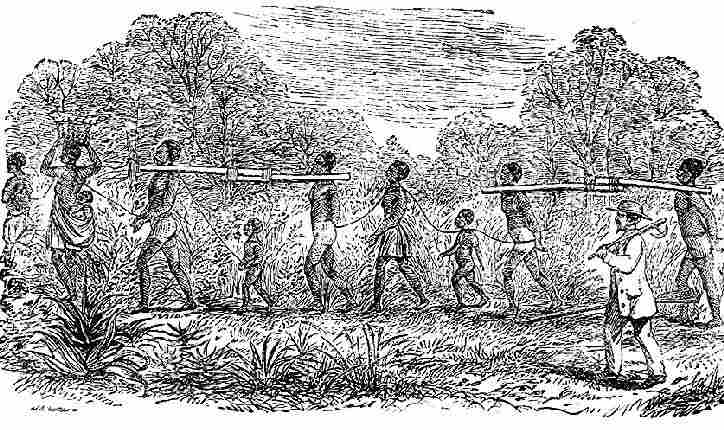
The African slave trade is generlly viewed as a European undertaking. In fact both African chiefs and Arabs played major roles. The Arabs were the first to enter the African slave trade. Arabs after their emergence grom the Arabian Peninsula in the 7th century not only moved into Mesopotamia and North Africa, but also dominated the eastern Indian Ocean, Arabs traders gradually established trading posts along the African Indian Ocean ports. Slaves could be sold to the Arab traders operating from Indian Ocean ports. As the powers of the Arabs increased they began raids on villages to seizes blacks that could be sold in Middle Eastern slave markets. A new outlet appeared in the 15th century. Portuguese explorers began voyages south along the Atlantic coast of Africa. The Portuguese were looking for a route to Asia, but as they moved south they began setting up trading posts. First the Portuguese established trading posts along the coast of West Africa, but gradually moved further south along the coast. Other European maritime powers followed suit. This was the beginning of the African slave trade. The Europeans differed from the Arabs in that they did not normally conduct raids themselves, but usually bougth slaves from Arab slave brokers and African chiefs. As the demand for slaves expanded, whole areas of Africa were depopulated.
Slavery in Christian Europe largely died out after the fall of Rome and the rise of the feudal system. Feudal serfdom was not far removed from slavery, but sefs did have some rights. And slavery did not entirely disappear. As Muslims took Christian slaves, some Christian states held Mulims in slavery. The perpetuation os slavery and the legal and historical framework varied from country to country. Slavery, however, after the European discovery of the America became largely race based and mosly restructed to the New World, especially the Caribbean, Brazil, and the southern colonies of North America. It was most important in the major colonial powers (England, France, the Netherlands, Portugal, and Spain). The history of slavery , its economic importance, and the campaign for abolition varied greatly in each European country.
The Islamic Caliphate conquered Christian provinces in the Middle East and North Africa in which slvery had already began to decline. After only about a cenury, the Caliphate began to splintet early in the medivl peiod giving rise to largly indepedndednt emirates. Slavery contginued to decline as the Koran discourged Muslims from enslavng other Muslims. Manumission of Muslim slaves was promoted as a way of expiating sins. [Gordon, p. 40.] Thus there was a strong motivation for slaves to become Muslims. Slavery conyinued largly through importing caotive Africans, For nerarly a millenium, he fican slave trade was almost entirely bsed on the Muslim world importing cptive Aftricans, This only changed to ny significnbt extent when Portuguese navigators began moving south aling the western coast of Africa to fund trade routes to the East, India and China (15th century). Soon the political labndscape changed when the Ottoman Enpire conquered the the Arab lands of the Middle East including Egypt and gined control over North Africa (16th century). With this the Ottomans inherited the Indian Ocean and Trans-Saharan slave trade. Major battles were fought with the Christin powers, especially Spain, for control of th Mediterranean. While Ottoman control over North East was tenuous, the Middle East becanme Ottoman provinces. North Africa evolved into largey independent emirates. This was a time of huge ecomonic nd political chnage. urope developed modrn science and increasinly productive progress. The Ottoman Empire made much less progress and camee to rely on Christian Europe for technology. The North African emirates made almost no technologicl and economic progress. Slavery in accpoted in Islamic, but has no racial basis, but in practice this was not a clear cut matter. [BBC] This was because many captives were taken from non-Muslim areas, especially Africa. And the enslavement of non-Muslims was a well establihed practice and sanctioned by the Koran. The Ottoman slave trade before the conquest of the Arab lands, captutredc asnd enslaved Christins in eastern and central Europe and the Caucasus. The semi-autnomous North African emirates conductcd the Barbary Coast slave trade. They had two sources for captives to enslave. These emirates had been participging in th ranbs-Sahzrn slve trades for centurius. They also conducte slave tring raids along Europe's southern coast, some tgimes reching Irelnd and Britin. (The Gilbert and Sullivan 'HMS Pinafore' opertta is not entirely fannciful.) But the rise in he Mediterranran serious ffected costal communities. The decline of the Ottoman Empire and the rise of Europe gradully changed the power dynamic, ending Ottoman slave raiding. Particularly lucrativd was ransoming the captives. The Barbary Pirates continud raiding Mediterranean shipping into the 19th century. The major powers gerally paid off the Barnaryn emirates as a cost effctivde approch. The young American republic decided to take them on. Britain using the Royal Navy launched a campaign to end the slave trade (1807) and eventually slavery itself. The British effort would take decades. One of the most difficulr probdems, edspeciallhy when dealing with Arab states was the entrenched support entertwined with Islam for the slave trade and slavery. Britain established a protectorate in Egypt, largly because of the Suez Canal (1869). They moved to close the important slave market in Cairo and end slave trading in Egypt and Sudan. This resulted in the Madist rebellion in Sudan (1881-98). It was finlly ended by the last great calvalry charge of history--in which a young Winston Churchill participated. Slavery persisted t losw leverl in rabia , the OIttoman Empire and Iran.France began colonizing North Africa (Tunisia, Algeria, and Morocco) as well as large areas of Western and Central Africas part of the Scrable for Africa (1880s-90s). France also abolished slvery in its colonies, but was not as agressive as Britain in intrfering wih Arab society. And thus slavery persisted at a low level in French colonies largely to avoid incidents like the Madist revolt in their colonies.
There were slaves in most Asian societies. As far as we can tell, however, there were no Asian societies that correspibded to classical Western socieies like Greece and Rime in which a third of the pppulation were slaves--a substantial part of the population. Slavery varied over time and from society to sociiety, but nowhere did it aporoach the levels of Western clasical society. This was in part because in societies like China, most of the population was a landless rural peaasntry who while not slaves had lives constrained in many ways essentially a serf-like ner slave condition. Much has been written about the mistreatment of Chinese immigrants in America--much of it true. Rarely asked is if they were so badly treated, why they came and stayed. The answer is simple, they were actually better treated in Anmerica than China. Not only were they treated and paid better in America, but Amnerican law protected them better than Chinese law. The U.S. Supreme Court set a mkor precedent Yick Wo v. Hopkins (1886). This was a case in which a Chinese laundry owner took issue with a discriminatory city ordinance. The Court ruled unanimously that the 14th Amendment's promise of equal protection extends to immigrants and not just citizens.
The Portuguese as they pushed south along the coast of West Africa were the first Europeans to come into contact with the people of Sub-Saharan Africa. Thus when Portugal and Spain established the first American colonies, they first introduced Africans as a labor source in the New World. It was sugar that first made slavery important and Caribbean sugar islands became enormously important. The European countries which conquered native American civilizations in the 16th century enslaved millions in Brazil and South America to work in mines and the tremendously profitable sugar plantations. The conditions were so brutal and European disesases so virlulent that native American populations were descimated. The Spanish and Portuguese turned Africans. Millions of Africans were transported across the Atlantic and sold into slavery in the Americas. Slavery in earlier epochs had no racial connotations. With the growth of the African slave trade, slavery in the Western mind became associated with race as with the collapse of Native American populations, it was Africans who were enslaved in huge numbers. European Christian who would not have tolerated the enslavement of other Europeans found little objection to enslaving black Africans.
The United States banned the importation of slaves (1808). There was, however, only minimal enforcement by the U.S. Navy. It was the Royal Navy that eventually ended the slave trade. The slave trade had been a lynch pin in thr triangular trade that has been a key element of the British economy and helped bring great wealth to Britain. It had in part helped to finance the growth of the Royal Navy. The expansion of the British merchant fleet under the protection of the Royal Navy resulted in Britain dominating the slave trade by the 18th century. British ships beginning about 1650 are believed to have transported as many as 4 million Africans to the New World and slavery. The British Parliament during the Napoleonic Wars banned the slave trade (1807). This was a decession made on moral grounds after a long campaign in Britain against slavery at considerable cost at a time of War. After Trafalgur (1805) the powerful British Royal Navy could intercept suspected slave ships under belligerent rights. After the cesation of hostilities this became more complicated. The only internationally recognized reason for boarding foreign ships was suspected piracy. Thus Britain had to persue a major diplomatic effort to convince other countries to sign anti-slavery treaties which permitted the Royal Navy to board their vessels if suspected of transporting slaves. Nearly 30 countries eventually signed these treaties. The anti-slavery effort required a substantial effort on the part of the Royal Navy. The major effort was carried out by the West Coast of Africa Station which the Admiralty referred to as the 'preventive squadron'. The Royal Navy from this station for 50 years conducted operations to intercept slavers.
Slavery did not end with abolution in America and somewhat later in Brazil. Slavery has continued into the modern world, especially child slavery. It persisted into the 20th century, primary in Islamic socities and in 20th century totalitarianism (Communist, Fascist, and Japanese military occupation areas). And has not entirely disappeared in the 21st century. Slavery continues in India as a form of indentured servitude where porr families sell their children for work as weavers or even worse. Child slavery is a serious problem in several Islamic countries. Islam for reasons I do not fully understand seems more tolerant of slavery than any other modern religion. Some Arabs appear to believe that it is acceptable to capture non-Moslem children and make them slaves. For the most part this involves Arabs capturing Black African children. This practice has been reported in the Western press to widespread condemnation. It appears to cause little concern in Arab countries. Actual slavery continues in the Arab world. Often it is not enforced by statue, but some Arab countries take no steps against it. The problem of child slavery is especially serious in Sudan. Mauritania is another country in which the practice is widespread. One of the most moving accounts that we have noted is an account by a Nubian girl. She and 31 other children were captured in a 1993 Arab raid on their village. She was sold to a family in Khartoum where she was terribly treated and abused. [Nazer and Lewis] Slavery is not just a historical subject. Slavery was reintroduced by the socialist totalitarian regimes of te 20th century (especially Soviet Communism and NAZIs). The Soviet Gulag reintroduced slavery into the modern world. And similr manifestations occurred in other Communist countries after World War II. The most egregious examples being China and North Korea. We are not yet sure about Vietnam. The Axis countrues had substantial slave labor opeations furing the war, especially NAZI Germany and the Japanese Empire.
Slavery is a very common social institution. We find a histort of slavery in most countries over different time periods. Our discussion of slavery follows a generally chtonological/regional thread. This works for most countries, but some countries which have undergone massive social changes over time are mote difficult to follow with this approach. Countries of more modern origins can be better studies with the alphaberical country index. More borders are not the same as ancient borders, complicating an assessment of slavery based on modern states. A good example here is Egypt where in addition top Phronic times, we have Roman and Arab period which both fostered slavery. Cairo for many teaswas an important slave market. This we will create general country pages here so readers interested in a specudic country can follow the country information we have compiled. Much of our informaton on slavery comes from Africa and the Americas, but we have begun to acquire some informatin from Asia.
Slavery or the ownership of anpther individual for forced labor is widely seen as the ultimate evil in today's world. This has not always been the case. Svery has been with us proibbly before the advent of civilization which provide wrutten account. And even into the late 20th cventury persisted, nespecially in the Muslim world. China coninues to use slve labor even today. While is hs not been totally eradicated, almost everyone would gree tht slvery is not only wrong, but an absolute evil. Those who practice slavery today no longer attempt to defend it, but rather hide it. The reasons are obvious. The slave-owner benefits from the labour of another without real recoinspence. Slavery exploits and degrades human beings, Slavery violates basic human rights: The United Nations Universal Declaration of Human Rights prohibits slavery and many of the practices associated with slavery--"All human beings are born free and equal in dignity and rights. They are endowed with reason and conscience and should act towards one another in a spirit of brotherhood. [UNUDHR--Article 1] There is no doubt that skavery is wring, even evil. We find, hoevr, that modern discussions of slavery, formulations like Critical Race Theory nd the 1619 Project are not based on historical fact. In the United States, before and after the Revolution (1776). something like 10-15 prcent of the populaion was esclved, the great bulk in the southern colonies/states. Mow slavery was a historical fact and deserves scholarly attention. What woke critics which now dominate academix, Hollywood, the media and noe corporate boardrooms, simply ignore is that slavery was only one form of forced labor, albeit admitedly the most horific. The great bulk of the world population did not own the labd they tilled and worked under some form of forced labor. This was the case for the peasantry in China, India, Latin America, the Middle East, and Russia. America did not create slavery and was a repient of a very small portion of the captive Africans transported by the Atlantic Slave Trade. Slavey was not what was created in 1619. Slavery has been in existence for millenia. What was beginning that was important in 1619 was a society based on free labor and wide-spread land owbership. It is important to study the 10-15 percent of Americabs who were enslaved. It is, however, ahistorical and a scholarly absurdity to ignore the 85-90 pecenbt of the populauion which for the first time in human history were able to live and work under a system of free labor and then launch a system where the commom man elected his governent and was not ruled by monarchs and aristicrats. These two developments were the real achievemnts of America. Slavery was a serious flaw , but not the core of the economy or American society. We do not say this because we do not believe that social disparities should be ignored, but because our belief is tht it is importnt that the disparities should be honestly studied without ideological nias and mindless wokism so they can be effectively addressed.
BBC. "Slavery in Islam" (2009)
Gordon, Murray. Slavery in the Arab World (New York: New Amsterdam Press, 1987).
Lovejoy, Paul E. Transformation in Slavery (Cambridge University Press: 1983).
Nazer, Mende and Damien Lewis. Slave: My True Story (Public Affairs: 2004), 350p.
Pernilla Myrne1, "Slaves for pleasure in Arabic sex and slave purchase manuals from the tenth to the twelfth centuries, in Journal of Global Slavery (June 6, 2019).
United Nations. Universal Declaration of Human Rights.

Navigate the Children in History Website:
[Return to the Main forced labor page]
[Return to the Main working page]
[Return to the Main religion and history page]
[Return to the Main labor economics page]
[Introduction]
[Biographies]
[Chronology]
[Climatology]
[Clothing]
[Disease and Health]
[Economics]
[Geography]
[History]
[Human Nature]
[Law]
[Nationalism]
[Presidents]
[Religion]
[Royalty]
[Science]
[Social Class]
[Bibliographies]
[Contributions]
[FAQs]
[Glossaries]
[Images]
[Links]
[Registration]
[Tools]
[Children in History Home]