|
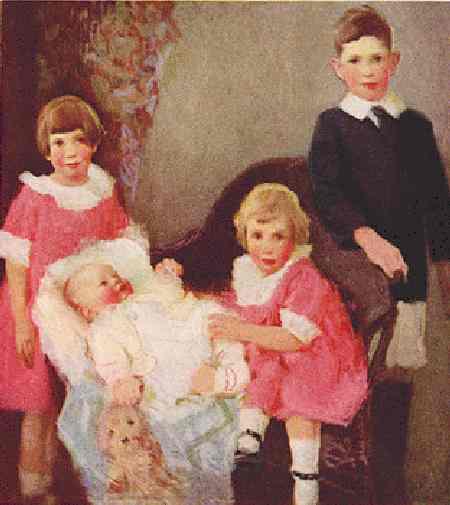
Some interesting glimpses of period clothing can be ssen through advertising. Perhaps the first is the famous Pears soap ad of the boy blowing bubbles, but over time there have been many more. Actual clothing ads are in catalogs and magazines here we arequive images where children's clothing can be seen in products for other products. Some companies, as today, were famous for their ads. These ads not only provide insights on comtemprary clothing, but also on social trends and conventions. We have only begun this section. Please send along your favotite ad to add to our aechive, even if you do not have the actual image. One interesting aspect about ads is that often they may not have pictured commonly worn fashions, but rather fashions designed to appeal to the group targeted by the ad.
HBC will list individual ads here chronolically. We stress the are not clothing ads themselves, but the clothing of children who appear in advertisements for various other products. After we have collected a reasonable number of adds, we will analize them for pertinent trends. Advertising of course came to its own in the 20th century and the number of available 20th century images is enormous. Adverising, however, dates back to the ancient world. Archeologists have noted signs written on the walls of Pompeii. Printed and broadcast ads are a much recent phenomenon. We have acquired a few 19th century ads, but most of our advertising material dates from the 20th century.
Advertising is strongly associated with the United States. It of course did not begin in the United States, but the rollicking free market capitalist economy of the United States brought advertising to a new heught and levelof sophistication unknown in other countries. The story of advertising in various countries is a fascinating topic, and one which HBC with its limited resources has not yet been able to address, although it is one of the topics we hope to be able to addrss. A Russian reader has provided us a fscinating account of Soviet advertising. Soviet advertising had a different purpose thannadverising in the West. We have begun to collect individual advertisements displaying children's clothes. Most are American ads, but we are gradually adding advertisements from other countries as well. At this time we have the ads sorted chronolologically. We will eventually sort them by country as well and list them here. This will help in country assessment of the advertising industries in different countries. One interesting country is Germany. It is fascinating how adverising becme important so soon after World War II. and became a feature in the Cold War. The German Economic Miracle was a potent advertisement for freedom with foirced the Communist to build a horific wall to keep their people in. After only a few years of freedom, the Grmans had not only recovered, but delivering a life style tht Germabs could only dream of before the War.
We also plan to sort the collected advertisements by the type of garments depicted. This project will have to wait, however, until we collect more advertizing images.
TV advertising began modestly in the late 1940s and by the 1950s was a mahjor force in the American economy. Children frequaently figure in advertisements. Im fact many child stars began their career acting in commercials. An analisis of the costumes in this commercials yield some interesting insights into fashion treds. Television only began to be
commonly watched in the early 1950s.
The history of advertizing is a fascinating history in itself. Advertising can be found in ancient ruins. While America did not create advertising, but no other society has so embracd adverising and created science of it. Author Palmer Cox (1840-1924) helped develop modern ideas of licensing popular children's characters. We have archieved here some intersting advertisements depicting boys' clothing. One important aspect of modern adverizing is the degree it has been directed at teenagers and the extent to which teenagers have been used in that effort. The first use of teenagers may well be singer Frank Sinatra (1915-98) used bobby-soxers to generate enthusisam for his concerts. [Quart] There are many questions concerning children and youth and advertizing. Can demand be created totally out of thin air. Many observer complain that modern advertisers exploit children and teenagers. One author writes, "Raised by a commodity culture from the cradle, teens' dependably fragile self-images and their need to belong to groups are perfect qualities for adverisers to exploit." [Quart]
We have discussed several different publications, mostly magazines, in HBC. Many are publications which carried illustrated articles, both drawings and photographs, along with information about fashion trends or historical developments of interest to HBC. Most of these publucations also carried advertisements. Some rarely had clothing advertisements while others often included clothing advertisements. We also notice magazines of relatively limited interst to HBC that did gave clothing adverisements. Some of the magazines specified in certain kinds of clothing advertisements. These cklothing ads when we could determine the date are archieved in the HBC catalog/advertising section.
Advdertising is one of the most accessible sources of information on color, but one of the least reliable. Here we are talking about advertizing in general and not clothing advertisements. (We have included clothing advertisements in the catalog section.) Tremendous advances were made in lithography so that illustrations could be easily and inexpensively added to newspaper and magazine adverising during the 19th century. This was a great boon to advertising because illustrations were so eye catching. And by the late-19yh century, color lithography made high-quality color printing possible. We begin to see advertisment in bright, eye-catching colors. This is the problem with using advertisement as aource of information on color trends. There is a temptation to use them, becaause msany are dated. But the purpose of advertisement is to catch a potential customer's attention, not to accurately depict the color of garments. We do noit suggest ignoring advertisements, but we suspect that bright colors are more commonly used in advertising than was common in actual fashions.
Advertising is of course not only publications. There are a range of other media. One interesting medium is the German Litfaßsäule/Morris Tower. There are various comparable ways of displaying psters and displays in public. Radio was not very effective for selling clothing, bus a visual medium like television is. And of course the internet is medium particularly suitable for selling clothing. May manufctuers and retailers have websites.
Quart, Alissa. Branded: The Buying and Selling of Teenagers (Perseus, 2002), 329p.

Navigate the Boys' Historical Clothing Web Site:
[About Us]
[Introduction]
[Activities]
[Biographies]
[Chronology]
[Clothing styles]
[Countries]
[Girls]
[Theatricals]
[Bibliographies]
[Contributions]
[FAQs]
[Glossaries]
[Images]
[Index]
[Links]
[Registration]
[Search]
[Tools]
[Main HBC Topic page]
[Boys' Historical Clothing Home]