***
artists illustrating boys fashions: Sofonisba Anguissola
Sofonisba Anguissola (Italy/Spain, 1535-1625)
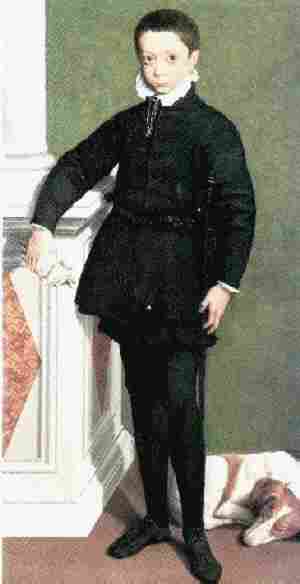
Figure 1.--This enigmatic painting by Anguissola is a 9-year old scion of an Italian nobel family, Massimiliano Stampa. He was the third marquis of the northern Italian city of Soncin. The porteait was done in 1557. It was Anguissola's first major commission painting people beyond her family circle. Female artists were rare amd it was not seen as proper for a yong woman to paint male strangers. Painting a boy was more acceptable than an adult man. You can see the bloomer like breeches and long, tight-like stockings worn by men and boys.
Anguissola is first known woman artist of any prominnce. She is one of the few know Renaissance women painters and by far the most prominant. Unlike most girls of her era, she and her susters was encouraged by her unusually enlightened father. She was trained as a painter by being apprnticed to local artists. At the time, most well-born young women of Renaissance Italy were expectedf to sit closed up in their palazzos and pursue needle work and perhaps play musical instruments. Her accomplishments led to a life of drama and romance on a grand scale. She became a celebrated portrait painter at the court of Spanish King Philip II. She lived to a hearty old age, and became an international celebrity who was praised but no less an artist than Michelangelo and lauded by artists throughout Europe.
Childhood
Sofonisba Anguissola was the oldest daughter of Amilcare Anguissola, a member of the Genonese minor nobility. Her father had uncharacteritically enlighted views about women, perhaps because he and his wife Bianca had five daughters and only one son. By all accounts their comfortable palazo was a happy home, rich in laughter and the intelectual fermant of the high Renaisance.
Education
The life of Renaisance women was severely restricted. Girls were not educated and in Italy they were virtually cloistered in comfortable pilazaos and expected to care for their husbands and children. Sofonisba's father, however, educated each of his girls and each demonstrated artistic promise. He could not send them to school as schools did not accept girls, but he saw to their education. Sofonisba at about 11 years of age began to study in the studio of Bernardino Campi. It was mostly boys who wee apreticed at the time. Anguissola's apprenticeship with several local artists set a precedent for women to be accepted as students of art, although it continued to be rare.
Sofonisba's early paintings were of her family, her panents and siblings. This reflected the conventiins of the day. A young women was not allowed to have abything to do with strangers. This included painting strangers. As a result, we have quite a few family images and they are wonmderful images. If you study their faces you get a good idea of what ws going through their minds. And of course we have very accurate dpictions of hair styles and clothing. Her intreaguing portraits were soon attracting the notice of the airistocracy in Mantua and Parma. Michalangelo praised her drawings. Anguisolla, still in her 20s, was called to Spain by King Phillip II, a patron of the arts. Much of Italy at the time was ruled by Spain. She worked in Spain for 14 years, as an art instructor to Queen Isabel and as a court painter, producing some of the most personal images of the royal family. Most are now in the Prado. In Spain she had to conform to court painting conventions so we do not see the same dlightful play of personality tht we see in her family portraits.
Marriage
Anguissola returned to Italy in 1573. King Philip II tookan interest in her and found a Spanish nobelman fir her to marry--Fabrizio Moncada Pignatelli, son of the Prince of Patern�, Viceroy of Sicily (1571). He supported her painting. They left Spain with the king's permission, and lived in Patern� (near Catania) in Sicily (1573-79). Here she continued painting and tutoring aspiring artists. She helped supportthe family aftervher father suffered financial reversesabd died. Fabrizio died (1579). While sailong to Genoa, she fell in love with the ship's captain, son of a Genonese noble family. He was a sea merchant Orazio Lomellini. Although her brother disapproved, they married in Pisa (1584). They lived in Genoa (until 1620). They had no children, but she maintained cordial relationships with her nieces and her stepson Giulio. It was a happy mairrage and a generous pension from the King allowed her to paint and live comfortably into her 80s. She was an international celeberity, in part because she was a woman, one of the few who achieved artistic prominance until the 20th Century.
Clothing
The boys and men Anguissola painted in the 16th Century wore bloomer like breeches and long stockings. Interestingly, the women that she painted wore long dresses as, unlike men, it was not considered proper for women to show their legs. There were no childrens clothes. Boys after breeching wore the same style as their fathers. Their breeches in the 17th Century evolved into knee breeches.