|
No country is more important in art histiry than Italy. Mostv young European artists aspired to go to Italy to study the great masters. Italy during the Renaisance was the birth place of modern European art. Many of the greatest artists of all time are Italian, men like Leonardo, Micelangelo, Rafael, and Titian. There work ranks as some of the finest art of all time. Most date from the Renaissance. We have not yet cross indexed them here, but plan to do so soon. Interestingly, however, is the rather limited number of modern art work we have been able to find from Italy. It interesting that Italy which played such an important role in the history of Western art has produced so few modern artists of stature. It is also interesting to note that Italy does play a major role in the fashion industry. Often art and fashion go together.
Anguissola is one of the few
know Renaissance women painters. Unlike most girls of her era, shev was encouraged by her unusually enlightened father. She was trained as a painter when most well-born young women of Renaissance Italy were expectedf to sit closed up in their palazzos and persue needle work. Her accomplishments led to a life of drama and romance on a grand scale. She became a celebrated portrait painter at the court of Spanish King Philip II. She lived to a hearty old age, an became an international celebrity who was praised by no less an artist than Michelangelo and lauded by artists throughout Europe.
Luigi Bechi was born in Florence (1830). Italy at the time did not exist. The peninsula was divided into different states and much of the north as still in Austrian hands. As a young man fired with patriotic fervor, he joined in the war for independence. He joined up as a private soldier to fight in tge Second war of Independence (1859). He served in the artillery. Later in the Third War of Indepndence he fought with Garibaldi in the Trentino (1866). He was wounded and captured at the Battle of Bezzecca. He trained as an artist under Giuseppe Bezzuoli and Enrico Pollastrini in Florence. Between the wars he developed as a member of the 'Macchiaioli'--the Italian artistic movement committed Plein-air realism. His mentors helped him secure a post as professor at the Royal Academy of Fine Arts in Florence (1870). He worked in several areas, historical and biblicl paintings, landscapes, pastoral scenes, and genre. We notice serious historical scenes, including images of the wars of independence. He also did a range of genre paitings, inclusing charming even humerous scenes. He like several other Italian artists was especially inteested in peasant life. Quite a number of his genre works are peasant scenes. often of children or including children. We are not positive that the peaaant childten depicted look like how the children may have dressed at the time he painted. They look to us more like children in the 18th and early-19th centuries rather like the late-19th century. Perhaps our Italian readers will have a better fix on this.
Mosè Bianchi was an Italian painter and graphic artist. He was born in 1840 in Monza, near Milan, then in the Austrian Empire. His family apparently lived in Venice and moved to Milan. Mosé enrolled at the Brera Academy. Before he completed his studies, he joined the Italian forces to fight in the second war of independence. He returned to finish his training at the school of painting which was headed by Giuseppe Bertini. Shortly aftr finisgingb his studies, he was awarded a grant to visit Venice (1867) and then Paris (1869). He participated in the Brera exhibitions and the Vienna Exhibition of 1873. His early works were well received. He began to paint genre scenes for some reasons with 18th-century rather than modern settings. He also did portraits. He became one of Milan's most popular artists. His was a prolific artist working in mixed media and his output included portraits, landscapes, historical scenes and genre subjects, basically pieces that woukd sell well. He worked with bold colors created insughtful scenes. Milan was a growing industrial city and Bianchi was very suuccesful. He returned to Venice (1879) and began working in Chioggia. Both would play a major role in his work. His later works featured scebes from both places in image series of both Venice city scenes and landscapes and genre scenes around Chioggia. One of his genre works, 'The Schoolmaster' was painted in Milan, it is undated. We also notice genre paintings of altarboys being confrinted by geese and another of children playing blindman's buff. The paintings would have been done some time between 1865 and 1895, The clothing in the schoolmscene suggests an 18th century schooln scene. The painting shows a teacher reprimanding a boy who has carelessly broken an object. The altarr boyspainting andthe children playingare abasically timeless. Bianchi was also noted for his print making. He served as a principal of the Accademia di Belle Arti Cignaroli in Verona.
Italian genre and portrait painter. He was born in Ferrara and educated at the Academy of Florence. He achieved success at a young age painting portraits in London, but he moved to Paris in 1872. He was a good friend of the American painter Whistler.
Sandro Botticelli is one of the leading artists of the Italian Renaissance. His painting the "Birth of Venus" is considered one of the masterpices of the Floretinr Renaissance. He was born as Alessandro di Mariano Filipepi in Florence. He was the son of a tanner, a very low status trade. Botticello meaning "little barrel" was a nickname, but the name that he is widely known for today. Sandro was first appreticed to a goldsmith and later to the painter Fra Filippo Lippi. He also worked with the engraver Antonio del Pollaiuolo. He painted both Biblical and classical scenes as well as the increasingly popular portrait. Interestingly in sharp contrast to his his equisite lines and reaistic depictions, Botticelli clothed his subjects in contemporary Italian Renaissance clothing.
Michael George Brennan was born on September 28, 1839 in Castlebar, County Mayo, Ireland. His father operated a hardware store. He was educated at Castlebar. And while still a youth tought himself shiorthand and earned money selling reports to newspapers, includung a Dublin paper. He had inate artistic skills before any training. He began to acquire a reputation as a cracturist at school and in Castlebar. Some local personages took an interest in the boy. They sent hom to Dublin at the age of 15 years to study at Dubkin Society's School in the Royal Hibernian Academy. He then went to London and entered the Royal Academny's School. He earned money by submitting drawings to Fun. a Punch rival, but quit as a staunch Iriush Cathokic when ordered to caricature the Pope. It is at this time he contarcted typhoid. He went home, but was advised to move to a warmer climate. He chose Italy and settled in Rome. He spent much of the rest of his life in Italy. As a result, although Irish born and educated. He few works he painted in his short life were Italian, not Irish images.
Brunias is a rare Italian artists who did not paint Italy and Italian scenes. Instead he painted The East Indies at a time thar slavery was in full boom, the late-18th century. We know of no other artists that provided so many paintings and drawings on the West Indies and enslaved people that he actually observed. We knew next to nothing of his early life. We do not even have a confirmed birth date, but it was in Rome, probably about 1730. Most of his work depicted the West Infies, many including enslaved people. After graduating from the Accademia di San Luca, he begn painting in ome. We know nothing of his early works. He befriended prominent Scottish architect Robert Adam and went with him to Britain. It was there he met Antiguan-born Sir William Young. Prime Minister George Grenville had Young appointed o be President of the Commission for the Sale of Lands in the Ceded Islands--Caribben sugar islands. The islands included Grenada, Tobago, Dominica, and St Vincent, that had been acquired from France as a result of the 1763 Peace of Paris ending the Seven Years War. (France kept Guadalupe and Martinique in exchange foe ceding Canada.) Young commissioned Brunias to record his activities. Brunias left for the British West Indies to pursue. Although he was primarily commissioned to paint Yiung and tge wealthy planter families and their plantations. He painted many scenes depicting free people of colour and cultural life including the skaves. We are not sure who he uintended selling these paintings to. We cn't imagine plabter families would be interested. He appears to have brought his pintings back to England where he sold them. We are not sure how they were received or what prices they commanded. Brunias spent most of his time in the West Indian career on the island of Dominica, where he would die (1796). He also spent time in St. Vincent, but visited other islands, includung Haiti. Historians differ on their assessments. Sme praised his subversive depiction of West Indian culture. One cintemprary adnirer was Haitian revolutionary keader, Toussaint Louverture, Others criticised, especially abolitiinists leaders. Hisworks are nothing like those abolituiiniusts distributed. They were bothered because Brunias seems to romaticize slavery and captures none of the harshness and brutality of the slave system. We are sure that the relentlessly woke among us would agree and actually this also occurred to us. Brunias does for the most part does not show slaves at work and never being punished. But his images do something the Abolitionists never do, it depicted people of color, both slaves and free, in a dignified way, people that were fully human as cultured and capable as the white planter class. As far as we know, Brunias did not hold racist views--unusual at the time. He married a free multto woman and had two children.
Cesare Cabras was an Italian painter. He was born in Monserrato southern Sardinia from a land owning family of modest means (1886). The family had mosest fields, almond groves, and vineyards close to Cagliari.
As a boy, he worked in the fields with his family. As a result, unlike many artistrs he was persomally involved in the scenes he chose to depict in artistic career. He was was familar wit every aspect of rural life from having experienced it personally. At age 19 years he began an apprentice in the workshop of the craftsman Giuseppe Conci (1905). This was an older age than appreciship usually began, but Conci was a noted Art Nouveau decorator, catering to the Cagliari upper class. It was an oportunity to begin a comfortable career a part of the urban middle class. Conci noriced some specual about Cabras. He convincd hus father to have Cabras train as an artist (1907). As a result, he enered the Academy of Fine Arts in Rome where he graduated in at the 26 years of age (1912). The Rome artistic environment was an eye-opening experienvde for Cabras whose life up to that point was largely confined to rural Sadinia. He mixed in the dynamic artistic mileau. He was most influence, however by verismo art -- not the many modern movemnts of the day. Verismo was a pictorial movement of the Italian 19th century. Cabras was not unterested in the many modern abstract movements. After finishing his atistic career, he began working in the studio of Pietro Gaudenzi in Genoa. He also enrolled in the the nude evening school of the English Academy. The association with Gaudenzi continues for some time.
After the outbreak of World War I, Cabras returned home to help with family agrcultural operations. His briothers were conscripted for military service and help was needed in the fields. Because of a congenital problem, he was exempted. He was able to continue painting. His works are realistic, often with rural, peasant subjects. A good example of his work is 'Famiglia Campidanese', family from the Campidano plane, the plane in southern Sardinia.
Michelangelo Merisi da Caravaggio (1571-1610) was one of the most important painters of his time. Although seen as the bad boy of late Italian Renaissabce art, both because of his ababndinment of established iconography (seen as indecorum) and his stormy personal life, incluing carousing brs and fuighting. He was born in 1571, althugh some recent scholaship suggests 1573. he was apprenticed for 4 years to Simone Peterzano a Bergamasque artist who insisted that he had been a pupil of Titian (1584). After his apprenticeship he seems to have gone to Rime, although vurtually no information is available on this period of his life. He eventually appears working for Cavaliere d'Arpino. His first works were uncontroversial still-life subjects. He also painted small rather dramatized self-portraits showing a northern, perhaps Venetian style. From an early point his work exhibited strong chiaroscuro and detailed realism. Cardinal del Monte employed him to paint genre scenes (1590s). The Church was still the source of major commissins. And presumably through the cardinal he obtained a commission to decorate a chapel in S. Luigi dei Francesi (the French church in Rome) with three scenes from the life of St. Matthew. This his first public work was finished only after many difficulties Difficulties with Church authorities continued throughout his life.
Lorenzo di Credi was a Florantine painter of the Florentine school. A gifted, but unspectacular Renaissance style. He painted many nativity scenes or other scenes with the Madonna and Child as well as other religious works. More interesting were his deeply personal portraits, including some children showing hair styles and fashions. A long-haired youth painted in 1490 could have come out of any American junior high school in the 1970s. His early work are considered to be somewhat similar to Leonardo's youthful style. He reportedly came to regret doing these secular portraits for which he was undoubtedly well paid. The artist in his later years attemopted to destroy all of his secular paintings which are the ones of greatest interest to HBC.
No list of Italian artists would be complete without Lonardo Da Vinci, although he did not paint many works illustrating boys clothing that would be useful for HBC. We include him primarily because of his importance in Italian art history. We have archived a children's book about eonardo in our children's literature section. It is useful because of its discussion on his childhood.
Lavinia Fontana is the most noted and prolific woman artist of the Renaissance. Lavinia was born in Bologna, a city that was
noted for encouraging the academic and artistic abilities of women--unusual at the time. Women were educated at the University of Bologna when they were not
allowed at other European universities. Bolognese painters chose Caterina dei Vigri (Saint Catherine of Bologna). Fontana is not only the most important woman artist of the Renaissance. She is believed to be the first woman painter known to history to hve had a successful career. As so often is the case in such instances, her father was a paiter. When he died. Fontana supported the family with her poainting. She painted in many genre, but among her religious and secular works showing the clothes worn by the children of Bologna. Many but not all are portraits of the children of wealthy families.
Ettore Roesler Franz was an important Italian painter. He was born, lived, worked and died in Rome, although his grandfather came from Germany. He painted many watercolors representing the places and the people of Rome. He had his inspiration from the everyday life. To prepare his pictures, he took also some photos of street scenes and some studio portrait of simple people of Rome.
Venetian artist Giorgione is one of the great masters of the High Renaisance. He was not only a master draugthsman, but also a leading figures in the artistic revolution sweeping Europe. He was one of the first painters to paint people in a landscape setting. Giorgione was born in Castelfranco Veneto near Venice (c1477). At the time before the discovery of the Americas and rounding the Cape of Good Hope, Venice was at the center of the trade with the East. And the wealth created was part of what generated the Italian Renaissance. Virtually nothing is known about his childhood which most art historians see as suggesting humble origins. He is believed to have shown artistic talent from an early age. Giorgione was apprenticed to Giovanni Bellini--one of leading figures of the Renaissance (1490). Only incredibably talented boys would have been accepted as aprrentices. And in Belini's studio he was tutored in how to depicr lighting, atmosphere, color and mood. And the result wa virtually immeiate. While still a teenager, Giorgione produced his first two major works: 'Trial of Moses' and 'Judgment of Solomon' (1495-1500). Some after he painted 'The three ages of man' (1500-01), a brilliant dpiction of age. His most recognized work is 'The Tempest' (1505). About the same time he painted He painted many half-length portraits. Tragically has only a short career. He died at only 33 years of age, struck down by Venice dening us many master works (c1510).
We have little information on Giotto's childhood. We note that French artist Léon Bonnat depicted him as a sheppard boy. Giotto is very important in the history of art. He is widely comdidered the most important Italian painter of the 14th century, which means the important painter in the world at the time. His work were a an early hint of the innovations of the Renaissance that would begin a century later. Most artbhistorians see him as the father of European painting and the first of the great Italian masters that would lead art into modernity. He played a major role in revolutionizing Western art. Which is why we include him on our Italian list. Before Giotto, Italian art art was flat and strongly influenced by Byzantine forms. Giotto brought realism, depth, and individuality to his painting. The people in his paintings are depicted in the long robes commonly worn in medieval Europe for centuries. We notice few children in his paintings that we can use to illustrate how children dressed at the time. The subjects of Giotto, like virually all art at the time are religious. Jesus as a baby is always depicted wearing a tunic. In St. Francis' 'Renunciation of Worldly Goods', a fresco in Assisi basilica, we can see two girls about the same age. St. Francis took off all his garments returning them to his father. Giotto put two girls in this scene. Giotto saw no need to hide the event from their eyes.
Michele Gordigiani was born in Florence (1835). His father was a well-known Florentine musician. He was interested in art froim an early age. He studied at the Academy in Florence under Giuseppe Bezzuoli. He also sdtudied under Luigi Norcini and Silvestro Lega. He worked in the studios of Luigi Mussini and Adolph Sturler. He and his brother Anatolio socilaized in the Caffè Michelangiolo (1855). It was herethey came in contact with the Macchiaioli painters, an Itlaian art movement rejcting rigid vacademic convntions, somewhat similar to the French imppresioinists. His work deviated from the Macchiaiolists. He attempted costume genre work, but these paintings were not well received. His portaits, however attracted attebtiion. A friend,
Virginia Oldoini, Countess of Castiglione invited g=hum to loaris (1860). Hevquicjkly sevelpedva substantial reputation. He painted several imprtant portraits, includiung King Vittorio Emanuele II, his daughter-in-law Queen Margherita, and the Count of Cavour. This was at the time that Vuctior Enanauel and Cavour had suceeded in uniting Italy. In London he painted portraits of Queen Victoria and Prince Albert jist before Albert's death. Another important English work was Elizabeth and Robert Browning. While in London, he participated at the exhibition of the Royal Society of Arts. One of the best was a portrait of Cornelia Ward Hall, wife of businessman John H. Hall, with their four children, we think painted in America (1880). Late in his career he submitted works to the Florentine Exhibition of Art and Flowers and at the Second Venice Biennale. He died in Florence (1909).
Renato Guttuso was a modern Italian artist. He was born in Bagheria, close to Palermo, Sicily (1911). He nobed to Rome (1937) and largely worked there. He engaged in a range of artistic acticities. He did sets and costumes for Histoire du Soldat (1940) and llustrations for books. His illustratiins for Elizabeth David’s Italian Food (1954) introduced him outside of Italy. Guttuso was a fervent anti-Fascist. He joined the Communist party (1940) which was banned by Italy's Fascist Government. He become an active participant in the partisan struggle which rise up after the Allied invasion (1943). After World War II, Guttuso created the Italian Communist Party's official logo. We note a painting bond to his homeland (1953). It shows the workers in the Ma href="/country/it/act/work/area/iawa-mine.html">Sicilian sulfur mines. In the same year a press report on the Sicilian mines showed that there were still boys working there. One art historian describes Gurrusp as developing 'out of Expressionism and the harsh light of his native land to paint landscapes and social commentary.' [Hamilton] We have always wondered hoe an artist can be a Communist given that artists in Communist countries are not free to create freely. And they have to conform to the dictates of the Party in subject matter, depivtion, and style. Is that really acceptable to artists like Guttuso? It is notable that Communist countries have produced relatively little great art. An important part of art is social commentary like the suloher mine, yet Communist countries do not permit seriius citicism of their society.
Bastiano Mainardi (14601513) was an Italian Renaissance artist born in San Gimignano (1460). He is not one of the better known Renaissance artists. Besides his paintings, most of what is known about his life comes from the writings of Giorgio Vasari. Domenico Ghirlandaio was his brother-in-law and master. He was working in San Marco, Florence under the supervision of Ghirlandaio (1485). Mainardi is believed to have contributed to the frescoes in the Abbey of Passignano in Val di Pesa, near Florence. He is nest known for a series of Madonna with Child and of female portraits. Ar critics debate as to whethr some were done by Ghirlandaio. Even the religious paintings are of some value in a study of fashion, bcaus Renaissance artists tendedto paint Biblical figures in contemprary fashions. Mainardi died in Florence (1513).
Andrea Mantegna was a noted Italian painter and engraver of the High Renaisance. Mantegna was noted for his depictions of heroic figures. He is especially known for his foreshortening technique to give dramatic perspective in wall paintings that were viewed from below. He was adopted by an art teacher, but broke with him at age 17 to open his own work shop. His career is associated with the Gonzaga family in Mantua where he worked as court painter. Some of his work provides fascinating glimses of Renaissance court life.
Michelangelo Buonarroti was one of the greatest artists of all time. He had an enormous influence on the art of the Renaissance. Incredibly he felt it was not painting that was his calling, but sculpture. As a result the number of his paintings are limited, but there are numerous drawings, each a masterpiece in their own right. We note one that is a dazzling image of a Florentine boy.
Giovanni Battista Moroni is noted for his numerous children's portraits. The children were often depicted with their father.
Italian painter Luigi Mussini was born in Berlin (1831). His father Natale Mussini had a position as chapel-master in the Prussian court. As a youth he ws sent to Florence from Berlin to be educated in art art, music and literature. He was taken in by his older brother, olderr brother Cesare Mussini (1804�79) was supervised his artistic training. We do not know a great deal about Mussini yet, but do notice a range of drawn portaits as well as large scale historucal works. One is titled 'Spartan education'.
Piero della Francesca was an important Italian painter during the early-Renaissance. His father was Benedetto de' Franceschi, a merchant. His mother was Romana di Perino da Monterchi related to the Florentine/Tuscan Franceschi noble family. Very little is know about Piero's childhhod. He was born and and worked in the town of Borgo Santo Sepolcro, modern-day Tuscany. Although not definitive, he seems to have been apprenticed to the local artist, Antonio di Giovanni d'Anghiari. He worked with Antonio during his early years (1432-38). He was respected as both a mathematician and geometer during his career. Today he is known mostly for his paintuings. As was the case for most early-Renaissance artusts, most of his work had religious themes. And was the case for others at the time, he used geometric shapes and perfected the use iof perspective. He improved the depiction of movement, but was yet able to fully capture it. In addition to his relgious works, he also painted portraits, including one of an unidentifid boy. He is best known for the cycle of frescoes 'The History of the True Cross' painted for the church of San Francesco in Arezzo, another Tuscan town.
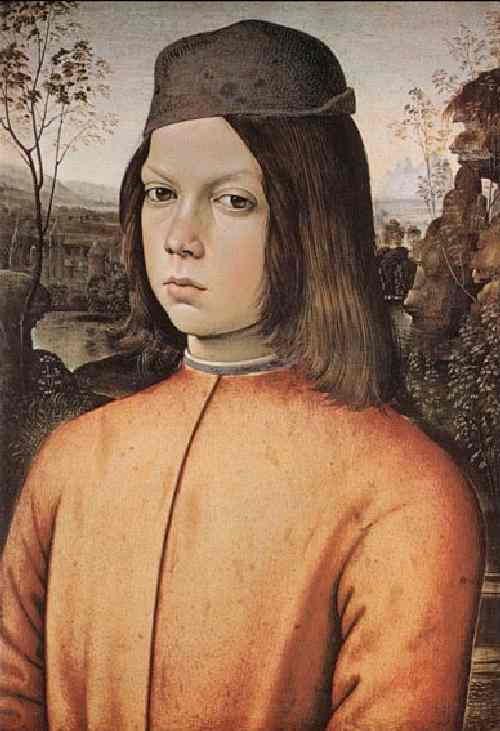
Bernardino de Betti is better known as Pinturicchio. He was born in Perugia in 1454 at the heigth of the Italian Renaissance. He was an assistant to Pergino and assisted with the frescos in the Sistine Chappel. He worked for 8 years (1484-92) on the frescos in chapels of the Santa Maria del Popolo in Rome. He also painted the walls of what is now the Vatican library. For our purposes here, Pinturicchio's work is notable for the Renaissance fashions that appear in many of his paintings.
Czech artist Leopold Pollak was born in Lodenitz (1806). This is a town in what is now the Czech Republic. At the time it was in Bohemia, part of the Austrian Empire which was under fire from Napoleon's French Empire. Leopold's father was a prosperous Jewish merchant. His talent for drawing was noted as a child. He entered the Academy of Fine Arts in Prague (1819). He studied under the Director of the Academy Joseph Bergler for 5 years. He wnt on to study in Vienna under Johann Peter Krafft. His parents helped him move to Rome so he could finish his artististic education (1831). He studied under an established German arist, Leopold Schutz. He quickly joined the circle of German-speaking artists in Rome (1832). This was a natural development as Bohemia at the time was part of the German cultural sphere. It is difficult to define his nationality. He was born in Austrian Bohemia as part of a Jewish family raised in a German cultural meliu, and painted primarily in Italy (the Roman Papal States). Pollak was a founding member of the Deutscher Kunstler Verein (Federation of German artists). Much of his work was thus done in Italy. He was particularly known for charming genre images.
Rffaele Monti (Rafael) is one of the great figures of the Italian Renaissance. He was contemprary with Micaelangelo but his much shorter life span limited his artistic career and body of work. Both stand as towering figures of the High Renaissance. Rafael was not an innovative artist, but he perfected the innovations made by other more creative spirits. Rafael was a master draftsman to which he was able to add keen psychological insight. Much of his work was religious in nature because the Church was the major financer of art at the time. His work does include a number of masterful portraits. Pope Julius II was a particularly important patron. These commissions required Rafael to hire teams of assistants to comoplete. We have not yet found, however, images of children which we can use to learn about contemporary fashions. We notice a children's book about Rafael which is useful because it discusses his childhood.
Giandomenico Tiepolo (1727-1808) was an Italian painter. His father was the well known painter Giambattista Tiepolo (1696-1770). We note a fresco that Giandomenico Tiepolo painted in Villa Valmarana, a mansion in the country of Vicenza, near Venice, in 1757. The fresco shows a peasant family's lunch. They are eating in open air. On the table there is the "polenta", a porridge made with corn flour. The polenta was the main food for the peasantry in northern and central Italy. It can be eaten with meat, fish, cheese, tomato sauce and many other foods. The poor, however, often ate only polenta. A pregnant woman is eating standing, a man seated on the floor and another man seated on a stool. This one has a little child on the left knee. The child don't wear any clothing. Among peasant people it was not infrequent that little children spent the hot summer days naked.
August Anton Tischbein was born in Rostock, MeckIenburg (1805). August Anton was August Albrecht's son. He worked in his father's studio and also bcame an artist. He entered the Berlin Art Academy at age 19 years. He then entered the Dresden Academy (1826). He made his first trip to Rome to study master works (1829). He made another trip to study master works and broaden his horizons, this time to the Netherlands, England, the cities on the Rhine, and Switzerland (1832). He like many of the Tischbeins travelled throughout Italy because of their interest in art. He was, however, the only Tischbein to open a studio in Italy. He lived in Trieste which at the time was part of the Austrian Empire (1838-67). He ended up in Munich to continued his studies. Munich gave him access to the Alps and he made many trips to the Bavarian Mountains, the Tyrol, and northern Italy. He painted many landscape and genre scenes set in the Alps. Thus we see German, Austrian, and Italian scenes. The other Tischbeins mostly painted Gerans and German scenrs. August Abton pained quite a number of Italian dcenes. He traveled to Rome again (1837). He subsequently taveled throughout northern and southern Italy. He finally settled in northern Italy. He married in Venice Venice and settled in Trieste.
Titian (Tiziano Vecelliois) is of course one of the great masters, the greatest painter of the Venetian school. Titian's influence on later artists has been profound: he was supreme in virtualy every aspect of painting and fundamentally changed painting with oils technique with his free and expressive brushwork. He worked on a wide range of subjects, but it his wonderfully expressive portraits that offer important information to HBC. He painted portraits for nearly 60 years provising a wonderful record of 16th century scociety. Nearly 100 portraits are known. They include the most poweful figures of the day. Others indvividuals are unknown.
Ettore Tito was an Italian painter and sculptor. He was born in Castellammare di Stabia (near Naples) (1859). His father was Ubaldo Tito, a sea captain. Naples was Italy's mot important port. His mother, Luigia Novello Tito, was a Venetian. The familky returned to Venice when Ettore was still quite young. His talkent was recognized at an early age. He trained at the Fine Arts Accademy of Venice. He was professor in the same Accademy (1894-1927). Although born in Naples, his work is primarily associated with Venice. It was a city occupied by the Aystrians for many years. He was known for his paintings of contemporary life in and around Venice. He painted in a very realistic style leaving a wonderful record of Italian including fashions. Here we have a painting from 1898. It shows a life scene in Chioggia. This is a realistic depiction of the life in the fishermen town on the Venice Lagoon. Tuto was awarded the Grand Prize in painting at the 1915 Panama-Pacific International Exposition in San Francisco. Somewhat late in his career, he was made a member of the Royal Academy of Italy (1926). Tito died in Venice (1941).
Onofrio Tomaselli was the inspiration for several generations of Sicilian painters. Tomaselli was born in Bagheria (1856). He grew up in Palermo. He completed appretiships under Palermo artists. The Palermo municipal government provided a scholarship to study (1884-86). He was a genre artist painting realistic scenesm, seeking to represent 'truth'. Tomaselli's major influnce was Domenico Morelli, a major figure in Sicilian art. He participatred in the 'forbidden pictorial compositions' at the Institute of Fine Arts of Naples (1886) He then married Emilia Glaudi, daughter of the Marquis of Tagliavia (1887).
Some of the artists influenced by Tomaselli were Alfonso Amorelli and Renato Guttuso, another painter from Bagheria considered Tomaselli's instructiion as the inspiration for the production of 'La Zolfara' (volcanic sufur mine). An observerr writes, "It is the light-filled mountain pass of a Sicilian sulfur mine, the theater of social shame with which the humanists of one day so vainly occupied themselves; where the youngest creatures wear themselves out in a work that consumes mind and body...." Tomaselli painted 'I Carusi' an important 20th century Italian painting. Carusi was the plural for a Roman word for boy, but by the 19th century meant boy mine workers. He presented it at the Universal Exhibition in Milan (1906). He was associated with the Maison de la culture» which addressed issues of the day such as child labir. ,
Giovanni Battista Torriglia was born in Genoa (1858). He studied at Language Academy (1875-1882). He destinguished himself as the winner of the Durazzo grant (1886). He also studied in Florence where he met established artist Nicolo Barabino (1832-1891) who at the time was also focused on religious paintings.
Tottiglia settled in Tuscany (1901). He lkived with a friend and colleague, Tito Lessi (1858-1917). It was at this time that he began to shift from rekigious and hustorical subjects to nostalgic interiors. He became a master at creating images of Italian family life rather like Normnan Rockwell, but with more of a rural and working-class focus. His early mastery of figurative painting enabled him to create wonderful images nostalgic paintings of the italian family. The images of course include many depictions of children. He lived a long life, but most of his images seem set in the 19th century. He is known for the detailed and coloful depiction of the interiors. He also was renounced for turning each fifure in his paintings into individual character. A good example is 'The seesaw' (L'altalena). The scene is set in a fisherman's home.
Hamilton, Adrian. "Past masters of Futurism" (February 28, 2011). he Independent, review of gallery show of Alberto della Ragione's collection of Italian paintings at the Estorick collection, from the 1930s to the 1950s, p. 18 Review section

Navigate the Boys' Historical Clothing artistic pages:
[Return to the Main European artistic page]
[Return to the Main artistic page]
[Chronologies]
[Individuals]
[National]
[Styles]
Navigate the Boys' Historical Clothing Web Site:
[Return to the Main Italian page]
[About Us]
[Introduction]
[Activities]
[Biographies]
[Chronology]
[Clothing styles]
[Countries]
[Girls]
[Theatricals]
[Bibliographies]
[Contributions]
[FAQs]
[Glossaries]
[Images]
[Index]
[Links]
[Registration]
[Tools]
[Main HBC Topic page]
[Boys' Historical Clothing Home]