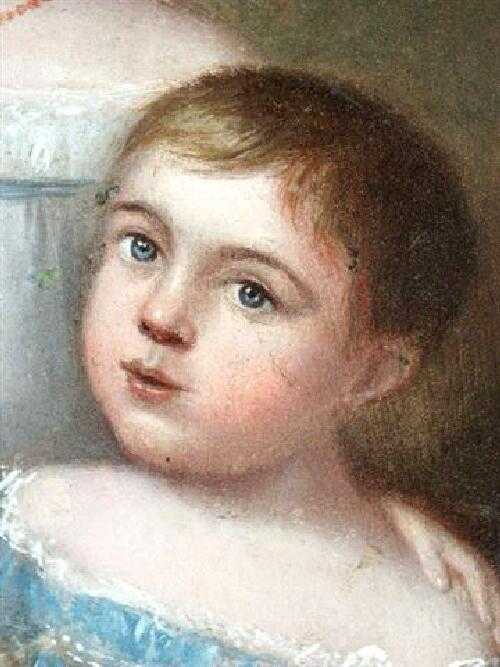
Figure 1.--This is a detail from a unidentified portrait of four brothers anbd sisters, probably in the 1810s. The children all wear regency dresses. We believe two are boys, including the child here. |

|
We have found some paintings which we believe to be English, but of course are not sure. Several offer fascinating depictions of children's clothes. Unfortunaly as the artist is unknown, it is difficult to date the paintings with any precession. Some of them seem to be done by competent artists and we may eventually be avle to identify them. Others are clearly done by less competent artists with little professional training. While not of great interest to the art world, they are very usful to HNC in our fashion assessments as they provide many valuable depictions of fashion before the invention of photography. And even after photogrphy wa invente (1839), they provide color knformation lacking in the blsvk abd white world of 19th century photgography.
Here we have a fascinating portrait of Anne Cliford and her family, including her two brothers. We do not know who the artist was, but a HBC reader has provided a good bit of information about Anne Clifford. The portrait is displayed in Skipton Castle in Yorkshore.
Most of the unidentified artists we have found come from the 19th century. This is no accident. Art in contrast to popular assumptions is in part a function of economic activity. This is a primary reason that much of the world's great art comes from rich, economically successful civilizations. And this was just what was happening in Europe. The Industrial Revloution which began in England (mid-19th century) was generating unprecesented wealth. For the first time in human hostory, not just a few aristocrats (usully land owners) or wealthy merchants, but large numbers of common people could lead comfortable lives. The size of the bourgeois (middle-class) exploded. And the middle class were able to afford modest luxuries. And one of those countries were portaits of themselves and their family. The middle-class could not afford to commission the great artists of the age, but they could afford the more modest fees works by untraimed primitive or naive artists. Most of this we see in the first half of the century because with the advent of photography, portraits could be had at modest cost. Thus in the forst halr of the cntury, art is one of the major fashion sources. We see far fewer painted portraits in the second half of the century, especially porttaits of unidentified artists.
We know very little about this oil portrait. It is unsigned, but almost certainly executed by an English artist. The style of painting almost certainly dates it to the 20th century, probably the early 20th century. The gallery selling the portrait describes it. "Here is a fantastic early 20th century portrait of four rosy children in bust length depicted against a powder blue background. All shiny blond, three with blue eyes and one with penetrating brown eyes (placed "en face" with her round Raphaelian countenance effectively placed smack center in the canvas). The three oldest girls are in matching frocks in pastel variations of the primary colours blue, yellow, red. The youngest is in white lace from head to toe, with a green sash about the waist. Simple elegance and quiet grandeur!"
While the painting was done in the early 20th century, the children are dressed more like the early 19th century, perhaps the 1830s. We are guessing the family decided to have their children painted in historical costumes. The three older children are all painted in dresses. You would guess that they were sisters, but the hair does not seem quite right for girls who would have more likely had center parts.
Here we have a fairly modern English portrait, even so we do not know who the artist was or weho the boy painted was. We believe that it was painted in the 1920s. It is a striking portrait of a red-haired boy about 10 years old. The British would say ginger-colored hair. He wears a turtle-neck light blue sweater. This is a wonderful minature, painted on ivory in watercolor. It was housed in its original silver and paste set frame, the visible size of the image is 1 1/2 x 1 1/4inches. There are no biographical details or signature.

Navigate the Boys' Historical Clothing artistic pages:
[Return to the Main English artist page]
[Return to the Main artistic page]
[Chronologies]
[Individuals]
[National]
[Styles]
Navigate the Boys' Historical Clothing Web Site:
[About Us]
[Introduction]
[Activities]
[Biographies]
[Chronology]
[Clothing styles]
[Countries]
[Girls]
[Theatricals]
[Topics]
[Bibliographies]
[Contributions]
[FAQs]
[Glossaries]
[Images]
[Links]
[Registration]
[Tools]
[Boys' Clothing Home]