|
Adolf Hitler is arguably the most evil individual in modern history. The tendency today is to view Adolf Hitler as both evil and mad. Evil he was, mad he was not. Adolf Hitler was a sewred and resourceful politician who constantly out maneuered his opponents as he rose to power in Germany. After seizing power in Germany he became enormously popular through a combination of dynamic action, charisma, control of the media, and brutal supression of the opposition. He brought many Germans just what he had promissed, jobs, national prestige, and the return of German territory lost in the Versailles Treaty. His success and dynamism also made him greatly admired throughout Europe where many began to question the benefits of democratic government. Had Hitler not launvched World War II he today would be seen as the greatest chancellor of Germany by many Germans. Ironically it was a war that Hitler coveted. He saw war as the greatest of all human endevors and benfeficial for the human species. And it was war that would brring about dissaster for Hitler and the German people who supported him.
He is a good example of how individuals do matter in history. Major economic and social forces may largely frive history, but time and again individuals have arrise that have directed events for good or evil.
Adolf Hitler had peasant roots. Both his parents were raised in poor peasant families. His father was Alois Hitler. He was the illegitimate son of a housemaid. Alois was both intelligent and ambitious and thus despite his humble origins rose to become a minor customs officer. While not a senior official, his accomplishment was impressive given his humble origins. Alois married twice before marrying Klara P�lzl. She was very young, Alois was 23 years older than Klara.
Alois Hitler had two children from his previous two marriages. His elest son was a disappointment. The boy was convicted of theft and sentenced to prison. With Klara there were five children but only Adolf and his younger sister, Paula, survived to adulthood. Paula was apparently border-line retarded. Hitler was ashamed of her. This as he became an important Germazn politican, he had her live in obscurity as Paula Wolf. Wolf had been a childhood nickname of Hitler. The German people never learned that she existed. Eva Braun only met her once. Despite being ostracized by Hitler, she retained an affection for him. She never married.
Adolf was born in Braunau, a small Austrian town near the Germnan border (1889). At the time Branau was located in the Austrian part of the Austro-Hungarian Empire. Alois was 51 years old when Adolf was born. He was intent that his younger son do well to retrive the family honor. Alois was very strict and beat his children, especially the boys, if they did not do as instructed. Biographers have described the beatings as savage.
At the same time, he was pampered by his mother who he revered.
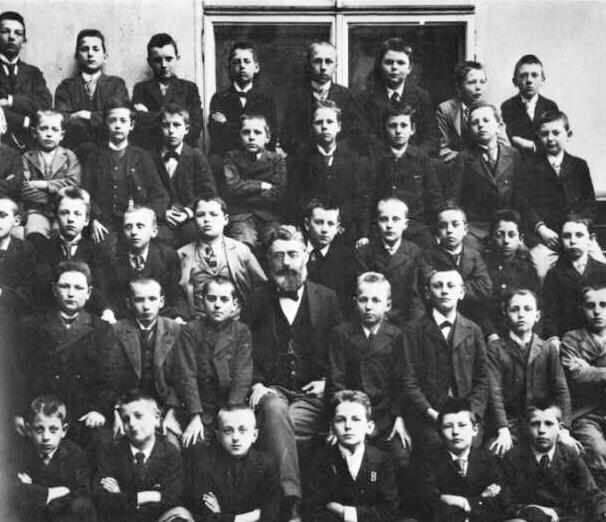
Adolf was a bright boy and at first did very well at school. He was at the top of his primary classes. He gave every indication while at primary school of having a bright future. His father was not rich, but he made a comfortable living and could afford to send him to secondary school after completing his secondary education. He was also popular with the iother boys at school and demonstrated leadership qualities. And as a result of his home upbringing was also a religious Catholic. He even considered for a while becoming a monk. He spent 5 years in primary school and apparently did well enough to enter the Linzer Realschule. Unfortunately for Adolf, secondary school did not go as he and his parents expected. As here the program was more academically demanding than primary school, even clever boys had to study to do well. The curriculum was more demanding. Adolf had the ability, but academic success was required more effort and hard work to compete with boys who were just as bright if not brighter. Adolf found the new situation difficult to accept. He was not preoared to work hard and was frustrated at not being at the top of the class. He apparently just stopped making any effort with his studies. His father was had higj hopes for his younger son was incensed at the turn of events. He had hoped that Adolf would follow his example and enter the civil service. Hitler despite his father's tirades, simply would not lisren. He stubbornly resisted efforts by his parents and teacghers to consul him. He simply would not take his studies seriously. He also found that he was not as popular with the other boys as he had been in primary school. Hitler found that he enjoyed ordering other boys about. As this was no longer p[ossible with boys in his class, he began plsying mostly with younger boys. He most enjoyed playing war. At the time, the Bier War had broken out in South Africa (1899). His favorire gamne was reportedly recreating Boer War battles. Amazingly, he liked playing a Boer commando rescuing women and children from British concentration camps. Adolf not only hated school, but he disliked his teachers as well. There was one teacher he did like--Leopold Potsch. Potsch was his history teacher and a fervent German nationalist. This was not uncommon in Upper Austria. Potsch recounted stories in his history class of thrilling German victories in the Franco-Prussian War (1870-71). He criticized his own country for not joining Germany in the war. Otto von Bismarck, the Iron Chsncellor, emnerged as the young Adolf's important historical heroes. Adolf failed his first year of Realschule and had to repeat it. Here we see him at the end of his second attempt to pass the first year class in June 1901 (figure 1). Even in the second year he did not do well. He spent 4 years at the Linzer Realschule. When Adolf told his father that he wanted to study art. Alois was furious.
Next Adolf began to study art in Munich. At the time it was fairly easy for Germans to move within the German-speaking world (Germany, Austria-Hungary, and Switzerland).
Hitler's mother died when he was 18 years ols, leaving him alone. He moved to Vienna (1907) hoping to study art. He appears not to have had a realistic appreciation of his artistic talents and assumed he would be ad =mitted to study at Vienna's pretigious Academy of Art. He failed the admissions exam to the Academy in Vienna and he was cast adrift. He lived in great poverty. He spent about 6 years in Vienna. He attempted to survive by selling paintings. His work is notable for the absence of peole or in other works poorly drawn figures. Some authors speculate that it was in Vienna at this time that he appears to have acquired a deep-seated anti-Semitism in reaction to his failure and poverty and Vienna's large prosperous Jewish population. Other authors believe that his hatred of the Jews was not acquired until after Worlkd war I. One author points out that the rejected, penyless artist would call in a Jewish shop for a free cup of tea on rainy days, An elderly Jewish couple wrote to the Chancelloe after their Vienna shop was seized by the NAZIs. They appealed to the F�hrer, reminding him of their shop on the Siebensterngasse. Hitler apparently saw the letter and ignored their plea. [Hamann]
Finally he seems to have given up on his dream to be an artist. Hunger and the need for shelter may have been the motivating factors. Austria like other European countries had conscription laws. Hitler apparently did not want to serve. Thus to avoid military service, he moved to Munich (May 1913). He received a small anount of money from a dyinhg aunt. The Austrian authorities apparently tracked him down. The Munich police pounded on his door and delivered his Austruian dradt notice (January 1914).
The draft notice explained that he could seerve a year in prison and a fine if he was found guilty of leaving Austria to evade military service. The Munich police escorted him to the Austrian Consulate. He returnedc to Austria and eported to Salzburg for duty (February 1914). He failed the medical examination which before the War was more than prerfuntory. As a boy his report cards described his performance in PE as excellebnt, Apoparently his rough existence in Vienna and lack of food had affected his health, The medical report found that he was too weak to carry weapons. He decided to return to Munich. A photograph shows a crowd in Munich's main square reacting to the deckaration of war (August 1914). Hitler can be found in the crowd, overcome with emotion. He then joins the Bavarian Army and somehow passes the physical.
Hitler with the outbreak of World War I immediately enlisted in the Bavarain Army (1914). Thus while born in Austria, he wouund up serving with the German Army. The Bavarian Army was a kind of national guard reflecting the German Empire's still federal structure. He served on the Western Front. He advanced to the rank of corporal and was awarded two iron crosses. His primary assignmrent in the days before radio was to serve as a runner. Informnatin about his military service is sketchy. The principal available source is Hitler's own description in Mein Kmmpf. He paints a picture of valiantly carrying messages through enemy fire. He was in a military hospital at Pasewalk near Berlin, temporarily blinded from a gas attack when he learned of the Armistice. He wept at the news. This of course is hardly an unbiased source. Yet many historians, perhaps anxious to move on to his rise to power have accepted it uncritically. Yet it leaves unanswered questions. Why if he was such a decorated war hero did he not rise above the rank of corporol after 4 years of service? Men with leadership qualities did rise from the ranks, but Hitler never did. And however you view him, he certainly had leadership capabilities. And why were his war comrads not among those who flocked to his leadership of the NAZI Party. And why did they nor write books and articles about serving with him. Why gicven the often-described comradeship of the trenches were some of these men among his suppoters? We now know the answer to some of these questions. He did indeed receive two iron crosses, but his runner assignments were not dangerous ones and he lived in regimental headquarters behind the front lines. Many headquarters staffers got such awards as long as they did what they were told. The first one was ironically awarded by a Jewish commabnder. Front line soldiers referred to rear echelon men like Cpl. Hitler as Etappenschweine--rear pigs. Hitler apparently in the early years as he was buiklding the NAZI Party found little support from his old comrads. Apparently they did not like him. [Weber, First] He appears to have gone on and on about the glories of serving in the trenches--even though he lived safely behinf the lines. He never condemned the War like tge men who actually fought at the front.
He was not adept socially and did socialize with his comrades. And many of the nen who actually served at the front were not enthusiastic about another war. Even so, Hitler, appears to have found fulfilment in the War. Although he was only promoted to corporal, it was the first time he found any success in life.
Hitler describes in Mein Kampf that his tears soon turned to a desire for revenge against academics, Jews, and leftists who were responsible for Germany's defeat. He remained in the Army as was sent to Bavaria to supress the Communist uprising. Hitler does not mention that he had his own fling with the left. He wore a red bassard and supported the Bavarian uprising. [Weber, One issue about Hitler is when he necame radiclized. He was know in his army dys for pratteling on about poltivall issues, but is only after the War does he begin to adopt really radical views on the Jews snd geo-poliitics. A great deal has been written about this. Some date his htred toward the Jews to his family and early life experidncdesd kin Vienna. But anti-Semitism was common in Austria and Germany, not the genocidal anti-Semitism of the NAZIs, but the polite anti-Semitism common in Europe and America. There is no evidence that Hitler varied from this until after the War. What seems to have hit Hitler like many Germans was the Versailles Peace Treaty (July 1919). Actually they were not adverse to the conditions in the Versailles Treaty, only they did not want them applied to their country. The Armistice was harsh, but most Germans welcomed an end to War and expected a much softer, negotiated peace treaty that the Versailles Treaty that the Allies imposed on then without any negotiation. It needs to be said that Versailles was not as harsh as the peace treatiers the Germans imposed on countries they defeated. or countries they occupied (Belgium, Montenegro, northern France, and Serbia). But the German Military kept the scale of reverses on the Western Frint from the population. Thus there was not the sence that Germany had been decisely defeated. The Grmany public thus expercted a soft, negotiated peace based on President Wilson's Fourteen Points. In additioin the Germans did not believe that they had started the war or committed war crimes in occpoied countries or that there was any thing wrong with unconditional submarine warfare, bombing civilians, or using poison gas. And they were eitherr unaware ir did nor care about the massive danmage they had caused in other countries. So the Versailles Treaty came as a severe shock. And this seems to have been the primary step in radicalizing Hitler. [Weber, 'Becoming'] At ther time he was injured by poisoin gas it looked like Germany had won the War. Then suddenly when he recovered the War was over. He had no sence that Gerrmany had been defeated. He seems to have really believed the stab-in-the back myth.
The tendency today is to view Adolf Hitler as both evil and mad. Evil he was, mad he was not. Adolf Hitler was a sewred and resourceful politician who constantly out maneuered his opponents as he rose to power in Germany. The National Socialist German Worker's Party (NAZIs) became the most powerful of all Fascist parties. It was not founded by Hitler, but became dominated by him at an early point. He fashioned it an instrument for a personal totalitarian dictatorship. Mussolini and his Fascists seized power in Italy a decade before the NAZIs seized power and stronly influenced Hitler. After the NAZIs seized power they soon elclipsed Mussolini's Fascists. One of the central questions of the 20th century is how an esentially criminal gang took over the government of a great nation. There are of course many factors involved. Perhaps the central one is the power of natioanalism, a still powerful force today, although waning in much of Europe. Here was Hitler's great skill as a politican. The vast majority of the German people did not endorse the plan he spelling out in Mein Kampf with almost startling frankness. Most Germans did, however, believe and some with great fervor that Germany was an agreved nation that was being trampeled by its enemies. And most wanted the territorial and populatioin losses of the Versailles Treaty reversed as well as other restrictions of the Treaty. Hitler by concentrating on these popular issues was able to attract adherents and voters that never would have endorsed his real program. His success was made possible because the Weimar Republic allienated the right and military because of Versailles and the middle-class because of the disastrous inflation. The Depression was a claminity because it alienated many working-class people from democracy and the Weimar Republic. The central factor, however, has to be Hitler's skillful political manipulation of and handling of the issues, especially nationalist fervor.
Adolf Hitler after his conviction for treason as a result of the Munich Beer Hall putch wrote Mein Kampf while confined in Landsburg Prison. He dictated orally which Rudoolf Hess, his secretary, wrote down. This probably contributed to the rambling text. Mein Kampf is a long and rambling book which as a result, the content aside, mskes for difficult reading. Hitler as an avid consumer of crack pot ideas, many of which are exhibited in the book. The essential thesis, however, is very simple. To Hitler the core of the German people is the farmer. The first step in the revival of Germany was the destruction of the Jews who he saw as weakening the Aryan German people. Once the Jews were eliminated, Germany could develop the strength to seize the land needed by the German farmer in the East from the Slavs (Czechs, Poles, and Soviets). The German soldier would then seize the land from the Slavs who would be expelled or enslaved. The land would then be colonized by German farmers. Germany's policies in the Occupied East followed just this perscription. The anti-Semetic aspect of Mein Kampf is often mentioned in connectin with the Holocaust. Less commonly discussed is the Hollocaust for the Slavs which the NAZIs would have persued if they had won the War.
The NAZI's after the July 1932 election were the largest German political party, but did not have a majority in the Reichstag. Hidenburg dismissed Br�ning and the result was political instability in the Reichstag. President Hindenburg refused to appoint Hitler Chancellor and instead turned to Papen. The political situatation remained unstable. The newly elected Reichstag in September voted no confidence in the Papen government. The November 1932 Reichstag election results were: NAZI Party 196 seats, Social Democrats 121 seats, The Communist Party 100 seats, and the Centre Party 70 seats. The NAZIs lost a few seats, but continued to be the largest party in the Reichstag. Hitler continued to demand to be appointed Chancellor, Hindenburg refused saying that he said he did not trust Hitler to rule democratically. Hindenburg preferred Papen, but the Army objected. Hindenburg turned to General Kurt von Schleicher who lasted 57 days. Finally Hidenberg, running out of options, turned to Hitler whom he appointed January 30, 1933. Hidenberg attempted to control Hitler by placing Papen as vice-chancellor and surrounding Hitler with moderate ministers who supported Papen. Hitler by carefully selecting his cabinent posts was within days gaining control. To be sure of success, however, he needed a mahority in the Reichstag. He insisted on a new election. In the middle of the elections the Reichstag went up in flames on Februarry 27, 1933. A Dutch Communist was blamed. Historins still debate who was responsible. Many blamed the NAZIs, but it appears that neither they or the Communist Party was responsible. Hitler took full advantage of the situation and claimed that the fire was a Communist plot, and persuaded Hindenburg to sign an emergency Law for the Protection of the People and State. The law suspended people's rights and allowed the Nazis to arrest many Communists and others. This was the key legal document allowing Hitler and the NAZIs to seize power. Historians use different terms to describe the NAZI victory. Some suggest that Hitler was elected. In fact the NAZIs never gained a majority in as German election, even the tainted 1933 election. The description of seizing power seems more correct.
After seizing power in Germany he became enormously popular through a combination of dynamic action, charisma, control of the media, and brutal supression of the opposition. He brought many Germans just what he had promissed, jobs, national prestige, and the return of German territory lost in the Versailles Treaty. His success and dynamism also made him greatly admired throughout Europe where many began to question the benefits of democratic government. Had Hitler not launvched World War II he today would be seen as the greatest chancellor of Germany by many Germans. Hitler today is often seen as a right-wing conservative. He was in fact a revolutionary planning to carry out a thorough going social revolution in Germany. He was an egalitarian populist. He proceeded to construct a national community based on race and ethnicity. In many respects he succeeded in tearing down social barriers in Germany. Under Hitler humble working-class Germans through ability and loyalty could rise spectacularly in German society. NAZI propaganda trumpeted projectrs like the Volswagen (People's Car), designed to provide a car for the average worker. Military spending and the War made that imposdsible.
An even more difficult question to answer is what the Germans saw in Hitler. Americans and Brits lestening to Hitler's speeches are repelled and have a difficult time understanding how the this frenzied politican could have moved a great nation. We can understand how some of the nationalist issues resonated (war guilt, loss of territory, Germans left in foreign countries, military restrictions, and repriations). What is more difficult to understand is why Hitler captured the hearts of so many Germans. There is no doubt that he did. It might be argued that a totalitarian state can use its control of the media to turn anyone into a national hero. Perhaps, but we suspect tht more ws involvedc here and that somehow something about Hitler Hitler tapped into the yearings of the German people. This is probably a question that only the Germans themselves can answer. One German author who has made an important effort to address this question is Sebastian Haffner. Haffner grew up in Germany during the inter-war era. He fled Germany in 1938 when he was 27. He decribed his efforts to resist the NAZIS as "... a duel between two very unqual adversaries: an exceedingly powerful, formidable, and ruthless state and an insignificant unknown private individual". Haffner is not easy on the Germans. He tells us, "At the momnt of truth when other nations rose spontaneously to the occasion, the Germans collectively and limply collapsed". [Haffner] And the Germans continue to follow Hitler even after the country physically collapsed around them. Even though the War was lost by 1943, the Germans continued to support Hitler and the NAZIs. There was no national uprising. Almost earily, Germany began to change only after Hitler's death in Berlin was reoorted. It was almost as if magically his grasp on Germany was released.
Hitler met Eva Braun while she was working for his persona; photographer--Heinrich Hoffman (1929). Hoffman played an important role in creating an appealing image that could be sold to the German people. She was 17 years old and he was more than twice her age. The NAZI Party had at the time just become a major force in German politic. She is today well known to history. During the 12 years of the Third Reich, she was unknown to the German people. Only Hitler's inner circle knew about the relationship. Some authors believe Hitler did not want her to become public knowledge because he wanted to be seen as married to the German people. This may be an important factor. Another factor may also be involved and that was Hitler's dark hair and brown eyes. It is likely that Hitler did not want to foster children because they would likely not be the Aryan ideal of blond and blue eyes. Unlike the wives of many world leaders, Eva stayed strictly out of politics. That was just how Hitler wanted it. She was perhaps vacuous, but not stupid. She knew that this was what Hitler wanted in a woman. She was very interested in photography. She dreamed of becoming a major Hollywood movie maker. It is Eva's home movies, many taken at Berchtesgaden, that provide us glimses of the private life of Hitler. She saw herself as making an important record/ These were home movies without any sound. Interestingly new technologies developed in 2006 now allow us to hear what was being said in these movies. Of course in viewing her movies, the question arises as to how she could be so close to such an evil man. She herself, was not an evil oman. In factshe was well liked by those around herm but genberally dismissed by the NAZI bigwigs. This leads to the question of how much she knew--the same question that is still debated about the Germn people in general. This is not known with any certinty, but there are certain known matters that suggest she knew a great deal--certinly the charcter of the regime. And there is good reason to believe she knew far more thab the average German.
British Prime Minister Nevill Chamberlain was a Conservative, but with a liberal outlook. He was determined to conduct foreign policy personally. He was a decent man told Parliament that he would deal with Hitler on the basis of their "common hmanity". It did notv occur to Chamberlain that the leader of a great nation like Germany could actually covet war. Hitler for his part understood Chamberlain all too well. He knew he would consent to almost everything to avoid war. At the time Hitler was popular. The German people thought he had brought them out of the Depression. There were two events, however, that tied the German heart and soul to Hitler. The first was the Munich Conference (September 1938). Here Hitler delivered the Sudetenland without what the Germn people feared most--war. Of course war was precisely what Hitler wanted. After having the Sudetenland handed to him on a platter by Chamberlain, Munich was actually a disappointmebt for him. For a time he thought that he had been cheated of his war and his chance for greatness s a great war leader. The second schievenment would come 2 years later. Hitler delivered France, the great prize that Laiser Wilhelm failed to deliver. And Hitler dlivered it at very limited cost.
Adolf Hitler is one of the most photographed men of the 20th century. His personal photographer, Heinrich Hoffmann had virtually unlimited access. Amd there are countless images of him with children. This includes not only children greeting him on his travels around Germany as well as more intimate encounters at the Berghof. This of course made for good propaganda in the German media, but he seems to have genuinely enjoyed contact with young children. The NAZI bigwigs brought their kids to the Berhof when socializing with Hitler. And Hitler encouragd the visits. The Goebbels children were frequent visitors. He seems to have genuinely enjoyed their company. They seem to have helped him relax. He did not have to be careful as to what he said around them. Perhaps readers will have some idea as to the psychological processes at play. Apparently the innosence of childhood even appeals to evil among us. We don't see Hitler actually playing with them, at least in Hoffman's photographs. The children, of course instructed to be on their best behavior, seem to have been presented to Hitler and then allowed to play on their own. Hitler made it very clear as to how German children should be raised. Once in power he wrote, "My program for educating youth is hard. Weakness must be hammered away. In my castles of the Teutonic Order, a new youth will grow up, before which the world will tremble. I want a brutal, domineering, fearless and cruel youth. Youth must be all that. It must bear pain. There must be nothing weak and gentle about it. The free, splendid beast of prey must once again flash from its eyes. That is how I will eradicate thousands of years of human domestication. That is how I will create the New Order."
Adolf Hitler is one of the most photographed men of the 20th century. His personal photographer, Heinrich Hoffmann had virtually unlimited access. Amd there are countless images of him with children. This includes not only children greeting him on his travels around Germany as well arranged encounters with Hitler Youth groups. Thee were especially intimate encounters with youngr children at the Berghof. This of course made for good propaganda in the German media, but he seems to have genuinely enjoyed contact with young children.
The NAZI bigwigs brought their kids to the Berhof when socializing with Hitler. And Hitler encouragd the visits. The Goebbels children were frequent visitors. He seems to have genuinely enjoyed their company. They seem to have helped him relax. He did not have to be careful as to what he said around them. Perhaps readers will have some idea as to the psychological processes at play. Apparently the innosence of childhood even appeals to evil among us. We don't see Hitler actually playing with them, at least in Hoffman's photographs. The children, of course instructed to be on their best behavior, seem to have been presented to Hitler and then allowed to play on their own. Those that remember the experience seem to have found memories of their Uncle Wolf. We suspect that it was more of a nice place to play and they probably got treats. Eva Braun was apparently kind to the children. I don't see them playing with Blondie. We note one Holocaust denier referring to the photogrphs as evidence that Hitler was not the evil mpnster depicted. But this was not unusual, many NAZIs has tender relations with their children, including those directly involved with the Holocaust. It seems to us incomprnensible, but was quite common. Most of these intimate images are with younger children.
Hitler and his Propaganda Minister, Joseph Goebbels, sought to create an environment in which Hitler would be virtually worshipped. As far as we can tell, they were largely successful. The images of children greeting the F�hrer a countless events are starrk and horrifying testamony to their success. We see the same kind of fervor that we see with rock stars. We see nothing like this with any othe national leader. The emotions reflected on their face are nothing short of terrifying. And in the final months of the War, it was poorly-armed German boys, including pre-teens who were some of the most devout fighters as the Soviets and Allies drove into the Reich. Nothing could not forcefully demonstrate the vitually religious devotion of young people to Hitler.
One has to ask, why are their so many photographs of Hitler with children. No other orld leader we know of was so often photographed with children. We think this is an accurate reflectio of Hitler's public and private life and not a manufactured propaganda illusion. Perhaps the release of these images was done for propaganda purses, but not the time tht Hitler devoted to encounters with chilktren. His peronal photographer Hintich Hoffman simply captures ht was occurring. As far as historians know, Adolf Hitler did not have any children of his own or even sexual relations with women. Throughout his life, he did not have close relationships with women. Even his relationship with Eva Braun does notvsem to have been a normal reltionship. She appears to have loved him. He mist hsve been fond of her, must he never seems to have expressed or demontrated love. All that must have affected his attitude toward children, but we are not sure just how.
Hitler made it very clear as to how German children should be raised. Once in power he wrote, "My program for educating youth is hard � weakness must be hammered away. In my castles of the Teutonic Order, a new youth will grow up, before which the world will tremble. I want a brutal, domineering, fearless and cruel youth. Youth must be all that. It must bear pain. There must be nothing weak and gentle about it. The free, splendid beast of prey must once again flash from its eyes�That is how I will eradicate thousands of years of human domestication�That is how I will create the New Order."
It is difficult to identify an individual who so influenced the course of the 20th century. Thus a single assasination could have had a major impact on the course of history. There was no shortage of people who wished they could kill Hitler. But only a few actually tried it. Despite elaborte protection measures by the SS, there were several attemots, some of which were no detected. This included both individual lone-wolf assasins and a vast Wehemacht conspiracy. An ordinary German citizen, Georg Elser, working by himself came very close to killing Hitler. Ortner was a carpenter working in a watch shop. He worjked in the Munich Beer Hall where he secretly assembled his home-made bomb. He hid it in a hollowed-out space close to the speaker's platform. It denonated, kolling eight people, but not Hitler (1939). [Ortner] The best known assination attempt was the Wehrmacht Valkyrie conspiracy ending in the July Bomp Plot (1944). In the end, the ehrmacht's sense of hinor condemned the German people who they were resonsible for protecting go a cruel fate. The real loser was the German people. Nearly a million Germans would die in 1945. More were wounded or raped. And many who sonehow survived had their homes and work places destroyed. To form the Honor Court trying the conspirators. Hitler appointed Field Marshal Gerd Von Rundstedt--a Prussian aristocrat who despised Hitler personally. After Valkyrie, securiy measures were tightened to the point that assasinatio was no longer possible.
Adolf Hitler is often described as mad because so many mostly liberl people can not conceive of such depravty possible in a sane man. Any study of history, however, shows that evil eists in the world, even in our advanced modern age. Hitler was very much sane and in control of his sence, at least in the early phases of the War. Hitler was evil, but very much sane. Germany had importnt strengths, but also major eaknesses. The overal strtegic ballance meant that Germany was not prepared for another major European war, even after a massive rermament program. The country had serious weaknesses, lone reason we believe that Primemnister Chamberlain believed he could reson with Hitler. Hitler understood Germany's weaknessess, he thus adopted a strategic vission aimed at taking full advantage of Germany's strengths and covering its weaknessess. There were several carefully calulated policies. First, Hitler pursued a moderate foreign policy while he ruhed forward a massie rearmament program. Second, he moved forward with small desrete steps, beginning un the Rhineland (1935). He calculated that none of these steps would be sufficent to cause the Allies, deperate to avoid another war, to react in force. Third, he cloked his initial moves in the desire to unite Germans within the Reich. There were no demads for trritory inhabted by non-Germans. He notably assured Chamberlain, "I want no Czechs." Fourth, he offered the Allies their greatest desire--peace. All they needed to do was grant Germany, its 'legitimate' goals. Fifth, he pursued one target at a time (Austria, the Sudetenland, Czechslovakia, and Poland. He believed that the Allies would not react for any one of his targets. Sixth, he diided his potenial enemies. He divided Austria and Czechoslvakia from the Allies. His biggest coup of course was dividing the Soviet Union from the Allies with the NAZI-Soviet Non-Aggression Pact. The Soviet Union was his ultimate goal, but the Non-Aggression Pact allowed him to defeat Poland and the Allies before tuning East. Sixth, he attempted to avoid conflict with the United States. Central to his strategic vision was to conquer Europe before cnfronting either America or the Soviet Union. This was difficult because of President Roosevelt's relentless attacks, but he had powerful allies with the Isolationists. Seventh, his divide and conquer tactics set up the Wehrmact to gain one victory after another in short campigns. This played to Germany's strenghs and avoided a war of attrition like World war I. Eigth, having defeated the French Army, he launched Barbarossa to destroy the Soviet Union. He calculted correctly that with the resources of the East, Germany's mastery of the Continent was unasilable. He miscalculated the Whermacht's ability to destroy the Red Army in a bref summer campaign. This strategic vision almost succedded. Ironically it was a war that Hitler coveted. His domestic successes had made him a towering figure in Germany. But it was a great war commanderv that he saw as his destiny. Hitler saw war as the greatest of all human endevors and benfeficial for the human species. And it was war that would bring about dissaster for Hitler and the German people who supported him. There was in Europe only one important political leader who desired a war--Adolf Hitler. Hhe saw war as an exhaulting human expeience. Even before he seized power in 1933 he began to see a war as the only way of creating a new European order. The only question in his mind was when and how to launch the war for maximum strategic advantage.
Hitler in the first year of the War proved remarakably astute. In fact he was lauded by the NAZI press as the greatest German of all time. Something appears to have changed with the great success in France (May-June 1940). And almost immediately failures begin. He failed to destroy the British Army at Dunkirk and the British to seek terms. Even so Hitler's personal assessment of himself was unchanged. Hitler not only saw himself as a visionary strategic war planner, but as a great tactical commannder and as the War progressed played an increasingly important role in Wehrmacht operations. Historians debate Hitler's effectiness as a war leader. Here his basic strategic concept was to divide his enemies and defeat them one by one which was the same tactic used in domestic politics. Here his on failure was the failure to defeat the British and then going on with the Soviet invasion with the British still undefeated in the rear. His grasp of the political situation proved more insightful than that of the military and was responsible for the startling success of the Germans early in the War. His actions in the Rhineland, Austria, and Czechesolvakia were all at first opposed by elements of the Germany military. He played key roles in the campaigns aginst Poland, Norway amd in the West against France and he was proven correct against more timid military commanders. Jodl based on these campaigns called him "a great military leader" even after the War. [Schramm, p. 1721.] After the early military victories, his value as a military leader declined even has he played an increasing important role in German planning. The one exception was his insistance on holding in the Winter of 1941-42 before Moscow. In general, however, after the success in France, his decisions were almost always wrong.
These include a long litiany: a switch of tacics in the Battle of Britain to bomb London, the invasion of the Soviet Union (this is debateable), the division of the army in the Soviet Union in both 1941 and 42, the decalration of war on the United States, the failure to allow Von Paulis to break out at Stalingrad, the use of reserves to bolster the Afrika Corps after Allemain and Torch, the failure to attack the Normandy bridgehead in force, the attack in France leading tp the Falaise pocket, various unsuccessful stands in the East, the deployment of SS Panzer divisions to defend Budapest leaving Berlin essentially undefended, and fianlly the decession to fight on the west side of the Rhine. Jodl does agree that Hitler did when the tide turn against Germany interfere in operational matters which disrupted the military, some times disastrously. [Schramm, p. 1721.] Hitler also had a major role in German armaments. Here he had some successes such as the selection of the anti-tank gun used in Soviet campaign. [Picker, p. 96.] He made, however many huge mistakes. He delayed theGerman jet program and then insisted that the Me-262 be used as a bomber. Huge resources were devoted to the V-1 and V-2 programs which had little real impact on the War. He cobstantly went for massive projects like the Bismarck or tiger tank when more numerous smaller systems would have been more effective. Here Hitler appears to have over-emphasized the psychological impact of weapons. It was his idea to install sireens on Stuka dive bombers and he ordered several terror bombing raids. He also greatly over em[hasized the power of the will--especially in Russia. He consistently demanded more of the German troops there than was physically possible. [Hadler, p. 489.]
The United States Office of Strategic Services (OSS) in 1943 hired a Harvard professor (Dr. Walter Charles Langer) to prepare a psychological profile of Adolf Hitler. Langer was a Freudian who analyzed Hitler's childhood and discovered that he had had an abusive father and a doting mother. Langer's conclusion about Hitler's personality was that he was psychically injured in childhood because of his Oedipal relations to his parents. As he grew up he developed a Messianic self-concept with a very strong and driving will to
compensate for his inner weakness with suggestions of sexual perversion deeply buried in his personality. Langer learned that Hitler's relations with the woman he eventually married, Eva Braun, were totally
asexual. And he predicted with uncanny accuracy that when Hitler's facade of Messianic strength finally collapsed and defeat was obvious and inevitable, he would commit suicide. [Langer]
Eva Braun was not the only figure commonly seen at Berchtesgaden at Hitler's side. The other was Blondie--Hitler's German shepard. I believe Blondie traveled with Hitler, some thing Eva Braun did not do. It was at Berchtesgaden and in Eva Braun's films that we see most commonly see Blondie. By all accounts, Blondie was well trained to respond to Hitler's demands. Hitler by all accounts was devoted to the dog. But note Blondie's body language. The dog appears to be cowering in many photographs. Its ears are commonly down, not sitting up like should be thecase. And it is often hunched down with its tail almost between its legs. We have no idea how Blondie was trained, but its body language seems that of a a broken, sunmissive dog, not a healthy German shepard. We would be very interested in anyinformation that readers who have worked with Shepards have to say about this. Hitler at his Berlin bunker used Blondie to test out the effectiveness ogf his cyinide pills.
one wonders if Hitler really believed all that he said about the Jews. Hitler did not create abti-Semitism in Germany, but it provedcpolitically expedient in his rise to power. Of course after seizing power he used the instrument of state to instituionalize anti-Semitism as anational policy and to teach it to young people. One can help but conclude that Hitler's anti-Semitism was deeply held conviction and not like some NAZIS an expedient. Even in his Berlin Bunker he was still railing bout the Jews. No one reading Mein Kampf has any doubt where Hitler and the NAZIs were headed. Most people, however, did not take Hitler seriously. There are no documents linking itler directly to the Holocaust. Those cloest to Hitler that would have been given oral orders (Himmler, Heydrich, and Boreman) did not survive the War. G�ring did survive, but denied any reposnsibility. All respected historians concur that Hitler gave the orders that set the Hilocaust in motion. Only the professional Holocaust denyers dispute this.
Hitler's bomb-proof bunker was built under the Chancellry. Hitler's advisers pleaded with him to leave the Berlin and continue the War from an Alpine redoubt. He refused and decided to stay where he was still in control of the situation. He fantasized over a map table about armies long since destroyed. The ones that still existed were ignoring his orders. When President Roosevelt died (April 12), Goebbels fueled the fantasy that the British and Americans wold make a separate peace. The last photographs of Hitler (newsreel footage) was taken on the occasion of hif his 56th birthday (April 20). That morning he played with Bolndie (his German Shapard). He took his cocaine eyedrops. Then he climbed the steps into the Reich Chancellery courtyard. There he received the NAZI salute from representatives of the cutoff Courland Army, the SS-Division "Berlin", and 20 HJ boys who had erarned the Iron Cross. Hitler muttered a few words to them and patted a few of the younger boys on the cheek. He then disappeared back into the nunker leaving the boys to face Russian tanks. There in the bunker Martina Goebels played solitare after killing her children. He ordered Eva Braun's brother shot for trying to escape. When picked up by the SS, he had a pocket full of jewells. Italian partisans shot Mussolini and his mistress Clara Petacci and string up their bodies (April 28). Hitler was determined that he not be caught on the run like Mussolini. Hitler finally married his long-time mistress Eva Braun (April 29). On the same day he dictated his last will and testimony to his private secretary, Martin Bormann. He expelled G�ring and Himmler from the Party for disloyalty. And he designated Admiral Karl Doenitz as his replacement. (Doenutz was not informed until the next day after Hitler was dead.) The next day with the Soviet sildiers in the nearby Reichstag, Hitler set about commiting suiside (April 30). After testing the cyninide pills on his dog Blondie, he and Braun took cyninide and he shot himself. Martin Borman and the remaining NAZIs gave a farewell salute as the bodies were burned. [Fest] That pitiful scene was a far cry from what Hitler wanted. He had told his associates, "We may go down, but we will take the world down with us."
Adolf Hitler is arguably the most evil individual in modern history. Many have debated this question, suggesting other individuals such as Stalin and Mao. One way of assessing the evil of these individuals is to tally the body count left in their wake. By this accountging both Stalin and Mao would rank higher than Hitler. The thing to bear in mind it that Hitler's killing was cut short by the Allied victory in Wotld War II. While he is popularly remembered as an ant-Semite, the Jews were just one of the people he targeted. The next prominant group were the Slavs. Had the NAZIs won the War the Hollocaust of the Jews would have seemed a minor event compared to what Hitler had in mind for the Slavs.
Langer, Walter. The Mind of Adolf Hitler (Basic Books: New York, 1972). This was the secret wartime report prepared for the OSS.
Hadler, Generaloberst. Kriegstagebuch ed. Hans-Adolf Jacobsen, 3 vol (Stuttgart, 1962).
Hamann, Brigitte. Hitler's Vienna (1999).
Ortner, Helmut. Ross Nenjamin, trans. The Lone Assasin: The Epic Story of the Man Who Almost Killed Hitler (2012), 192p.
Picker, Henry, ed. Percy Ernst Schram Hitlers Tischgespräche im Führerhauptquartier, 1941-42 (Stuttgart, 1963).
Schramm, Percy Ernst., ed. Kriegstagebuch des OKW iv: 1944-45 (Frankfurt-on Main, 1961), pt. 2.
Weber, Thomas. Becoming Hitler: The Making of a NAZI (Basic Books: 2017).
Weber, Thomas. Hitler's First War (Oxford University Press: 2010), 450p.
Wistrich, Robert. Who's Who in Nazi Germany (Macmillan Publ., New York, 1982).
Navigate the CIH World War II Section:
Radicalization
NAZI Party
Many ultra nationalist parties were founded in Germany in the aftermath of World War I. The National Socialist German Worker's Party (NAZIs) was one of those parties. The NAZIs became, however, the most powerful of all Fascist parties. It was not founded by Hitler, but became dominated by him at an early point. He was essentially an Army spy sent to infiltate the party. He soon became more interested in using the part for his personal advancement. He fashioned the NAZI Party into an instrument for a personal totalitarian dictatorship. Mussolini and his Fascists seized power in Italy a decade before the NAZIs seized power ans stronly influenced Hitler. After the NAZIs seized power they soon eclipsed Mussolini's Fascists.
Rise to Power
Mein Kampf
Seizure of Power
Transforming Germany
Messianic Leadership
Eva Braun
Racism
MunichConference (September 1939)
Hitler and Children
Encounters
Children at the Berghof (1937-44)
Children's attitude toward Hitler
Asessment
Vision
Assasination Attempts (1939-44)
Strategic Vission
World War II
Psychological Profile
Blondie
The Holocaust
Berlin Bunker (1945)
Evil
Sources
CIH -- WW II

[Return to the Main G-L biographies page]
[Return to the Main World War II biographies page]
[Biographies]
[Campaigns]
[Children]
[Countries]
[Deciding factors]
[Diplomacy]
[Geo-political crisis]
[Economics]
[Home front]
[Intelligence]
[POWs]
[Resistance]
[Race]
[Refugees]
[Technology]
[Totalitarian powers]
[Bibliographies]
[Contributions]
[FAQs]
[Images]
[Links]
[Registration]
[Tools]
[Return to Main World War II page]
[Return to Main war essay page]
[Return to CIH Home page]
Created: 8:33 AM 7/4/2004
Last edited: 4:00 AM 7/10/2016