|
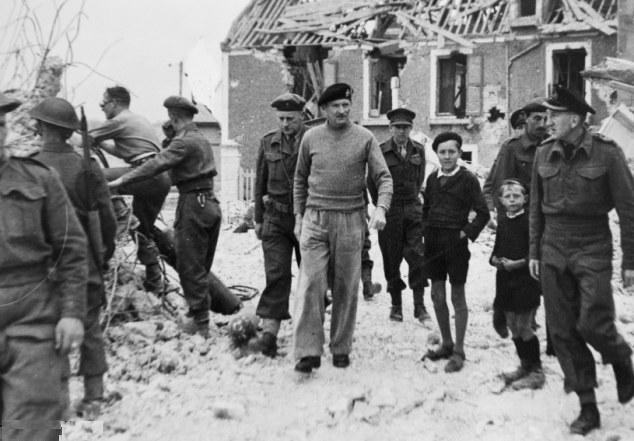
Field Marshal Bernard Law Montgomery achieved the first important Allied land victory over the Germans by defeating Rommel and the Afrika Korps at El Alamein. Churchill had replaced Auchinleck with Montgomery after Rommen had been stopped at El Alemain. Montgomery was the most inspirational British military commander. The 8th Army's victory was due to Montgomery's competent leadership and overwealming material superority as a result of vast quantities of weapons and supplies provided by the United States. Montgomery saw his victory as a result of his brilliant leadership and looked down on mist other commanders--especially American commanders. His arrogant attitude made him extremely difficult to work with. Alexander was one of the few high ranking officers that was able to manage it with any equanimity--mostly by rarely disagreeing with him. One observr described Montgomery as "annintensely compacted hank of steel wire". Montgomery bridled when Eisenhower was given command of the Allied assault on Hitler's Fortress Europe. Montgomery was the senior British military commander at D-Day. American commanders are generally critical of Montcomery's failure to take Caen with the uinitial landings and subsequent operauions to take the city. The failed Market Garden offensive to cross the Rhine was largely planned by Mongomery. He continued as the senior British commander through to VE-Day.
Bernard's father was an Ulster-Scots Church of Ireland (Anglican) minister, The Reverend Henry Montgomery. His mother was Maud (n�e Farrar). The Montgomery family was an 'Ascendancy' gentry family. They were the County Donegal branch of the Clan Montgomery. His father at the time Bernard was born was Vicar of St Mark's Church, Kennington. He was the second son of Sir Robert Montgomery, a native of Inishowen in County Donegal in Ulster. This of course was before Ireland was divided politically, but was divided religiously. Ulster and northern Kreland in general had a majority Protestant population. Sir Robert was a noted colonial administrator in British India. He passed away a month after Bernard's birth. He is believed to be a descendant of Colonel Alexander Montgomery (1686�1729). Maud, was the daughter of The Very Rev. Frederic William Canon Farrar, a celebrated preacher. She was much younger than her husband (18 years). Maud met Henry when she was 12 years old. There apparently was an immediate connection. They became engaged at 14, and married before she was 17. Like her husband, she had strong Christian convictions. When Sir Robert Montgomery died, Henry inherited the Montgomery ancestral estate of New Park in Moville (Inishowen in Ulster). It was not a financial windfall. Henry had to pay off �13,000 on the mortgage. This was a very substantial sum in the 1880s, especially for a
an Anglican vicar without independent means. He had sell the farms at Ballynally. Henry complained, "there was barely enough to keep up New Park and pay for the blasted summer holiday" which was spent at New Park.
The family moved to Tasmania of Bernard's eight siblings, all but Sibyl who died prematurely in Tasmania sirvived to adulthood. Harold, Donald, and Una emigrated. The newly appointed Bishop Montgomery was very concientious as to his duties. He thought it important to spend time in rural Tasmania and thus was away from home for long periods, as much as 6 months at a time. This meant that Maude, still in her 20s was largely responsible for the large brood. They were not, however, a priority for her nor was she a very affectionate mother. Her approach marriage was to focus on her duties as the Bishop's wife and to ignore the children, except when administered frequent beatings. In fairness to his mother, corporal punishment was widespreadat the time, although more associated with fathers than mothers. And by Montgomery's own admission, he was a bit of a hellion. His mother's lack of interest and beatings certainly left an indelable imprint. Montgomery refused to allow his son David to have anything to do with his grandmother, who spent her last years in Ireland. Despite their estraingment, she spoke admiringly about his accomplishments. Montgomery for his part declined to attend her funeral after the War (1949).
Bernard was born in Kennington, Surrey (1887). Bernard was the fourth child of nine children. He was strictly disciplined by his young, but very stern and uncaring Victorian mother and when he grew up he wanted nothing to do with her. Bernard was very young when his father was made Bishop of Tasmania (1889). Tasmanias south of Australia, was a British colony. Bernard spent his boyhood there, growing up with no memories of England at all. The posting to Tasmania was a financial boon for the family beause the post carried a higher salary this his previous post of a vicar. Their mother was the major figure in the raising of the children. In Tasmania the father was often away from home. She by all accounts took very little interest in the childten who had tutors. He primary involvement was as a strict disiplinarian, delivering frequent beatings. Her motherly role has been described by many historins. [Hamilton] We might describe it oday as that of a tyrant. Once Bernard was caught smoking. His father took him into the family chapel and prayed with him, after which he said that he had forgiven him. When Monty turned around, his mother was waiting for him and announced, "God may have forgiven you, but I have not." She marched him off to be dealt with. Historians speculate about the impact on Bernard of growing up in a loveless home. One historian suggests it turned him into a bully. Looking back, Montgomery writes, "I was a dreadful little boy. I don't suppose anybody would put up with my sort of behaviour these days." His mother reprtedly would tell the other children to see what Bernard was up to - and tell him to stop it! Others suggest that Maud helped put the steel in his character. A family historian provide a less censorious view. "Bernard did not grow up in an atmosphere of fear - of mother - or develop any inward-looking, withdrawn characteristics because of her." [Brian Montgomery]
Bernard's mother took no interest in the education of her children. While in Tasmania they were taught by tutors engaged in Britain. After the family returned to Bitain, Bernard attended St. Paul�s School and the British military academy Sandhurst.
Montgomery received his commission after graduating from Sandhurst at age 21 (1908). His first unit was the Royal Warwickshire Regiment.
Montgmery served as a young officer in World War I. By all accounts he was an effective leader and was promomoted.
After the War Montgomery was promoted and received varous commands in both Britain and India. On the eve of World War II he was promoted to major-general (1938).
After Germany invaded Poland (September 1, 1939), Britain declared war on Germany (Seoptember 3). Montgomery commanded the Third Division of the British Expeditionary Force (BEF). He perforned with great credit in the face of the German Western Offiensive (May 10, 1940). While the BEF was smashed by the Wehrmacht Panzers Montgomery's performance may have been the most inspired of his military career. (His victories were largely achieved with overwheaming material advantage.) Montgomery played a major role at Dunkirk in sucessfully evacuating the BEF.
Field Marshal Bernard Law Montgomery achieved the first important land victory over the Germans by defeating Rommel and the Afrika Korps at El Alamein. Churchill had replaced Auchinleck with Montgomery after Rommen had been stopped at El Alemain. Montgomery was the most inspirational British military commander. The 8th Army's victory was due to Montgomery's competent leadership and overwealming material superority as a result of vast quantities of weapons and supplies provided by the United States. Montgomery saw his victory as a result of his brilliant leadership and looked down on mist other commanders--especially American commanders. His arrogant attitude made him extremely difficult to ework with. Alexander was one of the few high ranking officers that was able to manage it with any equanimity--mostly by rarely disagreeing with him. One observr described Montgomery as "an intensely compacted hank of steel wire". [Shaw] He was, however, popular with the men of thev8th Army--especially those that had little contact with him. His victory at El Alemain in combination with Zukov's victory at Stalingrad are generally seen as the great turning points of the War. Montgomery did not press his victory at El Alemain and Rommel managed to extricate the Afrika Corps. The Anglo-American landings in North Africa known as Operation Torch pressed the Germans from the West. Final victory came in Tunisia (May 1943).
Montgomery bridled when Eisenhower made Supreme Commander and given command of the Allied assault on Hitler's Fortress Europe. Montgomery was the senior British military commander at D-Day. American commanders are generally critical of Montcomery's failure to take Caen with the uinitial landings and subsequent operaions to take the city. Montgomery disagreed with Eisenhower on strategy. Montgomery
wanted a full-scale advance on Berlin via the Ruhr. Eisenhower favored a broad front push. Montgomery and Eisenhower had a generally correct professional relationship but Montgomery constantly complained that Eisenhower was to partial to the American forces. Montgoimery in paticular disliked Patton. At times Montgomery bordered on insubordination. At one point Eisehower was prepared to seek his replacement. Montgomery's aides finally convinced him that give the overwhealming role of the Americans in the War after D-Day that Churchill would be forced to replace him if Eisenhower insuisted. Montgomery appoligized and the crisis oassed. Montgomery was promoted to field marshall (Septemver 1, 1944).
Montgomery commanded the 21st Army Group that liberated the vital port of Antwerp in Belgium. This was vital to thevpush into Germany as it was close to the frontblines. Large quantities oif supplies were still being landed in Normandy and had to be trucked across France to reachbthe Allied frontblines. The failed Market Garden offensive to cross the Rhine was largely conceived and planned by Mongomery, but failed. The 21st Group was also involved in the Battle of the Bulge, Germany�s final offensive of the War. Montgomery�s succeeded in crossing the Rhine (March 24, 1945). He accepted the formal surrender of the German military at Luneburg Heath (May 4, 1945).
Montgomery was the best known British general of World War II. He was the only British general to deliver a victory over the Germans before joint operations with the Americans began, although huge quantities of American equipment were key to the victory ar El Alemain (October 1942). Montgomery also played a key role in the D-Day planning. He was emensely popular in Britain and absolutely detested by the American commanders he worked with. That Patton and him would quarely is understandable, they were both primadonnas. But he also had trouble with American commanders like Omar Bradley who was much more professional in his conduct. Problems began in Tunisia as soon as Montgomery first came in contact with the Americans, but it was after D-Day during the fighting in France that matters came to a boil. Bradley refused to speak to him unless it was absolutely essential offical business. Then Monty essentially told Ike that he should turn over command. Ike was the consumate master of running a war with allies. The Anglo-American Alliance was probably the grestest alliance in miliktary history. Much of the success of making the alliance work was due to Eisenhower political skills. He is said to have explained to an American officer he retirned to the states that he was not fired for calling a British officer a bastard, but for valling him a "British" bastard. Even so by the end of the War the alliance had frayed considerably. Ike while the fighting was still going on in France was prepared to ask that Montgomery be relieved. Montgomery who finally seems to have realized that Churchill probably would have complied, applogized to Eisenhower.
After the War, Montgomery served as Chief of the Imperial General Staff (1946-48). He then served as Deputy Supreme Commander of NATO forces in Europe (1951-58). King George VI created Montgomery a viscount in 1946 in recognition of the part he played in the War. Montgomery antagonized Eisenhower again with his memoirs which consistebnt inflated his role in the victory and down played the contributuioin of American commanders. ontgomery died in 1976.
Hmilton, Nigel. The Full Monty: Montgomery of Alamein 1887-1942 (Allen Lane: 2001).
Montgomery, Brian. A Field Marshall in the Family.
Shaw, George Bernard.

Navigate the CIH World War II Section:
[Return to Main World War II bio page]
[Return to Main biographt "M" page]
[About Us]
[Allies]
[Biographies]
[Children]
[Concentration camps]
[Countries]
[Decision]
[Denyers/Apologists]
[Displaced persons]
[Economics]
[Eisatzgruppen]
[Eugenics]
[German Jews]
[Ghettoes]
[Impact]
[Justice]
[Literature]
[Movies]
[NAZIs]
[Occupied Poland]
[Process]
[Propagada]
[Resistance]
[Restitution]
[Questions]
[SA]
[SS]
[Special situations]
[Targets]
[Wansee Conference]
[Return to the World War II]
[Return to Main Holocaust page]
[Return to the Main mass killing page]
[Return to CIH Home page]