The HBC biography section is for people or families that have achieved some degree of notariety or fame. HBC readers in many cases have submitted family portraits. HBC has until now not added them to the biography section. We believe now that this is a mistake. Many of the HBC readers contributing family portraits can also provide details about the boy and him family. This background information help us to assess social trends and put the fashions involved in perspective. This is just why the biographical section is an important part of HBC. As a result, HBC has decided to create pages for these relatively unknown people, when some basic family data is available. Incidentally if you find a relative here, please do tell us somehing about him. Here we are listing these biographies alpahabetically to facilitate looking up individual names. The alphabdetical list is the primary data base in this section. While we have not persued geneolgical resreach on these individual, having the names and in many cases the loaction provide the potential to acquire more back ground information in the future which may provide additonal insights into the fashion and life style trends.

We know little about John, but a portrait shows a very English face and he wears the Eton collar that was was so common at turn of the century England. The portrait reads, "John Christopher Bradshaw Falleglove born on Chrismas day, 1887. The second date reads April 1898. The word before April is very hard to read I will tell you what I get J (then three dots) poix or pox. I believe this is a portrait of a child who died in 1898. Presumably the portrait was made in 1898. It is unsigned.
We have no biographical information on James Farber other than that he was an American boy. We do not even know where he lived in America, but from his coat I would guess a northern state. We do have two family portraits. They are undated, but look to have been taken about 1905. James looks to be 3-5 years of age. In one portrait he wears a winter coat. In the other a sailor tunic, one of the most popular outfits for younger boys at the time. In both portraits James has perfectly done think ringlet curls.
This photo postcard shows Grant Fehvenbach in his First Communion costu,e. All we know about the portrait is the boy's name and the fact that he is American. The portrait is undated, but we would guess about 1910. The portrait is interesting for a number of reasons. Here Grant wears a fancy blouse and bow, but not a suit. We note many portraits of boys doing their First Communion beginning in the 1910s, but few earlier. And First Communion portraits are rare before the turn of the 20th century. We can not yet explain this chronology.
Hulbert Fels had a formal photographic portrait taken about 1900-05. The olive framed card and albumen print suggest it was taken around the turn of the 20th century, but probbly not later than 1905. Hulbert is dressed very formally, with a white tie, buttonaire and even holding gloves. I am not sure wht the event was, perhaps a graduation. I don't see any religious props suggesting a communion or confirmation. I am not sure precisely how to describe his hat on the table. Hulbert wears a three-piece suit knee pants suit with long stockings. Note the cut-away cut of the jacket. There is a watch fob on the vest. I think the stockings are black rather than matching the suit. He has a center-part hair cut.
Grant Wood painted young Gordon Fennell, Jr. (aged about 5) in 1929. Gordon was sitting in a large overstuffed chair with a ball in his hands. He wears a white blouse with a Peter Pan collar and string tie with tassels. He also wears button-on short pants. Unfortunately we have only a black and white reproduction. This is a wonderfully executed portrait, but illustrates a difficulty faced by artists in the modern age. I'm not sure the portait here adds anything a photograph would not have provided.
An American press photographer took a portrait of Ernest Fischback, a cabin boy on the Graf Zepplin when it landed at Lakehurst, New Jersey (1929). Most German boys in the 1920s finished school at about 14 years of age. Only a minority of children persued secondary studies. So the boys finished scgools got a range of jobs. Many began aprenticeships. Ernest got a job on the Gran Zeppelin which must have been a really exciting experience for him. The caption read, "Ernest Fischback, 15-year old German cabin boy on the Graf Zeppelin and youngest member of the crew, will serve in the same capacity when the giant air liner starts its world cruise thursday." The photograph was dated August 6, 1929.
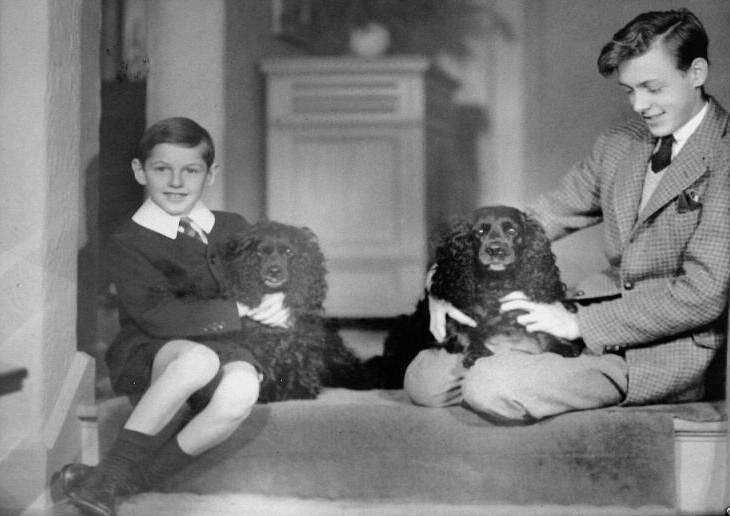
Here we have a portrait of who we believe to be the Fithian boys. We know for sure that their grandfathr was Dr. Edward James Fithian, a well known prominent member of Grove City Pennsylvania society. Dr. Fithian was a 32nd degree Mason and the vice-president of the Grove City Bank which still stands today. He also held the patent for a gas and gasoline power engine. He built it for the Bessemer Gas Company also in Grove City. Of course the boys could be from the other side of the family. They boys look to be about 10 anf 15 years old. The portrit is by the prestigious photography studio Aimee Dupont. The younger boy wears a short pants Eton suit. His older brother wears a checked sport jacket with long pants. The portrait is undated, but we would guess was taken in the 1930s. The dogs in the photo are Black Springer Spaniels and belonged to the boys. One was named Prince.
Harold and Phyllis Fitzroy-Carrington were extensively photographed outside what is probably their home in New York in about 1905-15. A HBC contributor has a collection of nine albums of photographs that were taken by the childrens father, an enthusiastic amateur photographer. He was obviously a wealthy man as they also had a home called 'Mallowfield' at Mamaroneck. N.Y. There are approx 100 photos in each album, many of them of Harold and his
siblings playing with toys, pets, bikes etc some in swimming costumes, some playing musical instruments. Yje collection is a wonderful view of childhood in a wealthy NewcYork family in the years before World War I.
The sailor suit in the late 19th and early 20th was a popular school style for boys through about age 10, after this it became less common. After World War I the sailor suit became worn by younger boys usually up to about age 7 or 8 years old. The photographic studio portrait here is of Charles Samuel Fix. I'm not sure about his age, but would guess
about 10 years old. Charles wears a very smartly done sailor suit. Note the sun burst emblem on his dickey and the buttoning collar. The portrait was taken by a Cleveland Ohio studio "R.T. Krumhar", so I would assume this child was from Cleveland or the nearby area. The photo is not dated but from the type and style of the photo and the way the boy is dressed, I believe this photo would be circa 1890.
Here we see Lloyd Flint with his parents. The portrait is undated, but was probably taken about 1915. We do not know where they lived in America. Lloyd looks to be about 3 years old. Lloyd seems to be wearing a wehite shorts set with checked trim and white long stockings. We see him a couple years later in 1917 with his parents again. He is dressed similarly, but his outfit this time does not hasve the checked trim. Also he wears doublr-strap sandals.
We notice a portrait of a boy about 10 years old taken on November 27, 1902. He wears a very plainm but heavy dark wool sailor suit. There is very hard to see dark detailing on the sailor collar. There is adickey, but the boy's undershirt seems to show above the dickey. The lapel of the "V" collar front has a non-traditional shape. We know very little about the boy, but so often images are not dated, it is useful having a precisely dated image.
The portrait here shows Mrs. J. B. Fowler's children, aged about 4 and 9. The
photograph was taken in November, 1927, at a studio in Montreal. I'm not sure
whether the child on the left wearing a one-piece romper outfit in white is a
boy or a girl--although I suspect he is a boy. The schoolboy on the right
seems to be dressed in typical schoolboy clothes, although, since the photograph is a professional one, he may be a bit more dressed up than usual. Notice that he wears a light colored woolen pullover sweater, perhaps beige or maybe even white, with knitted cuffs and waist, with a shirt with a very wide collar that spreads out over his shoulders.
Here we have an undated CDV of two children, presumably brothers. We would date the portrait, becuse of the CDV format and the clothing, to the 1860s. It is definitely not from the 1850s, but could be from the early 1870s. A dealer believes it is enscribed in pencil Master Fox, but we think it says "chas Fox" or Charles Fox. The little boy with the curly hair seems to have a capital letter "F" on his shirt as you can see. Only one child is identified. The photographer is Wm. Reiterman at the Sturgis Art Gallery in Sturgis, Michigan. The boys wear different outfits. The younger boy wears a rather plain collar buttoning jacket. His older brother wears an elaborately embroiders cut-away jacket. This ome is unsual in that the blouse has the same embroidery as the jacket. The boys has similar hair styles, but the younger boys tip sausage curl much larger than the hair styled on his older brother.
We see Sidney Franks with his schoolmate and buddy Russell Gustavson. They are pictured in the school yard. The photograph is undated. The dealer suggested the 1930s, but the Denver, Colorado school in the background looks rather modern. We might guess the photograph was taken in the 40s. Strangey the photograph was printed in New York City. The boys wear the casual clothes common in Americam schools at the time.
We note a portrait of Arthur Franz taken about 1898. Arthur was born in Borodino. The source indicates Borodino wa located in Bess. which I think means Bessarabia. We had thought that Borodino was the town near Moscow where the bloody battle was fought by Nappleon during the 1812 invasion of Russia. Bessarabia is located, however to the south and is the border region between the Ukraine and Romania. Bessarabia in 1893 was part of Tsarist Russia. I believe the portrait we have was taken in America, but we are not sure.
Poznań in Poland.
Here we see a backyard scene from Jersey City, New Jersey. We even know the address, 9 Hancock Avenue. It is a family snapshot probably taken by dad in July 1937. The boys are Ralph Herman Freudenberg I (1931-92) and Richard Charles Freudenberg (1932- ). They wear "T"-shirts and white shorts. American boys had for many years worn knickers, but they were becoming less popular in the late 1930s. Youngr boys like Ralph and Charles commonly wore shorts, especially in the summer. Note the ankle socks. They were not common in the 1920s, but becamme increasingly common in the late 30s. Some boys eve wore them with knickers. Also note the leather shoes. Sneakers existed, but boys very commonly wore leather shoes, even for play. We also see two neighbor girls: Winifred T. McManus (1928- )and Nora Belle Piatt (c1921-?). Girls still commonly wore dresses, even for play. Girls also wore leather shoes, nut more commonly strap shoes or sandals.
Here we see a water color painting of Alfred Fuller, an English boy. He was 4 years old when the portrait was painted. We know nothing about his family, but surely he must come from a very affluent family. We do not know who the artist was. We do know that it was painted in 1836 which is helpful. The boy wears a low-cut blue dress with lace edgeing and ballon sleeves. We have noted other paintings of boys wearing dresses with baloon sleeves, but the baloon sleeves here are as about as large as we have noted. I believe these sleeves were also called gigot or leg-of-mutton sleeves. The boy here also wears white patalettes, white socks, and strap shoes. The boy looks to be about 5-6 years old, but estimating ages is often more difficult in paintings than in photographs. While the child is unidentified, the short hair and side part, whip, and stick horse all suggest a boy to us. Note that the dress here is just the same style a girl might wear, although a girl might wear fancier pantalettes.
Earl William Furlow, Jr. had his portrait taken in Harrisburg, Pennsylvania about 1910. He was about4 years old. His teddy bear is sitting on the floor beside him. The portrait is undated, but the clothing and the gray heavy paper frame helps date it. He wears a button-on blouse with a bordered Peter Pan collar and short pants. He seems to be wearing white long stockings.
Navigate the Boys' Historical Clothing Web Site:
[Return to the Main ordinary biography alphabetical page]
[Introduction]
[Activities]
[Biographies]
[Chronology]
[Clothing styles]
[Countries]
[Girls]
[Topics]
[Bibliographies]
[Contributions]
[Essays]
[FAQs]
[Glossaries]
[Images]
[Links]
[Registration]
[Tools]
[Boys' Clothing Home]