|
The HBC biography section is for people or families that have achieved some degree of notariety or fame. HBC readers in many cases have submitted family portraits. HBC has until now not added them to the biography section. We believe now that this is a mistake. Many of the HBC readers contributing family portraits can also provide details about the boy and him family. This background information help us to assess social trends and put the fashions involved in perspective. This is just why the biographical section is an important part of HBC. As a result, HBC has decided to create pages for these relatively unknown people, when some basic family data is available. Incidentally if you find a relative here, please do tell us somehing about him. Here we are listing these biographies alpahabetically to facilitate looking up individual names. The alphabdetical list is the primary data base in this section. While we have not persued geneolgical resreach on these individual, having the names and in many cases the loaction provide the potential to acquire more back ground information in the future which may provide additonal insights into the fashion and life style trends.
This beautifulmportrait of a mother and child was taken in Wabash, Indiana on December 13, 1900. It has a heavy paper matte with a small oval portrait. We see these small oval portrait quite a bit at the turn of the 20th century and during the 1900s. They declined in popularity during the1910s and we no longer see them in the 1920s. This was an early one. We find very few from the 1890s. We see oval portraits in the 1890s, but not ones where the oval is only a small part of the matte. The matte measures 10" X 12", unusually large. The oval photpgraph is about 3 1/2" X 5". The little boy looks to be about 5 years old abnd still has ringlet curls. He wears a lapel suit, but done with sailor trip. Notice the three bittontrimon the knee pants a long stockings. We don't know his first name, but it was the MacCarr family. His mother was E.P. MacCarr which means they were of Scottish origins. The image quality is not good, but the date is useful in not only dating fashion trends, but also photographic trends as well.
This photograph was taken in 1954 on South Uist, the second largest island Outer Hebrides. The names of the three children are Agnes MacDonald along with Morag and Ewan MacLellan. They are clearly not glad to have the photo taken. Perhaps they weere shy, but an experienced photographer knows how to make the people being photographed at ease. This is a little unusual because children this age are normally happy to have their photograph taken. Teenagers and adults are often notb so pleased, but younger children commony think it is fun to have their picture taken. And the phiotographer was Margaret Fay Shaw a local photographer who took numerous phothgraphs on the island and would have been know to the children. At the time most children on the Hebrides, like these children, still commonly went barefoot. We are not even sure that the children had shoes. The older girl may be hiding her feet.
This studio portrait is undated, but the mount suggests it was taken after the turn of the 20th century, perhaps about 1910. The boy seems to have written his name on the back--Allan Victor Mackenzie. We believe he is a Scottish boy, both because of his name and his Highland outfit. One question we have is how common kilts were in Scotland. Note that the outfit here is a formal costume, not clothes that Allan would normzlly wear. While we believe that Allan is Scottish, the portrait was not taken in Scotland. It was taken in in a High Street studio at Rhyl. This is a coastal town in northern Wales near Liverpool. Rhyl is a seaside town located in the Clwyd estuary on the Irish Sea. Rhyl was a small traditonal Welsh seaside town. It developed during the 19th century into an elegant Victorian resort. This may explain why a Scottish boy had his portrait taken there on the High Street. Since World war II the character of the town has changed markedly.
Here we see a newly minted Boy Scout in 1949. He is identified as Ronald J. McAlister. Ronald may have just moved uo from the Cubs. We think he has just joined because his unform only has the troop number and no other patches except the BSA Scout patch on his garrison-style cap, a style adopted in the early 1940s. The BSA tended to follow U.S. Army styles at the time. This would remnain the official American Scout cap into the early-1980s. Ronald looks to be about 12-13 years old. He also wears the large scarfe that was still popular, We know nothing else about Ronald except that he was from San Bernadino, California.
This cabinet card portrait is undated, but looks like the 1890s to us. The boys look to be about 2-8 years old. The inscription on the back reads, "John W. McAndrew + 2 brothers who died of diphtheria." Notice the youngest boy wears a dress and the middle boy wears a kilt suit, suggesting different ages conventions for dresses than kilt suits. It looks like at this family, boys were not brreched until about 6 years old when they began school. Notice how long the skirts are. The studio was Coumb in Bath, New Tork.
This is a the new style cabinet card which appeared at about the turn-of-the 20th century. It tooks to have been taken about 1910. It appears to be a family snap shot mounted as cabinet card. It shows a boy sitting on what looks like the back step. The boy is photographed with his dog and they look to be best friends. The pooch looks to be some kind of terrier and he looks to be full of energy. They look ready for a day of fun. No photographer or location is indicated. The back of the matte has the name Raymond McCarthy. The last name is crossed out and replaced with "McQuade?". Raymond looks to be about 8 or 9 years old. He wears a white strioed blouse with whire bloomer knickers and black long stockings.
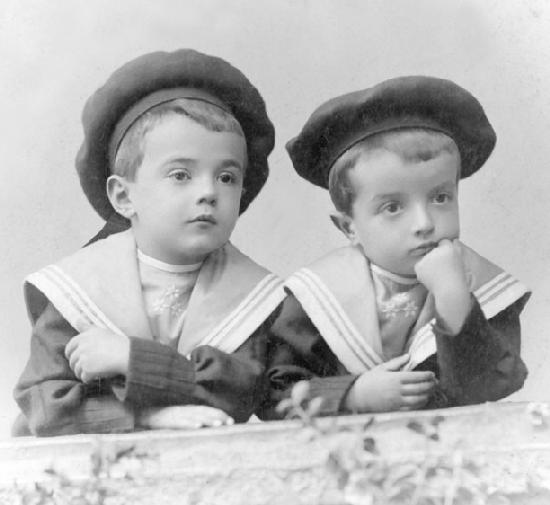
Two cabinent card portraits show twins Harold and Howard Mc Cay. They look to be about 5 years old. The portraits were taken at the Smith studio in Wilmington, Ohio. They are undated, but we would guess the early 1890s. The first portrteait shows rhe boys wearing sailor caps with wite Eton-like collars, and plain middy blouses, knee pants and long stockings. Mother had added matching floppy bows, but not as large as some we have seen. Mixing Eton collars and middy blouses was rather unusual. Another portrait shows the boys sitting down without their caps.
Frank and Eva McCellan had their portrait taken in 1909. we know little about them, but they were 5 and 6 years old. They are American children, although I do not know where in the United States that they were from. Given the fancy hair styling we suspect that they came from an affluent family. Their mother has chosen different clothes. Eva wears a white frock. Frank wears a white middy blouse and scarfe and bright plaid knee pants.
#
Here are the McCrea children from Montrel. We see H. McCrae and his baby brother. Unfortunately we do not have their Christian names. The photographs were taken in Montreal on December 2, 1919. Master H. McCrae (about age 7 or 8) wears a short pants style suit with a wide belt made of the same material as the suit and large front buttons. His very wide white collar covers almost half his shoulders and is secured by a black ribbon tie, I think with tassles. The jacket has patch side pockets.
Here we have portrait of the McCurdy children, at least we think it is McCurdy, the writing is a bit difficult to read. They had their portrait taken for a Christmas card, a popular fashion at the time. The children are wearing clssic 1950s outfits. The boywers a Hopalong Cassidy shirt. Hoppy was a popular TV cowboy during the the late-1940s-50s early-50s. I had a similar shirt at the same age. Hoppy was for some reason my favorite TV cowboy. We had just gotten our first TV. It had a very small screen and I had to get close to get a good view. His sister wears a dress with baloon sleeves. She wears eye glasses which look to be from the early-50s jyst before more elaborate styles developed. The children look to be about 7-11 years of age.
Here we have a wonderful portrait of three generations of an America family taken in Bradley County, Arkansas. The grandparenrs were Thomas Henry and Sarah Voss Cox Stanfield. The parents were Lonnie and Katie McDougald. The children were Henry (oldest), Rufus (middle) and Beatrice (the baby). The boys wears blouses, kneepants, and were barefoot. It was very common for American boys, especially in the South, to go barefoot during the Summer. While wealthy children did not common go barefoot, it was common for poor children and many middle-class children to go barefoot. Age was another factor, younger children were more likely to go barefoot than older children. Here even for a formal portrait the boys are barefoot.
This portrait shows four brothers, stair stepped by age and height. I'd gues they are about 4-11 years old. The older boys look to be wearing sneakers, not very cmmon in formal portraits like this. Two notations written on the back - on the actual picture in pencil - Mrs. H. Multhauf (guessing on the spelling due to handwriting) 8728 Loomis St. We do not know who she was. There is also a small piece of paper taped on stating McErlean boys, Paul, John Henry, Charles & James. Thats not a family name we have noted before. The portrait is embossed in the lower right with the photographers mark - Wood Bros., 63rd St. and Union Ave., Chicago. The portrait is undated, but we would guess was taken during the 1920s.
This cabinet card shows Harry McFarland with his violin. It was a Christmas present that was sent to friends and family with a Happy Christmas inscription. Harry wears a knee pants suit with what looks like dark matching dark long stockings and high-top shoes, standard for the day. We can't make out much about his jacket. He is wearing some kind of white shirt. He looks to be about 10 years old. The new style mount does not indicate the studio or location. The studio useds drappery as a background. He seems to have a center hair part. There looks to be a ring.
Hugh Patrick McGinley was born April 5, 1922. He was photographed at about age 2 years wearing a boy dress, a very plain long sleeved dress with a Peter Pan collar. This shows that wile outfitting boys in dresses declined after World War I (1914-18), the custom did continue into the 1920s.
We see Robbie McGregor and Everett Tallmadge in a wonderful early snapshot. This wonderful photograph is a good example of what the Kodak Brownie and amateur photography provided sharply increased views of everday life. Before 1900 there are few images of children playing. After 1900 there are rnumerable such images. This snapshot is undated, but woyld have been taken in the very early-1900s. Two little boys are dressed in fancy clothes for play, but that was common at the time. One boy wears a fancy Fauntleroy blouse, the other a sailor suit. They are in the back yard at 3314 9th (now Elliot) ave South, Minneapolis. The house belonged to the wealthy Tallmadge family. Robbie probably lived next door. The inscription on the back reads "playing with sand".
We do not know much about Sam McGown. We note a portrait of him in 1908. He looks to be about 8-9 years old. It was a destinctive Cynotype print. We do not know where in the United States Sam was from. He is sitting on the strps of what was probably a substantial home in a town or subburb of a large city. Sam is wearing a large wide-brimmed hat, side-buttoning blouse, and knee pants. It is summer and Sam is going barefoot.
This CDV portrait shows Lonsdale Hall McIntosh, aged 3 years & 5 months. He wears a velvet sailor suit with both traditional stripe detailing. (In this case four rather than three stripes, not only on the collar, but repeated on the pants.)There are additions such as a ruffled collar. Notice the socks rather than long stockings. You do not see this in America. The portrait was taken September 1880. The photographer was Stuart hich has studios in Helensburgh and Glasgow.
This boy is posing for his portrait in full Scottish Highland attire. Written on the back of the matte is his name, Hugh McKay, son of Hugh and Cecelia Mc Kay. The photo was taken by the I. S. Griffing Studio in Jersey City, New Jersey. The portrait is undated, but looks to us as if it was taken in the 1870s. It is not possible to tell from the costume, but the mount suggests an early cabinet card. He wears a Glengary complete with feather, Eton collar, bowtie, black jacket, plaid, kilt, sporan, and buckle shoes. Only the socks or stockings are a little unusual.
Here we see a 7 year old boy wearing a classic sailor suit in 1923. The boy is identified, but the writing is difficult to make out, but we think it must be E. McKenzie. The Mc, at least we think it is an Mc, usually means an Irish or Scottish name. McKenzie was a Scottish name. The boy lived in Brooklyn, New York. He wears a summer short pants sailor suit. The collar has the classic three-stripe detailing with a petty-officer rank badge on his sleeve. We see that a lot on American sailor suits after World War I. We are not sure what color the suit was. Light blue is possible, but unlike the dark suits, blue was not as dominant for summer suits. These light-colored summer suits were made in various colors, such as brown and grey. They were worn as both dress-ip and play suits. He also wears white knee socks and oxford low-cut shoes.
The Apache like other Native American tribes took captives. This included both other Native Americans and well as white settlers. These were commonly children. Adults were often killed. Captives were variously treated. Adults might be tortured. Others were treated as slaves or adopted into the tribe. Americans generally did not have racial concepts. Thus membership in the tribe was not a acial matter. Actual experiences varied widely. This depended both on individual tribal members and well as individual captives. One captive was Santiago McKinn, who was taken in 1885 by Chiricahua Apaches from his home near Mimbres, New Mexico Territory. He was well treated during his 5 months with the Apaches, and learned to speak their language. The photo was taken by Tombstone's famous photographer, C. S. Fly.
This image priovides insights into the use of kilts as part of everyday life in the Highlands.
As far as we can tell, noy many Scottish boys wore kilts as everyday clothing (by the 20th cenury). We believe the same was the case. We are not sure about in the mid-19th century as so few photographs are available. We think earlier in the 19th century, kilts were more common at least in rural areas and among poorer families. A kilt could be imoprovised by simply simply wraping a tartan homespun textile around the boy's waist. The Industrial Revolution was bringing down the cost of clothing and thus pants were much less costly than earlir in the century. Here we have a photo depicting children wearing pleated kilts in everyday life. It was taken in Glenfinnan (1903). This was a hamlet in the Lochaber area of the Highlands. Two young brothers are riding the same horse. They are Lachlan (1894-1936) and James (1898-1916) McLaren. The boys were the sons of Catherine and Duncan McLaren. Their father was a deerstalker on Glenfinnan estates. We susoect that the sons of someone working on estates might be more likely to wear kilts than the average Highland boy, but that is only a guess. It was very common for Scotish children to go barefootb at the time, especially in the Higklands. A photograph taken of a Subday School group at the Cumberland Stone is a goog example. Both boys are wearing pleated kilts with jackets in bare feet. We know that both the brothers joined the British Army during the First World War. The younger brother was killed on the Western Front in France aged only 18 (1916). Lachlan served in the Army for the full duration of the war and was discharged for health reasons (1919). He went on to become a gamekeeper. He died of tuberculosis aged 42.
This is a tough one. The portrait is a cased Ambrotype. Most cased early photographs do not have names associated with them. This one does and we especially like to archive named portraits despite photographic quality. Unfortuntely the writing is very difficult to read. We venture Charles Arltiese McLong as a beginning point in deciphering it. All that we know for sure is the Charles and Mc bits. We will attach the enclosed writing. hoping that readers might be able to help decipher the writing. We can make out 'Age 9 years'. We would have guessed that he was younger. The portrait comes from Connectict so this may have been where Charles was from. He puts his hand in his jacket, a Napoleonic pose probably used my the photographer to steady Charles' pose. He wears a military styled collar-buttoning jacket with a small rounded white collar.
This professional portrait taken in a Montreal studio on January 30, 1897. Master McMaster looks as though he is about 6 years old. The photo is interesting because of the good detail it gives us about Fauntleroy blouses. Notice the elaborate lace collar and matching lace cuffs. The boy is young enough, apparently, to be very formally dressed without the traditional velvet jacket. Also, even though the boy was photographed in mid-winter (very cold in Montreal), he wears white knee pants which do not appear to have ornamental buttons at the hem. He wears strap shoes that fasten around the ankle. The haircut with bangs was fashionable for younger boys. Notice that the black stockings are quite long and obviously worn with supporters, undoubtedly attached to an underwaist.
We note a portrait of Laurence McSwain in 1897. Laurence was from Boone County, Kentucky. He looks to be about 8 years old. Laurence wear a Norfolk suit with knee pants. The jacket has verical vents, but no belt. He has alarge white collar and floppy bow. A watch fob as been added to the jacket. He has black long stockings and hight-top shoes. Laurence holds a rounded-crown hat with a flexable brim. He has short, slicked-down hair.
This rather basic cabinet card portrait shows George and Ewan McTherson in 1902. The boys look to be about 12-15 years old. We at first assumed they were English, but given their names, they could well be Scottish. It is difficult to tell and the dealer was in in Canada so it could be either or even might be Canadian. The location is not identified. And unlike most cabinet card portraits the studio is not identified. Also unusual is that is an outdoor rather than a studio setting, although the gate looks like a studio prop. The boys wear matching Norfolk knickers suits with Eton collars. Eton collars wer very common at the time for both school wear and wgen dressing up. They have matching caps. The caps were genrally associated with schools. We are not entirely posotive, however, that such caps might not have been been purchased with suits nd not just for school. Perhaps our British readers will know more. Note how small the peaks (bills) are these caps. That was the style at the tutn of the century. The caps and suits well could be school uniforms although there is no badge as was commo, but not alwats the case. Knicker suits were commonly worn at English schools in the late 19th century. We suspect thec same wa true at Scottish schools, but have not confirmation at this time. This began to change after the tur-of-the 20th century. The boys are shown with walking sticks as if they were going to go for a hike into the country. The suits and shoes look brand new, so perhaps there was atudio nearby.
We have two images of the Mahla brothers. We know that they are German boys, but we do no know where in Germany that the boys are from. Their names are Wilhelm and Ernst Mahla. Wilhelm was born on eptember 29, 1888 and Ernst January 12, 1890. he earlier photo of them was taken on April 15, 1894, the later one is undated. The first photo shows the boys weaing matching sailor suits. The second portrait shows the boys wearing German folk costumes. Hopefully that might help our German readers idntify where the boys were from.
Here we have a portrait of 4-year old Kurt Mahlke in 1900.
The portrait was taken in Neustettin, Pomerania. Kurt wears a plain kneepanhts sailor suit, a popular choice for German boys at the turn of-the-20th century. He has a very short clipped hair cut, another popular style in Germany at the time. Perhaps the most interesting aspect of this portrait is Kurt's patterened long stockings. Kurt holds flowers for his portait so we see that also boys got flowers as props.
The Malaguit boys lived in Bolonia and here we see a snapshot from 1967. The names of the boys are Dario, Marco, and Paolo. The boys look to be about 8-12 years old. The snapshot was taken at the seaside summer camp (colonia estiva) in Pinarella, a beach resort about 30 kms north of the better known Rimini resort. The camp was organized by the private boarding school the boys attended in Bolonia (Collegio di Casaglia). They are wearing the uniform of the summer camp: striped t-shirts and short pants. I don't know if the cap worn by the younger brother is part of the camp uniform. More likely it was part of their school uniform. Surely the uniforms were completed with the footwear when they left the beach, probably open toe sandals.
This portrait measures 3" by 4". It is on a cardboard mount that measures 6" by 5". On the back is written "Robert & Leonard Maltbie". The two young blond boys are wearing tunic suits with big collars, but styled differently. The younger boys wears double bar sandals. The older boys wear low-cut oxfords. Both boys werar black long stockings. The younger boy, presunavly Robert, is holding out his cracker to share with his older boy. The older boy is holding an old toy wagon. This photo is not dated but it came with a group of photos dating in the early 1900s. We would guess it was taken about 1910. The boys are American, but we do not know where they lived.
Here we have an oil painting on canvas of a boy, having a landscape background typical of the old Georgian portraits. The portrait was painted in 1837 by an unknown artist. Some one has written posibly 1897 on the back, but the collar to us seems more typical of the 1830s. It bears an inscription verso which identifies the subject as William Henry Manley as a boy aged 9. It is framed in an old gilt wood frame with velvet trim. It is alovely portrait, but provides only limited information about clothing. It does show William's hair style and collar in detail.
The boy here was Rauf Mansel (1915-67). Rauf is not a very English sounding name. The boy's mother has a Scottish name. It is a derivation of a Nordic name -- actually a boy's name. The modern equivalent is Randolf or Randolph. I
suspect that Rauf is also of Nordic origin. The name web sites state that Rauf is an Arabic name, but we are sure with
the mother having a Nordic name, her son has one too. Perhaps the eqivalent of Ralph. He was the son of Sir Courtenay Cecil Mansel, 13th Bt. His monther pictured here was Ranulf Dabridgecourt Mansel and his sister was Lady Mary Phillippa Agnes Germaine Mansel. We do not know much about Rauf, but we do know that he served in the Royal Maruines duruing World War II. looks to about 5-years old and wears a button-on outfit. We know the portrait was taken in 1921. The studio was Bassano & Vandyk, an imoportant London studio.
This photo back post card shows Peet Marris, probably about 1920. His proper name was probably Peter Marris. He looks to be about 5 years old. Peet wears a traditionally styled long pants sailor suit. We are not sure about the color. This type of peaked cap was not a common style, but we have noted a few boys wearing it. He is riding a tricycle. The AZO stamp box (four squares) along with rthe clothing and trike suggest the snapshot was taken in the mid- or late-1920s.
We know the boy in this cabinet card was Albert Martin, but we know very little about him, except that he was in Milwaukee, Wisconsin. Albert looks to be about 6 years old. He wears what looks like a Norfol jacket, with the vertical pleats, but without a belt. He has a chain with we assume va pocket watch in a pocket of the pleats. It is a knee pants suit, worn with black long stockings. This was a standard suit, but Albert is wearing with a Fauntleroy blouse. The portrait is not dated, but looks like the 1890s. We see a soda fiountain chair. The studio was Gomber in Milwaukee
We know that James Martin was 5 years old when he was breeched. His adoring mother had two photographs taken, before and after the big event. Before breeching he wears a white summer frock with hairbows and afterbreeching the hair bow was removed and he wears a sailor suit. HBC dates the portrait to the 1890s, but can not be more specific.
We do not have much information on individual Australians involved in the War. We have learned about Jim Martin. He was the youngest soldier that fought at Galipoli. We were told he was the youngest Australian soldier that fought there. Jim Martin was 14 when he volunteered to join the army. Jim, like so many others boys fibbed about their real age to join the military. There is an Australian War Grave Cemetery at Galipoli called Lone Pine. One of the names on the monument is Jim Martin. We have found a picture of him and found out a little more information. Jim was an Australian soldier. He served with the 21st Battalion Australian Infantry. Jim was only 14 years old when he volunteered to join the Army.
Louis G. Martin had his portrait taken with his mother in 1895. I am not positive about the date, but it was reported by the dealer. Louis wears a military uniform. We see these costumes more commonly after the turn of the 20th century. We suspect he was from a military family. Rather incogrously he wears ringlet curls with his military uniform. I have not noticed that before. The portrait was taken by the Stevens Studio in Chicago. Louis later in life reportedly joined the American Expeditionary Forces Medical Corps during World War I.
This reprint photo shows a little boy, dressed as a Union drummer boy. He wears a cut-away jacket with button work to give a military look. It is not really based on the uniforms worj by Uniin drummer boys. Note the long knee pants and white stockings. White or light-colored stockings were quite common in the 1860s. The little boy is identified at P.H. Martin. He was photographed in 1862. I think it is from a CDV, but I am not sure. The original is in the Library of Congress collection.
This cabinet card pprtrait shows two boys with their swords and the American Flag. The boys wear open jackets with Fauntleroy blouses and different colored floppy bows. Besides the colored bows, the onlt difference is their caps. The older boy wears a saucer styled cap. His younger brother a yatching-style caps. The boys wear long pants because this was considered a sailor style. At the time American boys this age mostly wore knee pants. The studio was Lainer Johnson, 31 Third St. We are not sure about the city. The portrait is not dated, but is was a new-styled mount, so along with the outfits and fklag, we would guess the early 1900s.
A HBC reader tells us, "These two photos, are of my uncle Cedric Arthur Mason, born Titchfield, Hampshire, on 7 March 1908, died Winchester, Hampshire, 27 December 1979. He joined the Shanghai Municipal Police on 7 January 1929 and remained at his post in Shanghai at the request of HM Government, until his internment by the Japanese in 1942. At that time he was a Captain in charge of the Fingerprint Bureau and Crime Branch Studio. He was also Official Handwriting Expert to the Shanghai Police, speaking fluent Northern dialect Chinese and Shanghai dialect. Returning to the United Kingdom in 1945, he joined HM Government Control Commission in Germany, where he developed fluent German and was promoted to Police Staff Officer in charge of some 600 men at Munster RBD. He was married three times. Firstly, to Elsa
Stehlneek, at Shanghai on 17 March 1934. Secondly to Muriel Vera Southerton, at Newcastle under Lyme, Staffordshire, on 8 March 1947. Thirdly, to Anita Gurowich, at Port Said, Egypt, in September 1952. Two daughters by third marriage."
This studio portrait of E. Masson was taken on May 11, 1897 in Montreal. The boy is Master E. Masson, who looks to be about 12 years old. He wears a very sporty spring outfit--a checked suit. These louldly paterned materials were much more popular for suits than is the case today. The boy wears a double-breasted knee-pants suit, with long black stockings and fashionable leather gloves. Gloves were an important part of proper clothing at the time. Notice the high starched collar on his shirt and the striped bow tie. If he were an adult instead of a child, he'd be perfectly dressed for the races or a fashionable garden party. The only juvenile part of his outfit is the kneepants and long stockings. The neatly center-parted hair style adds to the dapper effect. This boy clearly comes from an affluent. He clearly enjoys his celebrity in the photograph and looks extremely self-assured.
We note a wonderful Anbrotype portrait of Matsuda Komataro who looks ready to sett of for school in 1885. This Japanese Ambrotype portrait is of Matsuda Komataro. Japanese cased portraits were commonly done in wood without guttaperca or leather covers and plush interiors. As a result of the wood, inscriptions are more common than in Western cased photographic portraits. The case herev is inscribed " Taken by WATANABE Tomio living in Kotohira Village ( Ehime Prefecture, Shikoku Island ) on March 7, Meiji 18 (1885) ". The portrait was 5cm x 8.2cm. The boy looks to be about 10 years old. We would guess that the outfit he is wearing is what he wore to school. Note the school book and ruler. In addition to the traditional outfit, note the separated toe socks.
This boy is identified as Virgil Matthews from Knoxville, Tennesee and the snapshot is dated August 13, 1925. That is probably his home on the background. Unless the information was on the back of the snap shot, we might have guess he was a little younger. Flat caps continued to be standard in the 1920s. Notice how he has buttoned his collar. And we see that black long stockings and high-top shoes were still being worn.
We notice an ambrotype photographer in Boston who included some infoirmation about his studio in the cased ambros. The portrait was of Ralph W. Maxwell. The ambrotype, in gold color framing, after slowly removing picture, the white little letter and green advertisment were found, the white paper reads- (Roallph?) Ralph W. Maxwell August 19th 1861 aged 3 years 1 month". Ralph wears a dress abd has not yet been breeched. On the green piece looks like a small business card it reads- Ambrotype and Photograph Saloon! C. D. Healey, Artist, from Hale's Daguerreotype and Photograph Rooms, Boston. The studio had a sky and side light. Then goes on with more about Mr. Healey, where he would go out to you home to take photos of someone sick or deceased.
This is a photographic portrait from the Nadar Collection held at the French Ministry of Culture. Gaspard-Felix Tournachon Nadar of course operated the most prominant studio in Paris during the mid-19th century. The notables of French society flocked to his studio. He produced masterful portaits of the graet figures of the day from the mid-1850s through the mid-1860s. And of course he photograohed manybordinary people as well. We have no idea who M. May is, or even if the child is a boy or a girl. The Ministry provides no details. The facial features are boyish as is the hair cut. The dress is, however, rather fancy and full skirted for a boy. The oortrait is undated, but we would guess it was taken in the 1870s.
This school portrait photo was taken in southern Fermany -- Bavaria (1951). It depicts Erich Maydl on his first school day beginning first grade. This means that he was 6 years old. We can note the traditional first day cone full of goodies. Erich is wearing Lederhosen with a sleeveless striped T-shirt and is barefoot. Note the large size. They were either hand-me-downs or purchased in a lkarge size so Erich could wear them for several years. Going barefoot to school reflects the difficult economic conditions in Germany following World War II (1939-45). The German Economic Miracle was underway but at an early phase. This can be easily followed in school photography. Agter the War, barefoot children were very common in Germany. At the beginning of the 1950s decade we still see a lot of children going to school barefoot, but by the middle of the decade we only see a few barefoot children. We notice a lot of boys wearing Lederhosen after the War, especially by the 1950s, more than before the War. We are not sure why Lederhosen suddenly became so popular. We believe that Lederhosen were especially prevalent in Bavariia and more in Western than Communist dominated East Germany (DDR).
This 1896 cabinent card shows the three Mayer children. The are carrie Al, Florence and Adolph. They look to be about 6-12 years old, perhaps 13 years old. We are a little unsure about Adolph's age. The girls wear white dresses with lacy collars. Adolph wears a fancy striped Fauntleroy blouse which has a large ruffled collar and front placket. He also has a floppy bow. This was an optional item. People in the 1890s tended to dress formally. Boys during the summer might just wear fancy blouses like this. This was the origin of the expression 'shirt-sleeve youngsters'. The studio was Lyman and Wells in Columbus Ohio.
Franz Xaver Mayer was born in Ansbach, Bavaria in 1858. At the time Bavaria was an independent country, but would become pat of the new German Empire in 1871. His portrait here was tken about 1862. He looks to be about 4-5 years old. Unfortunately the portrait is very faded, but we can make out some details. Franz has short curly hair. He holds a brimmed-hat with a rounded crown. It seems to be decorated, but it is hard to make out the detail. There are no streamers. He wears a kneepants suit with a cut-away jacket. The sleeves come to just below the elbows and are cut and embroidered. His blouse has a ruffled collar and sleeves that blouse out. We hve no details on Franz's childhood or his family. His outdit suggests that the family was affluennt. Sadly Franz died at an early age in 1871 in Munich.
The boy is this CDV portrait is Francis Holmes Mayhew. He was born March 17, 1861. The portrait was taken in the Hugo Broich studio in Milwaukee, Wisconsin. He looks to be about 8 years old. This would mean that the portrait was taken about 1869-70. He wears a button-on knee pants outfit. The top is interesting, notice the diagonal detailing. Here it appears to be worn as a blouse. In other images we see similar garments worn as a tunic. The matching knee pants are quite long. Notice the white long stockings. Small collars and white stockings were popular in the 1860s. The outfit seems more characteristic of the 1870s. We do not know much about Frencis' life. We know that he married and a daughter was born in 1894. The image here was found in her estate. He died in 1937.
The boy in this 1903 cabinet card portrait is identified as Wayne Mayo. He is pictured with a pogo stick horse. Wayne wears a tartan dress with a large ruffled collar and matching waistband. Dresses were going out of style for boys in the 1900s, but the comvention had not yet disappeared. The hem was knee length as was standard for young, but not yet teenage, girls. He has black long stickings and high-top shoes wjich were virtually universal at ghe time. Wayne was 'probably age 4'. The imprecesion means that the notation was made some time after the portrait was taken. But as the date is known, we can assume that the age estimate is fairly accurate.
The cabinet card is one of the new style card, this one slightly larger. With an image that covered most of the card. At the same time there were small cards with small images. The card measured 6-1/4 by 5-1/4 in. The photographic image is 5 by 4 in. The studio is not identified, but given the basic back drop and poor pose, was clearly not a very competent establishment.
This photograph shows Simon Mellitto, age 10, selling newspapers outside F.W. Woolworth store, you can even see some of the prices. I'm not sure about Simon's name, I think it is Italian. We do not know just where the photographwas taken. As a newsie, Simon earned 25-75 cents per day. His father's occupation was listed as locksmith, making about $12 per week. Simon had a brother who also sold Newspapers. The photograph was taken by Lewis Wickes Hine in June 1910. Simon wears a suit, I'm not sure if it is with knee pants or knickers, but he wears the black long stockings that were so sommon at the time.
This cased ambrotype portrait shows a brother and sister anout 3-6 yeats old. It is not dated, but ambrotypes were made in a relatively short period. We would guess tht this portrait was taken during the mid- or late-1850s just before the Civil War. We have no idea where. Unlike most cased portrauts (Dags and Ambros), this one had a note. It is very difficult to read, but we think we can make out the boy's name--Tom Milton. The girl wears a polkadot dress with a low neckline and pantalettes. The boy ears a blouse made out of the same polkadot material with a ruffled collar. This suggests home made clothes. The white pants are rather like drawers. We see a lot of boys dressed like this in the 1940s and 50s. Suits did not become standard for boys until after the Civil War. We think this was primarily a matter of income. America was industrializing, especially the North. It would be the principal reason that the Federals won the War. And by the 1860s industry was having a real inpact on income and living standards.
This CDV portrait shows Joe Meyer. The portrait was taken in the J.P. Weckman studio in Cincinnati, Ohio. We do not know any thing about Joe except that years later he was "Harry's father". Joe has slicked down hair. Its a little hard to tell about his collar, but it is probably a wing collar. He wears a neck tie with a large knot. I think this is called a Windsor knot, popularized by the Price opf Wales in Britain (future Edward VII). His suit jacket has very wide lapels. The CDV is not dated, but the clothing suggests the 1870s to us.
This boy's mame is Joe Meyers. All that we know about him is that he was from Anderson, Indiana. The nount and clothes suggest that the portait was taken about 1890. Joe looks about 5 years old. He is probably a Jewish boy whose parents immigrated from Germany. Give his elegant outfit, the family seems well established, probanlt immigrating during the mid-19th century. The most notable aspect of hos clothes is the military styled cap he is wearing. It is not a style we see being worn very commonly at the time. This military-styled cap is a style we see more commonly in the mid-19th century. It also seems a bit incongrous with the curly hair. It is not clear what kind of outfit Joe is wearing, other than his large lace-edged collar. We note only occassional portraits in the late-19th century of boys wearing these caps
These two little brothers had their portrait taken in 1928. They are Henry and Eugene Mezzanatto and lived in California. The boys look to be about 1-3 years of age. They were born in America, but their parents were Italian immigrants. This is noticeable in the portrait. We do not see Americans commonly photographed children without their clothes on, except for infants on the proverbial bear skin rug. This probably reflects the more prudish Puritan tradition in America. This was much more common in Italy and other Catholic countries.
This cabinet card portrait shows an American boy, Eugene Watson Milford. He looks to be about 5-6 years old. The portrait is undated, but the mount style and clothing suggests it was taken about 1900-05. Mount styles began to change in the late-1890s, thus helping to date these old portraits. We do know that the boy was from Anderson, South Carolins. The studio was J.H. Collins in Anderson. The card was enscribed, 'extra finish'. We do not know what that meant. Eugene wears a fancy Fauntleroy blouse with a relatively small floppy bow. He wears the blouse with light-colored knee pants and long stockings. There may have been a jacket to go with the pants. At the time it was common for boys to wear fancy blouses without jackets. This was particularly common in the South. The pants may have been purchased without a jacket, but we are unsure how common that was. Of course in South Carolina it was quite warm during the summer. Notice his rather large cap which matches the pants. This looks more like a sailor cap than a tam. We do not notice streamers.
This is Scottish children Betty and David Millar. There are a lot of Millers in America, but I have not seen a Millar before. We are not sure where they lived in Scotland. The snapshot was taken about 1930, perhaps the late-20s. Notice how Betty wears white knen sock. David wears dark turn-over-top socks. The colored bands mean that they were school soocks. The double-breasted jacket is probably not a school jacket, but he is wearing a horizontal stripe school tie.
This cabinet photo shows a boy with a cane and a top hat wearing what looks like a tuxedo. .
The portrait may come from Mossuri. There is writing on the back indicating that the boy was Arthur J. Miller. He looks to be about 6-7 years old. He has long hair which we believe have been done in ringlet curls. The portrait is undated, but I believe was taken about 1870.
This cabinent portrait is of Earl Miller. We know little about him and his family other than he had a sister named Ruth. He looks to be about 3 years old. We do know where he was from. The photographer was Mulligan Bros., Columbus, Ohio. Earl is reading a book and has another Book at his feet. This is probably just staged, but perhaps Earl was a bit of a prodigy and already beginning to read. Earl has not yet been breeched, but he has his hair cut short. We can see much detail in his rather plain long dress, but there seems to be a small white collar. The portrait is undated, but was probably taken in the 1870s.
This small tintype shows an unidentified boy who looks to be anout 5 years old. The tintype is done to mimic the size of a cdv so it could fit in an albumn. We would guess the portrait was taken in the early-1870s. The boy look to be wearing an overcoat, but we believe that the outfit would have been seen a dress at the time. Overcoats ratrly had fancy white collars, byt dresses do not normally have buttond that continue into the skirt section. It looks to be a low-budget studio, but is not named nor the city indicated. We might have guess the late-60s, but has a fancy paper sleeve with rounded corners. The boy holds a flat-topped straw hat. mother seems to have guven a little attention to his hair. Written in the inside of the sleeve is the boy's name. It is a little difficult to read, but looks like H.N. Miller.
We note a CDV portrait of Rollie Mitchell. He looks to be about 7 years old. The portrait was taken by Monfort & Hill in Burlington, Iowa. Rollie wears a cut-away jacket with piping around the edges. The jacket had amall collar. Note the tab attachment at the collar. He has a matching vest and kneepants. Notice the small ruffled collar. I am not entirely sure about the shirt or vlouse to which it was attached. He wears white long stockings which is one reason we do not think the portrait was taken in the 1860s or very early 70s.
These two little Amerucan boys wear wide-brimmed hats and matching white tunic suits which they are wearing with white long stockings. They are posing with their loyal hunting dog in the garden. The outdoor setting, clothing styles, and paper fram tells us that the portrait was taken in the early 20th century, probably about 1905. The oval portrait is mounted on a 7-1/2 x 6 inch sturdy matte. The portrait was taken by the J. G. Stenger Studio. inscription on the back is a bit confusing--William Pevy is the son of Goldo Mitchell. Albert Henry Steigler is the son of Mary Mitchell". Surely the boys' last names are Mitchell. The dog's name is Wiser Mitchell.
This CSV portrait shows Robert Stanley Mitcheson. (The handwriting is indestinct.) The portrait is undated, but the pose and furniture/background looks like the early-1870s to us. Rober has an elaborate Highland outfit, complete with a feather in his Glengary cap--although it does not look like an eagle feather. Robert even has aagger. Only his socks are not appropriate, they are striped rather than plaid. We suspect plaid socks were hard to get in America at the time. The portrait was taken in Philadelphia by Studdards & Fennemore. Robert looks to be about 5 years old. Note the ringlet curls.
David Albert Mizener had three sons: Logan, Claude, and Mark Mizener. They lived in Mitchell, South Dakota. The child in the upper right on the porch is an unknown neighbor boy. Notice that they are playing around the front porch, an area very useful for children andadults alike. One boy is barefoot. The photograph is indated, but it looks like the 1900s and it is a snpshot. Notice the wide-brimmed hats. Only one boy wears a caps. We though that they were primarily for dressing up, but here seem to be worn as casual wear. The boys seem to be wearing blouses ahnd knee pants.
This cabinet card portrait shows an Iowa boy at the turn of the 20th century. Hec lived in or bnear Occeola, Iowa. This was a small town in southern Iowa and shiows hiw opervasive the Fauntleroy Craze was. We do not just see biys in the fashionable big cities wearing these ekaborate outfits. The boy is Walter Moffett. We know nothing more about him. He looks to be about 7 years old. Walter wears an elaborate Fauntleroy outfit, but not the classic cut-away jacket. He has a lapel jacket, but worn open. The Fauntleroy blouse he wears is unusual. It has a huge collar, extending well over his shoulders and large mathing cuffs, but none of the frontplket work commonly assiciated with Fauntleroy blouses. Amonh with the huge colar he has a rekativelynmodest floppy bow. And he wears the standard knee pants and long stockings of the day. Ghe porttait is undated, but the style of the mount, includinng the emboaaing suggests the late-1890s. The very eraly-1900s decade is possible, but the late-90s is more likely. The studio was Smith in Osceola, Iowa.
Here we have another Canadian turn-of-the-century studio portrait, This one was taken of 'Master Molson' in Montreal on January 24, 1900. The Molson's of course are famous for founding a brewery. This Molson boy, whose Christian name we don't know, but could be William Hobart Molson (1888-1951), the only son of Dr. William Alexander Molson. He seems to be the family member closest in age to this boys, but the dates seem a little off. The boy here looks to be about 8-9 years old in this portrait. He wears an all white sailor suit, except for the embroidered anchor on the dickey. Notice that he wears what we might think of as a summer sailor suit (white) but that was apparently considered dress-up wear for boys even in frigid January. Wearing white in the Winter seems to have been more common in Canada (at least Montreal) than in the States. The white sailor suit is interesting. The dickey has an anchor showing at the chest opening and a matching white tie loosely knotted below the large open collar. The suit has a bloused top and long sleeves but no ornamental buttons at the hem of the knee pants. The ornamental buttons seem to be another convention that was less common in Canada than in America.
Major John Elsdale Molson (1863-1925) was a Canadian-born British Conservative politician and member of the Molson family of Montreal that founded the famous Molson brewery. He married Mary Leeson in London (1891). She was born in Argentina, but was British. There was a substantial British community in Argentia. Major Molson had four sons. Here we see Major Molson's two oldest boys who were close in age, Harold and Eric. They look to be about 7-8 years old. They appear to have been painted in 1902. The artist was Gerald Fenwick Metcalfe who was woking in Clelsea at the time. We do not know much about him. The boys wear fancy white Fauntleroy blouses with ruffled colars, white knickers, white long stockings, and white strap shoes with decorative poms. The only difference is their outfits is the red waist sash Harold has and the red bows on Eric's knickers. This looks to be page boy outfits for a society wedding or other formal event.
Harold Elsdale Molson (1893-1946) died after World War II as a major in Princess Patricia's Canadian Light Infantry (1946). Eric Elsdale Molson (1894-1915) died during World War I. He was killed in action on Good Friday as a lieutenant in the Royal Scots, Lothian Regiment (1915). Gerald Hildred Elsdale Molson (1896-1939) joined the Royal Navy. He was killed serving as second in command of HMS Rawalpindi, an armed merchantman, when she was sunk by the German battleships Scharnhorst and Gneisenau at the beginning of World War II (1939). Arthur Hugh Elsdale Molson (1903-91) followed his father as a Conservative politician and was created a Life Peer as Baron Molson (1961).
The four Momsen children were 8 year old Alica, 10 year old Dick and their baby brother called Billy. A little later Beatrice, their new baby sister came. This arrival was after the events in this story. The adventure that happened occurred to Alica, Dick and Billy. At its end they became known as the Zeppelin children. It was their luck to travel by airship from Rio to Akron. This took place in 1933. The airship was the famous and majestic Graf Zeppelin. The children were Americans who lived in Brazil with their parents. Their father was a lawyer. His law firm took care of the legal affairs of the Brazilian subsidiary of the Goodyear-Zeppelin Corporation.
The boy here is Sal Montasano. We are not yet sure if he is Italian or Italian-American. He wears a white short pants suit with white knee socks for his first communion. We thought the portrait might have been taken in the 1950s, but the background looks older, perhaps the 1940s. Sal looks to be about 10 years old.
Here we have a rather unusual cabinet photo of a little boy laying on a fancy sofa. Almost always boys were either standing up or sitting down for photographs. The photograph is undated, but was probably taken in the early 1900s. He has long ringlet curls and wears a velvet jacket with piping. I'm not sure if he is wearing knickers or kneepants. The portrait is enscribed H.R. Montgomery on the back. The boys is Lyman Montgomery. We do not know where he lived in America.
Here are four members of the Moon family (Volney, Robert, Grace and Edith, two of which were identified on the photo) in a school picture from 1907, according to the information available. The family came from Lincoln, Oklahoma. Two children in the center are wearing closed-toe double t-strap sandals. This is another example of these sandals first appearing in rural areas. We note these sandals being sold in period catalogs.
This new sytle cabinet card sows a boy wearing a knee pants suit with long black stockings. Notice the wide lapels. It looks like a flannel suit, probanly grey. The portrait is undated, but the mount style and the white whicker suggests the ealy 1900s. For some reason, white whicker was very popular in photographic studios at the turn-of-the 20th century. We have no idea why. The boy is identofied as Howard Moore. Hevlooks to be about 11-years old. The size of this cabinet card is 4.25 X 6.00 inches. On rge both of the card the studip is identified as The Ground Floor Art Studio, Concord, New Hampshire.
Here we see 4 year old Randolph J. Moore. We are a little unsure anout his middle initial. It is written in script and could be a T. rather than a J. His name and age is on the back of the photograph. There is no indication where yhe photograph was taken. He is posing with his best friend, the family pooch which may be Jeb Stuart--surey named after the famed Civil War Confederate calvalry commander JEB Stuart. This tells us that Randolph was surely from the South. We are not sure what state, but JEB Stuart was from Virginian so that would be a good guess. The portrait cold have been taken any time from about 1890-1910. As this is a family snapshot, we would guess that it was taken in the 1900s rather than the 1890s. Randolph wears a wide-brimmed hat, small floppy bow, and plain white dress. Unfortunately we can't make out styling details from the photograph. He also wears dark long stockings (probably black) and high-top shoes.
This postcard format snapshot with a AZO stamp box shows Harold Morrill in a wool sailor tunic. Tunics were a very popular outfit for younger boys in the early 20th century. This would have been a Fall-Winter suit. Unfortunately we don;'t know what color it was. It may have been grey. He looks to be about 5 years old. The postcard is postally unused, but looks like the 1910s to us. We do not know where in America Harold lived. Notice his home has a step, but no porch.
We note a wire service photograph of Alexander Morris marching with the Grenadier Guards in 1962. He wears a grey short pants suit with pattern top knee socks. These knee socks suggest that the suit was not a school uniform and he is not wearing a school cap. The June 2, 1962 wire service caption reads, "Boyish endeavior: Nine-year-old Alexander Morris of Bootle, England, tries to match the style of a 2nd Battalion Grenadier Guard during chsngiong of the guard at Buckingham Palace in London yesterday. The youngster said of the army which he 'joined' as a temporary recruit: 'It's smashing. I really want to jopin the Guards when I'm old enough.' The four-foot-tall Alexander is visiting the Gusrds as a gimmick for a recruiting campaign."
L. Wistar Morris, Jr. apparently grew up in Germantown, Pennsylvania. At least he was photographed there in a studio during 1921. He has a short cut and wears a clasic sailor suit with above the knee knickers and light-colored long stockings. He was 7 years old when the photograph was taken. This seems to be typical dress-up clothing for an affluent boy at the turn of the century. Molson is a famous Canadian Anglophone name, possibly connected with beer brewing.
The boy here is Tom Morris. We believe he is an altar boy rather than a chorister. The cabinent card portrait was made by Hellis & Son. This was a concern with stdios located throughout London. So we know Tom was from London, but we do not know where. Tom was born in 1886 and was 12 years old when the portrait was taken in 1899.
This cabinet card shows a a boy in a velvet suit that has piping and with long ringlet curls. He was photographed by A. W. Judd, Chattanooga, Tennessee. The boy's name was Willie Morrison, identified in pencil on the reverse. The portrait is not dated. It looks to us as if it was taken in the 1880s. It is an interesting image in that it is a side shot and show how ringlet curls were handled at the back.
Here we have a portrait of a Scottish boy wearing a Fauntleroy outfit. Unfortunately we have little actual information about the portrait. We believe that the boy's name is Morrison, but we are not positive. We do not know his first name. The portrait is undated, but we would guess was taken about 1910. He wears a cape instead of a jacket with a Fauntleroy blouse, knee pants, white knee socks, and strap shoes.
Here we have a old style cabinet card portrait. The children are beautifully posed with connections between them. The card is a light color, but the plain back is done in that olive green color so common in the early-20th century. These children are identified as Louis Mortimer at the age of 7 years and presumably his sister, Sara Mignon, aged almost 3. We are unsure why Sara has a dfferent last name. Perhaps Mignon was a middle name. The photogrph is dated March 1908. This info is written on the reverse of the card. There is also some text we cannot make out. Louis wears a belted sailor tunic with an anchor dickie, knickers, long black stockings, and high-top shoes. It seems to have double-breasted styling. His sister has a voluminous dress with what looks like a ribbon waist. The children were photographed at the Fordtran Studios. This may be in Chicago.
This serated edge cabinet portrait was taken in San Luis Obispo California of a little boy who looks to be about 3 years old. He is dressed up in a cut-away jacket kilt suit. It is a light-colored suit, but we do not know what the color was. As was common in America, it is worn with long stockings. Mother has added a Fauntleroy blouse. Here we get to see the headwear worn with the dress, a rounded-crown hat with a wide hat band that presumably ending in a streamer. The way he is holding the hat, we can not see the streamer, but they were very commion at the time. We are not sure about the color of ribbon used. The boy is identified as Allan G. Moses. The portrait was taken July 3, 1892. The studio was Arnold in San Luis Obispo near Monterrey, California. The proprietor was Richard J. Arnold (1856-1926). He was born in England and emigrated to America. died in 1926. The photographer�s stamp on this image indicates he was located on Monterrey Street, San Luis Obispo, at the time of this portrait was taken.
Here we see Charles Mosley, with his mother, the wife of William Mosley. We know nothing about the family at this time. Charles wears a classic, red velvet skeleton show. The skeleton suit had long pants. Men of the era wore knee breeches. This is an example as to how American fashions cpied those of Europe, at least the urban elite. Also notice Charele's long hair.
Here we have a cabinet card portrait of a boy wearing a Fauntleroy blouse. He wears the blouse with a realtively modest floppy bow. The portrait is undated, but the mount suggests about 1900-05. After the turn-of the century the size of the bows began to decline. The studio is unidentified, but the boy was apparentlty E. Mosier which was written on the back. The wonderful hobby horse woukd have been a studio prop.
This little boy was Lincoln Muenks. He is wearing a plaid kilt skirt and a fancy big-collared coat. He is also wearing what looks like a flat cap. It looks to be a plaid dress rather than a kilt suit. He is holding a toy pistol in one hand and petting his beloved pet black dog with the other hand. The photographer was Chas. F. Weeks, Linn, Missouri. The portrait is undated, but oval format card mounts and the boy's outfit is consistent with about 1905.
This cabinet portrait shows Robert Muir wearing asailor styled tunic suit with some Fauntleroy trimming at the collar and cuffs. The tunic hs large cloth-covered buttons and a low self belt. The sailor collar is white with a white dickey and dark blue ruffles. We have not seen trim quite like this before. He has matching long stockings and high-top shoes. Robert looks to be about 7-8 years old. The studio was J.E. Mack Studio in Northern Ireland Coleraine, Portstewart, and Ballymoney). Presumably Mack had studios in these three towns. The cabinent mount was styled a little differently than the ones we have seen in America. We are not sure how to date it. The traditional cabinet card mount suggests the 1890s. We are not sure about the chronology of tunic suit in Ulster, probably the same as Englsnd. Tunic suits in America were popular at the turn of the 20th century. We are less sure about Britain and by extension northern Ireland, but something like 1895-1905 sems likely. His hair is done with a top curl and ringlets.
This cabinet portarit shows Corneal Murphy. He looks to be about 7-8 years old, although this is a little difficult to tell. All that we know for sure is that his portrait was taken in Bagor, Maine. The clothes and the portrait mount with pinking suggest to us that the Corneal's portrait was taken about 1890. He wears a wide-brimmed hat and Little Lord Fauntleroy outfit. It is a mid-range color and a collar-buttoning but not a classic cut-away jacket which is another reason we think that he is a school age boy. He has a large white ruffled collar and matching cuffs, but no floppy bow. We are confused, however, but what looks like a floppy bow half way down his jacket. One fancy element is a long sash. He wears knee poants with what look like black long stockings. The studio is Weston in Bangor.
Here we see a 4-year old smiling Martin J. Murphy in 1912. He lived in the Bronx, a New York City borough. He is enjoying a ride on his tricycle in front of the family brownstone. You can see the steps up from the sidewalk behind him. We are not sure how to describe his hat, probably a sailor hat with turned up brim. They were popular in the 1910s. There is a hat band that probably matches the colored detailing in the tunic suit. Unlike some styles, this was not one actually worn with sailor uniforms. He wears a white sailor tunic with color detailing, probably blue but other colors were also used like red. It has match white knee pants and he wears the suit with white three-quarter socks, Martin seems to have his hair done in bangs wih longish hair at the side over his ears.
We note a portrait painted by Fortuné Dufau (1770-1821) of Paul du Musset and his younger brother Musset in 1815. The museum lengend for the portrait reads, "Le garçonnet once boucles blondes est Alfred (1810-1857), le futur cruteur des Les Caprices de Marianne (1833), de Lorenzaccio (1834), de la Confession d'un enfant du siècle (1836), ect. Son frère ainé, Paul (1804-1880), allallait hui cnissi devenir éncrivain et fut notamment l'cuteur d une Biographie de son cadet (1877). Legs de Mme Paul de Musset (1889)." Alfred Louis Charles de Musset-Pathay (1810-57) was an important French romantic author, writing plays, poems ans novels. He is best known for his poems and novel--La Confession d'un enfant du siècle (The Confession of a Child of the Century. It was an autobiographical study published in 1836. His older brother Paul wrote his biography.
We see a 1937 press photo of Esther Gordon and her son Harold Mussman. We have no idea who she is , but was presumbky of some prominence or the prss would not hav photographed her. Harold is presumably from a previous marriage or perhps the son of her current husband. He looks to be about 5-years old. He wears a white beret and a blur sailor suit. Berets often called tams were commonly worn by girls at the time. They were not very common for boys, but mothers did buy thenm for youngr boys whendressing them up.

Navigate the Boys' Historical Clothing Web Site:
[Return to the Main ordinary biography alphabetical page]
[Introduction]
[Activities]
[Biographies]
[Chronology]
[Clothing styles]
[Countries]
[Girls]
[Topics]
[Bibliographies]
[Contributions]
[Essays]
[FAQs]
[Glossaries]
[Images]
[Links]
[Registration]
[Tools]
[Boys' Clothing Home]