Biography: Stalin ( Joseph Vissarionovich Djugashvili ) (Soviet Union, 1879-1953)
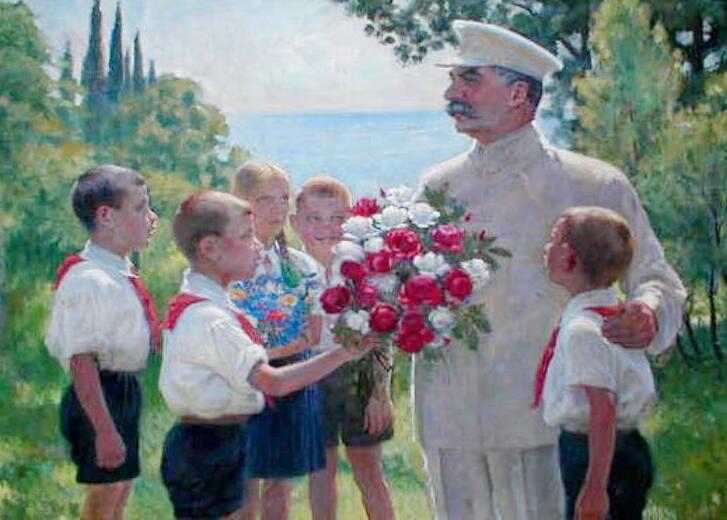
Figure 1.--During the Stalinist era, Stalin could cotrol how he was depicted and what was said about him. Here is a painting by an unidentified Soviet artist. It is called 'Roses'. It shows Pioneers of early 1950 giving Stalin a bunch of roses. Given the background it probably is meant to depict a scene at the Artek Pioneer Camp pn the Black Sea. There are many sentimental paintings and photographs like this showing Stalin with children. Notice how Stalin is depicted with the children, but strangely detached from them. He is not even looking at them.
Joseph Stalin is undeniably one of the most important figures of the 20th century. His impact on the devolopment of the Soviet state and society and the international Communist movement was immense. He is also one of the most evil figures in world history and was directly and indirectly responsible for the deaths of millions in the Soviet Union and Eastern Europe, a death toll even exceeding that of Adolf Hitler. He is hated throughout Estern Europe. And despite killing many of Soviet citizens, the Russian people are deeply conflicted about his legacy. Many despise him him. Others honor him as a strong leader. Perhaps his greatest legacy is the continuing reluctance of the Russian people to adopt Europen standards of civil rights abd the ruke of law. Some Russians lear for democracy abnd a strng civil society. Others see democracy as a dangerous threat to national security ad year for Siviet days in which neigbioring countries could be controlled. Russia today is a strange blend. It is country with an educated, capable peopleyet the economy is that oif a Third World country based on the export of raw materials. After seven decades of soviet rule, Stalin abd his successors signicantly affectedcthe mentality of the Russian people, fostering not only a fear and dustrust of foreigners, but also undermining conditions thtwoukd enable free market capitlish to flourish. Under President Putin, Rusian attitudes toward have generally become increasingly favorable.
Overview
The overwealming historical view of Stalin is that he was a fantical believer in Marxist-Leninismdogma. One biographer, however, maintains that this is a misunderstanding and that Stlalin who of course was a Georgian is best viewed as a traditional "Caucasian cheiftan". [Lukas]
Family
A great deal is know about Hitler's parents. In contrast, we know very little about Stalin's parents. Hitler idealized his mother. Stakin did not. Stalin's mother was Ekaterine Geladzewas. He was estrained from both his parents. Religion was a major issue beteen him and his mother. In particular he was very bitter about his mother forcing him to enter the Tiflis Theological Seminary. One account indicated that he referred to his mother as an 'old whore'. His assession to power occurred while she was still alive. She died (1937). He refused to attend her funeral and only sent a wreath. Stalin's father was Besarion Ivanis dze Jughashvili commonly known as 'Beso'. Stalin resembled him. When Joseph was 12 years old, he was struck by a carriage and hospitalized in Tiflis. After he recovered, his father took him away to be trained at his shoe factory. Ekaterina managed to recover her son with the help of friends in the clergy and school system. In retaliation, Besarion cut off all financial support to his family and left them without support. He was a successful cobbler, and did not understand his sin's involvement in revolutionary politics. He slid into alcoholism and became a vagrant. He died (1909).
Childhood
Joseph Vissarionovich Djugashvili was born in Gori, Georgia on December 9 (21), 1879. Gori was then in the Russian province of Transcaucasia. Little is known about Stalin's childhood.
Boyhood Home
A HBC reader viisited Stalin's boyhood home in Gori. He writes, "Here you can see the boyhood home of Stalin. It is a shrine in the grounds of a much grander home he had built when he was the the Russian Leader. It is now a museum. The museum rooms are a collection of paintings and photographs telling the biography of Stalin. The paintings include 5 about his childhood. The first picture shows him at a religious school in Gori. He is depicted as a studious boy working hard at his school work. Another painting shows a scene in which Stalin and his friends are going to school. Stalin is the boy with his school books pushed down the belt holding up his trousers. Another picture shows Stalin a little older with his friends visiting Gori Castle. This seems to be a place he liked to visit and several references are made to this place in the pictorial narrative. The fourth photograph showed him at a religious school that he attanded in Tbilisi when he was of secondary school age. He must have read a few books by this time because he became a radical student. The fifth picture shows Stalin being expelled from the school. His clothing shown in these pictures are of peasant styles. His clothes are checkered shirt, long trousers and boots. He has a short cut hair style, as do all the boys in the pictures.
There are other photographs of Stalin with his family. He had three children, two boys and a girl. The boys are dressed in military style uniforms. There is one photograh showing Stalin at a political event. Also at this event I believe is his youngest son. The boy is wearing a neckerchief showing he is in the Pioneers. The boy seems to be taking part in some kind of event because he is standing by a microphone.
Another photograph shows Stalin with a group of school boys. The message this picture gives is of a father figure encouraging his children to work hard at their studies and to go on to university.
There is a display showing a furnished room and on the walls are pictures of Stalin the family man. There is an affectionate pphotograph of him with his wife and three children. Most of the paintings show him with his daughter. These are very sentimental depictions designed to show Stalin as loving family man." In fact Stalin was teriblt cruel to his wife and sons. He was kinder with his daughter--until she began to hasve ideas of her own.
Education
Stalin attended the Tiflis Theological Seminary. Accounts vary as to whether he was expelled or quit to persue revolutionary activities.
Tsarist Russia
Russia at the time of Stalin's birth was among the most backward countries in Europe. It was ruled by the autocratic Romanovs in the person of a Tsar who ruled absolutely unrestrained by anyb legislature or elected body. The Russian Army after the defeat of France in the Napoleonic Wars (1799-1815) had been the most powerful in Europe. The Industrial Revolution had an emense impact on European society and weaponary. While Western Europe (especially England, France, abd Germany) underwent rapid change, Russian was only minimally touched. Westerm Europe's rapid industrialization had changed the power ballance and the impact Russia's backwardness was shown by mid-century in the impotence of the Russian army in the Crimea (1854-56). Despite the fact the serfs were legally freed in by Alexander II (1861), Russia remained an essentially feudal society into the early 20th century. Stalin grew up at a time when conditions for bothbformer serfs and urban workes were abisamal. Russia decline was further evidenced by its defeat by the Japanese Navy in the Russo-Japanese War (1905).
Revolutionary Activities
Stalin participated in revolutionary activities against the Tsarist regime. The extent and importance of his activities are a matter of sone conjecture. Here there are many varied accounts. After Stalin was in controll of the Communist Party and state by 1929, his role as a revolutiionry was expanded to increase his stature. Thus officual sources during the 1930s, 40s, and early 50s have to be treated with considerable skeptiism. Stalin became an axctive member of the Social Democratic movement in Georgia. It is unclear as to precisely when he became a Bolshevick. Stalin was arrested in 1902 under the alias Zakhar Grigoryan Melikyants and confined in the Bailov Prison in Baku. While in prison the Viceroy of the Caucasus ordered him from living in the Caucasus for 5 years. He was taken under escort during 1903 to Solvychegodsk, Siberia. Stalin escaped in 1904 and returned to Transcaucasia. He played an active role during the Revolution of 1905 which following Russia's disatrous defeat in the Russo-Japanese War, rocked the Trarist regime. Stalin organized attacks on Tsaeist officials as well as bank robberies to acquite funds for revolutinary activities. It was at this time he came to Lennin's attention. He was involved in various revolution ary activities after the 1905 revolution changed. He was arrested and escaped several times. He was in his absence elected a member of the Central Committee of the Bolshevik Party at the Sixth ("Prague") General Party Conference (1912). Tsarist officicials arrested him in 1913 anf he was exiled to northern Siberia. He remained there until freeded after the March 1917 Revolution overthrowing Tsar Nicholas II.
World War I was actually a largely European war. What made the war so important were
the huge casualties caused no only by the duration, but the introduction of new weapns,
including poison gas and rapid advances in the lethality of weapons. A whole generation of
European men was largely killed in the fighting. The consequences were enormous.
Empires and ruling families fell. Long held social systems collapsed. The Bollshevivks
seized power in Russia. New countries based on nationality were created in Eastern
Europe out of the old empires. The national hatreds that were spawned errupted in an even
more destructive war 20 years later. The Tsar's insistence on backing Sebia in a dispute with Austria-Hungaria helped triger Germany's declaration of war. No nation suffered more than Russia in the War. While Russia's participation in the War saved France from defeat, the country was unprepared for modern warfare. Russian soldiers died by the millions before German artillery and machine guns. The losses from poison gas were dreadful as few Russian soldiers had gas masks. Conditions on the homefront also deteriorated and by 1917 peoole faced stavation. Fianlly the Army muntinied and the Tsar was overthrone in March 1917 and a Provisional Government was established.
October Rebellion (1917)
Stlalin when he was freed in 1917 went to Petrograd and was made editor of Pravda ("Truth"), the Bolshevik Party newspaper. Stalin at first adopted amoderate policy of accomodation with the Menshevik and Social Democratic parties which made up the Privisional Giovernment. These parties believed in democratic government and they kept Russia in the War. The Germans, desperate to end the two front war which f\divided their forces, secetly brought Lenin accrss Germany in a sealed train from exile in Switzerland. After Lenin's arrival in St. Petersburg, Stalin adopted his policy of withdrawing from the War and establishing a proletarian dictatorship. Stalin throughout 1917 played little role in developing policy. He was not an inortant orator and was not directly involved in the events leading up to the seizure of power from the Ptovisional Governmen in October. Stalin was, however, a very effective organizer for the party.
The Bolsheviks after seizing power negoatiated the humilaiting Treaty of Brest-Litovsk with the Germans, resulting in the loss of huge terrtitories of Tsarist Russia, including the Ukraine. Thisenabled the Germans to rush their Eastern forced to the Western Front and launch a powerful Spring offensive in 1918 that came close to cracking the Frech lines before Paris. Kaiser Wilhelm had, however, launched unrestricted which had brought America into the War. The American Army helped to support the French and eventually launch an Allied offensive which compeled the Germans to seel an armistace which was signed November 11, 1918, eding the War.
Politburo
With the October Revolution, Stalin was made Commisar for Nationalities, in part because of his Georgin (non-Russian) origins. He was appointed to the Political Bureau (Politburo) of the Bolshevick Cntral Committe. In theory the Politburo was subcomitte of the governing Central Committe, but in practice important decissions came to be made in the smaller more manageable Politburo. Under Lenin the Politburo emerged as the authoritative central political center of the Party.
Civil War (1918-21)
The end of World war I did not bring peace to Russia. Russia's Bolsevik regime was considered an international paraiah. Germany was forced to renounce the Brest-Litovsk Treaty, but the Soviet Government was not invited to the Versailles Peace Talks (1919). Tsarist loyalists organized the White Armies to restore the Tsar to power. Lennin in 1918 ordered the execution of the royal family when the White Army approached. The Whites were aided by the Allies (including America, Britain, and Japan). Stalin during the Civil War (1918-21) and the Russo-Polish War (1920) was active in formulating military stategy and saw service as a political commisar with the Red Army.
Personality
Stalin was a man possessed by extreme paranoia. One biographer describes "... a large and crude claylike figure, a golem, into which a demonic spark has been instilled." [Conquest]
Seizure of Power (1922-29)
Lenin began to lose control of the Soviet Givernment in 1922 with developing arterioclerosis. It was at this time in a reorganization on the Party leadershiop that Stalin was made the General Secteatry of the Party. This have him enormous influence over not only the Party, but the greatly expnded secret police or Cheka. Lennin concerned about Stalin's growing power dictated a letter to the Central Committee recommending that Stalin be removed as General Secretary. For reasons not fully understood, he did not actually send the letter to the Centarl Committe. As a result, during 1923 Stalin consolidated his influence over the Party aparatus.
Lenin's death in 1924 resulted in a power struggle within the Bolshevik Party. Stalin was intent on building socialism in Russia. He was oposed by Leon Trotsky who dominated the left-wing of the party and had played a key role in building the Red Army which emerged victorious in the Civil War. Some of Stalin's early supporters (Lev Kamenev and Grigori Zinoviev) moved to Trotsky's side. The right wing of the Party led by men like Nikolai Bukharin supported Stalin.
Stalin moved in 1926 to decide the issue. He removed Trotsky, Kamenev, and Zinoviev from the Party leadership. He then in 1927 expelled the left Opposition from the Party and immediately ordered the arrest and deportation to Northern Russia and Siberia of tens of thosands of the supporters of the Left Opposition. Next in 1928 Stalin moved against the tight-wing faction of the Party which had supported, but was not subservient to him. It was at this time that Stalin seized control of the Comintern and began to demand that Communist parties in other countries accepted the ladership of the Sovier Communist Party.
Stalinist Era (1929-53)
Stalin by 1929 was in absolute control of the Soviet Ciommunist Party andcthe Soviet state. Thus the poplicies initaited beginning with 1928-29 are essentially policies that he personally approved and directed. Stalin and his Government was directly and indirectly responsible for the deaths of tens of millions of people. One debate in Soviet studies is the degree to which Stalin made the Soviet system or that system made him. One scholar argues that Stalin's death was in fact the beginning of the end for the Soviet Union. [Mastny]
Domestic Program
Stalin's domestic program included the following.
National Economic Plans
Stalin in 1928 instituted a series of 5 year plans which were essentially economic planning on a grand scale. Great empahasis was put on the expansion of heavy industry. Western companies like Ford were brought into to greatly expand production.
Collectivization
The forced collectivization of the peasantry was begun in the early 1930s. When the peasants resisted, hundreds of thiousands were killed outright and millions more deported.
It is now recognized by most authors that Stalin's ruthless policies including engineering a famine in the Ukraine resulted in more deaths that even Hitler's Holocaust
and other genocidal policies. Millions died in the Ukranian famine. The Soviet government made it a state secret and denied to the outside world that there even was a famine. No one knows for sure, but 6-7 million peopkle are believed to have died in a famine engineered to destroy the independent peasantry and prom
Cult of personality is also described as cult of the leader. [Mudde and Kaltwasser, p.63.] It is created when a country's dictatorial leader portrays himself as the embodiment of the nation. The pheomenon appears early in human society. Art was an important early was to propigate the cult of the leader. The giant sulptures of Egyptian pharoes are the greatest embodiment of this. It was not until the 20th century, however, taht the cult of peronality came into full force. This was because that mass media provided the technocal capability to propigate a cult of personalaity (newspapers, magazines, radio, and television). Through mass media a leader with control of the state could spread his message to every single member of society, including the children through the schools and compulsory youth organizations. Another key component is the rise of socialism leading many people to adopt Marxist ideas -- on a basically relgious plane. Nationalism had always been part of the cult of the laeder, but socailism provided an appealing ideological message to add to patriotism. Josef Stalin was the first modern leader to create a cult of personality. Hitler a few years later would be the next. Mass media along with spectacles, government-organized demonstrations and rallies to create the required mystique--the idealized, heroic, and worshipful image of an allpowerful, natioinal-socialist leader. Socialism was essential because of the claim of benevolence and the ability to create a one party state confering control of the media. Joseph Stalin's cult of personality became a key component of Soviet culture as soon as Stalin established dictatorial control of the Soviet state. It began with a lavish celebration of Stalin's 50th birthday (December 1929). For the next 23 years of Stalin's rule, the Soviet media and institutions like schools, youth opganizations, unions, civic hroups, atristic grouos presented Stalin as an all-powerful, all-knowing leader. Stalin's name and image appearing everywhere. Loud spoeakers in parks and city centers began to blare out the cult message. A new title was added--Father of Nations' (1936). The term was popularized by Nikita Khrushchev's secret Destaniozation speech 'On the Cult of Personality and Its Consequences'. It was delivered to a shocked audience on the final day of the Soviet 20th Congress of the Communist Party. Khrushchev at the time was the First Secretary of the Communist Party---the leading Soviet Leader. He criticized the abject iealization of Joseph Stalin, and by implication the Communist contemporary Mao Zedong as other Communist leaders. Khrushchev claimed that personalty cults violated Marxist principles. His speech was subsequently made public and was part of the "de-Stalinization" process in the Soviet Union.
Stalin organized a series of show trials in which priminent officials and military officers were forced to admit to ludicrous accounts of treason. Soviet citizens were encouraged to denounce their neigbors. Many did in an effort to improve their chances of survival. Stalin consolidated his personal power by eliminating opponents, suppressing any vestige of independent thought. A biographer reports that Stalin ruled by the Big Lie "not only by terror but also by falsification". Stalin used torture to extract false confessions creating what has become known as the Great Terror. [Conquest] Stlalin turned the Soviet Union into a police state in which Soviet citizens lacked even the most basic civil liberties. Workers were completely at the disposition of the state. Stalin ordered purges in which millios lost their jobs, homes, freedom, and often their lives. Most important Blosheviks that had led the Revolution were arrested and show trails organized in which the tortured defendents confessed to traechery and traeason (1936-38). Most were executed. Only a few Bolsehevik leaders, men like Molotov who were close to Stalin, survived.
Stalin did not create concentration camps. This was begun under Lenin. The approach was initially corrective labor. Stalin fundamentally changed the systems. The increasing numbers of arrests under the Stalinist Terror were used to fill an ever expanding number of camps throughout the country. The focus changed from corrective labor to slave labor. Not only did the arrests terrorize the Soviet people, but it provided a slave labor force which could be put to work on large scale projects decided on in the Five Year Plans. Many liked the Northern Canal resulted in enormois loss of life for pootly conceived projects. An estimated 18 million people are believed to have passed through the Soviet Gulag.
National Persecutions
The Cossocks were one of several nationalities persecuted by Stalin.
Foreign Policy
Stalin's foreign policy from an early period had to deal with the rise of Fascism in Europe, especially the NAZI seizure of power in 1933. He oversaw the German Communist Party's capitualtion to the NAZIs (1932-33). He then participated in the Common Front against Fascism. Stalin was one of the few leaders to support the Republic in Spain (1936-39). The major steps, however, was the decission in 1939 to make commmon purpse with Hitler. Stalin agreed to a Non-Agression Pact with Hitler and proceeded to seize territory from or annex Estonia, Latvia, Lithiania, Finland, Poland, and Romania (1939-40).
NAZI Germany
Stalin and Hitler came to power at about the sane time. , Stalin a few years earlier. Stalin praised Hitler for murdering much of the Soviet ruling class, many of whom opposed his rise to power. Few of the Old Bolsevicks survived The Terror. Hitler was basically loyal to the people around him and helped bring him to power. He did purge the Sturmabteilung (SA Storm Troopers) in the Night of the Long Knives (1934), but the numbers were infentesible compared to the Purges anbd Terror orcestrated by Stalin. [Conquest] The two were sworn enemies noes, although curiously they cooperated in one undertaking--the NAZI-Soviet Non-Aggression Pact (August 1939). They aggreed to partition Europe between them and to bring this about launched World War II by invading Poland. The two were allies for nearly 2 years. Stalin under the terms of the Non-Aggression Pact provided Hitler vast quantities of oil and other raw materials to support the Germn war economy. Hitler had calculated that a war in the West beteen the Germabs abd Allies (Britain nd France) woud weaken both, permitting the Soviet Union to dominate Europe. Instead, it enabled Hitlr to destroy the French Army. This mean that the Red Army faced the Wehrmacht with no posiubility of a two front distraction.
Mind Set
Histirians have debated what dominated Stalin's mind. Historians have tended to label Hitkleras finatical and Stalin as more calculating. There is, however, considerable reason fir bveklieving that Stalin was a fanatical believer in Maxist-Lennist doctrine. It is what blined him to the danger psed by Hitler. Domestically, Because he believed that Communism was a scientific approach and inevitable, he could justify disposing of those who stood in his way. Foreign policy was also dominated by his ideological beliefs. As Fascism was seem as the ultimate evolution of cpitalism, he saw little difference betwen the liberal democracies and Fascist Germany and Italy. Thus when reason would gave dictated alinging himself with the Western Allies, he was willing to negotiate an alliance wih Hitler and the NAZIs. Somehistorians have argued that Stailin enjoyed killing people. [Baberowski] notgher important obsever down played ideology and stressed traditional Russian foreign policyb objectives. [Kennan]
Other author believes it was his fannatical belief in Mrxist-Lenist ideology that was at the heart ofthe killing.
One author who had access tobSoviet archives writes, "Marxist-Lenninistv teachings infirmed everything in Stalin's life from his politics and his militarty srategy to his personal values." [Gellately]
Stalin had three wives, although one was a common-law wife. He had four children. Stalin's first wife was Ekaterina Svanidze. Rhey were married only 3 years. She died (1907). At her funeral he reportedly told intimates that any warm feelings he had for other human beings died with her because she was the inkly person capable of mending his heart. They had one son, Yakov Dzhugashvili. As the boy grew up, the two did not getvalong. Yakov served in the Red Army durin Wiorld War II. He was captured by the Germans who offered to exchange him for a German officer. Stalin refused, reportedly saying, "I have no son named Yakov." Yakov was not popular among other POWs with whom he was held. He was placed in a camp with British officers where conditions were better than in the camps for Russian POWs. The Germans offered to excahange him for captured German officers. Stalin replied that he had no son named Yakov. Yakov and the British officers did not get on. Yakov expected the kind of preverential treatment that he was accustimed to receiving as ain of te Soviet dictator. He apparently refused to clean up after himself in the latrine, seeing that a beneath his dignity. The British officers were not happy about having to clean up after himself and repeatedly brought the issue up. Yakov demanded the German camp commander intercede, but the German officer apparently considered it beneath his dignity to get involved in an issue about latrines. He died in German captivity although the circunstances are unclear. One account says that he ran into an electric fence surronding the POW camp. [Kundera] It is widely believed that however it ioccurred that his death was a uiside.
Stalin had a commin-law wife Lida, during his exile in norther Siberia. This was never mentioned during his reign as Soviet dlctator. Alexander Solzhenitsyn mentioned a son being born (1918). Russian Independent Television NTV discovered a previously unknown grandson living in Novokuznetsk--Yuri Davydov. His father had told him about his granfather, but because of the de-Stalinization campaign was advised to keep quiet.
Stalin's third wife was Nadezhda Alliluyeva. Nadezhda told him of the Ukranian famine which id couee he not inly alkready knew about, but had caused (1832). The result was a fight between the two. A few days later there was a public scene of brutality. Afterwards Nadezhda shot herself. [Conquest] Stevlana years after reported that she had left a suicide note which was "partly personal, partly political". Publically it was reported that she died of an illness, but other theories claim that Stalin himself killed her. Stalin repotedly said at her funeral "She died an enemy." They had two children: a son, Vassili, and a daughter, Svetlana. Vassili made a career in the Red Air Force. He died an alcoholic (1962). Stalin doted on Svetlana when she was young, but as she entered her teens problkems developed. She defecting from the Soviet Union (1967).
NAZI Foreign Minister Ribbentrop and newly appointed Soviet Commissar for Foreign Affairs Molotov on August 23, 1939, signed the Nazi-Soviet Non-Aggression Pact. At the time of thesigning, British and French delegations were in Moscow trying to reach an understanding with Stalin. Hewas convinced,
however, that they were tring to draw him into a war with Hitler. The two countries which until that time had been bitter foes, pledged not attack each other. Any problems developing between the two countries were to be delt with amicably. It was last for 10 years. The Pact shocked the world and the purpose was
immedietly apparent. It meant that Germany could attack Poland without fear of Soviet intervention. Thus after defeating Poland, Germany did not have to fear a full-scale European war on two fronts. What was not known at the time was that there was a secret protocol to the pact which in effect divided Eastern Europe betwen the two countries. This protocol was discoered after the end of the World War II in 1945. The Soviets continued to deny this protocol until 1989. The NAZIs 8 days after signing the Pact invade Poland on September 1, 1939, launching World War II. Although the Soviet's did not enter the War against Britain and France, the Soviets were virtual NAZI allies as they provided large quantaies of strategic materials, especially oil. Communist parties in Britainand France opposedthe war effort. The Communst Party in America opposed President Roosevelt's efforts to expand defense spending and assist Britain and France. Stalin has rightly been criticized for cooperating with Hitler, both because it led to World war II and it proved a disster for the Soviet Union. In fairness, however, Allied timerity before Hitler has to be considered. The Soviets were ready to fight over Czechoslovakia. Chamberlain's behavior in particular gave the impression that Britain was an untrustworthy ally if not trying to engineer a German-Soviet war that the Allies would sit out.
Histories of World war II generally focus on German and Jaoanese aggressions. After signing the Non Agression Pact with the NAZIS, Stalin in vurtual alliance with Hitler, launched on a series of aggressions of his own. The War in Europe began on September 1, 1939 when the German blitzkrieg smashed Poland in only a few weeks. The invasion was made possible the preceeding week when Stalin signed a non-aggression pact with Hitler. The Panzers crossed the Polish frontier on September 1 along with a devestating strike by the Luftwaffe. The Polish Army and Air Force was shattered. Britain and France declared war September 3. Within 6 days Cracow, the center of Polish nationhood, fell. Pincer movements began on September 9 to encirle the major remaining Polish forces. Once certain of Polish defeat, Stalin ordered the Red Army to attack from the East on September 17, sealing Polans's fate. German and Russian forces met at Brest-Litovsk on September 18. Warsaw fell a few days later after a ruthless bombing assault. After Poland, Stalin ordered an invasion of Finland. Britain and France considered coming to Finland's aid. The Finns infliced serious losses on the Red Army, but the wight of numbers eventually forced them to come to terms. Stalin next made demands on the Baltic Repiblics (Lithuania, Latvia, and Estonia) and the countries were seized in 1940. Stalin also seized part of eastern Romania.
The Battle of Britain in many ways changed the course of the War. An invasion of Britain was impossible without air superiority. Hitler, fearing a cross-Channel invasion, decided that the only way to force the British to seek terms was to destroy he Soviet Union. He began shifting the Wehrmacht eastward to face the enemy that he had longed to fight from the onset--Soviet Russia. The nature of the War changed decisevely in the second half of 1941. The Germans invaded Russia in June 1941, launching the most sweeping military campaign in history. The Soviets were surprised and devestated. Stalin ignored warnings from the British who as a result of Ultra had details on the Germna preparations. Stalin was convinced that they were trying to draw him into the War and until the actual attack could not believe
that Hitle would attack him. The attack was an enormous tactical success. The Soviets were surprised and devestated. The Soviet Air Force was destoyed, largely on the ground. The German scaptured 3.8 million Soviet soldiers in the first few months of the campaign. No not knowing the true size of the Red Army, they thought they had essentally won the War. German columns too the major cities of western Russia and drove toward Leningrad and Moscow. But here the Soviets held. The Japanese decission to strike America, allowed the Sovierts to shift Siberian reserves and in December 1941 launch a winter offensive stopping the Whermacht at the gates of Moscow--inflicting irreplaceable losses. The army that invaded the Soviet Union had by January 1942 lost a quarter of its strength. Hitler on December 11 declared war on America--the only country he ever formally declared war on. In an impassioned speech, he complained of a long list of violations of neutality and
actual acts of war. [Domarus, pp. 1804-08.] The list was actually fairly accurate. His conclusion, however, that actual American entry into the War would make little
difference proved to a diasterous miscalculation. The Germans who months before had faced only a battered, but unbowed Britain now was locked into mortal combat with the two most powerful nations of the world. The British now had the allies that made a German and Japanese victory virtually impossible. After the Russian offensive of December 1941 and apauling German losses--skeptics began to appear and were give the derisory term " Gröfaz ".
The war on the Eastern Front was the most gighantic conflict in the history of warfare. In large measure, the result of the campaign determined the outcome of the War. It is difficult to see how the Western Allies could have staged the
D-Day invassion to liberate France if the NAZIs had succeded in destroying the
Red Army on the Easern Front. The resistance of the Soviet people to the
NAZIs is one of the outstanding instances of heroism and valor in human history. It is no reflection on the character of the Soviet people that Stalin became virtually an ally of Hitler and launched a series of aggressions comparable to those of the NAZIs. Opperation Barbarossa came as a complete shock to Stalin (June 22, 1941). The Wehrmacht achieved stunning successes. In the drive toward Moscow and Leningrad, the NAZIs committed the most heinous attrocities in modern times. Hitler had made it clear from the onset that the campaign would be a war of extinction. At the gates of Moscow, the Russian Winter, interference by Hitler, and the bravery of the Red Army broke the Wehrmacht. Slowly after Moscow
and Stalingrad the the weight of Allied production, the resurgent Red Army, the
strastegic bombing campaign, and finally a second front with D-Day doomed the
Wehrmacht.
Character
Stalin shares many characteritics with Hitler. One was his ability to be charming in his personal contacts with colleagues. He was particularly kind to the wives and children of his inner circle. Of course he also had many of his associates and wives arrested. In his free time he liked to garden. He was also gifted with a wonderful singing voice. He loved movies and theatrical plays. His favorite film was reportedly Mukhail Bulgakov's "Days of the Turbins". He was what might be called a "workaholic" and was known to work in his office for hours on end. Here he differed from Hitler. Stalin had a keen intellect and was willing and able to master new fields. He was also a voracious reader as reportedly regularly read on average 500 pages nightly. [Montefiore]
World War II had left Europe devastated. A staggering 40 million people were killed in World War II. German cities had been levelled by the Allied strategic bombing. Fighting on the Eastern Front had also destroyed cities in Russia and Eastern Europe. The economies were prostrate. Jobs did not exist and capital was scarce to revitalise the economies. The performance of the Communists in the Resistance had increased their prestige. The desperate economic conditions also increased support for the Communists. After the War, the Communists were one of the largest political parties throughout Western Europe, especially in France and Italy. Only in Germany where people feared the Russians did the Communists not build an electoral threat. In an effort to promote economic recovery, the United States implemented the Marshall Plan. (It was not called the Truman Plan because that would have doomed it in the Republican controlled American Congress.) The Plan was proposed by American Secretary of State George C. Marshall in 1947. Eventually over $12 billion (in 1948 dollars) was provided. This assistance is generally credited with helping to launch the European economic recovery. Some authors down play the importance of the Marshall Plan, maintaining that the recovery was already well underway. [Hitchcock] Marshall Plan assistance was offered to Russia and the Eastern European satellites. Stalin, suspicious of American intentions, rejected the offer and speeded the establishment of Stalinist regimes throughout Eastern Europe. [Hitchcock]
Germany's defeat left Stalin in control of the countries of Eastern Europe. President Harry Truman whe he became president in April 1945 began taking a stronger aproach to the Soviets, disturbbed by Soviet actions in Poland. Stalin proceeded to install People's Republics in these states which men Stalinist police states subservient to the Soviet Union. American and European democracies sharply critivised the Soviet actions. Winston Churchill warned in 1946 that an "iron curtain" was descending through the middle of Europe. Joseph Stalin who had virtually allied himself wih Hitler in 1939 to launch World War II, blamed the Wat on "capitalist imperialism" and threatened Wrestern Europe. Preident Truman decided to support Western Europ ecomomically (the Marshll Plan) and militarily (NATO). The Cold War was a period of intense East-West competition, tension, and conflict, but always short of full-scale war. The first major episode was the Soviet blockade of Berlin in 1948. Berlin was during much of the ColdWar a focal point of the conflict. The Soviets brutally supressed attempts by Eastern Europeans to overthrow Soviet imposed governments: East Germany (1953), Poland (195?), Hungary (1956), and Czeselovakia (1978). There were proxy wars and
competition for influence in developing countries, many of which introduced Soviet command economics. There was also an arms race between the two super powers. After Stalin died in 1953, the Cold War became more unanced. There were periods of relaxation followed by resumed confrontation. The most dangerous point of the Cold War was th Cuban Missle Criis (1962). There were efforts to persure detente during the 1970s. Unlike the other major conflicts in world history, in the end the Cold War was not settled by force of arms. It was the example of the West, especially the success of free market economics and political democracy
that defeated Communism. [Mandelbaum]
Korea (1950)
Stalin's focus as the Cold War unfolded was on Europe and Germany, but after establishing a Soviet empire of Eastern European satellite police states, further advances were stopped by stiffening Western resistance made possible by the United States. The Soviet-backed Western coup in Czechoslovakia was the last straw for the West. Stalin was surprised. Unlike World War I and contrary to his expectations, the United states did niot withdraw from Europe. His effort to seize West Berlin failed (1948). And yh United States hrlped organize the North Atlantic Treary Organnization, a defensive military pact (1949). This essentially ended the possibility of further advances in Europe. At the same time, the Soviet Union tested its first atomic bomb (1949). This must have affected Stalin's thinking, meaning that America no longer had a nuclear monopoly. The Chinese Communists finally defeated the Nationalists (1948). We are not sure just how, but also must have affected Stalin's thinking. The Soviets had provided substnhtial military assistance to Kim II Sung's regime in North Korea, including heavy weapons such as artillery and tanks. American military aid to South Korea was much more limited. We are not sure to what extenht that Soviet intelligence was aware of this or what was reported to Stalin. Russian sources based on access to Soviet archives insist, "Until the end of 1949 Stalin did not plan any aggression against South Korea. Instead he was worried about an attack from the South, and he did everything to avoid provoking Washington and Seoul. In 1947-1948 Soviet leaders still believed in the possibility of a unification of Korea, and refused to sign a separate friendship and cooperation treaty with North Korean leader Kim II Sung." [Bajanov] The Soviet Embassy began reporting growing South Korean violations of the 38th parallel. Of course one has to ask, how did the Soviet Embassy know this. The most likely source is the North Koreans. We do not know for sure, but it seems unlikely that this was actually occuring.
Soviet Ambassador Shtykov 'bitterly' complained to Moscow that the North Koreans did not have the personnel, weapons and ammunition to rebuff 'intensifying incursions' from the South (February 3, 1950). Again we suspect that he was relaying demands from Kim. Kim traveled to Moscow and in a meeting with Stalin appears to have asked for permissiion to invade South Korea (March 3, 1949). Stalin was, however, adament, "The 38th parallel must be peaceful. It is very important." Reports from Pyongyang and the Soviet Embassy seem to have gradually changed his mind. We suspect that Western resistance in Europe created a need in his mind for a victory somewhere. And the Communist Chinese success also probanly motivated him to achieve a success in Asia. The United States withdrawing its troops in 1948 reduced the danger of a big-power cobfrontation was seriously reduced. Just what Stakin's thining was will never be known with any certainty. It was all processed in Stalin's mind and he left no written accounts. Stalin finally consented, but did not confer with new Chinese Communist regime in Bejing. [Bajanov]
Andrei Alexandrovich Zhdanov
Andrei Alexandrovich Zhdanov (1896-1948) is not a name known to most Americans except a few Soviet scholars. He was a Soviet Communist Party official and leading Soviet cultural ideologist. We know nothing about his childhood. He became a membr of the Russian Social Democratic Labour (Bolshevik) Party during World War I (1915). He rose rapidly in Party ranks after the Revolution. He became the All-Union Communist Party manager in Leningrad after the assassination of Sergei Kirov (1934). This was important not ionly because Lennigrad was such an important city, but because Stalin probably ordered Kirov killed. Thus his choice of a replacement was especially important. Part of Stalin's manmagement strategy was to involve his associates in his crimes. Zhdanov seems to have been less active than others (Vyacheslav Molotov, Lazar Kaganovich and Kliment Voroshilov), but vhe was one of the perpetrator of the Great Terror and purges. He his known to have approved 176 documented execution lists. [Memorial] Zhdanov played a major role in the all importannt defense of Lenningrad with the NAZI World War II invasion (1941). He served as Chairman of the RSFSR Supreme Soviet (1938–47).
Control of Soviet culture was an important post. And it was Zhdanov responsibility to ensyre that Soviet intelectuals creating art conformed to the Party definded ideology. Ideology perhaps until recently may not seem very important to Americans. To the Soviets, however, it was important. Intelectuals could be shot or sent to the Gulag over questions of ideology. And Zhdanov was at the center of thius. First to work in the arts you needed Government apprival. Second all artistic work was government employment. Third, all artistic work had to confirm to the ideolgical mandates of the Party. And Zhdanov is the person who set the standards and oversaw the evluations and disclipining the artisistic community. Even more important, he became very close to Stalin to the point that there was talk of him being Stalin's sucessor. Zhdanov's relatinship with Stalin deteriorated as a result of the Yugoslav crisis and heavy drinking.
The Doctor's Plot (1953)
Stalin conjured up a Jewish medical plot against him. He ordered his Jewish doctors arrested it would prove to be greatest mistake he ever made. The plot he he fabricated was conspiracy of prominent Soviet medical specialists (mostly Jewish) to murder leading government and party officials. Many Soviet scholars today blieve that Stalin intention was to use the doctors’ trial to launch a massive party purge. Many believe it may be better descibed as a Jewish pogram.
Soviet newspapers (Pravda and Izvestiya) reported that nine ptominent doctors who had been or were attending ed major Soviet leaders, including Stalin, had been arrested (January 13, 1953). Most were Jewish. They charges were stunning. The doctors were attending Andrey A. Zhdanov, Central Committee Secretary, who had died in 1948 and Alexander S. Shcherbakov who had been head of the Main Political Administration of the Red Army and who nhad died in 1945.
Others were accused of attempting to murder several marshals of the Red Army. Those arrested included Stalin's own doctor which would have fatal cinsequences -- to Stalin. The doctors were accused of being in the pay United States and British intelligence services and notabkly of serving the interests of 'international Jewry'. This was a turn in Soviet opropagabnd. The Soviet press reported that all of the doctors had confessed their guilt. This was the only aspect of the case that was accurate. The arrested sictors were brutally torturd by the NKVD and forced to confess. The trial and what ever purge/pogram that Stalin was planning never occured. He suffered a heart attack (March 5). It was severe, but no ones knows how serious. He was with close assiociates and because his doctor was in the Lubyanka being tortured by the NKVD, emergency medical assistance was not called in for some time. The first actin taken by those un power was to arrest an execute Beria. As head of the NKVD he had mastermined the Dicrors' Plot. The next month, Pravda reported that a reexamination of the case showed the charges against the doctors to be false and their confessions to have been obtained by torture, an astonishing admission in Soviet newspapers. The arrested doctors were exonerated, although two had dies as a result of the torture inflicted on them. The next year, an official in the Ministry of State Security and some police officers were executed for fabricating the whole episiode (1954). Beria had already been executed. No mention was made of Stalin's role. This finally came 2 years later. Nikita Khrushchev in his Secret Speech to at the 20th Party Congress informed the delegstes that Stalin had personally ordered that the cases be developed and confessions elicited (February 1956). He said that the 'Doctors’ Plot was to begin a new purge and that Stalin had intended to include members of the Politburo in the list of purge victims.
Stalin's Plans
One historian charges that Stalin was planning much more than a purge or pohgram and was preparing an invasion of Western Europe and knew that would be a dissater for the Soviet Union. [Radzinski] The historical record supporting this is weak. We don't discount it, but have not seen sufficent evidence to support it. Suposedly the deportation of Soviet Jews was a step toward raising tensions with the West. As was the so-called Doctors' Plot. Stalin believed as Hitler did that Jews had enormous influence in world finance and American society.
Death (1953)
Stalin died at 9:50 p.m. on March 5, 1953. Controversy swirls around Stalin's death. There were no shortage of individuals even in his inner circle that hated him. Stalin’s two grown children were aware of how he treated their nother. His abuse hadled to her suicide. He had Foreign Minister Molotov's wife arrested and committed to the Gulag. We know that Khrushchev was fully aware of Stalin’s crimes. (He had participated in them.) NKVD Chief Beria had been publicly humiliated by Stalin and fully aware of the fate of previous office holders. Some maintain that he was poisoned. Others that his Politboro colleagues witheld medication after the stroke. Lavrenti Beria (1899-1953) is most commonly identified as a key ploter. Of course Beria had more than World War III to worry about. He knew that Stalin periodically disposed of his secret police chiefs so that details of his crimes died with them. There is considerable reason to believe that Beria poisoned Stalin. Beria is believed to have put rat poison in Stalin's wine. Beria was apparently concerned with good reason that diappointments in the H-bomb program had caused Stalin to prepare for his arrest. Here Beria struck first. Stalin reportedly vomited blood for 3 days. [Reed] There was no doctor present. This was an indirect consequence of the Doctor's Plot that Stlain himself had dreamed up. Thus when he fell ill there was no doctor fully competent to treat him. He was in bed and no body dare give him a so mush as an aspirin. His Kremlin toddies anxious to assist. Everyone feared him and what would happen if he should die while they treated him.
Mourning and Internment
Stalin was the longest ruling Soviet leader. Soviet radio began to issue grave account's of Stalin's health (March 2). Stalin at 73 years of age suffered Tass repoted was a cerebral hemorrhage. The Soviet propaganda machine had succeeded to an extent that many inside Russia venerated him as a virtual god. (An interesting outcome given the Soviet athiest campaign.) Coomunists worldwide looked up to him. The result was an outpouring of grief that bordered on religious hysteria. Thousands in Moscow lined up in the snow to see Stalin's body laying in state. The crowds were so large that some people died in the press to see their leader. Some estimates are as high as 500 deaths. Stalin was interred next to Lennin in the Red Square mosoleum. Three speeches were made, by Georgy Malenkov, Lavrenty Beria, and Vyacheslav Molotov.
Beria
Beria in the annals of the 20th century is a man so monsterous that he is approached only by Himmler. In the end, Beria 's role in Stalin's death, whatever it may have been, did him no good. His colleagues were more than aware of what Beria hd in mind. Before Beria could effectively use the NKVD to place himself in power, his Politboro colleagues expelled him from the Party before he could use the NKVD to seize power himself. They then had him tried and executed.
Image
During the Stalinist era, Stalin could cotrol how he ws depicted and what was said about him. Here is a painting by an unidentified Soviet artist which provide the favored heroic image (figure 1). here are many sentimental paintings and photographs like this showing Stalin with children. Images like this were designed to reinforce what became to be called the "Cult of Personality". Stalin's image after his death varied widely during the various regimes which followed him. Nikita Khrushchev shocked the Communist world when he denounced Stalin at the 1956 Party Congress. When Khrushchev was replaced in 1964, the Party line changed. There was no further discussion of Stalin's crimes. The few references to Stalin dealt with his role in the World War II victory over the NAZIs. No reseach was permitted on Stalin and his crimes. Of course this greatly complicated Soviet history as Stalin was at the center of the Soviet State from its inception and especially agter the death of Lenin in 1924. Stalin's image changed again with the advent of Gorbechec and perestroika. Censorship was first eased and then ended. Solzetezin's books became available. A series of starteling memoirs and books addresing the Stalinist era appeared. Soviet archieves were oopened to historians. Some school text books began to provide factual accounts of Stalin's crimes and terror. The Memorial Society has played a prominent role to promote scholarship on the Stalinist era. While Stalin is today reviled, the Russian people who sufferd under the terror do not have the same negative image of him. A poll conducted in St. Petersburg during February 2003 found that 45 percent of the respondents felt Stalin played a generally positive role in Russian life. (38 percent felt his role was negative and 17 were undecided.)
Legacy
Although Stalin died in 1953, his legacy continues to haunt the Russian people. A fundamental distrust of the Goverment continues to be felt by the Russian people. The Russian state continues to distrust its people. Russian officals deeply distrusts the idea of a free press--a fundamental institution in any modern democratic government. The Russian peopke are deeply conflicted. During the Soviet era they were taught to rely upon the state to provide basic services and jobs and to make major decissions in their live. This dependendency continues to exist, although efforts to distrust and deceive the state (census, taxes, ect.) are also strongly ingrained.
Monument
In the aftermath of the fall of Communism and the Soviet Union at the end of 1991, statutes to the Soviet dictator were torn down all over Russia. Was had not occurred in a country obsessed with monuments is that none have appeared to honor the millions executed by Stalin's police, starved in the Ukraine, died in orce locations, and disapperared into the Gulag. Numerous sites of mass graves have been discovered, some near Moscow, but no effort has been made to build any kind of memorial to Stalin's victims.
Sources
Babeeowski, Jörg. Verbrannte Erde. Stalins Herrschaft der Gewalt (München: C.H. Beck, 2012).
Bajanov, Evgueni. "The Origins of the Korean War: An Interpretation from the Soviet Archives," (1995). This article is based on recently declassified Soviet archives. The article was originally presented by Dr. Evgeni Bajanov to the conference on "The Korean War, An assessment of the Historical Record," 24-25 July 1995, Georgetown Univ., Washington, D.C. Dr. Evgueni Bajanov is Director of the Institute for Contemporary International Problems, Russian Foreign Ministry, Moscow, Russia.
Conquest, Robert. The Great Conquest.
Conquest, Robert. Stalin: Breaker of Nations.
Fest, Joachim. Hitler (First Vintage Books: 1975), 844p.
Gellately, Robert. Stalin's Curse: Battling for Communism in War and Cold War (2013), 496p.
Kennan, George.
Kundera, Milan. The Unbearable Lightness of Being (English translation--Harper & Row, 1984).
Lukas, John. June 1941: Hitler and Stalin (Yale University Press, 2006), 169p.
Mandelbaum, Michael. The Ideas that Conquered the World: Peace, Democracy, and Free Markets in the 21st Century.
Mastny, Vojtech. Woodrow Wilson Center. Library of Congress Panel, March 5, 2003.
Memorial Society. Stalin Lists.
Montefiore, Simon Sebag. Stalin: The Court of the Red Tsar (Knopf), 785p.
Mudde, Cas and Cristóbal Rovira Kaltwasser. (2017) (New York: Oxford University Press, 2017).
Radzinski. Edvard.
Reed, Thomas C. At the Abyss: An Insider's History of the Cold War (Ballantine Books: 2004).