Many famous and not so famous men remember the clothing and hair styles they wore as boys. Not so many years ago it was all up to mom how junior was dressed. In some cases, especially in the late 19th and early 20th Century, moms in Europe and America let their imaginations run wild, choosing elaborate Fauntleroy and kilt outfits for their darling sons. The wife in affluent families rarely worked and thus she had a great deal of time, and in some cases the assistance of nannies and governesses, to see to the care and dressing of their children. The results were very little boys kept in dresses. Ever after they passed out of dresses, little and not little boys done up in dress-like tunics and kilts and lacy Fauntleroy suits and kilts as well as more manly sailor suits. Biographical information is available on selected individuals (S-Z) here. This page is still being developed. If you have any historical information to add, do let me hear from you.
|
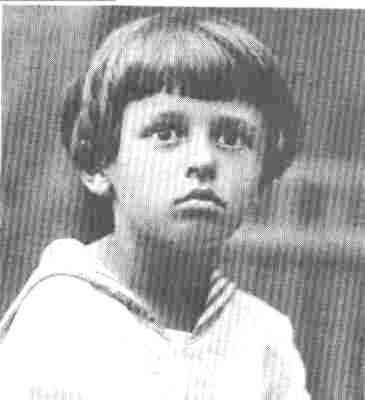
Sakharov, Andrei Dmitrievich - (USSR, 1921-89): The father of the Soviet Union's hydrogen bomb grew up after the Revolution. He was born into a Moscow family of cultured and liberal philosophy--a background which was to prove dangerous in the 1930s. "From childhood, I lived in an atmosphere of decency, mutual help and tact, respect for work, and for the mastery of one's profession," he later wrote. This was the environment that shaped Sakharov's life. As a younger boy, his parents kept him out of Soviet schools. Andrei was quite a charming little boy. I have seen a picture of him as a little nipper with bangs and dressed in a sailor suit. At Moscow University where he studied physics, he was quickly recognized as one of the most brilliant students. He was exempted from military service during the war with Nazi Germany and completed his studies in 1942. For several years he worked as an engineer at an armament factory and patented several inventions. Soon after the war was over he was recruited into the top-secret nuclear weapons project. He is now universally known as the father of the Soviet hydrogen bomb. He later wrote about the dangers of nuclear war and the resulting environmental and human damage. He heroically became a symbol for human rights in the Soviet Union, earning the admiration of the world and a Nobel prize.
Sadriddin, Aini - (Tajikistan, 1878-1954): One of Tajikistan's most important writers is Aini Sadriddin (1878-1954). Aftr the Revilution he got into trouble for speaking Tajik. Soviet police whipped him thin an inch of his life. Then he was thrown into prison (about 1924). The Soviets were making Tajikistan into a Socialist state. The overthrew the Emir of Bakhara. Aini was released from prison and from then on supported Soviet Ideaology and wrote books about the despotic times of the reign of the Emirs. We do not have chilhood portraits of Sdriddin, but we have some of his family.
Sargent, John Singer - (US, 1856-1925): The brilliant American portrait painter was born in Europe and received no formal education. I have no information on how he was dressed as a boy. He did grow up among European high society. As a painter no one portrayed the rich and famous of the Gilded Age more brilliantly with such dazzling beauty. Many of his portraits included children showing their fashions as well. With a few masterful exceptions, however, most of the children he painted were girls.
The Sassons - (England, 1890s): Alfred Sassoon had three sons, Siegrried (b 1885), Michael (b. 1886), and Hamo (b. 1887). The photograph shows the boys and their father about 1895, several months before Alfred's untimely death, Alfred and his wife were estranged. He spent most his time in London where he was having an affair.
van Schendel, Arthur: (Netherlands (1874-1946): Arthur van Schendel was a Dutch novelist and short-story writer with a decidely romantic temperament but possessing what the Encyclopaedia Britannica calls "a concentrated, restrained, almost classical style." He wrote some of the greatest novels of the period. His first significant novels, A Wanderer in Love (1904) and A Lost Wanderer (1907) are set in medieval Italy. Some availavle family snapshots show how his children were dressed.
Schiller, Friedrich - (Germany, 1759-1805): Friedrich Schiller is one of Germany's most noted poet, dramatist, historian and philosopher. Along with Gothe he is cinsidered a founder of German literature. He is widely considered second only to Gothe. He was born in November 11, 1759 in a small village Marbach near Stuttgart in Württemberg. We know little about his childhood. His work in German language have similar importance in literature than Shakespeare's work in Britain. (Shakespear of course is also important linguistically as he wrote a time when modern English was just begin to emerge.) Schillerwrore with an already well-developed German language. His first important play was "Die Räuber", a fairly standard Sturm und Drang play (1781). A major work wa :An die Freude" (1785), this was the ode to joy used bt Betoven in his 9th SymphoThis was followed by one of his most notable works--Juan Carlos (1787). There were several historical works--a genre Schiller was particularly adept at. He published a work on the Thirty Years War (1793). There was a dramatic trilogy on Wallenstein (1798-99). Colleridge trnslated part of this for his poem "WAllensttein (1800). Nexy was Maria Stewart (1800) and ther Die Jung frau von Prleans (1801). A favorite of many was "William Tell" (1804). Schiller is notable for this account of Swiss hero Wilhelm Tell, giving the Swiss their national hero. Perhaps no work is more widely known than "THe Song of the Bells". He and Gothe had a celebrated friendship. He was active in Weimar during his last years. He died May 9, 1805 at Weimar in Thüringen.
Schmeling, Max (Germany, 1905-2005): Max Schmeling was one of the best known boxers of the 1930s. Max was born in Klein-Luckow , a small town in the norther German state of Brandenburg (1905). His father with the same name was a helmsman (boat pilot). His mother was Amanda (nee Fuchs). The couple moved to Hamburg, Germany's principal port. Max as a teenager after World War I became interested in boxing after seeing a movie. He began training as a boxer. He won both amateur and professional light-heavyweight boxing titles (1924). He became a sensation in Germany and moved to Berlin (1926). As he developed and gaimed weight he began fighting in heavier divisions. He won the German heavyweight division (1928). He is best known today for his two matches with famed American boxer Joe Louis (1936 and 38). The fights in America were billed as a fight between America and the NAZIs. Goebbels propaganda machine played up both the national and racial aspects of the fights. Important NAZIs were often pictured with because of his popularity in Germany. Boxing also fit in with the NAZI mindset. Boxing was strongly promoted in the Hitler Youth. Actually, Schmeling was not a NAZI and refused to join the Party. The NAZIs dropped him after he lost the rematch with Louis. Schmeling showed bravery both in and outside the ring. He protected Jews during Kristallnacht (1938).
Schoonover, Frank - (United States, 1877-19??): Frank Schoonover was a famous illustrater in the Golden Age of Illustration. In the short autobiography included in a book, he talks about his youth and how much
he loved the outdoors, spending much of his time in the woods, walking along streams and fishing. However, in spite of this, he had long hair about the sme time that Fauntleroy curls came in vogue and least on some occasions wore dresses.
Schwarzenegger, Arnold - (Austria,1947- ): Arnold's father was the local chief of police. He was athletically inclined and demanded superior performance from his two boys. Arnold was the younger brother and his father apparently preferred the older son. I believe his father was very strict with the boys, but I have few details. In a school picture at about 10 years old he was wearing a middy blouse, presumably with shorts. I have seen a picture of Arnold with three of his friends at about 13, but he was the only one in shorts. He was not a stocky boy and only began to develop his physique after he got interested in body building as a young teenager. He liked soccer, but was not excited by team sports which is father favored. For some reason he really took to body building which his father attempted to discourage.
Scott, Peter - (England): In his biography, the late Peter Scott, son of the famous polar explorer, is shown dressed in an Isadora Duncan tunic as a child. He wore short trousers under his tunic.
Seeger, Pete - (United States, 1919-2014): Pete Seeger was born in New York during 1919. He was a son of Charles Seeger ( -1979) was an ethnomusicologist who taught at Yale and Julliard. Politically he was a strong critic of World War I. Pete had a privlidged if rather unorthodox childhood, attending a private boarding school and Harvard University. His hear from an early point was with the rural folk music his parents studie. It was involvement with his parent's work that he became emersed in folk music and the five-string banjo. While at Harvard he experimented with Communism. He seems to have rejected the regimentation, but was drawn to the social message. After dropping out of Harvard in the late-1930s he worked for folklorist Alan Lomax in cataloguing and preserving traditional songs. Over the next few years, Seeger and friends formed the Almanac Singers, one of several groups he sang with, and lived in a kind of commune in Greenwich Village. He struck up a friendship with Woody Guthrie. After World War II, he helped spearhead an American folk revival. He championed folk music which he saw as both a vital national treasure and a potential catalyst for social change. He turned 'we shgll overcome' into a thme songof the Civil Rights Movement. The issues he chmpioned included the labor, civil rights, anti-war, and environmental movements. He began singing at labor rallies and became a concert hit during the folk era (1950s-60s). His music was a heady mix of protest and traditional folk music. As a youth, I was moved by the power and persuaiveness of his message. He was a stong voice for the Americam left and protest. He once said, "If you love your country you will find a way to speak out." I would agree, but why did he never speak out to afirm the strengths of America? His music and ideology thus included many contradictions. He was a strong supporter of the labor movement, but seemed unaware that it was free market capitalism that bought prosperous lives to workers. His song tickie-taki criticised suburban housing which helped bring reasonably priced housing to workers. He was a mainstay of the anti-War movement, but after the Communist victory expressed no concern for the mass killing and supression of indivudual linerties carried out by the victorious North Vietnamese. While criticising violations of civil liberties in America, he never raised his voice to criticise much more massive violztion of humn rights in Communist countries. His Depression era unbringing and focus on protest never enabledhim to fully inderstand Americz;s role in the world or earh changing potential of free maket capitalism.
Shakespeare, William - (England, 1564-1616): English poet and playwright William Shakespeare is generally considered to be the greatest writer in the English language and perhaps the most important dramatist. He played a major role in the development of the English language. A vast number of modern words and phrases first appeared in his 38 known plays in addition to 2 long narrative poems, 154 sonnets, and a variety of other poems. He was born and raised in Stratford-upon-Avon. There are lots of speculations about Shakespeare's childhood in Stratford-upon-Avon, but there are no documentable facts beyond his baptism. We know that his father, John Shakespeare, was a glover and Alderman from Snitterfield and the family lived in comfortable circumstances. His mother was Mary Arden, the daughter of an affluent landowning family. William was the eldest surviving son. We assume that the young William went to the local grammar school--the King Edward VI Grammar School in Stratford. King Edward was known for supporting education. Historians believe that the youngv William almost certainly was educated there. Given his father's status in the community and his literary accomplishments, he clearly had an education and the local grammar is the only place that he would have gotten his education. William lived close to the school and there were no other schools in that Warwickshire town. Shakesperian scholars speculate as to John's loss of possition as Alderman. Some believe it was because of Catholic sympathies and this would have significantly colored William's prospects. Our first documented knowledge of Shakespeare concerns his marriage to Anne Hathaway and his early career in London in connection with the theatre. He had three children, but these stayed behind with his wife in Stratford while Shakespeare lived a single life in London. Ironically, the great writer made no provision for his daughter's education. HBC has done some work on his plays in our Renaissance drama section.
Shelley, Percy Bysshe - (England, 1792-1822): Shelley is one of the most notable English poet. His father founded a family fortune by the time honored expeient of marrying welthy heiresses. Percy was thus raised in a wealthy household with four sisters. A painting of his at about age 8 shows him with longish hair and a ruffled collar. At 10 years of age he was sent to Zion House school where he was miserable. Next he went to Eton where he was even more miserable. At Eton he refused to fag, an act of some courage. He was was terribly taunted and bullied at Oxford. He became known as Mad Shelley. He then went on to University College, Oxford. His father endulged his son's literary aspirtions by financing his first publication, not knowing anything about it. The pamflet, "The Necessity of Atheism" promtly got him expelled. He went on to lead a wild life, running off to marry and then adding another young lady to this circle who he lzter married. Mary Shelley wrote Frankestein (1818). Much of Shelley's poetry had a revolutionary flare to it. The British authorities kept him under strict observation. Shelley went to Italy where he wrote most of his best known poems. There he died in a sailing accident (1822).
Shepard, Earnest - (England, 1879-19??): Ernest Shepard is the artist who illustrated many classic children's books, including Winnie the Poo. It is his classic drawings of Christopher Robin playing in smocks and strap shoes that usually appear with any discussion of the A.A. Milne books. Shepard published a loving memoir of his and his brother Cyril's boyhood experiences. The many drawings nicely illustrate what the boys wore. Earnest wore dresses as a little boy and then mostly sailor suits with a Little Lord Fauntleroy suit and lace collar for a party suit. He didn't like the lace collar. He apparently never had to wear a kilt, which was good as he didn't like them. His older brother Cyril wore Norfolk suits and Eton collars. Both boys wore their suits with knee pants and long stockings.
Siegerist, Joachim (Germany, 1947- ): Siegerist is a very controversial figure in modern Germany. He wrote an amusing account of his childhood. He was brought up in Schleswig-Holstein and served an unhappy teen-age apprenticeship as a typesetter in a German newspaper, which is supposedly how he began a career as a journalist. Very early on, he associated himself with German right-wing politics (he describes himself as a Christian conservative), and at one point emigrated to Latvia, a country in which he still has dual citizenship as a German with two passports.
Sinatra, Francis Albert -- (US, 1915-98): Frank Sinatra known as "The Voice" is one of the greatest American singers. Frank was born in Hoboken, New
Jersey during 1915. He grew up in an Italian family in very modest circumstances. As a boy, he was more interested in becoming a journalist than a singer. His first job was with a newspaper, but he soon decided that he wanted to be a singer. He was fascinated by Bing Crosby who was the most important American crooner in the 1930s. Frank attended a Crosby concert in 1933 and at this time decided he was going to be a singer. At first he worked in clubs and bars. Radio was the media phenomenon of the 1930s. Sinatra go on the Major Bowes Amateur Hour. He combined with a trio also on the peogram and the four young worked together as the "The Hoboken Four". They won first prize on the show as well as their first concert appearances as partof the Major Bowes travelling show. Frank began appearing on various radio programs, often without any pay or just expenses.
Slater, Sammuel -- (England/America, 1768-1835): Samuel Slater is often seen as the father of the American factory system and esentially American industry. Sammuel was born in Derbyshire, England (1768). His father was a yeoman farmer. Sammuel was apprenticed to the owner of a cotton mill. He proved so competent thast he evebtually became the superintendent of the mill. In the process he became expert at running the mill macinery designed by Richard Arkwright, a key figure in the industrial revolution which began began in England with the textile industry. Arkwwright also devised improved methods for using water power to drive machines and divide labor among groups of workers with specialized tasks. Slater decided his future lay in America. He wanted to own and run his own textile factory. At the time Britain was protecting its new developind industrial technology. Parliament passed laws forbidding textile workers to share technological information or even to to emigrate. He thus left Britain for New York covertly (1789). He memorized details of factoty machinery so he would not be caught secreting the technology out of the country. A Quaker merchant, Moses Brown, helped Slater build his factory in Pawtucket, Rhode Island. It was America's first water-powered cotton spinning mill. Slater's factory was operatring only a year after his arrival in America (late-1790). At first power was provided by workers walking a treadmill which drive machinery that carded and spun cotton into thread. This was the beginning of the American industrial revolution. The next year a waterwheel was functioning (1791). Slater employed whole families, including the children, to live and work at his mill. Children worked on the farm so it was not seen as exceptionl that they worked in factories. This would become known as the Rhode Island System. He had no trouble attracting workers. Slater and his brother built a another mill ans a village around it (1803). It was called Slatersville. With the earings from his first mill, he was able to build a larger, better equipped mill as well as tenement housing for the workers and a company store. It was a small pocket of in a rural farmig area. Slater's Rhode Islans System was imitated by others as American began to industrialize and cotton became availavle in quantity from southern plantation as aesult of Ely Witney's cotton gin. Francis Cabot Lowell was one of many who adopted Slater's Rhode Island System and inproved upon it. Slater died in 1835.
Smith, David -- (US): American sculptor raised by a strict mother. I've seen one picture of him in a rather prissy little smock.
Socrates -- (Greece, 470-399 BC): Socrates was a classical Greek philosopher who lived and taught in Athens. His teachings are part of the foundation of Western philosophy. He was not an author, but ateacher. Thus heleft no actual works of his own. We know about him primarily through the works of his students, especially Plato and Xenophonas well as the plays of a contemprary drmtist Aristophanes. Socrates was a social critic and aroponent of frre thought. This began a tradition in the West of social criticism, openly questioning the accepted values of the day in many was merhing with the Jueo-Christian tradition. Socrates was of course senenced to death for his critism, but only after decaded of teaching abd criticism. Other prophets nd philosophers met untimely ends, but the overall arc of the West was a dynamic and tolerant society, leading to the Renaissance, Reformation, and Enligtement--essentially modernity. The he prevailing thread in Western hisory for whom the time of Socretes was freedom which eventually led to politicl feedom (democracy) and economic freedom (free marktcapitalism).
(de) Sousa Saramago, José (Portugal, 1922-2010): We have a photo of Portuguese novelist José de Sousa Saramago (1922-2010) as a boy. He recived the 1998 Nobel Prize in Literature. Saramago was from a family of landless peasants in Azinhaga, a small village in central Portugal. His family moved to Lisbon (1924). Portugal was a very poor country with a badlt educated population. He returned to his birth village every summer. Sousa Saramago wrote about those summers spent with the grandparents in Azinhaga. In his speech at the Swedish Accademy (December 7, 1998), he recounted, "The wisest man I ever knew in my whole life could not read or write. At four o'clock in the morning, when the promise of a new day still lingered over French lands, he got up from his pallet and left for the fields, taking to pasture the half-dozen pigs whose fertility nourished him and his wife. My mother's parents lived on this scarcity, on the small breeding of pigs that after weaning were sold to the neighbours in our village of Azinhaga in the province of Ribatejo. Their names were Jerónimo Meirinho and Josefa Caixinha and they were both illiterate .... Many times I helped my grandfather Jerónimo in his swineherd's labour, many times I dug the land in the vegetable garden adjoining the house, and I chopped wood for the fire, many times, turning and turning the big iron wheel which worked the water pump. I pumped water from the community well and carried it on my shoulders. Many times, in secret, dodging from the men guarding the cornfields, I went with my grandmother, also at dawn, armed with rakes, sacking and cord, to glean the stubble, the loose straw that would then serve as litter for the livestock... In the village I always walked barefoot till I was fourteen."
Spock, Benjamin -- (US): The famous American child psychologist says that he was pounded into shape under the iron thumb of his mother. He says that she was moralistic, unjust, domineering, oppressive, and prudish. She was a woman of ideals and stern principles. She had a horror of life. He apparently helped raise his brother Bob who was born when he was 9. He decided there had to be a more pleasant way of raising children, a rebellion against his mother's severity. She raised both under the stern dictates of a Dr. Henry Holt. He was part of the of the vice-giving industry that developed in the late 19th Century.
Spurgeon, Charles Haddon - (England, 1834-92): Spugeon was a noted English Baptist praecher. He was boen in Kelvedon, Essex. His father was a preacher and he was an excellent student. He wore pinafores at his dame school. At his subsequent school he antagonized both his school mates and an uncle who was a teacher. He went on to fame and his followers built the Metropolitan Tabernacle in London. He had twin sons who wore dresses as children.
Stahl, Herb (Germany, 1938?- ): Here we see Herb Stahl sitting on a town bench with the Teddy bear which is clearly a close friend. The photograph is undated, but was taken in the early 1940s, probably about 1941. He appartently was a kindergarten boy, meaning he was about 5 years old. He recalls the bombinh tht beegan to inrease in intensity a year or two after this photograph was taken. Herb wears a sleeveless sweater and very short trousers with brown long stockings. This photo is an excellent illustration of how long the stockings of the period were knitted to come up under very short shorts. And you can see by the way the hose supporters attach that he is wearing the usual Strapsleibchen with four hose supporters. We don't know the location except that it is Germany. As you can see, long stockings were not just worn in cold weather. Stahl grew up to be a intetesting German author.
Stalin, Josef - (Russia, 1879-1953): Joseph Stalin is undeniably one of the most important figures of the 20th century. His impact on the devolopment of the Soviet state and society and the international Communist movement was immense. He is also one of the most evil figures in world history and was directly and indirectly responsible for the deaths of millions in the Soviet Union and Eastern Europe, a death toll even exceeding that of Adolf Hitler. Even so, the Russian peple are deeply conflicted about his legacy.
Stephenson, George - (England, 1781-??): The builders of the railway were adult engineers and entrepreneurs and seem far away from the world of children. It does not seem possible that the idea for the railway came into the mind of a child one day when a 7-year-old boy watched horse drawn wagons pass by his home in the North of England. This then is the story of that idea and how it affected the lives of future generations of children. The idea was born in the 18th Century it was a child's dream. The boy imagined that machines would pull wagons along a track instead of horses. The name we gave to this method of transport was the railway and the boy with the dream was George Stephenson.
Stephenson, Robert Louis (Scotland, 1850-94): Robert Louis Stevenson is probably the bes known Scottish novelist and importasnt poet. He was was born in Edinburgh (1850). His parents were staunchly religious middle-class Presbeterians, Thomas and Margaret Isabella Balfour Stevenson. Robert was not a healthy problem and had a variety of problems. A nursemaid was ebgaged to care for him-Alison Cunningham. She was called Cummy within the family and helped care for Robert through much of his childhood. She was an invenerate story teller and her stories captured Robert's imagination. Cummy's stories were on the dark side. Her stories included accounts of the Covenanters (Scots Presbyterian martyrs). She also read extensively to Robert. The fare she selected was Victorian penny-serial novels, Bible stories, and the Psalms. She acidulously drilled the catechism into the boy. His parents approved, especially the religious element. His father also enjoyed telling stories. Robert was not healthy, but he was precocious. From an early age he was exponding on serious issues like church dogma. He was a dutiful son and onlt began to question religiou and his parents uncompromising middle-class values after entering Edinburgh University. While he died a still young man, he left a marvelous literary legacy. My favorite is Treasure Island with the boy character Jim Hawkins.
Stewart, Jimmy (United States, 1908-97): James Maitland 'Jimmy' Stewart was part of the Golden Age of Hollywood generation. He was born in Indiana, Pennsylvania (1908). His parents were Elizabeth Ruth (Johnson) and Alexander Maitland Stewart who owned a hardware store. He was of Scottish, Ulster-Scots, and some English, descent. The attended a local prep school--Mercersburg Academy. He had caruied intersm a keen athlete (football and track), musician (singing and accordion playing), and pccasionally theatrics. He entered Princeton University (1929), studying architecture. He participoated in the performing arts as a musician and actoras part of the University Players. After graduation it was acting that attraccted him. As part of the University Players he jad engamenents thtough the northeast, including a run on Broadway (1932). The Depression slowed his career, but he moved to Hollywood where he had more success. Stewart did not marry until reaching his 40s. Movie magazines had began calling him 'The Great American Bachelor". He finally married former model Gloria Hatrick McLean (1949). It was a successful marriage. They had twin daughters, and he adopted her two twin boys from a previous marriage.
Stowe, Hariet Beecher -- (United States, 1811-96): Harriet Elisabeth Beecher Stowe was born into a prominant religious family in Litchfield, Connecticut (1811). She was an ardent abolitionist and popular author. Henry Ward Beecher, Hariet's brother, was one of the most important church spokeman against slavery. They are examples as to how the Chrstain Church was at the heart of the growing Abolitionist Movement during the anre-bellum era. She wrote Uncle Tom's Cabin (1852), the most important of the slave literature published in the North. It was the most popular book of the 1850s before the Civil War. Stow was influenced by the experiences of two teenage Maryland slave girls, Emily and Mary Edmonson, who were rescued from being sold as 'fancy girls' to New Orleans bordellos. The story of Eliza , Topsy, Uncle Tom, and Simon Legree electrified northern readers and theater goers, powerfully affecting northern attitudes toward slavery. It virtually made the Civil War inevitable. and this is precisely what President Linson told Stow when he met her. Stowe's book moved people in the North that had not previously been touched by Abolitionis litrature. It infuriated people in the Siuth that were increainhly thinking tha they could not remain in the Union. The book depicts the harsh life for African American slaves and how it affected women and children. It was widely performed as a play throughout the North. Stow ent on to write 30 books, including novels, three travel memoirs, and collections of articles and letters as well as speaking at public fora. She was influential not only for her published works, but alao her positins on the social issues of the day. Nothing comapred, however, to the imapct of Uncle Tom's Cabon. It is easily the most influntial book in American history.
Stracheys - (US): The Stracheys was a well conected Victorian family. the family produced politicans, statesmen, and historical and sociological writers. The Strachey family was photographed by the famed French photographer Nadar, presumably while Sir Richard and his family were in Paris. Two older boys are
wearing Eton suits. Lytton and his sister Marjorie look quite similarly dressed with long hair, bangs, and Fautleroy-looking outfits. Some of the best known family members, and details (where available) on their childhood and clothing,
Streicher, Julius - (German, 1885-1946): One of the more reprehensible NAZIs, a prototype-Jew baiter. He was a truly twisted person. Streicher was born in Fleinhausen, Bavaria (1885). He taught primary school for a time. He married Kunigunde Roth, a baker's daughter, in Nürnberg (1913). The Streichers had two boys, Lothar (1915- ) and Elmar (1918- ). He enlisted in the German Army when World waar I broke out. During the War he was awarded the Iron Cross and promoted to lieutenant. He was an early recruit to Hitler and the NAZI Party. He was one of the most virulent promoyers of anti-Semitism through his vulgar, pornographic magazine, Der Stürmer.
Stretton, Gordon - (England, 1887-1982): Jazz is often seen as an African-American musical genre. This may be essentially true, at least in its origins, but it sent ripples out, at first affecting white American nusic culture and eventually Europe. One of those ripples was Girdon Stretton.
Gordon Stretton was born in Liverpool as William Masters. His father was of African, pribably African-Caribbean. His mother was Welsh, Ann J Masters Nee Williams (1862- ). He came from from a poverty-stricken childhood. This was not unudual in Liverpool among the wirking class, but William's childhood was also racially marginalized. He proved to be a pioneer. Liverpool today is known as a hot bed of popular nusic. It is of course where the Beatles emerged. Stretton was interestungly the first important music figure to energe from Liverpool. As a child, hHe played with Charlie Chaplin in the 'Lancashire Lads Dancing Troupe'. He toured Britain as a member of a Jamaican choir (1908). He performed in locales including London and Paris, eventualy settling in Buenos Aires. He gained fame as a spectacular jazz drummer (1910s). He recorded in New York Ciuty with the Syncopated Jazz Band ('Satanic Blues'/'Lucky Dog Blues' (1921). He led the Orchestre Syncopated Six in Paris, recording 'Fate' and 'Tu Verras'. (1923). He founded Gordon Stretton's Symphonic Jazz Band in Buenos Aires (1929).
Tennant, Stephen - (UK, 190?-??): Stephen grew up in an affluent London family in the years before World War I (1914-18). He was coddled by his mother and always dressed very fashionably.
Tennyson, Alfred Lord - (UK, 1809-92): The renowened English poet Alfred Lord Tennyson was born in Somerby in Lincolnshire in northern England. I know nothing about his boyhood or how he was
dressed as a boy. Presumably he came from an affluent family. Certainly he was outfitted in dresses as a younger boy as was the style throughout the 19th century. As an older boy he probably wore skeleton suits and tunics, two popular styles in the early 19th century. His two sons in the 1850s and 60s were almost always dressed in tunics with knicker pants and wore long uncurrled hair.
Thatcher, Margret -- (UK, 1925-2013): Margaret Hilda was born in Grantham, Lincolnshire (1925). Her father was a grocer. She began as a research chemist, but became a barrister which led her into politics. Mrs. Thatcher became leader of the Conservative Party in 1975 and was the Prime Minister from 1979-90. She was the longest-serving British Prime Minister of the 20th century and is the only woman to have held the office. The turing point in her premiersghip was first facing up to thre trade unions who were adversely affecting the economy and attempted to bring down her government and second the Argentine generals who seized the Falkland Islands. A Soviet journalist derisively called her the 'Iron Lady', a nickname that stuck in Britain became of her uncompromising politics and leadership style. Her policies became known known as Thatcherism. She supported President Reagan's foreign policy resulting eventually in the fall of the Berlin Wall and the collpse of the Soviet Union. She continues to be a controversial figure. She is hatd by trade unionists and criticized by Britons who want more of a welfare society. Many V=Britons look more gaviravly on her as she bgan a transition from aBritain with average income below much of Western Europe to a more business friendly and thus more propsperous Britain.
Theroux, Paul - (US, 19??- ): Novelist Paul Theroux had a French Canadian father and an Italian mother. He was a rather self-conscious boy who had a soitary boyhood. Paul wassmall for his age which further kept him apart from other boys. He was a Boy Scout. Paul grew up in Medford, Massachusetts where he watched trains thunder through the town. He liked to watch ships move in and out of Boston Harbor. He was a voravcious leaders. The family did not travel much, but Paul vicariously traveled through his reading. He was not, however, a particularly successful student. He realised fairly early that he wanted to be a writer, but did not begin to talk about it until a student at the Univer5sity of Massachusetts. He has written over 40 books. One of themost important was Mosquito Coast hich was made into a film.
Thorton, Inglis Synnot - (U.K., ??): A biography by E.M. Forester contains a photo probably taken in the mid 19th century of a girl and a boy, Henrietta and Inglis Synnot. The 11 year old Inglis in this photo has short hair but wears an off the shoulder dress just above the knees. The dress is open at the neck like a woman's formal and has a very high waist line. The dress is worn with pantalettes trimmed with lace just over the knees, strap shoes, and short socks. His younger sister is in a longer, more feminine, looking dress and has long curled hair. She does not wear pantalettes and her slippers do not have straps.
Thurber, James - (U.S., 1894-1961): James was born during 1894 in Columbus, Ohio and in many ways never drifted far from those Mid-Western roots. Literary critics tend to agree that his best works about his Ohio boyhood, especially My Life and Hard Times. He was assocaited with the New Yorker magaizine beginning in 1927 and was one of a number of writers that made the magazine a literary treasure trove during the 1930s and 40s.
Tolkien, John - (U.K., 1892-1973): John Ronald Reuel Tolkien of Hobbit fame remarks in his autobiography that he and his younger brother Hilary wore dresses and long hair until about 6 years of age. At about this age they moved to a rural area and were exposed to village children. The village children, who apparently were not used to seeing boys their age in dresses and curls, referred to them as "wrenches", a term they were unfamilar with. I don't think they were allowed to play with these village children.
|
Udett, ??? - (Germany, 189?-1941): ?? Udett was a World War I fighter ace. A picture of him at age 3 or shows him in a sailor suit with long hair and a wide brimmed sailor hat. I have no other information on his boyhood clothes. He came from a well to do middle-class family and from the eraliest age he was interested in flying. He became an important Luftwaffe functionary, but was not a committed NAZI. He committed suicide when he saw that the war could not be won and was apauled by the German atrocities in the East.
Virgil (Rome, 70-19 BC ) Publius Vergilius Maro was born Andes, near Mantua (70 BC). Virgil was greatest poet of the Roman poets, noted for his masterpiece the 'Aeneid' -- the nationa; epic which he never finished. His work was noted for his stately and heroic measures. The Roman assessment had held up to millenia of Wesrern scholars. It is the story of Rome's legendary founder and proclaims the Roman mission to civilize the world under divine guidance--the moral justification fpr empire building.
His reputation endures not only for the power of his verse, but only for the enchabting music and diction. This was conbined for masterly stoy telling, comvining imginative imagery with a keen understanding of human behavior. He died in Brundisium (19 BC).
von Trapp Family - (Austria, 1910s-40s): The von Trapp saga begins in 1910, when distinguished naval commander Georg von Trapp met Agathe Whitehead at a ball. Not only was it love at first sight, it was an almost royal match. Captain von Trapp was as distinguished a war commander in Austria as Eisenhower was in America following World War II. And the von Trapp-Whitehead marriage had the same mythical aura as that of the Kennedy-Bouvier union. Both Georg and Agathe came from privileged families, and the von Trapps were able to live comfortably off the interest from Whitehead's inheritance. Acording to Hirsch's book, the fairy tale started to take a turn when the Austro-Hungarian Empire collapsed after World War I. Now without a coast, Austria no longer required a navy, and the Captain lost his post. When Agathe died, von Trapp was inconsolable. According to Johannes von Trapp, his father was as devastated by the end of his naval career as by the loss of his wife: "My father's life was the navy," explained Johannes. "He was uncomfortable doing anything else. He was simply lost." After the loss of their mother, the children had an endless parade of governesses. The family sage was imortalized in The Sound of Music.
von Braun, Werner - (Germany, 1912?-77): Germany's World War II rocket scientist was dressed in sailor suits as a boy. One photograph taken about 1924 at age 12 shows him wearing a traditional sailor suit with a white middy blouse. He was fascinated with rockets as a boy and and at the amazinly young age of 20 received a contract from the Germany Army to persue his research.
Walter, Thomas Ustick - (United States, 1804-87): Thomas Ustick Walter was born in Philadelphia, Pennsylvania during 1804. We know nothing about his childhood. He studied masonry, mathematics, physical science, and the fine arts before finally studying architecture under William Strickland. Walter began practicing architecture (1830). He helped found American Institute of Architects abd served as its second president The United States by 1850 had added many new states and as a result the number of Senators and Congressman had substantially increased. This meant that the existing Capitol building was extremely crowded. President Millard Fillmore appointed Walter as the architect of the Capitol in 1851. He was assigned the task of expanding the building gto better accomodate the Senate and House of Representatives. He had more to do with the modern shape of the building than any other individual. He is responsible for the basic profile of the building instantly recognized around the world. Walter was responsible for the north (Senate) and south (House) wings and the cast-iron dome. He resigned his post in 1865 after most of the work had been completed. have found a daguerreotype of Walter's second family.
Walton, Sam - (United States, 1918): Sam Walton is one of the greatest retailers in American history. Walton is one of several merchandizers that concetualized some important management concepts. Walton is the founder of Wal-Mart. He began learning about retailing when he started working in his father's store. While most associated with Arkansas, he wa born in Kingfish, Oklahoma on March 29, 1918 and raised in Missouri. It was here he worked in his father's store while going to school. Unlike some children who have to work in their father's store, he actually enjoyed it. Sam went ob to the University of Missouri. He then began running Ben Franklin five-and-dime franchises in Arkansas (1940). He opened the first Wal-Mart store in Rogers, Arkansas (1962). Walton saw an unnder served market, small town America. Walton offered them name-brands at lower prices than oher smaller stores could match. Walton's management style which proved popular with employees was another aspect of his success.Soon Wal-Mart stores spread through rural America and the more it grew, the better deals it could demand from suppliers. The next step was to enter the surban markets of large cities. Here Walton proved as succesful as he did in small towns. We some a portait of Sam with his yonger brother James. The stlefor boys at te time was knickers.
Watson, Thomas J. - (United States, 1874-1956): Tom Watson was a pioneer in the development of accounting and computing equipment. He built International Business Machine (IBM) into one of the world's great corporations. Tom was born in Campbell, New York in 1874. After school he began working at age 18 as a bookkeeper in Clarence Risley's Market in Painted Post, N.Y. Then he sold sewing machines and musical instruments for a while. Finally he joined the National Cash Register Company as a salesman in Buffalo and noved up to general sales manager. He introduced the motto, "THINK," which later became a widely known symbol of IBM. Besides his commitment to business, Watson became interested in international relations. He adopted a slogan for IBM, "World Peace Through World Trade". He worked with the International Chamber of Commerce and was elected its president (1937). Two sons, Thomas J. Watson, Jr. and Arthur K. Watson worked with their father in IBM.
Wedgwood, Josiah - (England, 17??-??): Josiah was appretinced at age 9, somewhat younger than normal. Josiah had an inovative mind and went on to become the leading potter and the first manufacturer of porcelin in Britain. Wedgewood experimented with clay and glazes and his product was soon rivaling European delftware. Wedgewood also played a further important role in the industrial revolution, not only in his pottery processesses, but because he organized pottrs to build canals in the English Midlands.
Wells, Orson - (United States): Some believe that one of Wells' graetest films, The Magnificent Ambersons was partly influenced by his own childhood. Perhaps that is what drew Wells to the Tarkington classic. Wells father, Richard Welles, found himself "replaced" in the eyes of his wife, Beatrice Welles. His father drank heavily and in the end died of alcoholism. Wells' mother was a very independent woman, an active leader in politics and the fine arts and never close to her husband. When Orson was born, his mother apparently saw a chance to mold the perfect child. Orson's older brother was a great disappointment. He was not very bright and was expelled from school. The boy was horribly institutionalized for many years. Orson's mother tried to make Welles a cultured child, teaching him how to read with Shakespeare, taking him to plays, concerts, and teaching him how to play the piano. I am not sure how he was dressed as a boy. Welles's father would spend his nights drinking, fooling around with prostitutes, and waking up in a special house his own mother had for him whenever he came back drunk. His mpther passed away when Welles was still a young child.
Wilde, Oscar - (Ireland, 1854-1900): Oscar Wildec was an Irish born British author. He wrote a novel and melodic poems, but was especially known foe his witty drawing room plays which for a time made him the tost of London. His sardonic humor in his writings is still much quoted today. He delivered lectures on aesthetics dressed in velvet knickers for which he was rediculed in the press . He and his wife Constance had two sons. His life was ruined by charges of imporality and oe of the great scandal trials of Victorian England.
Wilder, Billy - (Poland, 1906-??): Billy Wilder is the famed Hollywood screen writer, film director, and producer. He was born as Samuel Wilder on June 22, 1906 in Sucha, Poland (then part of the Austro-Hungarian empire). His nickname, "Billie," was supposedly given him because of his childhood fascination with the American William Cody, "Buffalo Bill." Wilder was the son of a Jewish businessman. He went to school in Vienna, but baulked at the notion of pursuing a career in law and dropped out university without a degree, settling in Berlin where he associated himself with the German film industry as early as 1929. He worked as a screen writer. When Hitler came to power in 1933, Wilder realized that his Jewish ancestry would cause him problems. In fact Jews in the media industry were an early rarget for NAZI persecution. Wilder fled first to Paris and then in 1934 to America and headed for Hollywood.
William the Conqueror - (Normndy/England, c1028-1087): Willian Duke of Normndy is known to history as Willim the Conqueror because of his conquest of Saxon England (1066), one of the great turning points of history. This is one of the historical datres that every school boy must know. One historian describes it 'the year that changed everything'. It is a story of terrifying Viking warriors, entrenched nobel families, politically arabged marriages, sucessiin crises, seaborne nvassuoins in the north nd south, plcing England uo for grabs. In the end it would be a struugle between Harold the Saxon king and Duke Willian of Normandy which would be settled in one desperte battle. With the death of Harold and his brothers, there was no Saxon left with the stature to raise a new army. William would be the first Norman King of England, reigning from 1066 until his death in 1087. The Normans were the last major addition to the English ethic and cultural mix. It was William, for example, that introduced Roman principles into the development of English Common Law. While king of England, he still held Normandy. He died in Rouen, France (1087). He left four sons and five daughters, and every English/British monarch have been his direct descendants. William spoke French and never bothered to learn English. He like many aristocrats of the day was illiterate. Even so he had a major impact on the English lnguage, adding a French and Latin words and grammar to the largely German language of the Saxons. His skilled Norman administrators were a major step in making modern England. His policies as King William I set in motion the political and cultural process that led to England, a rather small backward kingdom becoming arguably the most influential nation in the world, the place along with the Netherlands that modernity began.
Williams, Roger (English colonies, 1603-83): Roger Williams is one of the heroes of the long struggle for freedom. The Puritans (Pilgrams) that descented from the Church of England and founded Plymouth Colony were descenters, but that did not mean that they believed in the right of descent. They believed that they were building the City of God and that their church should be the established church. They denied the right of descent to others. Roger Williams was an English Protestant theologian who proved to be an unwelomed gadfly in Plymouth Nay Colony. He was an proponent of religious freedom and the separation of church and state--still movel concepts. The Puritan authorities tired of him stiring up trouble and banished him. Rather thasn retun to England, founded the colony of Providence Plantation (modern Rhode Island) a few miles south of Plymouth and the developing Massachusettes colony. Providence Plantations proved to be a refuge for religious minorities, both from Plymouth and from England. Williams also founded the Baptist Church in the Ammerican colonies, but did not require the people of Providence Plntation to adhere to his new church. He also sdmired the Native american people and became a student of their languages. He advocated their fair treatment. He also was the first advocate of abolition. He made the first attempt ovidence. He was a student of Native American languages and an advocate for fair dealings with Native Americans. Williams was also arguably the first abolitionist and attempted to prohibit
slavery.
Wilson, Harold - (England, 1916-95): Harold Wilson was born in Huddersfield during World War I (1916- ). His father was an industrial chemist. He was educated at Oxford University where he was strongly influenced by his history tutor, G. D. H. Cole. He worked as a research assistant under William Beveridge at the London School of Economics before becoming a lecturer in economics at Oxford. During World War II he served as director of economics and statistics at the Ministry of Fuel and Power. He began his parlimentary career as a MP elected in the stunning parlimentary victory following VE Day that retired Primeminister Churchill and brought Clemet Atlee and the Labour Party to power (1945). He emerged as the leading figure on the left-wing of the Labour Party and was elected prime-minister with a razor-thin majority (1964). He promised to modernize Britain, but his view of modernization was social welfare and value issues (abortion, divorce, homosexulality). He was one of a series of Labour politicans which offered the British public more thn the economy could sustain, especially as their econmic policies did not promote the growth of the private sector. His socialist economic policies rather than stimulating economic growth, retarded it and by the time he resigned (1976), British income levels and industry had fallen further behind that of Continental rivals, especially Germany. Thus not only were British workers earning less than workers on the Continent, but the country was in a less favorable economic state to support the constantly expanding welfare state.
Wolf, Konrad - (Germany, 1925-82): An image shows Konrad Wolf, the film director, at the age of 10 years with his father Freidrich Wolf and his older brother Markus. Konrad and Markus were school boys in Moscow during 1938. Their father were among the German Communists that had to flee Germany fter the NAZIs seized power (1933). The boys wear typical Soviet boys' clothes--short sleeved shirts (it was summer time) with dark scarves or neckerchiefs. Konrad Wolf (1925-82) was born in Hechingen, Germany, and died in Berlin. Wolf joined the Red Army at the age of 18 and came to Germany as a liuetenant in 1945. In 1956 he became President of the East German Academy of Arts. He directed a number of famous films in the 1950s, 1960s, and 1970s. Among his most famous films are "Divided Sky" (1964) and "I Was Nineteen"
(1967).
Wolfe, Tom - (United States, 1900-1938): Noted American novelist, Tom Wolfe, grew up in North Carolina. He wore ringlets curls at 7-8 years of age, well after he began school. His mother insisted on them. Unlike many others boys wearing curls, he did not come from a wealthy family. I do not yet have details on his boyhood clothes, other than the fact he wore sailor suits.
Wolfe, Virginia - (United States, 1882-1941): Virginia Woolf was an author, but is probably best known as a feminist and literary critic. She drew on noted English female authors, especially Jane Austen and Emily and Charlotte Bronte, to examine women and their challenges as artists, Her best knowm work was "A Room of One's Own" (1929). She struggled with bi-polar disease. And as a passionate pacifist had to struggle with what the consequences of psacifism would mean for her Jewish huband when it seemed likely that the NAZIs would invade Britain (1940). She commited suiside (1941).
Woods family - (England, 1890s): Lucy M. Boston (her married name) published a fascinating autobiography describing
her childhood and youth. The autobiography is Perverse and Foolish: A Memoir of Childhood and Youth (Atheneum, New York, 1979). It contains some intriguing photographs and interested incidents that she and her brothers and sisters experienced in Edwardian turn-of-the-century England. The book covers the period from the 1890s to the 1920s. There are also some interesting insights into nursery life.
Wright, Frank Lloyd - (United States, 1867- ) The most renowned American archetect of the 20th Century was born in Wisconsin. Even before his birth, his mother dreamed of a famous archetect for a son. As a boy Frank wore dresses but I do not know when he was breeched. As a baby he had his hair done it a knot, which as he got older he wore at shoulder length. I'm not sure if it was curled into ringlets. His long hair was not cut until he was 11 when he worked on a relative's farm during the summer. He hated the hard
work. By that time he was wearing conventional looking suits. Eventually his parents separated and he never forgave his father. Even so, he later was to walk out on his wife and six children.
|
Yeltsin, Borris - (Russia, 1931- ): Born in the Urals he seemed to be always getting into scrapes. The priest dropped him into the baptismal font and he almost drowned. After he was fished out alive, the priest proclaimed him 'a good tough lad' and deserved the name Borris. His father was a quick-tempered worker who believed in giving his children a good beating for the slightest misbehavior. When he was 12, he got up at a school graduation ceremony and denounced the head teacher as a sadist who should not be entrusted with the education of children. He would play a key role in preventing the Communists from saving the Soviet Union. He would prove a failure, however, at guiding the a democratic future for Russia.
Young, Owen D. - (United States, 1874-1962): Owen D. Young was an American industrialist, businessman, lawyer and diplomat. His ancestors were early English immigrants to New York, but he had humble origins. A a boy he demostrated academic inclinations. He grew up on a small family farm. His parents had to morgage the farm to pay for his education. Young is little known today, but played a role in several important undertakings. He was involved in efforts to assist Germany with World War I reparations. This ultimtely failed because of the Deporession and the NAZIs. His greatest achievement was founding the Radio Corporation of America (RCA), a subsidiary of General Electric (1919). At the time the British threatened to control the infant American radio industry. He also played a key role in the New York state university. In retirement he was involved in local schools.
Zola, Emille - (France, 1840-1903): Zola's son Jacques/Dennis
(1891-19??) wore long shoulder-length hair even after he graduated from dresses at about 4 years of age. He wore broad-brimmed sailor hats with long hair. For most of his boyhood he wore sailor suits suits and smocks. Some of the sailor suits were rather like rompers. His clothes are a good representation of French boys' clothes at the turn of the century. He was most often dressed in above the knee white knicker sailor suits, sometimees with short socks and sometimes with long black stockings.

Navigate the Boys' Historical Clothing Biography pages:
[Return to Main bio page]
[Biographies A-B]
[Biographies C]
[Biographies D-F]
[Biographies G-L]
[Biographies M-R]
[]
Navigate theChildren in History Web Site:
[Introduction]
[Biographies]
[Chronology]
[Climatology]
[Clothing]
[Disease and Health]
[Economics]
[Geography]
[History]
[Human Nature]
[Law]
[Nationalism]
[Presidents]
[Religion]
[Royalty]
[Science]
[Social Class]
[Bibliographies]
[Contributions]
[FAQs]
[Glossaries]
[Images]
[Links]
[Registration]
[Tools]
[Children in History Home]