|
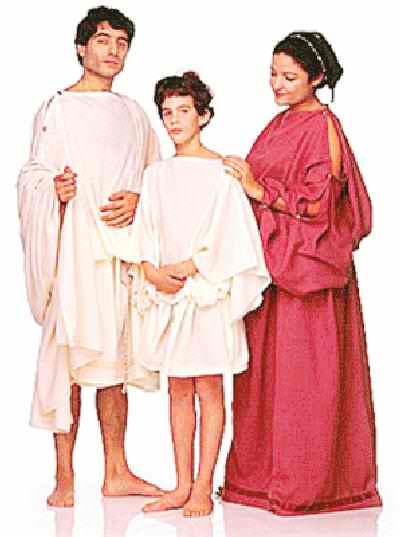
Greeks wore very simple clothing. Linen clothing was common in the summer and woolen clothing in the winter. Clothing was mostly made in the home by the mother, daughters, and female slaves. Garments included simple tunics and warm cloaks, made of linen or wool. They we often dyed bright colors, but bleached white garments were also worn. Decorations were often distinctive to each city state. One garment created by the Greeks was the broad-brimmed hat. Some clothing historians believe that the Greek "petasos" was the first true hat--headwear with a complete brim. It was worn mostly hen traveling. It had a hin strap and could be worn hanging down the back. Children of both genders often wore no clothing at all when they were very young. There does not appear to have been any specialized garments for children before they began wearing adult garments. Boys spent a lot of time naked in athletic training. There were some differences between city states and of course over time.
Greeks wore very simple clothing. This was primarily because tailoring skills and implements did not yet exist. Garments were not not shaped and fitted like modern garments, but rather draped on the body in folds and held in place by pins and belts. There were four types of garments, all of which were were formed from rectangular pieces of cloth. Women wore the chiton which when folded in place was a kind of dress. There were also Doric and Ionic over draperies, the himation and the chlamys. These garments were commonly worn throughout Greece. The decoration of the garments might vary and various decorative styles were popular in the different city states.
The two most important materials in ancient Greece were linnen and wool. They were worn seasonally. Linen clothing was common in the summer and woolen clothing in the winter. One material that was not available to the Greeks was cotton. Wool was available in many grades from soft to course. There were also different grades of linen. Vase paintings and sculptures suggest that there were important differences between the linnen used in Greece and Egypt. Egyptian tomb paintings and sculptures suggest a linnen that often folded crisply. Greek linen does not appear to have been as stiff and drapped naturally. In fact it is not possible as far as we know to tell from available depictions if the garments shown are linnen or wool. Of course the type of garment had sone affect on the material chosen. Cloaks for example were almost always made in wool. Eventually silk appeared in Grreece. We believe this was largely a result of Alexander's conquest of Persia, opening trade with the East over the fabulous Silk Road. Silk at the time came from China as was very expensive. Silk garments woukd have only been worn by the rich.
Clothing was mostly made in the home by the mother, daughters, and female slaves who weaved linnen and wool into textiles. It was fairly simple process because there was no real effort to create garment that fit the human body. This was up to the wearer who draped the woven textiles around his or her bodies. The fact that clothing was made at home was probably a factor in the simplicity of Greek clothing. The basic Greek clothing types were fashioned from the rectangular shape textiles profuced on looms. They were, however, used in masny different ways depending on the size and way they were draped on the body.
We know a great deal about Greek clothing because of all the available pictorial evidence through vases, pots and the clasic sculptures. Ancient Greek clothing was not fitted and shaped for the human body like modern clothing. Rather it was draped over the body in soft folds which can be seen in surviving Greek sculpture. We see much simpler clothing in Greece than would become the case in Rome. In part this reflects the greater richness of imperial Rome and the vast Roman Empire. The Ancient Greeks did not put a great empohasis on their clothing. Clothing was basically made for utilitarian purpses, surely a factor in the simplicity of Greek clothing. The Greeks woukd take a single piece of fabric and drape it in various ways to prepare for different occasions or adapt to a new fashion. Greek clothing has been described as elegant. In part because of the simplicity. This elegant look was achieved from the careful arrangement of folds along with the complex arrangements of girdles, strapping or belts. The Greeks tended to wear light, loose clothes relecting the warm Mediterranean climate. The Greek summers can be sifiling and thus the less fabric draped on the body, the more compfortable the person was. The Greeks also needed to be prepared for winter weather, especially in the north. Garments included simple tunics and warm cloaks, made of linen or wool. One garment created by the Greeks was the broad-brimmed hat. Some clothing historians believe that the Greek "petasos" was the first true hat--headwear with a complete brim. It was worn mostly when traveling. It had a chin strap and could be worn hanging down the back.
Greek garments for men and women wore very similar garments, although the length was very different. Neither men or women wore fitted garments. They both wore clothes that was draped around the body. A common factior for both men and women is that the clothing was fashioned from uncomplicated basic rectagular shapes produced from weaving looms. The various garments we see men and women wearing result from girdles, belts and brooches, clasp or pins. They were used to create shape and forms. Greek clothing was thus essentially artfully draped cloths which have been pinned and tucked into the desired position. This was true for both men and women. The basic garment for both men and women was a tunic called the chiton. It was a rectagular cloth textile which was folded and wrapped arond the body. The look could be different, especially for younger men who commonly wore chitons to a shorter length.
The Greeks are often seen as wearing white clothes. In fact the Greeks often died clothes bright colors. Greek wore clothes died in colors like yellow, indigo, green, violet, dark red, dark purple and other hues. While colorful clothing was popular, bleached white garments were also worn.
Decorations were often distinctive to each city state. Ther were many motifs. Geometric motifs were common, including the dentil as well as circles and squares/checks. Floral/plant motifs were also popular like the laurel, ivy, and waterleaf. The most recognizable pattern is probably key/fret pattern. These embroidered patterns were used to accent fabric edges, creating border effects. Such simple borders were made to fall into intriguing patterns when expertly arranged as a long chiton robe.
Greek clothing generally was very basic and the clothes fir children tended to be very basic indeed. Younger children of both genders often wore no clothing at all when the weather was mild. Babies might wear cloth diapers for sanitary purposes. This is confirmed by surviving satuary. If it was cold, of course, babies and younger childre would be wrapped up. Children might wear a cloth wrapped around their middles which might be liken to shorts leaving their torso bare. Both boys and gurls dressed like this. Men would wear garments at least to their knees or longer. There does not appear to have been any specialized garments except for the basic cloth worn around the middle for children before they began wearing adult garments. Boys spent a lot of time naked in athletic training. We hope to acquire some comtemporary images of Greek children such as vase paintings or sculptures which will improvide more informatiion as to how children were dressed. We are not sure, for example, just when children began wearing more adult garmebts like tunics and to what extent this was affected by social class.
There were some differences between city states.
There were some differences over time. Greek fashions, however, did not change significantly over long periods, unlike modern fashion.
We notice many depictions of Greek children in books, especially children's books. These depictions vary widely. Many of these depictions, however, do not seem very accurate as far as we understand Greek clothing styles. As can be seen here, we are just beginning to acquire some basic information.

Navigate the Historic Boys' Clothing Web Site:
[Return to the Main ancient Greek page]
[Return to the Main Greek chronology page]
[Introduction]
[Activities]
[Art chronologies]
[Biographies]
[Countries]
[Photography]
[Style Index]
[Bibliographies]
[Contributions]
[FAQs]
[Glossaries]
[Images]
[Links]
[Registration]
[Tools]
[Boys' Clothing Home]