The 1840s was one of the most significant decades in the development of boys' fashions. There were dramatic changes in boys' fashions during the decade. Queen Victoria ascended to the British throne in 1837. She married Prince Albert in 1840. Their first child, the Princess Royal Victoria arrived late in 1840. Albert Edward, the future Edward VI, arrived in 1841 and four additional princes followed. The British public was immensely
interested in the young queen and the outfits she selected for her children were eagerly adopted in England. The
immense popularity of the kilt and sailor suit as suitable boys' clothing was due primarily to Victoria's decision to dress the princes in these styles during the 1840s. The precedents set by the royal family in the 1840s were by the 1850s affecting boys' clothes not only in England, but beginning to affect boys' clothes throughout Europe and America.
Historical Perspective
The decade began with the Opium War in China (1839-42). A colonial war which for the first time showed the shift in power between East and West. The Amistad Case wound its way through American courts (1841) as the slavery issue increasingly divided Americans. Mexico and America fought a War (1846-48). It was little noticed in Europe, but would have vast consequences. The potato by the 19th century had become a mainstay of the European diet by the 19th century. European crops began failing at mid-decade. A blight affected the harvest (1845). But no where was it as severe as Ireland. One of the most tragic events of modern European history occurred in Ireland--The Great Famine. At the end of the decade, Europe was rocked by the Revolutions of 1848. Major inventions began to transform North America and Europe. Despite the lack of respected universities and technical institutes, many of those inventions came from America. The first electrical telegraph sent by Samuel Morse from Baltimore to Washington, D.C. (1844). Elias Howe patented the sewing machine in 1846. This device was to have a major impact on the fashion and garment industry, both for children's and adult clothes. Karl Marx and Friedrich Engels published the The Communist Manifesto (1848). Marxist ideas proved extremely influential in the 20th century despite the fundamental errors an economic and social thought. The California Gold Rush followed the Mexican-American War, bringing tens of thousands of immigrants to California and providing needed capital just as America was beginning its industrial revolution.
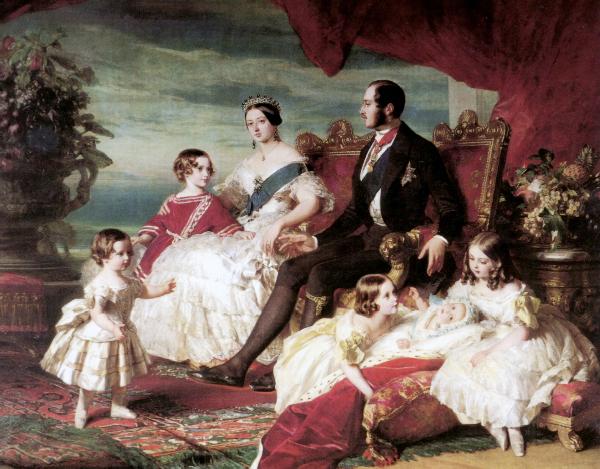
Figure 1.--The clothing styles chosen for Queen Victoria's children popularized classic styles such as kilts and sailor suits. This painting shows the royal family in 1846. I am not sure, however, to what extent the Queen personally decided on these styles.
Children's fashions changed dramatically during the early Victorian era. Many new styles were introduced or older styles popularized. The
styles set in the early Victorian era were to dominate children's fashions for a century. One of the key moving influences was of course Queen Victoria herself and the styles she selected for the growing roster of princes and princesses.
I am not sure to what extent the young Queen made these choices herself. Sailor suits were worn by British boys earlier. Scottish boys were wearing
kilts in the early 1800s. But their adoption by the royal family popularized the styles as appropriate for boys. I assume it was something in which she took a
great interest. I have no details such as discussions with Albert or the household staff. However and
by whom they were chosen, these were the styles eventually adopted throughout Europe and North America.
Victoria was born in 1819 and assumed the throne in 1837. The married Albert, Prince of Hannover, in 1840. Their first child, Victoria,
was born in 1840 and she was to marry into the German Imperial family. Their
first son, Albert Edward--Bertie, the Future Edward VII, was born in 1841. The family, a typically large family of the era, eventually reached nine children and was the subject of great interest, and fashion conscious mothers closely followed the sailor suits, kilts, Russian blouses, and
other fashions in which the children were outfitted. The marriages of the children and then grandchildren to
other European royal families helped to popularize the fashions Victoria chose throughout the Continent. Clothes were just one aspect of Victoria's influence. She in fact as one historian wrote "... exerted an almost unbounded moral control"--affecting many aspects of English and European
values and social customs.
Social and Economic Background
Clothing throughout the ages has always served to differentiate social classes. Many cultures including European cultures regulated who could wear what. As recently as the 16th century some European kingdoms
had sumtuory laws to ensure commoners could not dress like nobles. It was particularly important during the Victorian era. Good clothes now represented income and not social rank. Clothing
reflected a major social and economic shift. Technological developments during the period significantly reduced the cost of manufacturing clothing.
Thus middle class families and even some working class families could as the century progressed afford to but fashionable often elaborate clothing.
They could also afford more than a few garments, and in many cases relatively extensive wardrobes. Fashion was no longer a matter of the
upper classes. These changes affected children's clothing as well as adult clothing. The result was a kind of satorial arns race in which
the wealthy sought to adopt steadily more elaborate, ornate clothes to keep one step ahead of ready made copies.
The Industrial Revolution caused deep seated social changes concomatant with economic changes. Europe had been an agrarian, rural
economy with workers. Workers were largely bound to the land in an almost feudal structure. Serfdom continued to exist in Russia and eastern Europe. But even in
western Europe and Britain at the beginning of the 19th century, agrarian workers were still largely bound to the land by economic and social ties
if not by law. The Industrial Revolution involved many different technological developments which combined to
dramatically change the economies of Western Europe and North America--essentially forming modern western society. The advent of the concept
of the interchangeable part and the consequent application of this idea to the machinery already
available, the introduction of the coal-fired steam engine, and many other revolutionary inventions
change the agrarian lifestyle of the past to modern industrialized society in which mass-production ultimately destroyed many of the very values the
Victorians held so dear. Many of the most important early inventions involved the textile and clothing industry because that was a key industry at
the onset of the industrial revolution. Inventions such as the cotton gin, ????, and
sewing machine resulted in very significant real (in terms of earnings) reductions in the cost of clothing and the ability of middle and
working class families to buy clothes. The introduction of machines which could outperform manual labor many times over, the cost of cloth, and as result, clothing, tumbled. As just one example,
the cost of cotton cloth plummeted 50 percent between the 1830s and the early 1840s. Machine-made laces
and trims, while not as fine as hand made goods from the old lace makers, were readily and cheaply available, which lead to their increased use on clothing.
New chemical dyes (the Germans led here) and new cloth manufacturing techniques changed the look, color and styles, while the sewing machine lead ultimately to the
creation of Haute Couture in part as a way for the monied class to differentiate themselves from the wear of ready made off-the-rack clothing.
It was not only technology that was changing in the mid-19th century. The concept of the family itself and the role of children was changing.
Other images of heightened emotion (including scenes of parental devotion) move beyond the
didactic. The Victorians, especially the affluent middle class, often idealized their society. Often sentiment is so heightened that it
paradoxically distances the viewer from the reality of the social ills portrayed, placing children safely in a
flagrantly idealized world. Following the coronation of Queen Victoria in 1837, this kind of cozy
sentimentality often takes the upper hand.
On of the obvious results of the Industrial Revolution, and the
resulting social and cultural changes in society,
was an increased interest (especially among the female portion of
society) in fashion. Women of the day were as in past generations
interested in differentiating one's status. There were, however, several
major departures from past generations during the Victorian era: Increasing availability: The falling real prices for clothes
meant that fashionable wardrobes were much more available to a widening portion of society. As a result,
family wardrobes expanded significantly including those of children. Rising incomes: The rising industrial economies generated vast
wealth in the countries of Western Europe. While we often think of the
poverty of Dicksonian England, the simple fact is that
in comparison with past generations, the incomes of the middle class
and the working class increased significantly. Much more disposable
income was available to purchase clothing. Mass media: The growing popularity of newspapers and magazines
meant that information on the latest fashions of the day were readily available throughout Western Europe. Virtually any English mother could find drawings and articles decribing the fashions worn by young Queen Victoria and her growing family. Motherhood: The prosperity of the new industrial society mean that
there were increasing number of affluent families. The proprieties
of the day involved the mother staying at home to manage the home. Even
moderately affluent middle class families could afford help with the
laundry, cooking, and cleaning. The mothers were thus left at home with
a great deal of leisure time. Many devoted some of this time to outfitting
their often large families. Some let their romantic imaginations fueled by the literature of the day
run wild. This in part explains the elaborate and often
romantic styles adopted for children's clothing for much of the
19th century.
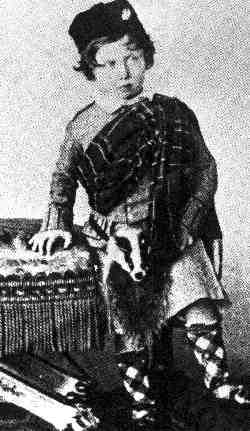
Figure 2.--Prince Albert bought Balmoral Castle in the 1840s and
began dressing the princes in kilts while they were in Scotland. Suddenly
kilts for boys became the height of fashion.
Clothing Trends
Clothing before the mid-19th century and invention of the sewing machine was sewn by hand by local seamstresses. The labor involved was tedious and extensive, mean that clothing was very expensive. Sewing machines changed this. The first workable sewing machine was patented in 1790 and by the mid-19th centuries refinments had produced very efficent machines which were soon being mass produced. Seamstresses were able to quickly sew up straight seams, and gradually led to the earliest formations of the "off the rack" or
ready-to-wear clothing. At mid-century, some garments like skirts were purchased with sufficient yardage to have the bodices 'made-up' by the local seamstresses. Increasing attention was devoted to children's clothing as well. Ready-made suits first appeared in the 1840s. The first American ready-made suits were marketed by Brooks Brothers. The development of the "tailor-made' garments of the 1880's and the 1890s were the end-result of this the industrialization of the textile and fashion industries. The mechanization of the clothing industry allowed designers to create
much more ornate garments at lower cost. Fashions for women included
ornate massifs with tucks, furbelows, and extensive decorative elements,
all of which could be fashioned in much less time and for only a
fraction of the cost of 18th century clothes. The problem for fashion
conscious Victorians, however, was that no sooner had
a fashion designer produced a new style, than the lower classes copied
the fashion--although in in a somewhat less elaborate and less
expensive version. This continuing tug-of-war of fashion between
the upper and lower class, in combination with ever more efficient
technologies, led to steadily more ornate fashions as the century
progressed--as well as the requirement that a lady have more clothing
than ever before. Prior to the Industrial Revolution, a woman would
usally have only a small wardrobe of one or two chemises, an apron, a dress of some sort, some form of
pocketbook and a cap. Shoes
were especially expensive and so more likely to be an option rather
than a necessity. Compare this to the lists of required
items for a Victorian lady of the
later era, with her "required" 12 chemises, multiple handkerchiefs, two
or three parasols, fans, jewelry, petticoats, corsets, drawers, various
toilettes (morning, afternoon, tea, evening, walking, and perhaps a
sports outfit or three), hats, gloves, shoes and boots, and so on.
Requirements
for children, especially boys, were more modest. The same process was
at play, however, as the Victorian mother sought to ensure that her
children showed off the success and rising income of her family. It was
important for affluent families to differentiated their sons and daughters
from the children of the less affluent.
Children's Clothing
Dresses
Boys and girls were still kept in similar dresses, even past the toddler period--often until about the age of 5 or 6 years. The style of those dresses changed as the child
grew. Infants might wear long dresses. As the reached an age where they were learning to walk, the dresses were made shorter. Both wore "dresses" of cotton or wool around the house. The graceful, soft Empire dresses that allowed for freedom of motion had cisappeared by the 1840s. Even little girls once ore began to be trussed up in bustles, stays, and bows. The usual child's dress was long or short sleeved to suit the season, with slim sleeves, round or boat-shaped neck and the waist was lightly fitted with a set-in belt. Preferred fabrics were linen and cotton, for ease of care. Little boys continued to wear dresses like their sisters. There were no dresses specifically styled for boys.
It was common for boys to wear dresses until about 5 years of age, although there was no set age. In most families this was a matter for mothers to decide. Some mothers
might keep their sons in dresses several years beyond the age of 5, especially wealthy mothers who were having him schooled at home.
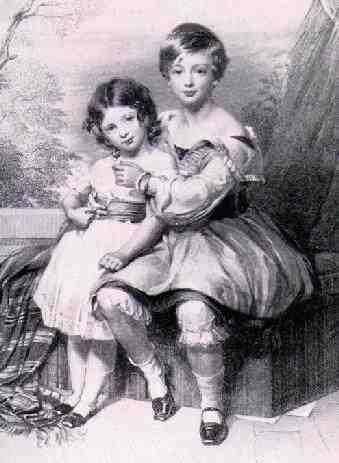
Figure 3.--This 1848 painting shows the Synnot children. The boy was 11 years old and still wearing dresses or perhaps a tunic over a dress. It is fifficult to tell. He lso wears pantalettes, white three quarters socks, and strap shoes.
Pantalettes
A boy's dress would still be commonly worn over matching "drawers" or panteletts, which showed beneath the dress, but less fancy than in the early decades of the 19th Century. The usual child's dress was long or short sleeved to suit the season, with slim sleeves, round or boat-shaped neck and the waist was lightly fitted with a set-in belt. Preferred fabrics were linen and cotton, for ease of
care.
Tunics
Tunics were worn by pre-school and even some primary-age boys after breeching. Here social class was a factor. Some boys might wear them with pantalettes, but long trousers were probably more common. Some of the long pants look rather like plain pantalettes/drawers, done in light colors. Paintings of the British royal family in the 1840s show Prince Edward Albert in tunics and his younger brother Alfred still in dresses. Photography was invented in 1839 so for the first time in the 1840s we have photographic images. Most of the early Dags come from America. While invented in France, Dag studios rapidly appeared in America, but the industry was much slower to develop in Europe, even in England and France wher much of the early work on photography was done. This only in America do we have substantial photographic evience on 1840s tunics. We mostly see pre-school boys wearing them. We think a factor here is that Dags while expensive ere much cheaper than a painted portrait. Thus the photographic record provides a much more more accurate record of popular fashions than painted portraits.
Pants
Boys in the 1840s after breeching were mostly wearing long pants. This had largely been the case since the turn-of the 19th century when boys unlike their fathers began making a transition to long pants. Msny of their fasthers tebded to wear knee breeches into the 1810s. We have a much better view of ghis because photographt was invented in 1839. And while just getting tarted, we have some Dag issues throughout the decasde. While this began in France, many of the images in our archive are American. Photography still spread in the still very rural Ameruca, much faster than in Europe. Abd e do not yet see shiortened-length pants for boys. Art is still an imprtant siource of clothing information as photyigrapjy was still studio based. A good example of children's clothing comes from a painting showing Americans moving west on to the Great Plains.
Suits
I currently have few details on boys' suits in the 1840s, but would appreciate any details HBC visitors may be able to provide.
Daguerreotype portraits provide us many views of how children dressed in the 1840s. We have collected a number of these portraits. For some reason we have only suceeded in finding American dags. We know much more about the 1840s than earlier decades because of the rapid spread of the new photographic process. The first commercial format was the Daguerreotype. We begin to see photographs as a major part of the historical record in the 1840s, although is it not until the 1850s that the photographic images becone more common and available in larger numbers. The available dags provide wonderfully detailed images. The problem with assessing the 1840s images is that so few are actually dated. Thus it is difficult to separate the 1840s and 50s Daguerreotypes. Almost all the 1840s images are Daguerreotypes as are early 1850s images. We will attempt to date these images, but our assessment is very preliminary. We are not at all sure at this time how to diferentiate 1840s and 50s dags. We welcome reader comments and insights.
We have only begun to develop information on hair styles during the 1840s. We know that some younger boys wore curls, but most images show boys with medium hair, mostly short but often to ear level. We are not sure how common curls were for little boys. Most images of children with curls that we have found are girls. We see few boys with cropped hair. We have relatively few images from the 1840s. This was because photography was still relatively new and there are relatively few available images. We note quite a number of boys boys wearing hair styles in the 1840s looking much like 20th century styles. We see boys in very dated outfits, but rather modern hair styles. Many boys had short hair, but not the close croped hair styles that became popular in the late 19th century and at the turn of the 21st century. We see many boys wearing short hair like the boys here. We also seen boys wearing their hair longer, styled over their ears.
Country Trends
We have many country chronology pages, but very few for the 1840s. The reason is that HBC relies very geavily on photography for its assesments. Commercial photography began with the development pf the Daguerreotype in France (1839). As a result, there were many Dauerrotypes taken in the 1840s. Not nearly as many as the number of photographic images available in subsequent decades, but far mote than in the decades before the develpmentof photography. Even so, we have not found many European Dags. We have, however, found a huge number of American Dags. This seems to reflect the actual prevalence of these impages. Photography spread like wildfire in America, but very slowly in Europe. This at this ime we only have aan 1840s couhtry chronology page for the United Srates.
Related Links
Careful some of these links will exit you from the Boys' Historical Clothing web site