|
Many American boys upon being, during the 1850s, might wear quite adult-looking clothes. In fact in many ways the boy of the 1850s might wear clothes that look more modern to us than those worn later in the century. The styles commonly worn in the 1850s might be called plain, almost the opposite of the outfits with the elaborate collars and frills that were worn at the end of the century. Some boys' suits while looking
relatively dull might have some distinctive features such as military-looking
buttons. Collars were small as was neckwear. Large bows were not worn.
Neckwear was commonly small bowties, but some small collar bows were
worn. Long pants were commonly worn after breeching.
HBC note: Many photographic images obtained by HBC are undated. HBC is able to provide approximate dates within a wide band of accuracy. It is often difficult, for example, to determine if a photograph or Dauerotype, was taken in the 1850s or early 60s. (Daguerotypes become much less common in the late 1860s.) HBC viewers should thus bare in mind possible errors in dating. Almost always HBC will indicate the date of a photograph if that date is available.
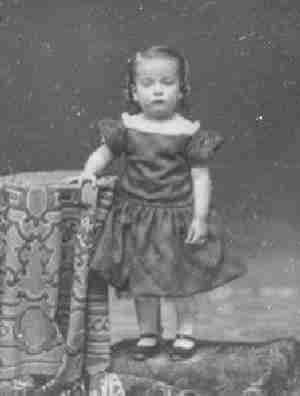
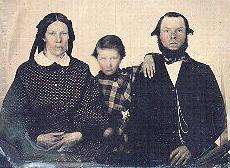
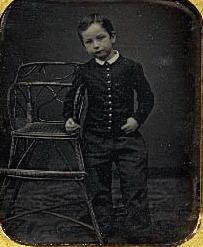
The garments worn by American boys in the 1850s might be characterized for their plainess, at least in comprison to subsequent 19th century trends. Thanks to the rapidly expanding photographic industry, we have more images of boys than ever before in history. This is especially true of America where the industry gew faster than in Europe and ordinary people had higher incomes. Using these images is somewhat complicated by the difficulty in dating the available Daguerreotypes. While Dags cannot be dated very precisely, Anrotypes are much easier to date. Not only do we have Dags, but Ambros as well. And we also see portraits fom naive artists. Our knowlege of 1850s boys headwear is still very limited. We see boys wearing both hats and caps. Hats seem the most common and we see several different types of hats. The most common type of hat in the 1850s was the rounded crown hats we at first noticed in the 1840s. Most of the dags and ambros we have found from the 50s do not show headwear. Thus we are not entirely sure about the range of these rounded hat styles, especially the brims. We also see flat top hats. Boys did not wear the famous stove-pipe caps, but we see some boys with hats much highter than boaters. We are not sure just what to call these hats. As a result of the 49er Gold Rush in Califonia, we begin to see a substanial entry of Ecuadorean straw hats, usally called Panamas. We also notice a few caps, but there was not very many different types. Little boys continued to wear dresses like their sisters. There were not yet any distinctive boy styles. The images we note are show boys wearing esentially the same dresse as thir sisters. We do not know of any contemporary written material on this issue. The images that we have, however, show boys wearing dresses with no distinctive boy styling. Boys wear styles with low necklines as girls did at the time. We have noted quite a few American boys wearing tunics during the 1850s. It seems to have been one of the most popular outfits for boys. A substantial number of photographs first becomes available in the 1850s. Quite a number of the early images show boys wearing tunics that look somewhat like shirts, although often the image quality is not very good or details obscured. Most of the photogrphs we have found show boys wearing long pants with these tunics, but fashion plates often show bloomer knickers. The detinction is the length and front buttoning. A good example is an unidentified New York boy wearing a green plaid tunic. I think plaid may have been used to give it a kilt look. Another example is unidentified boy, probably in the mid- to late-1850s. One interesting topic is the color of the tunics. Many American boys upon being, during the 1850s, might wear quite adult-looking suits. In fact in many ways the boy of the 1850s might wear clothes that look more modern to us than those worn later in the century. Some boys' suits while looking relatively dull might have some distinctive features such as military-looking buttons. We note many boys not precisely wearing suits with matching jacket and triosers, but rarher the jacket and trousers in contrasting materials. We note different styles of jackets. Some have rather a military look and button at the collar. We also note more modern looking jackets with lapels. The use of buttons was highly varoable on these suit jackets. We know much more about the mid-19th century when photographic images become available. The greatly increased number of images at that time provide a great deal of information on shirt-like garments and collars. Shirts with small collars seem the dominant type at mid-century, but we do see some larger collars as well. The collars were mostly part of the shirt and not detachanle, an inovation that appeared at the end of the 1940s. All shirts had long sleeves. Many blouced at the wrist cuff, but less elaborately than in the 40s. Younger boys had shirts which buttoned on to their pants. Most boys wore their shirts buttoned at the collar, often without neckwear. Most shirts seem to have been plain, light colors. We see many portraits of boys having their portrait taken wearing shirts without jackets. This proably means thast they did not have suit jackets. This was much less common in the 60s which probably is a reflection of growing affluence in America. unidentified American family. Neckwear for boys seems less common in the 1850s when collars became very small. The standard neckwear was the stock. Stocks were uually black, but we see some boys wearing brightly colored, patterned stocks. That was sometjhing that was not very common in the 1840s. And when tied that often looked somewhat like bows with tails rather than the partain stocks worn by adult men. These coloful stocks seem to be mostly for boys rather thsn these colorful stocks, but this needs to be pursued in more detail. We do know tht the black stocks were much more common for men and very common. Most men wore them when wearing suits. Very young boys did not wear them, but by about age 10 years or so we see boys wearing them as well at least when dresing up. The photographic record shows, however, that many boys did not have suits. We see, however, a lot more boys wearing suits than in the 40s. We suspect that if they if not wear a suit to the photograpohic studio, that meant they did not have one. Thus most boys did not wear stocks of ogher neckwer in the 50s. The standard stock was tied without tails. which essentially destunguished them from a bow. We note boys with stocks that were done with bows or at least a hint of tails. Most American boys wire long pants in the 1850s. Younger boys from fashionable families apparently began wearing bloomer knickers with fancy suits at mid-century, but the photographic recird suggests this was not very common. Long pants after breeching were the dominant fashion. The photographic record is a good example of how common long pants still were in the 1850s. And given the cost of Daguerreotypes and even ambrotypes, long pants were probably even more common with thge general public than indicated by the photographic record. Slow speeds meant that subjects usually were phothraphed seated. And poses usually focused on the tirso. Itvis often difficult go make out the pants a boy was wearing or much in the way of detail. A good example is an unidentified boy, we think in the late-1850s. He is wearing button-on pants. We note boys wearing both solid/flat colored psnts, but patterns were also very common. Loud checks wre considered very stylish.
|
Short hair for boys was prevalent, especilly after breeching. While most boys rarely had long hair, it was quite common to have hair covering part of a boys erars. The long hair for older boys which was to become common later in he 19th century was still rare. One source suggests that boys mostly parted their hair at the side and that a center part during the 1850s suggests a girl. (I have yet to confirm thuis.) If so, this is one the indicators which could help determine gender in unidentified images. This seems the prevalent style, but we do note boys with center parts as well. We note some children wearing ringlet curls in the 1850s, but most we have noted are girls. A good example of childrens hair styles is an unidentified American family and E.V. Grisen.
As children matured into pre-teen and teen years, their clothing more and more
resembled that of adults. Tennage boys in the 19th Century increasingly were dressed in destinctive juvenile fashion, such as knee length pants. This was much less common
at mid century. Their duties were adult. They were often aprenticed or
went to work by the time they were 12 or 13 years old. There was no "teen culture" as we now know it. Certainly there was no particular fad clothing for youth. Boys often wore
hand-me-down clothing of their parents, unless the family was very wealthy. Even wealthy families might pass clothes down. Queen Victoria, for example, reportedly
never threw clothes away. In middle class families as well as working class families, it was usual for clothing to be passed down from child to child, even shoes.
One monentous development for future generations was the invention of jeans, called overalls at the time. Though the ubiquitous blue jeans of today are worn for comfort, the rugged pants were born out of a necessity for work clothes: young entrepreneur Levi Strauss came out with the first pair made out of canvas and later out of denim for use by miners. Only in the late 1940s did the modern jeans emerge for boys. As for the women of the 1850s, they have yet to acknowledge the merits of trousers over skirts despite the advice of feminist Amelia Bloomer. But 40 years later guess what style women were are sporting on their leisurely bicycle rides? You got it--"bloomers."
|
The 1850s is one of the forgotten decades in American history coning as it does before the monmentous Civil War and Reconstruction of the 1860s. Therehad been a steadt flow ofEuropeans into America even before the Revolution. This increased in the 1850s, largely from two unexpected sources. The Irih Potato Famine drove huge numbers of starving Irish peasants to America--the first major infflux of Catholics go a lrgdly Protestant country. And at the same time the failure of the liberal Revolution of 1848 caused many Europeans debied democacy and ecomomic freedomto America. This was especially the case in Germany, astill ununited country. America was still a very rural country. . The country had finally chieved 'manifest destiny', strching from the Atlantic to the Pacific. Yet America stood alone in the 1850s as the only real republic. The rest of the world was governed by monarchies which with a few exceptions, notably Britain, had not yet fully accepted democratic government. Monarchial rule was still the established form of government around the world. The American Republic at the time a still very radidal experiment. There had been other republics in history. The United States was the only large republic for nearly two mllenium. And even more radical, the United States was the first state in history that permitted anyone who wanted to be a fully participating citizen if he only agreed to obey the law. There were still limits, Blacks and women could not be full citizens. While this sojunds terrible today, at the time is ws aadical proposition to allow all white males to participate in the political process. And also very radical ws the Constitution which barred the Federal government from directly attempting to shape American nationality. his was largely seen as the perogtive of the states. And as a result the United States in the 1850s was half slave and half free. The Abolitionist Movement had an enormoust impact on thinking in the North. More than slavery divided the North and South. While America was still a rural country, industrial development in the North was already well underway, but not in the South. The slave issue by the 1850s had reached te point that it had divided the nation. The Compromoseof 1850 meant to difuse the growing conflict, absolutely failed. The Abolisyionists continued to infuriate the south and ebforement of the Fugative Slave Act obly inflamed northern thinking. Fashion in America was still largely deterrmined by European fasion, primarily British and French fashions.
We have found a number of photographs which we believe date to the 1850s. Unfortunately many are not dated. We can only estimate the dates. These images are mostly Daguerreotypes and Ambrotypes. These images unlike later CDVs and cabinent cards had no place where notations as to names and dates could be easily written. Thus in most instances we can only guess as to the dates. We invite HBC readers to comment if they have comments. We note button-on clothes and small collars in the 1850s, both plain white and ruffle collars. We also note stocks and bows, but many boys did not have neckwear. Buttons were commonly used for decorative purpose. We note that tunics were popular. Many were styled similarly to shirts. Plaid was a popular fabric. Photography was still fairly expensive in the 1850s so the number of images is more limited than the 1860s when negative proceesses were perfected. We do not have a page just on American boys, but most of the boys we have archived are Americans.
The 1850s was the first decade in which large numbers of photographs are available. Many more portraits appear in the 1850s. More photographic studios openened as the more individuals developed the needed skills and photography becanme increasingly excepted. More people began to want both individual and family portraits. Prices declined, but were still relatively expensive, limiting the number of portraits made. New less-expensive formats including Ambrotypes and tin-types added to the growrg of the industrty. Boys tend to have short hair, but it is often down to their ears and sometimes covering their ears. Younger boys might have ringlets. We see tunics and tunic-like shirts. Jackets often buttoned to the neck. Collars were generally small. Most boys wore long pants. Dresses mostly had high neck lines, commoming buttoning at the collar. Also all the images are formal studio portraits so we tend to only see families dressed up in their best

Navigate the Historic Boys' Clothing Web chronological pages:
[Return to the Main U.S. mid-19th century page]
[Return to the Main U.S. chronology page ]
[Return to the Modern era]
[The 16th century]
[The 17th Century]
[The early 18th Century]
[The late 18th Century]
[The 1800s]
[The 1810s]
[The 1820s]
[The 1830s]
[The 1840s]
[The 1850s]
[The 1860s]
[The 1870s]
[The 1880s]
Navigate the Boys' Historical Clothing Web Site:
[Introduction]
[Activities]
[Biographies]
[Chronology]
[Clothing styles]
[Countries]
[Bibliographies]
[Contributions]
[FAQs]
[Glossary]
[Images]
[Links]
[Registration]
[Tools]
[Boys' Clothing Home]