The sailor suit epitomizes turn of the century dress for boys along with sailor hats
and the familiar streamers. Some new styles appeared after the turn of the century. Russian blouses were very popular. Clothing styles for boys became some what less formal.
Little boys emerged from dresses at earlier ages. Rompers for todlers. Formal dress was still common at the beginning of the centurry, but after World War I, the general trend in boys clothing was increasingly casual styles. Knnepants were displaced by knickers and short pants, but after World War II, long pants became increasingly common. In the late 20th this trend appears to have reached its peak. Boys commonly wore baseball caps, "T" shirts, jeans and sneakers. It is difficult to see that clothing styles can become any more casual. Here we follow fashion trends decade by decade.
The sailor suit epitomizes turn of the century dress for boys along with sailor hats and the familiar streamers. Russia blouses were very popular. Clothing styles for boys became some what less formal. Little boys emerged from dresses at earlier ages. Rompers for todlers and little boys became popular nursery attire. Little Lord Fauntleroy suits became less popular. Some mothers continued to choose them, but somewhat less fancy styles. Sailor suits continued to be very popular. Mothers in England often kept their sons in juvenile clothes until about 8 years old when they were sent off to their boarding schools. On the Continent even older boys wore sailor suits, even with short pants. Eventually as boys grew, they achieved the dignity of suits with below the knee pants. Eton suits with stiff white collars were commonly worn by English school boys. Some boys in knee length pants began wearing knickers, knee length
pants which pursed out at the knee.
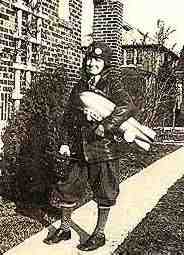
Boys fashions at the beginning of the decade were little changed from the turn of the century. Formal dress was still common, although the fresh air and sunshine movement as well as the Boy Scours had some impact. We see some less formal styles for children, especially boys, but adults still tended to dress very formally. Boys commonly wore knee pants, although in America, knickers suddenly became sandard for boys. World War I proved to be a major dividing point not only in world history, but fashion as well. It is unclear just how the War had this impact. Many major changes occurred during the War and affected life style and fashion after the War. It certainly had the impact of destroying all the old certanties of pre-War Europe. And during the war, industry including the clothing industry was directed toward the War effort rather han fashion. The impact was to permnntly alter fashion trends. The 1910s were a major dividing point between the formal styles of the late 19th century and the more clearly recognizable as modern styles of the 1920s. Certainly World War I (1914-18) must have been the major factor forging the new fashions. Similar significant changes ocurred after World War II. I 'm not sure of the sociological forces at play. Perhaps it was the loss of inosence brought about by the War. Perhaps it no longer made sence dressing children in the innocent, child-like fashions commonly worn before the War. As a result, by the 1920s boys were dressing very differently than at the turn of the century.
|
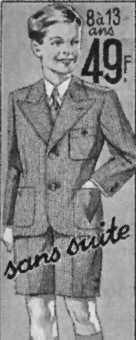
Fashions specifically designed to suit the needs of children began to emerge in the early 20th Century. Styles appearing in the 1910s increased in popularity after World War I. The new Century saw implicity and ease emerge as the dominant criteria for children's dress, a reflection of the active lifestyle of the modern child. Fashions specifically designed to suit the needs of children (short pants, rompers, overalls, and other styles) became increasingly popular. Sailor suits continued popular after the War, but for increasingly younger boys. Knicker suits became increasibly popular--especially in America. For the younger boys afterthe First World War, short pants suits (short trousers for our British friends) worn with knee socks became increasingly common. The style at first was for rather long shorts extending all the way to the knee. Many English private schools adopted uniforms requiring colorful blazers and short pants. Short pants suits were worn by young teenagers in England and even older boys in Europe. European boys as old as 16 wore short pants suit. Some schools required that even secondary school children wear short pants. Younger boys in America wore short pants suits, but mostboys wore knickers, even many American high school boys. Knickers were originall designed to be worn buckled above the knee. Some mothers insisted on this. Short pants were relatively long in England, usually worn just above the knee. The style soon spread to the continent where shorter lengths became fashionable. English short pants suits were often gray, while black or navy blue was more popular in the United States. Whatever the color or style, getting your first pair of long pants was a major rite of passage for American and European boys.
|
The 1930s were dominated by the Great Depression. This affected both the public mood and affluence, both matters which have a carry on effect on fashion and familiy spending. The unusual divergence between European and American clothes continued in the 1930s. European boys tended to wear short pants and knee socks or long stockings as well as a variety of country specific styles like kilts, lederhosen, sailor suits, and smocks. There were still major differences from country to country. And many of the destinctive country styles persisted in the 1930s, in some cases the last decade in which these styles were still prevalent. It was still possible to identify nationality from the clothes worn at leat for the larger countries (England, France, and Germany). And these countries strongly influenced styles in the smaller countries making it difficult to identify nationality in photographs from these countries. German styles were especially important in Eastern and Central Europe. Headwear was quite varied. American boys wore flat caps, at least at the beginning of the decade. English boys wore peaked school caps. French boys wore berets. German boys had more varied headwear. We see military styled school caps, sailor caps, and Schirmm�tze. Eton suits stiff collars and long trousers became increasingly less common in England as the decade progressed. Increasingly English schools turned to brightly colored and stripped blazers with short grey pants. Sailor suits for older boys disappeared in Britain and America, but were still seen on the Continent. Pants and trousers also varied from country to country and as the decade progressed Short pants were still rather long at the beginning of the decade, showing the continued influence of knee pants. We begin to see shorter lengths by mid-decade. Mothers in France and other European countries increasingly selected shorter length shorts for boys. Very young American boys at the beginning of the decade wore shorts, but by the time they reached 8 or 9 years old, they wanted to wear knickers. Knickers by the end of the decade, however, had begun to go out of fashion. Most American boys, however, tended to wear knickers, although mostly changed from long stockings to knee socks. Long stockings continued to be common seasonal wear in Germany and Central and Eastern Europe. By the end of the decade, older American boys were wearing long pants and many younger boys short pants. We also see more American boys wearing ankle socks. Sneakers became increasingly popular for casual wear in America.
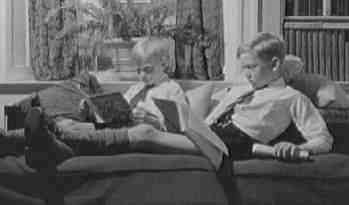
Knicker suits in America disappeared during the mid-1940s. Younger boys might wear short pants suits, but most wore knicker or more commonly by the middle of the decade, long pants suits. Conventions such as cuffs and pleats were ended as economy measures during the war. Boys increasingly asked for blue jeans for casual wear and picked up on GI "t" shirts after the War and sneakers grew in popularity. Jeans, "T" shirts, and sneakers were virtually unknown in Europe. British boys virtually all wore shorts until about 13, some longer if they went to a conservative school. Most Euriopean boys continued to wear primarily short pants suits, even some quite old boys on the Continent. While some boys wore longs, the predominate style was longs. Presumably the strained finaces of most families after the castastrophe of global war meant that some older teenagers were kept a little longer in shorts because of the cost of a new suit. The disruptions of the war meant that fashion was a largely frivalous concern until the recovery began to take hold toward the end of the decade. The development of synthetic fibers was intensified by the war and would hace a major impact on clothes and fashion after the war.
|
Short pants suits continued to be commonly worn by even older boys in Europe. American blue jeans, however, began to be seen in
Europe for the first time. Jeans dominated the American boyhood fashion scene, although they were banned from most secondary schools. Short pants Eton suits became
popular for younger American boys. American boys wore both long and short pants suits, few boys continued wearing shorts much beyond 10 or 11 years of age. Knee socks were much less common for boys than in Europe. American boys did begin to wear shorts as play
clothes, especially in the South. Sailor suits disappeared
for all but the younger boys. Eton suits appeared in the United States. They had jackets without collars and were worn with rather short short pants. Knee socks continued to be commonly worn in England, and Europe, but became increasingly rare for boys in America.
Young boys in America often wore shortalls. Slightly older boys might wear short pants
Eton suits. A few older boys, mostly in weathy families, wore short pants suits, mostly
black suits--unlike the grey suits more common in Eur ope. Shorts pants suits
gradually disappeared, especially in America. But even in Europe by the late 1960s they were
becoming increasingly rare. Dressy shorts continued to be somewhat more common in England
and Scotland because many schools required them as part of a school uniform. Many schools on the Continent continued to insist on shorts, but this began to change
after the Paris' student movement in 1969. British scouts went to long pants.
Little boys dressed up in
shortalls and Eton suits. Some boys at about
7 would wear short pants suits, but in America such clothes were rarely
seen on boys older than 10. Older American boys dressed up in suits little different from their fathers. Mostly they wore casual clothes with shorts becoming increasingly common. A major change occurred in Europe with shorts ans kee socks virtually disappearing on older boys who insisted on jeans and other informal
American clothes. A few traditional private schools continued to insist on shorts. Older boys dressed up in suits little different from their fathers.
Mostly they wore casual clothes with shorts becoming increasingly common. The hippies and flower children of the anti-war movement began to have a significant impact on fashion with long hair and colorful-old cloth es,
jeans, and military surplus clothes adopted by teenagers. For the first time "unkempt" clothes, a style intoduced by Americans with little social status began to infuence how middle and upper class children wanted to dress. Designer jeans apeared and became increasingly acceptable at schools and other occasions besides outdoor wear.
Trends in the 1980s continued and intensified those begun in the 1970s. No longer was there a monolithic style line for women. Instead, fashion was more segmented and women selected from among a wide variety of alternatives in silhouette, skirt length, and fabrics. Men and boys' fashions were less diverse. We used to be able to tell where European children were from by the way they dressed, at leat the major countries. This was no longer possible as a kind of pan-European style became increasingly perviasive. Basically this mean the increasing adoption of casual American styles. Here California was a kind of fashion epicenter for children and teen fashions. There were, however, some differences. We see all kinds of popular casul wear, inclkusing both colared shirts (like poli shirts and Rugby shits) as well as colarless "T"-shirts. T-shorts were no longer plain or striped. We see all kind of "T"-shirts with sports, music, and other motifs. Short pants suits disappeared for all but the youngest boys. Informal shirts and play shorts, however, became wide-spread even in America where shorts had not been as popular as in Europe. This trend had begun in the late-1960s, but by the 80s was filly developed. During the early and mid-1980s boys wore quite short play shorts with atletic knee socks, influenced by the growing popularity of soccer and basketball. OP cord shorts were a big hit in California and the popularity spread to the U.S. east coast. By the latter part of the decade, however, longer shorts first appeared on the Continent and became more common. Slowly many of the traditional English schools which had insisted on shorts dropped the requirement, especially for the older boys.
Virtually no boys, except for the very youngest dressed up in shorts. Toddlers often has long pants suits and outits, even long pants tuxedos. Log baggy shorts by mid-decade became common, part of the hip-hop fashion
trend, in part inflenced by black basketball stars who objected to the short
shorts basketball players formerly wore. Repeating a trend began in the late 1960s, a group
with relatively little social status was setting fashion tends, the opposite of the pattern at the beinning of the Century and as recently as the early 1960s when the
upper class set fashion. "T" shirts and caps are popular, especially when emblazoned with designer labels or logos.

Navigate the Historic Boys' Clothing Web Site:
[Return to the Main 20th century chronological page]
[Return to the Main modern chronology page]
[Introduction]
[Activities]
[Biographies]
[Chronology]
[Clothing styles]
[Countries]
[Bibliographies]
[Contributions]
[Essays]
[FAQs]
[Glossaries]
[Images]
[Links]
[Registration]
[Tools]
[Boys' Clothing Home]