|
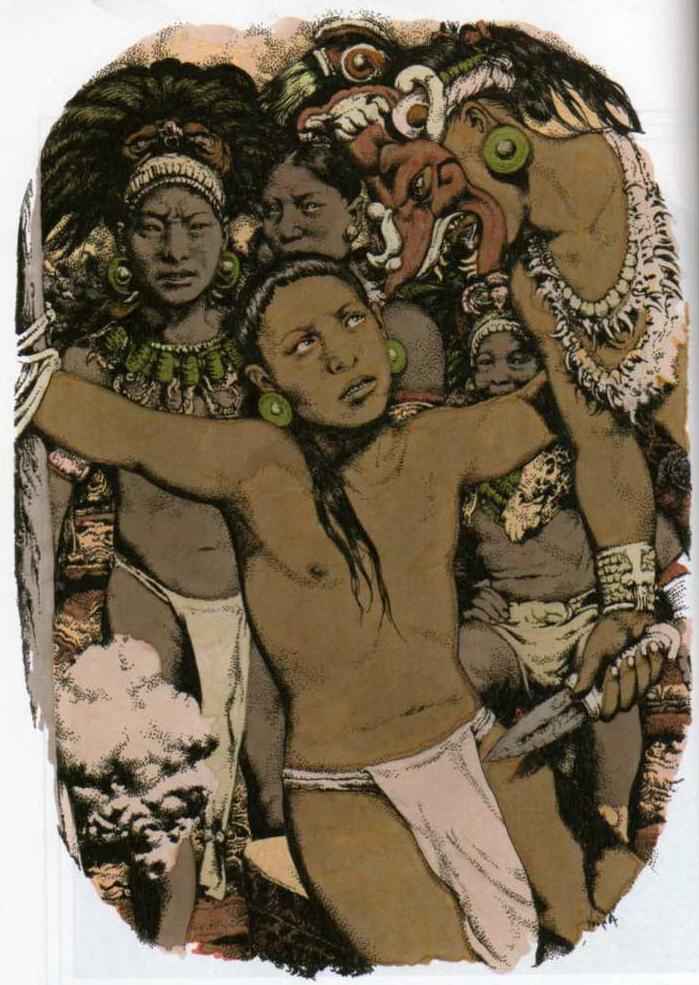
Many Native Americans never evolved beyond the hunter-gather stage. Others civilizations developed sedentary agricultre. The first evidence of settled habitation is first noted in modern Mexico during the Archaic period 5000-1500 BC. Here we note corn cultivation, pottery and stone tools. The first sophisticated civilization in Meso-America was the rise of the Olmecs around 1500 BC - 300 AD during what is known as the Pre-Classical period. The Olmecs settled on the Gulf of Mexico Coast of central Mexico. Very little information has, however, been learned about them as is the case of other early Meso-American civilizatons. Many archeologists believe that it is the Olmecs that developed many of the characteristics features of Meso-American cultures, including sophisticated calendars and hieroglyphic writing. Archeologists have not definitively developed the relationship between the Olmec culture and the Maya and other Meso-American peoples. Notably high civilization in the Americas is not associatyed with major river valleys as was the case in Asia and Africa. It was in the Andean and Meso American culltural areas that agriculture, weaving, metal working, painted pottery, and other technological developments occurred and spread to other areas. The three best known of these agricultural civilizations (Maya, Aztec, and Inca) were contemperaneous with Medieval Europe. These civilizations are well known because they are the civilizations that the Spanish encountered. The three great civilizations were brought to am abrupt end in the early 15th century by Spanish Conquistadores. While we can admire the achievements of these advanced Native American civilizations. it must be remembered that cut off from Europe and Asia that they were still essentially stone age peoples, in part explaining why they fell so easily to small European military forces.
Civilization in the Old World developed in the great river valleys. This was the case in each of the great early civilizations: the Middle East (Mesopotamia and Egypt), India, and China. The reason for this was simply that the technology for rover valley cultivation was less complicated than the cultivation of more arid land. Mesopotamia was the first such civilization and Egypt was in contact with Mesopotamia and benefitted from the advances there. Ancient India was more isolated, but not completely so. China developed in complete isolation, but like the other early civilizations in a river valley.
The river valley pattern of human civilization seems so basic that one would have expected civilization in the Americas to have developed along the similar lines. It did not and the reasons for this are not entirely clear. The great American rivers ate the Mississippi, The Columbia, the Colorado, the Rio Grande, the Magdalena, Guayas, the Orionoco, the Amazon, the Sao Francico, and the Parana-Paraguay. These river valley systems are not where agriculture (the neolithic Revolution) meaning civilization developed in the Americas. Rather it developed in two rather improbable places--Meso-America and arid areas along the northern coast of Peru. The Central Valley of Mexico was clearly a desirable place fought over by a sucession of people who defended it from war-like tribes to the north. The harsh conditions outside the Central Valley and the struggle to control it created perhaps the most merciless culture of all the graet ancient civilizations. The blood-drenched Aztecs were only the final manifestatioin of the civilizations begun by Teoteouacan. The Central Valley and Lake Texcoco may have represented similar conditions to river valleys. Driving along the coast of Peru one is struck by the utter desolation. At first glance it would seem one of the most likely places in the world for civilization to rise. But there are slender ribboms of green amid a vast desert landscape whoch becomes increasingly arid as you move south. And while there is no single large river in northrn Peru, there were several small rivers running down from the Andean Sierra creating the same river valley conditiins on a smaller scale that produced Mesopotamia and Egypt. The geography of the Americas also seems to explain in part the spread of civilization.
The Americas consists of three gepgraphic areas: North America, Central America (Meso-America, and South America). Advanced civilization appeared, however, in only two of the three areas, Meso America and South America. We believe that this is largely a function of climate. Very little of North Ameica outside of Meso-America has a semi-tropical climate. And notably only in tropical and semi-tropical areas did advanced civiizations develop. This is probanly the key factor explaining why advanved civilization did not appear in North America. Almost all of North America beyond Meso-America enjoys a temperate climate. This is the same pattern along with the first advanced cinilizations develped in he Old world. of Eurasia. This of course is in sharp comtrast to the modern development of North and South America.
One of the interesting questions of Native American Civilizatioin is why no great civilizations emerged in the north rivaling the many important civilizations that emerged in Meso-America and South America. Today North America especially the Mississppi River Basin is one of the world's greatest bread baskets. It is an area where the first Proto-Indians would have reached fairly early in their journey south from the Beringia. It is not, however, where agriculture and civilization first developed in the New World. The Americas that the first Native Americns found as they emerged from Beringia was a rich cornocopia. But it was very different from Eurasia where the mountain ranges beginning with the Alps and continue on the Himilaysa are arranged on a East-West axis. This incouraged east-west migrations and exchanges (read the Silk Road). American mountain ranges from the Sierra Madere to the Andes are on a North-South axis. This impeded migratiins and exchanges between peoples. Even so America did get people all the way east to the Atlantic coast. There are several important river valley systems in the North which would seem to provide the conditions for a rich agricultural economy, but nowhere in the north did a great civilization appear. We suspect that climate may be the key factor. The early civilizations developed in trpical and semi-tropical climates. This is important because it meant that with even basic technology, farmers could harvest more than one crop annually thus doubling productivity. Once civilization develops and takes root, then it can develop the technology to expand into more demanding climatic conditions. Early people were less able to deal with effectively with severe winter weather. Thus early river valley civilizations developed in a rather narrow sub-tropical band. Notably Meso-America falls within this range. The Missippi Valley is wekk north of it. The Missiippi Basin was the site of an important Native Community agricultural cilture, in fact the most important such culture north of Meso-America--the Missipians also known as the Mound Builders. This culture was centered at Cahokia near what is now St. Louis. While the area of this culture and the number of people supported was impressive. This was not where the crops they raised, especially corn was domesticated. This occurred far to the south in Meso-America. The Missippi culture was thus a technological offshoot of the Neolithic agricultural revolution which occurred in Meso-America. Cahkokia was a relatively modern Morth American culture. The Great Mound there dates to about 1000 AD.
The New World Neolithic Revolution occurred first in Meso-America. The term Meso-America is a cultural-geographic construct. The geographic area extends from central Mexico south to approximately the middle of Central America (Honduras/Nicaragua). Culturally it is defined as the area in which the great pre-Columbian societies of North America developed. These civilizations share important cultural traits, a corn-based agricultural economy with productive units centered on agricultural villages. In sharp contrast to the rural villages are the large ceremonial and politico-religious capitals. Mesoamerica means "mid America" in Greek. It was a term coined by Paul Kirchhoff, a German ethnolocist. Kirchhoff first noted the similarities among the major pre-Columbian cultures within the region. What is not entirely clear is why this fairly resrictive geopgraphic region proved such a fertile ground for cultural advance. But it was here that corn was domesticated--a technological advance of enormous consequences. Many of the Meso-American civilizations are poorly understood, especially the keystone civilization--Teoteouacan. The other great civilizations include the Toltec, Olmec, Maya, and Aztec.
In South America it was the Andes that proved the most fertile ground for the rise of high culture. Here corn-based agriculture was suplemented by the addition of the potato, a crop which was also of enormous consequence. It is not entirely clear why the most advanced civilzations developed in the Andes rather than the river valleys. South America is the only continent where high civilization developed in mountaneous areas. And adding to the puzzel, this occurred in South America and not North America where the Native Americans reached first and had much more fertile ground than the mountanous Andes. We have not yet seen this topic addressed by scholars, but presumnably some one has. We would be intetested in any insights readers may hve. We suspect that the humble potato is part of the reason. A key factor in the success of any early civilization was the agricultural productivity they were able to genetate. The potato had enormous caloric counts thus making agriculture in mountabneous areas tremedously productive. An exception was some of the coastal civilizations in Peru. Here the prodigious bounty of Peruvian waters as a result of upwelling was an important factor. The Inca are by far the best known of the South American Andean groups, but there are several other important groups. There is some dabate about the level of Amazonian culture before the arrival of the Europeans.
The population of the Caribbean began with Trinidad by South American peoples (8,000 -7,800 BP). This is confirmed by archeological evidence. Trinidad is not entirely a Caribben story. At the time (early Holocen) there was a land bridge to South America (modern Venezuela). Even today Trinidad can be viewed from Venezuela. The earliest known colonization of a Caribbean island requiring some kind of marine technologh has been found on Cuba and Hispaniola (7,000 and 5,500 BP). The population also probably originated in South America. There was probably also colonization from Meso-America. A second wave of colonization reached the northern Lesser Antilles (5,500 to 3,500
BP). This included , Puerto Rico and other islands in the northern Lesser Antilles, as well as Barbados to the south. These people came from South America, although not necesarially directly. Barbados is set out into the Arlzntic and could hve required some dgree of nuatical technolohgy. The fact that the colonization of th northeastern Antilles and Barbados in the south is interesting and largely unexplained, but may simply reglect the lack of edidence from other oslands. The third wave of setllement is more definitive because by this time the colonizing population had mastered pottery--the Early Ceramic Age (2,500-1,500 BP). This is a culture which is believe to have originated at the lower Orinoco River near the modern settlements of Saladero and Barrancas in Venezuela. They are usuallty described as an Arawak people. Here there is achaeological, archaeobotanical, and genetic evidence. Saladoid peoples had colonized all of the Lesser Antilles islands (by 2,000 BP). The Grenadines were a rare group to have been colonized a little later. About 1,000 years later a further disperal occured--during the Late Ceramic Age (1,500-500 BP). The earlier peoples who settled in Puerto Rico for some reason to disperse to other islands, including the Greater Antilles, Bahamas, and Jamaica. [MacKinney] The Arawak are a major Amer-Indian group of indigenous peoples of South America and of the Caribbean. The Lokono of South America and the Taíno, who historically lived in the Greater Antilles and northern Lesser Antilles in the Caribbean. have been dscribed as Aeawak. There was no central orgnizagion, but they spoke Arawakan languages. [Rouse, p. 5.] And they were found in northern Sourg meric, including the the coast of Venezuala and the Guianas. Colonial literature described the peaceful Arawak abd the warlike ans canabilistic Caribs. This seems to have beem a historiical fabrication which develope in part to justify the supression of Amer-Indian peoples. The Spanish crown at the urging of Las Casa and others was attmpting to protect the Amer-Indians, but the Royal court was a long way from the Americas as identifying the a group as war-like was a way to justify ensavement and land seizures. Even so, this destinction has persisted to this day.
Mann, Charkes C. 1941: New Relevations of the Americas before Columbus (Vintage: New York, 2006), 541p.
MacKinney, Taryn. "Mitochondrial DNA diversity of Saint Vincent and Trinidad and its implications for Caribbean settlement history," PhD Thesis (Univerrsity of Pennsylvania, 2017).
Richardson, James B. People of the Andes: Smithsonian Exploring the Ancient World (St. Remy Press: Montreal, 1994), pg.122-131.
Rouse, Irving. (1992). The Tainos. (Yale University Press: 1992).

Navigate the Children in History Website:
[Return to the Main Native American page]
[Introduction]
[Biographies]
[Chronology]
[Climatology]
[Clothing]
[Disease and Health]
[Economics]
[Geography]
[History]
[Human Nature]
[Law]
[Nationalism]
[Presidents]
[Religion]
[Royalty]
[Science]
[Social Class]
[Bibliographies]
[Contributions]
[FAQs]
[Glossaries]
[Images]
[Links]
[Registration]
[Tools]
[Children in History Home]