. Two major African rivers flow through Mali. The Senegal River flows northwest to Senegal and Mauritania. The Niger flows northeast and then southeast to neighboring Niger. Less than 5 percent of the land area is arable, a serious problem for an agricultural people. The country faces a serious problem of desertification and other environmental problems. While climate is the major cause, population pressure on the enviroment has worsened the problem.
The recorded history of the region in which we now find Mali began with Ghana Empire (4th century AD). It gradually expanded at at its pealk included eastern Senegal, southwest Mali, and southern Mauritania (10th century). It dominated African trade across the Sahara with the Arab states to the north, a major source of wealth. Trade items included ivory, gold, and slaves. The Ghana Empire disintegrated (13th century). It is at this time that the Mali Empire rises. This new Empire reached its peak under Mansa Musa (14th century). Musa seized Tombouctou and Mali became a center of Muslim scholarship. This was at the same time that the Renaissance was beginning to remake Europe and modern science began to develop. In Mali the focus continued to be on Islam and religious scholsrship. Tombouctou and Djenn� were also key links in the eastern trans-Sahara caravan trade. Over time the Mali Empire declined and by the time the Europeans were beginning to make inroads in coastal areas had desintegrated (17th century). The nomadic Tuareg came to dominate the northern area of the former Mali Empire. The Songhai Empire was founded to the east much earlier. It centered on the Middle Niger Rivert (8th century), but graduually shifted to Gao. The Songhai expanded west as the Mali Empire declined. The Songhai seized Tombouctou (1468). This was a significant event as Tombouctou was such an important trading center and thus source of wealth. The major Songhai rulers at the peak of the Empire were Sonni 'Ali Ber (r.1464�92) and Askia Muhammad I (r.1492�1528). A Moroccan Arab army from the north conquered the Sobghai (1591). The Moroccans established important military bases at Gao, Tombouctou, and Djenn�. Under Moroccan Arab rule, a military caste developed--the Arma. They controlled the countryside from these bases. Over time Arma rule desintegrated into competing principslities (late-18th century). Al-Hajj 'Umar from the Tukulor tribe launched a Muslim jihad against the remaining pagans (mid-19th century). He conquered S�gou and Macina mid-19th century (1862) and sacked Tombouctou (1863). He was killed in a rebellion (1864). It is at this time that the Europeans began penetrating the interior of Africa and formally establisjing colonoes. The Fremch appeared in the region (about 1880). Samory Tour�, a Malink� (Mandingo) leader opposed French colonization (1992-98). The French complete their conquest with the capture of Sikasso. The French called their new colony French Sudan (Soudan Fran�ais), although it was located far west of Anglo-Egyptian Sudan. It became part of French West Africa. The French introduced modern technology and infrastructure to the refgion for the first time. The French built the Dakar-Bamako railway and launched a Niger Delta development scheme. In 1946, the Sudanese became French citizens, with representation in the French parliament. Under the constitution of 1946, the franchise was enlarged and a territorial assembly was established. Universal suffrage was established in 1957, when enlarged powers were conferred on the territorial assembly, which was also given the right to elect a council of ministers responsible for the administration of internal affairs. In 1958, under the constitution of the Fifth French Republic, French Sudan became an autonomous republic, called the Sudanese Republic, within the French Community. After a failed effort to form the Mali Federation with neigboring countries, Mali declared independence (1960). The country quickly lapsed into dictatorial rule. A coup ended years of dictatorship and ushered in democratic government (1991). President Alpha Konare won the country's first truly democratic presidential election (1992). He was reelected (1997). Respecting a two-term constitutional limit, President Konare stepped down and was succeeded by Amadou Toure (2002).
Economy
Mali is a very poor country. Unlike many poor countries which are poor because of cultural and economic choices, Mali has ample reason to be poor. While economic and cultural choices aew part of the ptoblem, there are other issues. The country was once the center of a grear empire, enviroimental shifts have greatly expanbded the sahata to cover most of the country. Mali is on the United Nations list of 48 �Least Developed Countries� -- the polite way of saying poor. Over half of Mali's population survive on less than a dollar a day. Despite desertification, agticulture continues to be the principal ecomomic activity. In the dry north which cannot support crops, Malians raise goats, sheep and cattle, often havong to lead a nomadic lifestyle to find grazing land. In the better watered south, farmers can raise crops, but agriculture is mostly subsistance. Families raise their own food. The primary cash crops are peanuts, maize, and most importantly cotton. The fertile areas in the south along the River Niger make Mali an important cotton producer. Cotton exports earn Mali some $200 million annually. Gold was important to the medieval Malian Empire and still produces some 40-60 tons annualy and gold is the primry export. There is both industrial and artisanal activity. The most important mines are located at Sadiola and Loulo in western Mali. Other natural resources include salt, marble, and limestone, but nothing compasres to gold. Though Mali exports substantial quantities of gold and cotton, it has asignificant trade defecit. It has to import virtually all manifactured goods and the oil it requires which is used for transportation and electrical generation. It ran up substantial debts. And while international debt relief programs have helped Mali, the country continues to be reliant on foreign aid.
Oil is the most expensive fuel for generating electricity. Declines in oil prices have helped the economy. Five new dams (Markala, Sotuba, Selingue, Felou, and Manantali) arge generating hydro-electric power and reducing Mali�s oil imports.
Ethnicity
There are about 15 important tribal groups in Mali. The principal ethnic group is the Mande (Bambara, Dogon, Malinke, and Soninke) which comprise about half the population. Other etnic groups include the Peul (17 percent), Voltaic (12 percent), Songhai (6 percent), Tuareg and Moor (10 percent), as well as various other smaller groups like the Bozo, Somono, and the Khassonke. There are both ethnic and lingustic differences separating the different trives.
Language
The official language is French with many different African dialects spoken.
We do not have much fashion informzation on Mzli, including chronological fashion trends. The area of modern Mali was emcompased by several African imporatant kingdoms (Ghana, Mali, and Songhai). We do not have details on clothing trends in these majoe African empires. I the hot climate, it is likely that most young children did not wear clothes much of the time, but we have few details on what they might have worn. France colonized Mali and adjacent areas of West Africa in the late-19th century. Mali was called French Sudan, although the French made many boundary alterations. The French did not exert effective control of Mali until after the turn-of-the 20th century. Gradually French fashion began to appear. Mali became an autonomous republic within the French Community as the Sudanese Republic (1958). A brief confederation with Senegal know as the Mali Federation followed but lasted only a few months (1959-60). The Sudanese Republic after the collapse of the federation changed its name to Mali and withdrew from the French Community (1960).
Garments
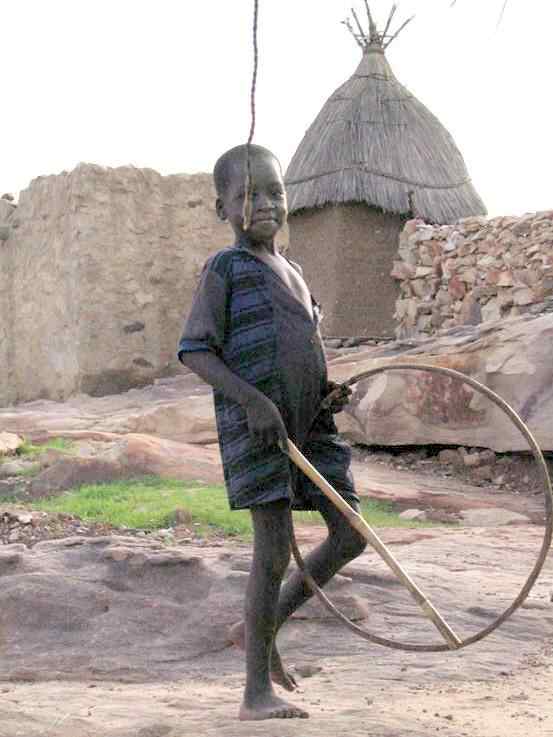
We do not have much information on boys' activities in Mali. We know nothing yet about traditional play activities. Here we see a Malian boy enjoying a classic toy, a hoop and stick (figur 1). As with children all over the world, school is a primary activity. This is limited by poverty and the nomadic life style of many families. Which means tht many children have to work to support the family. Mali is a largely Muslim country which means that it is an activity in which many children are involved. As in many poor countries, sport is not nearly as important as in the developed world. Economic success and sport are related. Poverty means that people neither have the free time or the money to participate or enjoy sport. And some Islamic clerics seek to discourage sport, believing that it detracts from a needed focus on islam. This is less true in Africa where Islam generally takes a more moderate form, at least Sub-Saharan Africa. We see boys throughout Sub=Saharan Africa absorbed with soccer. There is not a lot of sport activity but soccer is an exception. Everywhere we see boys (but rarely girls) kicking balls and if balls are not available a substitute.
Mali is a strongly Muslim country and Islam plays a major role in society and daily life. The amcient pre-Islamic religion was animist. These communities prayed to the Spirit of the Land asking them to increase the growth and harvest of the crops. This is an ancient traditional belief, which is still followed by many Mali people.
Trade with the Arab north through caravan trails across the Sahasra brough Islam (13th century). The area of modern Mali was ruled by Muslim emperors. Gradually the common people accepted the new faith, although they never entirely gave up their traditional animist faith. Slowly and gradually, Islam became the dominant religion of the country. Important Islamic universities were establisged in Mali. Islam is now dominant religion of the country. Some other religions also exist in Mali, especially the western region. Something like 95 percent of the populastion is Muslim. The others practice Chrtistianity or traditional animist cults. This strong Islamic faith has a major impact on the country's culture.
Slavery
There is a long history of slavery in what is now Mali and neighboring countries. There were important trde routes through Mali. The Gret Mali Empire grew rich by dominating these routes. Arabs and Arabized Africans with Koranic justification raided villages in the south for captives which were then forced to trek north to slave markets where they were sold. This trade eventully became dominated by the Taureg of theShara.
France colonized Mali and moved to end the slave trade (late-19th century). Domestic continued, however, primarily among the Taureg people of the Sahara. Domestic descent based slavery in the north was more difficult to eradicate, especially as it was tied in with Islamic practices. Slavery was formally abolished after Mali gained independence from France (1960). And this largely occurred in the south. There was, however, no law criminalizing slave keeping, a concession to the Islamic north where slavery is considered legitimate and sanctioned by the Koran. Thus there was no punishment of slave keepers. [Raghavan, p. A12.]Thus slavery continued in the north among the Taureg. People descended from African Bella (black) slaves remain as �property� of their lightr skinned �masters�. Arrangements varied. Some lived with their masters and serving them directly. Others lived separately but remaining under their control, having to serve their masters when needed. The Malian Government has had a difficult time surviving, against the Tureg and Islmicists of the north. Thus the government has been reluctant to stir up trouble by thretening to take their slaves away. One source working with the enslaved people provides a typical example--Iddar. Iddar�s grandmother was bought as a slave, so Iddar was inherited by his master. He was never paid and beaten regularly by the family. Iddar tells us, �The work is very hard. I had to do everything in my master�s house. I looked after the large flock of sheep alone, collected the water and did all the heavy domestic work. I worked day and night and I never received any money. Slavery by inheritance means my children are also slaves. My son Ahmed was barely three years old when a niece of the master got married. They took Ahmed away from me to work in her service. They thought he could do little jobs like make the fires. They like to enslave the children early so that they grow up understanding their place. Ahmed belonged to the family so there was nothing I could do. I was so sad. I spent 50 days pleading with them to give me my son back, but they refused. I was so shocked; I worried so much I could not sleep.� Iddar managed to escape in 2008 with Ahmed and his wife. ["Descent based ...".]
Another slave account is provided by Traore. She was born into slavery. "Her parents and grandparents were slaves of the same Tuareg family in a village1000 miles outside Timbuktu. So were her three brothers and three sisters. For as long as she can remember, Traore would wake up before sunriseto fetch water for the donkeys. At 10 years old, she was tending to the family's small animals. As she got older , she would pound millet for lunch, cook, ftch wood, and clean the house. She slept on the floor. She was paid no salary, received no education. She was given food, but even that depended on the appetites of her mastr\ers. 'After the family ate lunch, whatever was left in the pot I ate. After that I had tomake dinnerand wash up afterwards. I ent to be only afterthe family went to bed." And if she was sick or tired, she would be flogged with sticks or whips made from animal skins. 'If the father beat me, the children would also beat me next. It was a vey large family.' When her mother died, the family buried the body with no properfunerl, as they did with all their slaves, said Traore. And when she married another enslaved person and hd seven children, they 'automatically became slaves." [Raghavan, p. A12.].
All of this recently came to light when the Taureg separtists and allied Islamicist jihadis mounted a military drive on the south, seizing control of Timbuktu (April 2012). The jihadis provided weapons that the Taureg separtists formerly had difficulty obtaining. Many escaped slaves had gravitated toward Timbuktu seeking work. [Temedet] Freed slaves were returned to their former masters. Bella servants were returned to slave status. FRench troops allowed the Government to retake Timbuktu (February 2013). One group working in Mali estimates that some 0.2 million people continue to live as slaves or in slave-like conditions. [Temedt]
Sources
Raghavan, Sudrsan. "As Islamists fled, Timbuktu's slaves emerged free," The Washington Post (June 2, 2013), p. A12.
Temedt. This is an advocavy group attempting to aid escaped slaves.
"Descent based slavery in mali," Anti-Slavery website".
HBC

Navigate the Boys' Historical Clothing Web Site:
[Introduction]
[Activities]
[Biographies]
[Chronology]
[Cloth and textiles]
[Clothing styles]
[Countries]
[Topics]
[Bibliographies]
[Contributions]
[FAQs]
[Glossaries]
[Images]
[Links]
[Registration]
[Tools]
[Boys' Clothing Home]
Navigate the Boys' Historical Clothing national pages:
[Return to the Main African page]
[Algeria]
[Australia]
[Belgium]
[England]
[France]
[Germany]
[Ireland]
[Italy]
[Japan]
[Korea]
[Madagascar]
[]
[Mexico]
[New Zealand]
[Scotland]
[Uganda]
[United States]
Created: 3:24 AM 6/12/2006
Last updated: 9:28 PM 2/24/2013