
Belgian Boys Clothes Garments: Footwear
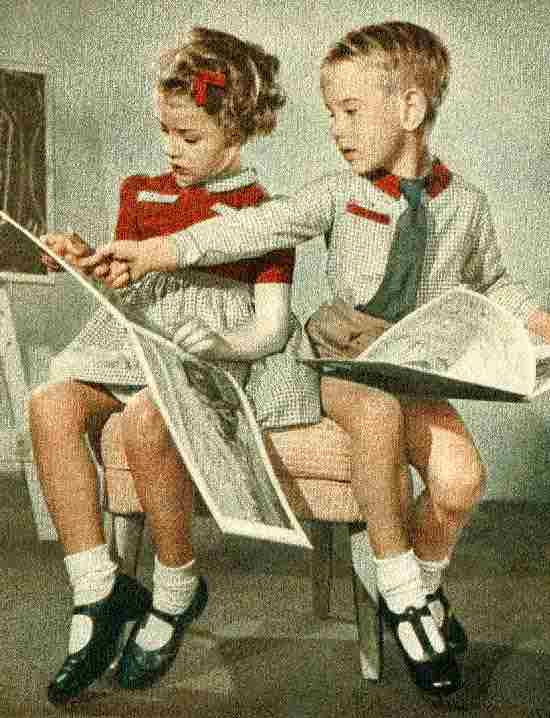
Figure 1.--This photograph shows a dress for a 6-14 year old girl and matching shirt for her brother. The boy's shirt is shown with classic short pants. This outfit was advertised in the Dutch-language "Vrouw en Huis" ("Woman and Home") magazine during 1953. Note the strap shoes the children wear. The girl wears classic strap shoes while the boy wears "T"-strap shoes. Both wear white ankle socks.
|
|
HBC at this time has very limited information on the footwear worn by Belgian boys. Our information is primarily based on Belgian images we have found. We note several different types of footwear that were commonly worn. We rarely see Belgian children going barefoot. We have very little informaion on the 19th century, but know more about the 20th century. We do not know to what extent wooden shoes were worn as in the Netherlands. They seem to have been primarily worn by working-class or rural children. Many younger boys appear to have worn strap shoes. This varied over time. Sandals were also popular. Strap shoes and sandals were also worn by girls. There appear to have been social-class differences concerning footwear, but we do not yet know enough about Belgian footwear to develop this subject. We see many boys wearing high-top shoes into the 1930s. We have not seen as many boys wearing sneakers as was the case in France by the 1950s. We have noted some boys wearing boo-like shoes through the 1940s, but oxford styles appear more common. By the 1970s sneakers or running shoes become increasing popular as was the case throughout Europe.
We note several different types of footwear that were commonly worn by Belgian boys. We rarely see Belgian children going barefoot. We do not know to what extent wooden shoes were worn as in Belgium. They mau have been more popular n Flanders than in Walonia, but we are not yet sure of this. They seem to have been primarily worn by working-class or rural children. Many younger boys appear to have worn strap shoes. This varied over time. We note different types of strap shoes. We notive boy dress and casual play styles. Sandals were also popular, mosly closed-toe sandal. High-top shoes were very common. They were commonly worn to school. We see low-cut oxfords becoming more common in the 1930s. We mosly notice standard oxfords. Belgian boys rarely wore sneakers until well after World war II. As in much of Europe we oly see them becoming popular in the the 1970s.
We have very little information on 19th century Belgian footwear because of our limited archive. We think high-top shoes became common in the late-19th centuty. We know much more about the 20th century. We see many boys commonly earing high-top shoes through the 1920s, but to a lesser exent the 1930s. We see more boys wearing lace-up low-cut oxfords in the 1920s and by the 1930s they were the dominant footwear of Belgian boys. Many children wore strap shoes into the 1950s. Both boys and gurls wore them, but the older children wearing them were mostly girls. There were different styles. School-age boys also wore them. We do not see sneakers before World War II. And we have not seen as many boys wearing sneakers as was the case in France even by the 1950s. Straps shoes and sandals until after World War II were often worn as American boys might wear sneakers. Only by the 1970s did sneakers or running shoes become increasing popular as was generally the case throughout Europe.
Gender
Gender differences in footwear varied over time. We see Belgian children wearing many similar styles of footwear in the 19th and 20th century. Strap shoes and sandals were also worn by boys and girls, including dimilar styles although there were age differences. We do not yet fully understand the gender convetions concerning footwear, but hope to as we expand this section. While both boys and girls wore strap shoes and sandal, there were some differences over time. Stap shoes were common ir both younger boys and girls, but the older children wearing them were mostly girls. And only girls wore the 'T'-strap style of dress strap shies. Sandals were lso worn by both boy and girls. Boys and girls wore various styles. The popularity of sandals for boys changed after World War II.
Barefeet
A French reader writes,"About the story on boyhood experience this reader who has lived in Belgian Congo. Note
the importance for the Belgian and French children to wear shoes even in hot tropical climates. For us, to be barefoot
is quite considered as carelessness. Only on the beach or in the back garden we could be barefoot. Never we could imagine a kid without shoes in the Bruxel , Paris streets or to go in the school! I guess our mothers will be afraid for her children's little feet." We note that all the Belgian children dressed up for a royal visit to the Congo in 1947 wear shoes, alothough quite a few do not wear socks.
Social Class
There appear to have been social-class differences concerning footwear, but we do not yet know enough about Belgian footwear to develop this subject.
HBC

Navigate the Boys' Historical Clothing Web Site:
[Introduction]
[Activities]
[Bibliographies]
[Biographies]
[Chronology]
[Clothing styles]
[Countries]
[Contributions]
[FAQs]
[French glossary]
[Images]
[Links]
[Registration]
[Boys' Clothing Home]
Navigate the Boys' Historical Clothing Belgin pages:
[Return to the Main Belgian garment page]
[Belgian catalogs
[Belgian choirs]
[Belgian movies]
[Belgian royals]
[Belgian schools]
[Belgian youth groups]
Created: January 25, 2002
Last updated: 10:44 AM 6/24/2012