|
We are preparing a series of pages on national clothing styles. We now have over 70 countries listed in our country section. Most have a linked page with at least some basic information on clothing in that country. We have developed detailed information for several mostly European counties and the United States. Many of the African country pages, however, are just being sketched out at this time. So don't expect too much yet. We have a lot of other pages to do, so it will be a while before we can focus on all the countries on our list. Of corse here we need your assistance. HBC does not have the capability to visit or even research all of these countries. Do let us know if you have any text or images to contribute about your country. We are interested in adding information about every different countries around the world. The current Euro-centric focus of HBC is because European readers have been the most willing to contribute information. We have tried to create a page for each African country, even if only limited information is available. This provides a location for collecting information. Our information on African countries at this time is very limited. Internet usage and thus vists to HBC from Africa countries is smallest of all the different world regions. Few African readers have contributed information to HBC. We have, however, slowly begun to create African country pages and acquire information on individual African countries. We hope that our readers will contribute insights into fashion trends in their own countries. The information on most of these countries still sketchy, but we have begun the process of collecting information on both African countries and tribes.
Pan-Africanism is a political ideology that promotes the ideal of a solidarity of Africans worldwide. Africans are defined in racial terms meaning blacks. It is centered on the idea that racial unity is essential to African economic, social, and political progress. Proponents asert that that the fate of peoples of African discent and African countries are related. intertwined. One author sums up the the core ideological belief, "... African peoples, both on the continent and in the diaspora, share not merely a common history, but a common destiny". [Makalani] Panafricanism is a very modern concept and originated in of all places the United states. It was in the United States that people of African ancestry began to see common interests. In African itself, blacks were more likely to see differences as the prevalebt social unit was the tribe and and the people there flt very strongly tribal differences and tribal conflicts. This was broke down in merica where eople from different tribes were thrown together and exploited by whire slave owners. It is interesting that Panafricanism first surfced in the United States and to a lesser extent the British West Indies. This was because after Emancipation, blacks here had rights of self expression and the ablity to organize and publish. In the The United States, this was motly in the South. There was, however, only limited support for Panafricanism. The earlier Abolition Movement of forced prompted the isea of ereturning freed slves to Africa. This proved unworkavle primrily because few american blacks had any interest in returning to Africa. There interest was primarily in suceeding in America. The most important American Pan-Africanist was W.E.B. Du Bois who promoted the study of African history and culture. He summed up his ideas with a single statement, 'the problem of the twentieth century is the problem of the color line'. American blacks showed relative little interest in Pan-Africanism and focused on the Civil Rights Movement. The locus of Pan-Africanism shifted with the post World War II Decolonization process. And as American blacks showed relatively little interest innAfrica. Africans showed relatively little interest in the diaspora--except perhaps how to reach America or Europe. Perhaps the leading African spokesmen for Panafricanism was Ghana's new president Kwame Nkrumah. He like many other Pan-Africanists were educated in the West. Other important voices were L�opold S�dar Senghor's N�gritude movement, and Mobutu Sese Seko's view of Authenticit�. Other important asspect of Panafricanism besides racial identity was a heady mix of Socialism, Communism, and authoritarian rule. And almost without exception, the proponents of Panafricanism presided over the economic failure of their countries and the implementation of authoritarian rule. Although major leaders were edicated in the west, what waslargely lacking among Panafrican proponets was an appreciation of democracy, the rule of law, and capitalism. This is why Decolonizatin proved such as collosal failure. It is something that only has begun to change anf the future of Africa it is not at all sure.
The great ancient civilizations of the world developed outside of Africa in Asia, Europe, and the Middle East. Here we are placing Egypt as part of the Middle East. This is not to say that there was no cultural development in Africa. There were some important kingdoms (Axum, Great Zimbanwe, Ghana Mali, anbd others). None of these, however, rivaled the great civilzations. No matter how you measure greatness, the Afrincam kindoms come up short. Art of course is important measure of civilization. Art is such a subjective matter, however, that we hesitate to use it. A major measure od civilization is a written language. We do not see written languages in Africa, except for the nirtheasternm quadrant uinfluenced by Eypt and the Middle-East. Meroitic iis the oldest known written language in Sub-Saharan Africa. It is assiociated with Meroe (7th century BC-4th century AD) and Napata (&th-6th century BC), kingdoms in the modern Sudan. The language is still only partially understood. In other areas such as architecture, mathamatics, science, technology, and oither areas, Africa lags far behind. We are not entirely sure why. Agriicultured develope outside the regin as did the most important grains. Domestic aninls are all nonm-African species. Disease (especially sleeping sickness/nagana) is a major problem. [Diamond] Slavery harmed Africa in the modern era, but this was not a problem until the African slave trade
The countries of Africa are extremely diverse culturaly, ethnically, a well as in size and levels of development. North Africa is Aran while sub-Saharan Africa is black. Most of the national borders of modern Africa reflect colonial borders rather than African tribal and cultural patterns. Our information on African countries is very limited. Few African readers have contributed information to HBC. This essentially reflects the nature of the intenet. There are realtively few computer users in African countries, essentially because most African countries are not developed economicallt and only a small proprtion of the population has computers and acces to the internet. We have, howeve, begun to compile some basic information on African countries. We encourage African readers to tell us about their countries.
Europe over more than two millenia of over devestating conflict has organized itseld along ethnic and linguistic lines. This has not occurred in Africa. Most modern African states reflect the boundaeies drawn by European colonial powers in the 19th century during the scramble for Africa. The Europeans commonly ignored tribal and linguistic afinities among African peoples. This mean that tribal groups were fracrtured and separated by boundaries. Thus modern African states commonly are composed of multiple tribal groups. And many tribal groups populate multiple countries. We have begun to collect information on some of these tribal groups. The Dinka people live in the southern Sudan along both sides of the White Nile. One of the most recognizeable tribes for their primitive life style is the Mursi in Ethiopia. Another destinctive tribe is the Tuareg of the southern Sahara, a people who for milenia dominated the Saharan cammel caravans. Perhaps the best jnown African tribal groups is the Zulus in South Africa.
Africa is the poorest and least developed of all the world's regions. Historians and anthropologists debate the reason for this. A variety of factors may be involved including the native flora and fauna and the extent of endemic diseases. Climate may be a factor. The slave trade conducted by the Arabs and Europeans may have also been another factor. Africans tend to see colonialism as a factor. The colonial experience, however, is mixed. The Africans do indeed have much to complain about. Blameing their problems on colonialism is an easy way of avoiding responsibility. European colonialism that brought Africa into the modern world and many African countries have declined since independence. A report by Oxfam and other charities suggests that one of the factors contributing to ppverty in Africa are the constant wars and civil strife that reportedly cost the various countries about $18 billion annually (2007). A range of other problens including over population, poor educaion, corruption, incompetent leadership, and a lack of economic freedom are also contributing factors to Africa's failure.
The African countries include many of the poorest countries of the world. The continent is divided ethnically and culturally by the Sahara Desert. This has affected the political and economic development of the different countries. Most of North Africa was part of the Roman Empire and thus part of the Western world. Economic levels were comparavle to the rest of the Roman Empire. After the fall of Rome there was a brief period of Germamic rule, but the region was then conquered by Arab Islamic armies. We do not know much about the economy during the early period of Islamic rule. We do know that after the onset of the Renaissance in Europe that North Africa appeared a period of economic and cultural stagnation. Much of the region lived off of trade with sub-Saharan Africa in wgivh the slave trade was very important. Another major part of the economy was Mediterranran piracy. While some individuals acquired great wealth, the great bulk of the population livedcin abject poverty. Many in North Africa at the onset of the 19th century lived lives that were little changed since the 19th century. The countries were colonized by the Europeans, in part to end piracy. Each of the countries achived full independence after World War II, convinced that ousting the Europeans would result in affluence. The results have been uniform failure. The reasins vary, but range from war and wasfeful military expenditures, socialist experiments, corruption, medieval religious traditions, bloated beaureacracies, and a failure to adequately develop the populations capabilities through education. Perhaps the key factor has been the failure to develop free market capitalism. Sub-Saharan Africavis somewhat different. Unlike Africa there was little contact with the Europeans until the Portuguese voyages of discovery to find a sea route to the East (15th century). The Europeans found African tribes that ranged from the stone age to the early-iron age in technological development. The primary interaction for the next few centuries was trade. The slave trade proved particularly disruptive. Few Europeans penetratyed into the interior. This changed as the europeans developed modern weapons, especually repeating rifles. The result was the European Scrabble for Africa which colonized almost the ebtire continent. The primary European interest was exploiting resources. This resulted in some infratructure development. Efforts to educate Africans varied from country to country, but was generally limited. This left the sub-Saharan Aftricans countries unprepared for indeopendence when it came after world war II. As in the North, the high hopes of independnce were dashed. These countries since independence have received over $2 Trillion from international doners. Except for Soviet Bloc assistance, this aid has been distributed on a non-ideological basis. The effortvhas been a total failure. [Kokorev] Most Africans or less well off than was the situation when the continent was still in colonial hands. The reasons for this range from civil wars and wasfeful military expenditures, socialist experiments, corruption, bloated beaureacracies, and a failure to adequately develop the populations capabilities through education. As in the north, perhaps the key factor has been the failure to develop free market capitalism. In both north and south, the new leaders of Africa failed to adopt democracy and free market capitalism that had made Europe so prosperous.
The earliest evidenceof religion in Africa comes from Egypt and the Nile Valley. Egyptians were worshipping Isis, Osiris, Ra, Amen, and other gods (3,000 BC). Egyptian religious practices . Further south uip the Nile, the Kushites generally adopted Egyptian religious practices and added gods like Apedemak and Sebiumeker. Nubian gods, like Bes, seem to have traveled down the Nile and entered the Egyptian pantheon. Subsaharan Africa was the home of a wide range of traditionalreligious beliefs. For the most part they were animistic beliefs, alought actual practices varied widely. There was no united Africam state, thus religious practices were highly varied. Culture patterns in Africa generally follow ethic lines. And this can be observed with religious patterns. The Bantu people of West Africa seem to have began to move from polytheism to monotheism at a faurly early point.
The idea of monotheism appeared in the person of the Sun God intrioduced by the Parph Aknaten (around 1300 BC). Monotheism disappered, however, with the death of Aknatenm. Polytheism continued in North Africa, spread by the Phoenicians who introduced Tanit and Ba'al. The Greeks and then the Romans introduced their gods to North Africa. Monotheism did not become entrenched in North Africa until Christianity began to becionme an important force in the Roman empire (3rd century AD). Constantine's conversion led to the comversion of North Africa and the spread iof Christianity in East africa, especially Axum (modern Erutrea and Ethiopia). One of the greatest Christian scholsrs was St. Augustine who lived in North Africa. North African Chrustians resisted attemopts by the Emperor, inclusing the Council of Nicea to standardize Christian beliefs. North African Christians included Donatists, the Catholics, and then the Vandal Arians. The Christian divisions and attempts by the Byzantine emperors to force adoption of a standardizeed faith were factor in the Muslim victories in Egypt and the rest if North Africa (7th century). The Moors turned north into Spain and not south into Adrica. In the east, Axum blocked Islamic expansion beyond southern Egypt. The conquest of Egypt and the Levant, however, off the Egyptian Coptic Christians and those in Ethiopia from the rest of Christendom. At the same time, the Bantu in sub-Saharan West Africa were gradually expanding into southern Africa, introducing their reloigious beliefs. The Bantu were moving away from polytheism. The Bantu tended to believe in ghosts and their power to influence the living. These ghosts included dead ancestors or popular rulers. Islam gradually moved across the Sahara and became entrenched in the northern grasslands areas of West Africa. Islam did not penetrate into the tropical rain forests of West and central Africa. South of the rain forests, Bantu religion remained dominant. Further south, in the Kalahari desert, the San people retained their own traditionl religion, similar to Bantu religious practices. Because Arab tradwers were active in the Indian Ocean, they mopved further down the coast of East africa, but did not move inland, except fot trade and slave raiding. The Europeans first reached beyond the Sahara (15th century), but theyu also did not move inland until the Scrable for Africa (19th century). At this time, missionaries began wide scale conversions. Traditional religious practices which once dominated the continent have declined as both Islam and Christianity have spread in Africa. Traditional religious tend to hold on in isolated rural areas. And while they have declined, elements survive in both Islamic and Christian religious observation.
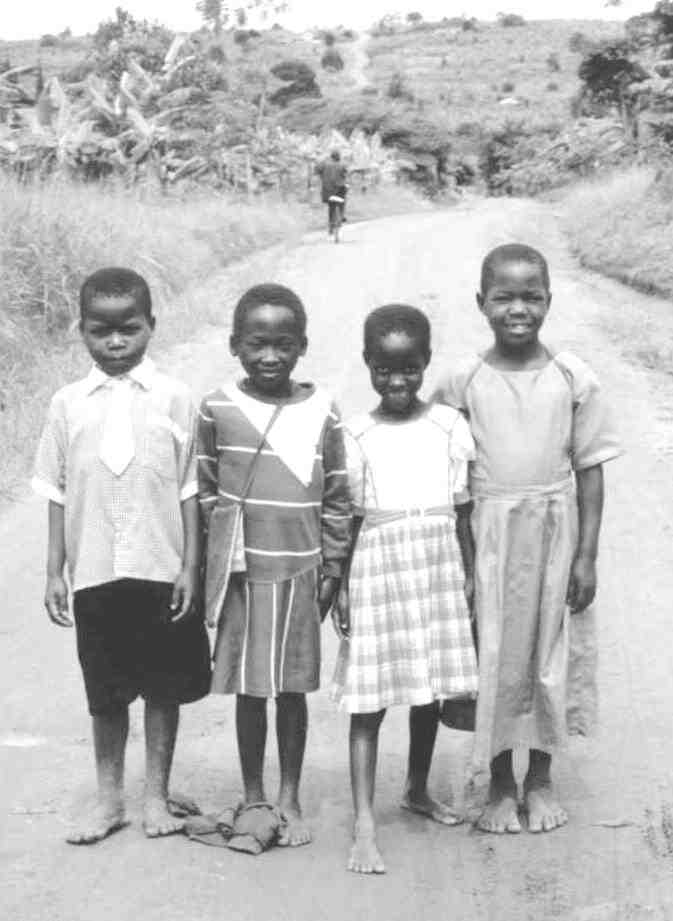
Until the 20th century, people in sub-Saharan Africa wore traditional clothes, with fe exceptions. There was some Aran influence on the rim of the Shara or in East Africa. And chiefs or other notables may have obtained some Western garments. After the late-19th century Scramble for Africa, Europeans began to exert more influence on Africans, moving into the interior and setting up colonial administrations. In additions, missionaries began to play a more active role. One of the many influences was introducing Western dress. Much of this was totally inappropriate for tropical Africa nor could many Africans aford Western clothing. We note a a postcard issued in the early-20th century by the Apostolic Vicariate of Togo with an office in Lyon, probably as part of fund raising efforts. It depicts 'petits chr�tiens' (little Christians). Whoever prepared this postcard clearly thought that wearing European clothes was a sign of Christian conversion and an indicator of the success of evangelization and missionary activity. The postcard also shows us the different trends for male and female clothing. Men and boys adopted European clothing while women elaborated a new African style with colored cotton cloths what Americans might call manny clothing. Traditional styles were varied, but men usually wore loincloths. The loincloth was common because it was simple to produce. Rectangles are the easiest textiles to weave. The decoration and adornment, however, was highly varied decoration and adornments. The women wore little skirts. Young children commonly did not wear clothing.
Diamond, Jared. Guns, Germs, and Steel: The Fates of Human Societies (W.W.Norton and Company: New York, 1997).
Kokorev, Vladimir. "SMEs or NGOs: Who can salvage Africa's economy?" AfricaNews.com (October 28, 2010).
Makalani, Minkah. "Pan-Africanism". Africana Age (2011).
Navigate the Boys' Historical Clothing Web Site:
Countries
Tribal Groups
History
Economics
Religion
Clothing
Sources
HBC

[Return to the Main country page]
[About Us]
[Introduction]
[Activities]
[Biographies]
[Chronology]
[Clothing styles]
[Bibliographies]
[Contributions]
[FAQs]
[Glossaries]
[Images]
[Links]
[Registration]
[Tools]
[Boys' Clothing Home]
Created: June 30, 1988
Spell checked: July 30, 1999
Last updated: 2:07 PM 5/10/2022