
English Families: The Stracheys (The 1880s)
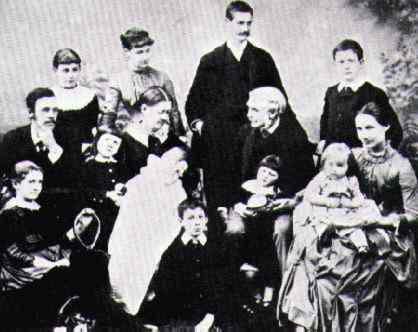
Figure 1.--This Strachey family photograph was taken about 1883 by the famous French photographer Nadar. Lytton is to the left of Lady Strchley -and wears a modest lace collar with a front buttoning Fauntleroy suit or dress. His hair is done similarly to his younger sister Marjorie who wears a larger lace collar and a velvet dress worn with pantalettes and strap shoes.
|
|
The Stracheys was a well conected Victorian family. the family produced politicans, statesmen, and historical and sociological writers. The Strachey family was photographed by the famed French photographer Nadar, presumably while Sir
Richard and his family were in Paris (figure 1). Two older boys are wearing Eton suits. Lytton and his sister Marjorie look quite similarly dressed with long hair, bangs, and Fautleroy-looking outfits. Some of the best known family members, and details (where available) on their childhood and clothing, include:
Sir Richard Strachey (1817-1908)
Lt. General Sir Richard was the family patriarch. He was born in Somersetshire. I have no details on his childhood, but he was a noted soldier and colonial administrator. He served in India (1836-50), lived in England for 5 years, and then returned to India. He served in several posts in the colonial civil service associated with public works and the railways. He authored in 1879 a major work on public works, finances and railways of colonial India, jointly with his brother--Sir John Strachey, another colonial administrator. Most of his children were born in India. There were a total of 13 children. Two of the best known were Oliver (1874-1960) Lytton (1889-1932).
Oliver was educated at Eton and Oxford. He is associated with British intelligence and cryptology during both World Wars. He spent much of his life working for British Intelligence as a Cryptographer. He began this work during World War I. He served in British Military (Army) Intelligence (MI1). Between the wars he worked in the Government Code and Cypher School and Hugh Foss cracked an early Japanese Naval Code--the Japanese naval attaché machine cipher. They achieved this without speaking Japanese. The Americans and British at the time of Pearl Harbor were working on an updated Japanese Naval Code, but had not yet cracked it. Strachey worked at Bletchley Park where the German Enigma Code was broken. Strachley headed the ISOS section deciphering various messages on the Abwehr network which used turned German agents--the Double Cross system. The first decrypt was achieved (April 14, 1940). The decrypts were first codenamed Pear. They became known as ISOS (Illicit/Intelligence Services Oliver Strachey). Strachey was replaced as ISOS head by Denys Page (early 1942).
One of the best known members of the Strachey family was Sir Richard's son Lytton. He was born at Clapham Common South Side, London (1880). His father was Sir Richard Strachey, an Indian civil engineer and soldier. His godfather, Lord Strachey, was Viceroy to India in the late-1800s. His mother was the essayist Lady Jane Strachey. He was the eleventh child and was named after his godfather, the first earl of Lytton, viceroy of India. Lytton attended Abbotshulme School, and then went to Leamington College and Liverpool University where he studied history. Lytton became a noted biographer and essayist. Lytton's most famous work was Eminent Victorians (1918), a collection of short biographies. The distinctive stylistic features of this work is an aloof irony, by which the author, through the artful juxtaposition of incongrous or inconsistent facts, makes obstensibly laudatory, but ambiguous statements which relect discredit upon his subjects. He employed this style in his well-regarded Queen Victoria (1921). Lytton was part of the Bloomsbury literary movement at the turn of the century before World War I. Lytton Strachey lived a full life, dieing in 1932.
The Bloomsbury Movement
For those too young to have known it, the Bloomsbury world is like the memory of a legendary great-aunt; a clever, witty, rather scandalous great-aunt, who was a brilliant pianist, scholar and needlewoman, who could
read six languages and make sauces, who collected epigrams and china and daringly turned her back on charity and good works. The influence of Bloomsbury can still be found in the adulation of France; in the mixture of delicious food with civilized values, and in "saying what you mean". Religion was covered by a belief in the importance of human relationships, and the belief seems reasonable enough, though one gets the impression that the milk of human kindness was kept in the larder and that the tea was usually served with lemon. But Bloomsbury, at least in its own eyes, stood
for something more important; it stood for tolerance and intelligence, for seriousness about art and scepticism about the pretensions of the self-important, and it carried on a crusade about the conscious philistinism of the English upper classes. Lytton Strachey displayed all these aspects better than any other writer connected with Bloomsbury, and
its faults and virtues reflect and explain his own.
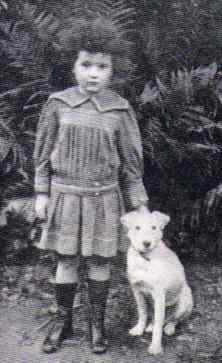
Figure 3.--John Lytton at about 5 or 6 in a photo taken aboy 1907. He is wearing a more boyish looking, plain dress. His hair is still long, but is not curled or worn in bangs as younger Strachley generations. Actually he looks at bit like "Orphan Annie".
|
|
Evelyn John St Loe Strachey (1901-1963)
Evelyn John St Loe Strachey was a noted socialist statesman and
author. He was a leader of the British Labour party,
following the reformist policies advocated by his farther. He was
born in Guilford, the son of John John St Loe Strachey. Evelyn, usually
called John wore dresses as a young boy. One photograph shows him still in a dress at about
6 years of age (figure 3). He was educated at Oxford and as Labour MP
in the 1930s wrote several penetrating works on the danger of fascism and
the coming European crisis. He served in the Royal Air Force during the
war.
HBC

Navigate the Boys' Historical Clothing biographies pages:
[Main English 19th century family page]
[Main English family page]
[Main biographies page]
[Biographies A-F]
[Biographies G-L]
[Biographies M-R]
[Biographies S-Z]
Navigate the Boys' Historical Clothing Web Site:
[Tunics]
[Curls]
[Long stockings]
[Pinafores]
[Smocks]
[Dresses]
[Sailor hats]
[Lace collars]
[Knickers]
[Strap shoes]
[Pantalettes]
Navigate the Boys' Historical Clothing Web Site:
[Return to Main English page]
[Introduction]
[Activities]
[Biographies]
[Chronology]
[Cloth and textiles]
[Garments]
[Countries]
[Topics]
[Bibliographies]
[Contributions]
[FAQs]
[Glossaries]
[Images]
[Links]
[Registration]
[Tools]
[Boys' Clothing Home]
Created: June 20, 1998
Last updated: 8:59 PM 2/21/2011