|
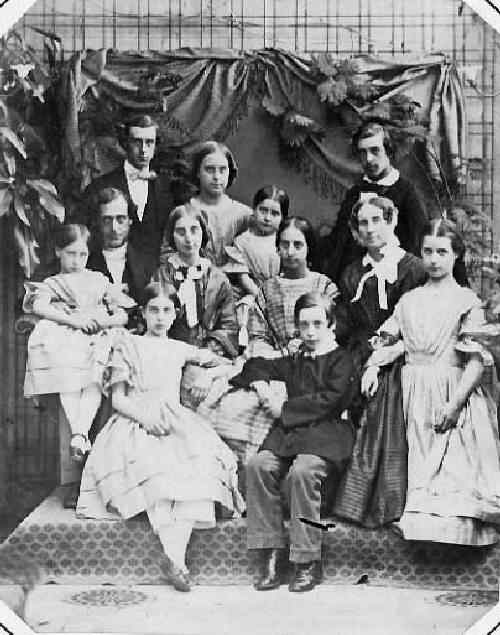
We note some large families in the 19th century. Not all families were large, but a number of children seemed the Victorian ideal. Younger boys throughout the 19th century wore dresses. Pattaletts were common. The age of breaching varied from family to family. Here social class was a factor. Boys in the early 19th century wore long pants skeleton suits. Tunics were also worn. Long pants contiued to be standard for boys until after mid-century. Gradually kneepants and knickers became more common. Wenote Eton collars becoming increasingly common by mid-century. Sailor suits became fashionable in the late 19th century, both boys and girls wore them. Girls wore dresses throughout the 19th century and the family photographs help to understand the changes over time.
This is Samuel Woodforde's portrait of James Bennett (1745–1815) anf his Lonnday family. His wife was Mary Clutterbuck (1762–1853) plaing the harp. They married in Truro (1789). The girl with the tambourine is their eldest daughter Mary (1790–1867). Beside her, holding a triangle, is her sister Eliza (1791- ). The boy in black is the eldest son James (1793–1872) and the boy in red is his brother Henry (1795–1874). The older girls are involved in music with their mother. Thb boys sare playing marbles. Both are wearing velvet skeleton suits. They would have been about 8-10 years old. The girl sitting on the carpet is Juliana Sarah (1794–1873). Her younger sisdter asleep on her lap is Frances Ann (1798–1846). Henry wears a skeletin suits with a large open ruffled collar. James wears a jacket suyit woth a smaller ruffled collar. The girls all wear white Empire dresses with coral necklaces. Notice their short hair.
George Bridges was a wealthy banker and merchant. He is pictured with his wife Mary and their eight children. The group is shown in what was probably the drawing-room of the home Bridges built in 1790, Lawford Place, Essex. You can see Lawford church in the indow landscape. The two oldest girls are at the spinet or early pianoforte. The portrait was painted by famed English artist John Constable. He is perhaps the most acclaimed English landscape artist, often described as the father of modern landscape painting. He also did some portraits, the sure way of earning lucrative commisions. This portrait of the Bridge's family in 1804 provides us a classic representation of Empire fashions for adults and children of both genders. Notice the simple, white high-wasted white dresses and the drab colors, often black, garments of the men. The boy is wearing a skeleton suit.
Here we have a portrait by an unidentified English artist. There are four children, whom we believe are brothers and sisters. we believe two of the children are boys and two are girls. The boys are the younger children and not yet breached.
Charles Darwin and his sister Catherine had a chlk portrait done in 1816. Charles was 6-7 years old. He wears a blue skeleon suit wih a open ruffled collar. Catherine wears a white Empire dress and pantalettes. The chalk drawing was neautifully done by
We do not know a great deal about the Bean family, other than they are part of the rising class of industrialists being made rich by the Industrial Revolution. Mrs. Bean's father owned a glass factory. A portrait made in 1829 gives us a tantalizing glimpse of family life in the Regency Period.
The water color shown here is unidentified. We know nothing about it. Our assessment, however, is that it was painted in England during the 1830s. It was not paintained by a master artist, it is however a charming image and the dresses and hair styles are painted in some detail. We believe the child in the blue dress is a boy, although there is no way to be certain about this.
We have been unable to find many English family portraits from the 1840s. This is probably because the Daguerreotype was not as common as in America. This appears to be because the cppyright of the process was strongly enforced in Britain and thus there was not as many studios and the industry did not grow as rapidly as in America. We have found a few painted portraits.
This Robert Thorbirn painting may be a minature, we are not sure. The children are not identified, but they seem to be boys. notice that there are no center hair parts. Nor is the work dated, but we would guess it was taken in the 1840s. The 1830s is unlikely because of thar artist's age. The 1850s is possible, but less likeky.
The Royal family was painted by Winterhalter (1846). This is of interest because Victorua and Albert liked to portray themselves as a model middle-class family. And of course royal fashions had a very important impact on popular fashion trends. The clothing styles chosen for Queen Victoria's children popularized classic styles such as kilts and sailor suits. This painting shows the royal family in 1846. I am not sure, however, to what extent the Queen personally decided on these styles.
This is a wonderful painting of a wealthy family on their Dorset estate by William Beetham. It is the family of the Reverend Nathaniel Bond and his family. The painting is a happy scene showing a prosperous family outside their country estate--Creech Grange. In the scene are the Reverend Bond and his wife Mary. There are five children:
The eldest child is a girl, Leonora Sophia. The boys are: Johnnie (holding the saddle), Denis (playing with the dog), Nathaniel (holding the bridle ), and George (sitting on the pony). The eldest boy is Johnnie and the youngest is George. They are dressed in the fashionable clothes of the 1840s. The youngest wears a red dress but it is clear that the child is a boy. Reverend Reverend Bond married Mary Hawksworth (183?). He was Canon of Salisbury (a cathedral town) and rector of Steeple and Tyneham. At the time of the painting they lived at Creech Grange near Wareham in Dorset. Vicars even canons were not that well paid, Creech Grange had been inherited from his wealthy brother. The painting seems to have been commissioned to celebrate the completion of the renovations to the property. These had been started four years previously when the Reverend Bond inherited the property. The children are well dressed. The older boys seem to be wearing a school uniform where they presumably boarded. It is interesting that they wear their school uniforms at home. They appear to be happy and carefree. The chikdren have ponies to ride, toys to play with, and pet dogs. The portrait not only provides interesting sociological insights into wealthy family life, but useful details about a range of different fashion styles and garmenhts.
Photography was becoming more common in the 1850s. New photographic processes were developed. We note Daguerreotype, Ambrotype, and tintype portraits in America, For some reason we have been unable to find many of these portraits from Britain. We are not sure precisely why. Surely there must have been many such portraits taken. Trade mark rules seem to have impeded the industry's development and thus the number of available images. We see younger wear pantalttes with tunics and older boys wearing pants with tunics, both white pants and pants matching the tunic. Boys that had not yet been breeched. After breeching boys from fashionable families wore tunics for several years. We see some boys wearing capes. Vested suits werecommon. Boys wearing shortened-length pants might wear stripped stockings.
We begin to see really large numbers of portraits in the 1860s a a result of the CDV. This was a negative based process and proved enormously popular. The negative pricess permitted the prining of duplicates and prining on paper substantially reduced the cost of a photographic portrait. We see a rang of different fashions. Younger boys wore dresses. Tunics seem less popular than in the 1850s. Many boys wore suits with cut-away jackets with trousers of the same color and material. This was not very common in the 1850s. Younger boys mifgr wear bloomer knickers. Most boys wore long pants. Boys by their teen years wore mpre adult styles suits. All girls wore dresses. Large hoop shirts were popular, but younger girls tended to wear more moderately sized skirts.
Younger boys continued to wear dresses. We also notice kilt suits. We notice some boys wearing tunics after being breeched. . Most boys wore suits in portraits and family portaits during th 1870s. Younger boys mightwar knee pants or bloomer knickers, but most boys still wore long pants. Girls wpre dresses, th length depended on the girl's age, although we see even some younger girls wearing long dresses like their mothers.
We continue to see extended families with grand parents and maiden aunts along with good sized families. We also sorts of headwear including sailor styles. Peaked caps were also common. The 1880s was the beginning of the Fauntleroy era. Only a fraction of boys wore Fauntleroy suits which were less common in England than america, but more common than the continent. Even so we do see quite a few boys with outfits that had some Fauntleroy styling. Sailor suits were another importnt outfit, especually for school age boys, although the popularity declined afyer about 8 years of age. Many younger boys had velvet suits. Suits were standard for boys, often with Eton collars. We see shortened-length pants (knickers and knee pants) were becoming increasingly popular. Norfolk suits were popular. Hosiery varied, including both socks and long stockings. Black long stockings were common. This contrasts with America where almost all children wore long stockings.
The photographic record by the 1890s is extensive. We have numerous famnily images, although still mostly formal studio portaits. We have collected images of entire families or in some cases just the children in the families. A few images include the nannies carrying for younger children. Good sized families were still fairly common. Younger boys still wore dresses. We see boys wearing Fauntleroy suits and sailor suits. The age range for the sailor suits were greater. We notice school-age boys commonly wearing Eton collars, especially primary-age boys and younger teenagers. They were worn both with and without neckwear. We notice both collar-buttoning and lapel jackets. Norfolk styling was popular. Boys wore both knee pants and knickers with long stockings. Younger boys might wear short pants and knee socks with the knee showing, but this was not very common for school-age boys. Girls wore a variety of dresses. Baloon sleeves were considered stylish during the decade.
Most photographs including portraits are undated. Thus we have to estimare the decade. This is usually possible, but we have found some family photographs that we are having trouble dating. This is more of a problem with english images because are more familiar wiyj American portraits and and formats. We are hoping that our English readers will have some insights to offer. Feel free to let us know if you have any information to offer. e will archive the imahes here tht we are not confident bout dating, hpoing ghat we cn eventually move them to the approprite decde.

Navigate the Boys' Historical Clothing Web Site:
[Return to the Main English family page]
[Return to the Main English page]
[Introduction]
[Activities]
[Biographies]
[Chronology]
[Clothing styles]
[Countries]
[Essays]
[Girls]
[Bibliographies]
[Contributions]
[FAQs]
[Glossary]
[Images]
[Links]
[Registration]
[Tools]
[Boys' Clothing Home]