|
Modern France was in ancient times Gaul (Gallia), the primary Celtic land after the Celts were driven west by the Germanic tribes. Gaul was conquered by Ceasar's Legions in one of the great and brutal military capaigns of history. With the fall of Roman power, the Germanic tribes flooded across the Rhine. In the struggle with the Romans Visagoths, and Huns, the Franks emerged as the dominant power (5th century). Modern France takes its name from the Franks. Francia is the Latin term for "country of the Franks". Pepin founded the Carologian dynaty which under Charlanegne include much of western and central Europe (9th century). Many of the modern European states developed from the break up of the Carlogian Empire after the death of Charlemagne. France emerged as one of those countries at about the time that the Viking raids began. The country thus was formed by the Celtic, Roman, Frankish, and Viking peoples. France developed with a weak monarchy because of the resistance of the nobility to cental authority. This left France open to attack from the Vikings and English. Frances played a mixed role in the Reformation. This changed after the Fronde when Louis XIV establish a centralized absolute monarchy. His efforts to expand France's borders to the Rhine brought a series of Wars. France competed with England Spain for control of overseas empires (India and North America). The French lost most of that empire in the overseas conflicts associated with the Seven Years War. French resentment was a factor in their support of the American colonies. The cost was a factor leading to the French Revolution, a major turning point in European history. The Revolution inspired some of the great ideals of the Western spirit, but unlike the American Reolution degenerated into the Great Terror. The Napoleonic Wars convulsed Europe in a series of wars until Napoleon's defeat (1815). The Congress of Vienna attempted to restablish the Ancien Regime. Afterwards France again began to build an overseas empire and the Industrial Revolution began to transform France. The restored Bourbon monarchy was finally replaced during the Revolution of 1848 with the Second Republic and Louis Napoleon's Second Empire. It was during his reign that Italy unified and after the disastrous Fraco-Prussian War that Germany unified. The loss of Alsace-Loraine created an embitered France seeking revenge. Louis Napoleon was replaced by the Third Republic. Kaiser Wilhem's disastrous diplomacy allowed France to negotiate a treaty with Russia and gradualy improve relations with Britain. Thus when World War I broke out France had allies. In the end France was saved by American intervention as it was again in World War II. After the War, France fought two colonial wars, but still lost its empire. It also persued a new relationship with German and European integration. France under DeGualle proved a divisive member of the Western alliance resisting Soviet expansion duruing the Cold War.
Geography is a major factor in shaping history and France is no exception. A flat plain streaches along the northern tier of Europe shared by modern France, the Low countries, Germany and Poland. It is bissected ny relatively small rivers that are not major barriers, with the exception if the Rhine. As a result, the countries of northern Europe are unprotected by geographic barriers. This has mean a struggke both between these countries and vulnerability ton invaders from the east. Much of French history has been defined by this geography. At times France has been the invader and other times it has suffered greviously from invasion.
Archaeologists have found thousands of Neolithic burial mounds and various crude monumental constructions in western and northern Europe. Many have been found in France. Some especially large sites have been found at Carnac in northwest France. There stone rows, standing stones, and huge burial mounds have been found (4500 BC). Neolthic sites have also been found in southwest France. Archaeologists have found more than two dozen early long mounds.
French history begins with the Gauls, a Celtic tribe with no real central orgnizatuon which inhabited the area pf modern France (beginning about 300 BC). The Celts for centuries dominated northern Europe. They moved west into the Iberian Peninsila and across the Channel into Britain and Ireland. The Celts were a pre-literate people. As a result, much of whatvwe know about them comes from their enemies--the Greeks and Romans. There never was a united Celtic people, but a cultural community of warring tribes. Warfare was very important to the Celts, but a kind of individual, ritualized war fare. They were a threat to the Greeks and Romans. A Celtic Army would seize Rome itself. The lack of discipline and organization as well as political unity would, however, eventually allow a relatively small Roman armt to conquer the Celts. Modern France was in ancient times Gaul (Gallia), the primary Celtic land after the Celts were driven west by the Germanic tribes and the Romans conquered Iberia. As a result a major contribution to the genetic stock of modern France is the Celtic people. Julius Caesar conquered the Gauls (mid-1st century BC).
Gaul was conquered by Ceasar's Legions in one of the great and brutal military capaigns of history. Romans would have migrated to Gaul at this tume. Roman legions were stationed in Gaul. It is not clear to what extent four centuries of Roman rule affected the genetic stock. It seems likely that the population remained largely Celtic. Persumably modern DNA studies can provide useful information here. We do know that culturally, Gaul was largely Romanized. The language of modern France is a Romance language meaning with a largely Latin base. The Romans founded many towns which today are major French cities. The most important of course is Paris. This was of great importance as the history of the development of the French nation is inseperable from the rise of Paris.
Paris began as a small Roman settlement on the Île de la Cité, one of two natural islands in the Seine around which the modern metropolis rose. The Seine was navigable providing an important east-west trade routes. North-south trade routes bisected the Seine at the Île de la Cité which fueld the growth of Paris. With the fall of Roman power, the Germanic tribes flooded across the Rhine.
In the struggle with the Romans Visagoths, and Huns, the Franks emerged as the dominant power in what is modern France (5th century). Gaul would be ruled by the Germanic Franks for several centuries. The Franks were the first Germanic tribe to adopt Catholic Christianity after the Roman Empire collapsed. The Frankish warlord Charles Martel turned back the Moors at Tours (732). His son and grandson (Pipin and Charlemagne) created the greatest state in Europe since the demise of the Roman Empire. This was, however, a Germanic and not French state. Modern France takes its name from the Franks. Francia is the Latin term for "country of the Franks". Charlanegne's empire include much of western and central Europe (9th century). Many of the modern European states in central and western Europe developed from the break up of the Carologian Empire after the death of Charlemagne. France first appeared as an indeoendent state with the Treaty of Verdun (843 AD). This divided Charlemagne's Carolingian Empire. Many of the modern states of Europe can also trace their origins to the divisioin of Charlemagne's Empire.
The imprtant mzatter to bear in mind about medieval French history is that it is the country's longest hiodtorical era--essentislly a millernium. French medieval history begins with the fall of FRome and the Franks. The Franks were, however, a Germanic tribe. Thus modern France does nott emerge until the division of the Frankish Caroligian empire. The division of the Caroligian Empire provided the basis for both modern Germany and France. After the Carloginians, the descendents of Hugh Capet for almost 1,000 years provided France with its kings as direct descendents and later branch families (Valois and Bourbon). France emerged as a recognizable modern country at about the time that the Viking raids began. The country thus was formed by the Celtic, Roman, Frankish, and Viking peoples. France developed with a weak monsarchy because of the resistance of the nobility to cental authority. This left France open to attack from the Vikings and English. France played a major role in the Crusades which absorbed the energies of kings, counts, clergy, and commoners, reducing interacine conflict. Medieval French history swirls around conflicts with both a divided Germany (the Holy Roman Empire) and a united England. The Norman conquest of England in the 11th century initiated centuries of conflict between England and France. The proud French nobility competed with the monarchy for power. This coupled with regional power centers like Normandy asnd Bugundy had the potential to create a sutuation as in Germany that prevented the creation of a centraklized French state. This was prevented by King Philip Augustus of France who defeated a coZlition led by the Emperor Otto of Germsny and King John of England, especially at the Battle of Bovines (1214). Two centuries laster, France again faced dismemerment, this time it weas saved by an unlikely savior, a French peasant girl--Joan of Arc. Her victory at Orleans was crucial (1429). The French went on to expell the English in the Hundred Years War and to defeat their Burgundian allies. The French nobility weakened by the War finally was forced to bow to the monarchy and its claim of absolute authority. Gradually trade revived and cities and towns begin to grow. The bourgeois of the towns engaged in a resurgent trade of agriculture and artisan crafts. The French built magnificent cathedrals to glorify God. Important universities were founded at many of these cathedrals. The quickening economy was caped by the Renaisance brining and end tp the medieval era.
The Viking depredations are best known in England, at least to English readers. The Vikings also ravished large areas of France. They arrived just at the time that Charlemaigne's powerful empire was beginning to unravel. A Viking war party seized Rouen (885) and then moved up the Seine in their long boats to Paris. This set up a harrowing 10-months seige. The Comte de Paris, Eudes, led the residtance. The Parisians eventually bribed the Vikings with silver and an offer if free passage. This allowed them to mive up tge Seine and attack Burgundy, setting in motion centuries of strained relations between the French monarchy and Burgundy. Count Eudes was elected king. And he bribed off the Vikings by gibving them Normandy from where they turned their attention north to conquer England.
A descendent of Count Eudes, Hugh Capet, was elected king (987). Capet was the first King of the Franks of the House of Capet from his election in 987 until his death. He succeeded the last Carolingian king, Louis V.
Rarely has so much royal blood flowed through a monarch's veins. Through his mother he was comnected to German and French roylty. Hugh was the nephew of Holy Roman Emperor Otto I; Henry I, Duke of Bavaria; Bruno the Great, Archbishop of Cologne; and finally, Gerberga of Saxony, Queen of France. Gerberga was the wife of Louis IV, King of France and mother of Lothair of France and Charles, Duke of Lower Lorraine. Through his fatherm the Robertians, were great landowners in the Île-de-France. His grandfather was King Robert I. King Odo was his granduncle and King Rudolph was his uncle by affinity. Hugh's paternal grandmother was a descendant of Charlemagne the most prestigiou European royal. Hugh had been elected. His son would begin the hereditary succession of French monarchs.
Duke Williams conquest of Saxon England began nearly a millenium of conflict between France and England. The Hundreds Years was a major part of that conflict. Edward III initiated the Hundred Years War with France (1337). Edward with his many French possessions refused to do homage to King Philip VI of France. Edward had aclaim to the French crown through his mother. Hostilities erupted and cintinued over 100 years. The French suffered some serious defeats in the early years of the war, Crécy (1346) and Poitiers (1356). At Poitiers French King John the Good was captured by the English Black Prince Under Charles V the struggle became a war of attrition. He relied on Bertrand du Guesclin to engage the marauding Free Companies, marauding mercenaries. Charles V by his death had stabilized the struggle (1380). England's Richard II seeme willing to settle the differences. Charles VI's mental instability and feuding princes undermined the French position. John the Fearless, duke of Burgundy, had the king's brother, Louis of Orleans murdered (1487). This left France deeply slipt between Armagnacs and Burgundians. Henry V seized the opportunity. The result was the most disastrous French military defeat until Napoleons defeat in Russia. Henry destroyed the cream of French nobility at Agincourt (1415). Henry forced Charles VI to acknowledge him as the legitimate heir to the French throne. France was split between the powerful John Duke of Burgundy and the Dauphin, Charles, son of Charles VI and Isabella of Bavaria. Gradually the Dauphin aided by the young peasant girl Joan of Arc built his power. He was crowned Charles VII at Reims, recaptured Paris, and recovered Normandy (1450). Charles then took Guienne (1453). With the the victory of Castillon, France had effectively defeated the English and united the country.
Although generally classified by most scholars as the last century of the medieval era, the 14th century is generally seen as the beginning of the Renaissance and the beginning of a modern state of mind. "Renaissance" means "rebirth" in French and describes the cultural and economic changes that occurred in Europe beginning in the 14th century. Humanism began to replace Schlolaticism as the philosophical foundation of European intelectual thought. The precise time is difficlt to set and of course varied accross Europe. The Renaissance began at Firenze around 1300 and gradually spread north. Even so, the indicators that constitute the Renaissance did not reach other areas of Europe 1-2 centuries. It was during the Renaissance that Europe emerged from the Feudal System of the Middle Ages. The stagnant Medieval economy began to expand. The Renaissance was not just a period of economic growth. It was an age of intense cultural ferment. Enormous changes began in artistic, social, scientific, and political endevours. Perhaps of greatest importance was that Europeans began to develop a radically different self image as they moved from a God-centered to a more humanistic outlook. The Humanist scholars used their clasical work to assess Church practices and Biblical scholarship. The Renaissance is probably most associated with stunning developmens in the visual artse, especially Italian and Dutch-Flemish painting. The Renaissance is also associated with advances in music, especially the brilliant polyphonic music. Another major achievement during the Renaissance was the birth of modern European drama.
The Feudal System
After the Spanish and Portuguese voyges to the south, England and France focused on North America. King Henry VII sponsored the first English voyage of discovery. After news spread of Columbus' discoveries (1492), King Henry contracted an Italian navigtor, John Cabot, to find a new trade route to Asia for England. Cabot sailed west from Bristol, England (1497). Cabot did not find a new trade route. but encoutered the eastern coast of Canada. Cabot like Columbus, at first thought he had encontred Asia. Cabot in a second voyage chartered the coast from abot Baffin Bay as far south as Maryland. King Henry laud claim to North America as it slowly became clear to Europeans that the early explorers had discovered a new continent rather than Asia. The first economic exploitation of North America came from a diverse group of European fishermen who began to hrvest the rich cod grounds on the Grand Banks. Some of the fishermen mde lndfall and encoubtered Native Americans. This was the first trading with the North Americans. The Europeans found they could obtain valuable furs for inexpesive trinkets. The Europeans were disappointed because what they found in North America seemed paultry in compsrison to the vast quantities of gold and silver that the Spanish Conquistadores found to the south. The Europeans, however, gradually decided to persevere in the north. King Francis I of France sponsored another Italian navigator, the Florentine Giovanni da Verrazano, to conduct Frnce's first voyage of discovery. Verrazano sailed along the coast from North Carolina to Newfoundland (1524). This was the initial basis for France's claims. The fact that it overlapped with Cabot's earlier voyage was the initial step in the developing struugle between Englnd and France to control North America. King Francis dispatched Jacques Cartier on another voyage (1534). Cartier did not explore new lands, but subitted a much more detailed report and focused on what was to prove the mouth of the St. Larence River. The first European penetration of the interior began through the St. Lawrence River was begun by Cartier the following year (1535). The attraction was finding a possible passage to Asia, more than a desire to move inland. Carttier's fleet of three small vessels reached the Indian village of Stadacona, (close to modern Quebec City). He continued further upstream and 150 west encountered the Indian village Hochelaga (modern Montreal). This was as far up the St. Lawrence he could sail his vessels. He named the high ground beyound the village Mont Real. Here they wintered. Many perished in the cold before the survivors returned to France in the Spring.
The French monarchy had a special relationship with the Church. French kings had generally avoided the kind of open split with the papacy like the Investiture Controversy that so divided Germany. The Pope gave the kings of France the title of "Most Christian King." Each French King took an oath to "extirpate" heresy in his realm. The French Church despite the close relationship between th moinarch an papacy had evolved considerable independence from the papacy. The French monarchy had perhaps more authority over the Church in his country than any other prince in Western Christendom. This was further recognized on the eve of the Reformation by the Concordat of Bologna which confirmed Francis I's authority to make appointments to benefices. As a result, many of the conditions which led to the Reformation in Germany were less apparent than in Germany. The Concordot provided for the rights of both pope anf king, but made the king clearly dominant over the French Church. While religious issues are most commonly discussed in connection with the Feformation, financial matters were a major concern at the time. The monarchy in France had enormous control over the disposition of the wealth and income of the French Church and routinely used the authority to appoint bishops, abbots, and other church officers to reward faithful followers because there was considerable income associated with many of these offices. As a result, the princes of the French Church included many worldly people, often uninterestred in spiritual or doctrinal matters, but often quite nationalistic. The Pope had a veto on such appointments, but out of defference to the monarch, rarely exercized it. Thus there was a considerable fusion of church and state in France very diffeent than the situation in Germany. The University of Paris (the Sorbonne) during the late Medieval era served as a kind of scholastic think-tank for both Church and state.
Spain had risen in the 16th cenury as a European superpower, bolstered by gold and silver from its new American colonies. France was temprarily eclipsed. After the defear of the Great Armada (1588), Spanish power gradually wained but still threatened France--especially when combined with their German Hapsburg cousins. The French monarchy appears to have dreamed of seizing the imperial title for itself. France finally entered the War openly (1634), concerned about the Spain's gains in the Rhineland and the Netherlands which seemed to surround France with Hapsburgs, both German and Spanish. This change the nature of the War making it as much a European war as a German civil war. The German states led by the Emperor and Spain now faced France, the Northern Netherlands (the Dutch), and Sweden. The religious issue had played itself out in the earlier fighting. Now national and dynastic issues come more to the fore--primarily the struggle between the Hapsburgs and the French monarchy now the bourbons. The War continued for over 10 years, but the battles while costly were largely indecisive. The most important was the battle of Rocroi (1643). The Duke of Enghein-later (Prince of Conde) gained a substantial victory over the Spanish forces.
The Fronde was a French civil war resulting from the conflict between and increasingly absolutist monarchy and the nobels of France. It occured during the monarchy of King Louis XIV, but while he was still a child. It occurred at about the same time as the later stages of the Civil War in England and immediately after the Thirty Years War in Germany. All three of these conflicts were caused by the attempt of the monarchy to expand its authority at the expense of the nobility and wealthy merchants. The outcome in each country was radically different. The name Fronde was derived from the play slings used by the boys of Paris in mimic street fights.
The pope in Rome claimed infalibility. The new monarchs of Europe in the early middle ages claimed rule by divine right. This put the two on a colision course. The struggle between the Holy Roman Emperor and the papacy suceeded in preventing the Emperor from creating a centralized German state. Gradually an uneasy truce developed between the various Europwan kings and the papacy. And by the 15th century, strong centralized monarchies began to emperge in Europe. And the monarchs of these states under the authority of divine sponorship began to persue the goal of absolutist rule. With the outbreak of the Reformation, the Church increasingly supported the Catholic princes persuing absolutist regimes that among other objectives could control religious expression. It was te Hapsburg emperors who first attempted to stamp out Protestantism. The huge influx of wealth from America enabled the Spanish monarchy to confront Protestahntism, both in the Lowlands and then in England. Both failed. Next France attempted to dominate Europe. The French kings acted out of more nationalist motivations, but religious factors were involved. Louis XIV sucintly expressed the essence of absolutism, "I am the state." And he acted to destroy Protestantism in France by supressing the Huguenots. Proostentatism is commonly discussed in theological terms, but there were political connotations. German princes in part embraced Luther, because of his nationalist appeal and as asuing independence from the emperor. Protestantism was also in essence the demoritization of religion. And it is no accident that political democracy began to emerge in northern Europe which was most strongly affected by the Reformation. Thus a struggle developed between Catholic absolutism and the new Protestant states. And with Louis XIV in the late 17th century, France became the acedent Catholic power. And French absolutism did not end with rge execution of Louis XVI (1793). The French Republic with the Tyranny persued the tyranny of the majority which was followed by Bonspartist absolutism. The main challenge to Catholic absolutism proved to be the Protestant German princes, the small Dutch Republic, and the English with their growing Royal Navy.
Louis XIV was committed to building an absolute monarchy. He is most famous for his statement, "I am the state." To this end, Louis ordered a mercilles percecution of the Huguenots, revoking the Edict of Nantes (1685). As a result of these percecutions life for many Protestants became intolerable in France. It was not just the lack of religious freedoms, but many other matters. The state refused to recognize Protestant marriages leaving the children illegitimate. This affected property rights and inheritannces. Large numbers of Huguenots fled France, leaving for Switzerland, the Netherlands, England, and the English colonies in America (especially New York, Massachusetts, and South Carolina). As a result, many Americans of French ancestry are Protestants. (Except for the Huguenots few French people emmigrated to America. France is one of the few Europrean countries that did not send large numbers of emmigrants to America.) No one knows precisely how many French Protestants emigrated. Estimates range from 0.4-1.0 million. About 1.0 million Protestants remained in France. Many settled in the isolated Cévennes Mountains becoming known as the Camisards. Louis XIV ordered them removed, resulting in the Camisard War (1702-05).
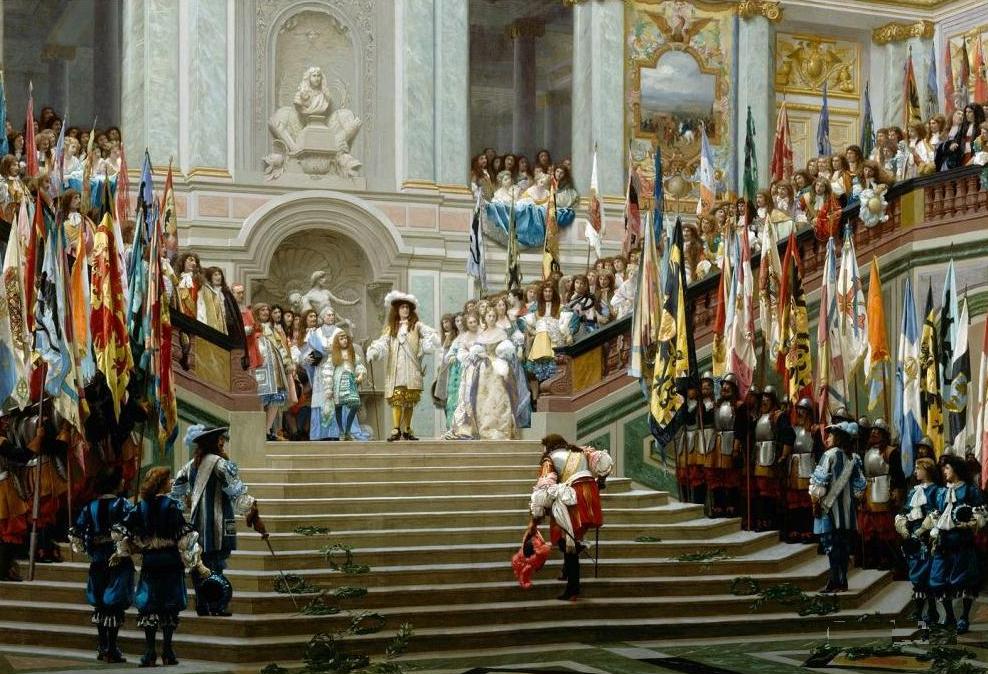
The French monarchy reached its zenith during the reign of Louis XIV--the Sun King. He reignedc for an amazing 72 years. He saw himselfas the Monarch of all European Monarchs and many of his contempraries agreed. His palace of Versailles and its Hall of Mirrors became a treasure-trove of Baroque art. Louis achieved military success in a realtively costless war early in his reign. This seems to have wetted his appetite for military "glory". After Madame de Maintenon closed down his constant affairs and philandering, Louis launched upon a series of ememsely expensive foreign wars. Earlier French kings were constantly getting bogged down in Italy with little to show for it. Louis decided to move north with aesire to estblish France's borders on the Rhine. France at the time was the most populace, richest, and powerful state. Louis did succeed in annexing Alscace, but while he waged war mdrcelessy, destroying large areas in the Netherland and Palatinate, he did not succeed in moving France's borders to the Rhine. His desire for Glory united all of Europe against him. English armies entered the Continent and led by Marlbourgh achieved great victories at Blenheim and other battles. With only meager gains, Louis bankupted the French state--a development that would lead directly to the Revolution. The scourging of Germany embittered relations with Germany, a emnity that would last through the centuries. It would a Prussian Army that would defeat Napoleon at Waterloo. And the emnity would have destroye the French nation entirely in World War II had the French not becrecued by the British and Americans--for a second time.
France competed with England Spain for control of overseas empires (North America, the Caribbean, India, and access to the China trade). Portugal and Spain got an early lead. But neither were rich countries and the Catholic Church and the Inquisition stifeled the learning and free thought necessary for inovation and science that would play an important role in the competition for empire. Thus the three countries that would compete for empire were the English, Dutch, and French. The tiny Netherlands admassed a huge navy and trading system, but the need to build an army capable of fifghting off fitst the Spanish and tan the French in the end limited their naval out reach and empire building. In the end the competition for empire would be fought between the Brotish and French. Beginning with the Glorious Revolution (1688) and Waterloo (1815), the two countries would fight anotherv Hundred Years War, including the first world war--the Secen Years War. In the end gepgraphy and the mind set of key leaders--especially Louis XIV and William Pitt would determine the outcome, Louis like other European monasrchs was focused on adding principalities to his realm. Thus huge sums of trasure and blood were expended to gain principalities like Alsace and the United Provinces. Some of these efforts failed. Others succeeded, but only after repeated wars. While Louis was occupied with draining the wealth of France and royal coffers in an ultiately futile attempt to extend his kingdom to the Rhine, the British with a smaller populastion and fewer resources were busdy building a navy and a world trading system. Thus when the key struggle came, Pitt with the the Royal Navy swept the underrf financed French navy from the seas which would lead to defeat in North America, the Caribbean, and Indua. Despite victory after victory in Europe, the position and naval fominasnce Britasin achieved would ultimastely prove decisive in the Napoleomic Wars.
The Barbary pirates or Ottoman corsairs, were pirates who operated under the cover of privateer operations authorized by the Barbary states. The Barbary pirates operated from western portion of the north Africa from Tripoli west to Moroccan ports. This became known as the Barbary coast. The Muslim Barbary pirates preyed on Christian and other non-Islamic shipping in the western Mediterranean Sea beginning with the Crusades, but more importantly inthe 16th century after the fall of Granada to the Christians (1492). The attacks continued into the early 19th century. The Barbary Pirates for centuries terrorized the Christian population of the Mediterranea (Spain, France and Italy/Sicily). It is not altogether clear why the French or Spanish did not deal decivily. with the Basrbary Pirates. It was apparently cheaper to pay them off than wage war. And they were able to play the various European powers off one another. In the end it would be distant America that would wage war with the Barbarry Pirates in two Barbary Wars.
The Enlightenment along with the Renaisance and Reformation was a key step in the formation of the Western mind. Many of the most influential Enlightenment thinkers were French, but the Enlightenment was a movement which over time affected all of Europe to varying degrees. America was also affected by the Enlightenment, but the American exoerience was different, in part because of the Great Awakening. The Enlightenment is also termed the Age of Reason. Authors define it differently and there were many different aspects, but the Enlightenment at it heart was a basic turn in the Western mindset. The West for more than a milenium had been dominated by religion, often descrined as faith. Even the Reformation had not changed this. In fact the Protestants were often more consumed with faith and theological questions than the Roman church. With the Enlightenment, primacy was given to reason. Intelectuals began to think that objective truth about life and the universe could be achieved through rational thought. The advances achieved in physics, led by Sir Issac Newton in Britain, had a profound impact on European intellectuals. Enlightenment writers begasn to think that the same kind of systematic thinking could be used to understand and improve areas of human activity as well. A whole new system of aesthetics, ethics, government, and logic was developed based on reason. The Enligtenment was an era of great optimism. Enlightenment thinks were convinced that reason could dramatically improve society. They were not openly athiestic, but they were highly critical of religion which they often equated with irrationality and superstition. The Enlightement also attacked political tyranny. The intelectual ferment of the Enlightenment led to the American and subsequent Latin American revolutions as well as the French Revolution which had a much more pronounced impact on Europe. the Enlightenment prepared the foundation for both classical liberalism and capitalism. There were comparable movements in music (high baroque and classical) and art (neo-classical).
King Louis XV concluded an alliance with Austria in 1756, and the two went to war with Great Britain and Prussia in the fateful Seven Years' War (1756-63), one of the most disatrous in French history. The War was actually precipitated with a young colonel in the Virginia militia, George Washington, chanced accross a French military force in the disputed territory west of the Apalachens. Louis' commitments to the Austrians prevented him from concentrating on the colonial struggle with Britain and as a result, by 1763, France had lost to Britain almost all her colonial possessions in North America and India. Later, the failure of his secret diplomacy resulted in the near elimination of French influence in central Europe. France also lost most of its overseas empire. The French defeat was so crushing that it stirred a desire for revenge, a major factor in Louis XV's grandson, Louis XVI's decission to support the colonists in the American Revolution.
Britain took much of France's overseas empire in the Seven Years War/French and Indian War, most notably Canada and India. The elimination of the French threat was a factor affecting Amrticasn attituds toward Britin. Thry nio longr neded Brutain o protect them from ghe Frnch. French Resentment and deft American diplomacy were major factors in France's decesion to aid the colonists. Battlefield victories, especially the American defeat of a British field army at Saratoga (1778) finally decided the issue. French assistance was crucial. It is difficult to see how the Colonists could have prevailed without French financial and material support. Frasnce povided cruciasl material support. And French regulars and the French Navy played a key role in the defeat of a second British field army at Yorktown (1781). The cost of supporting the American Colonists, however, balooned the French debt. This wouild be a major factor leading to the French Revolution.
The French Revolution was a major turning point in European history. The Revolution inspired some of the great ideals of the Western spirit, but unlike the American Reolution degenerated into the Great Terror. The rise of the bourgeoisie in France signaled the deathnell for Ancien Regime, the old aristocracy. Unlike Britain and the new United States, the economiclly important bourgeoisie was denied any political role and support of the increasingly frivolous aristocracy imposed a great economic cost on France. Not only was the bourgeoisie denied any real political role, but the lower classess lived in increasingly deprived conditions, a situation intensified by the bankruptsy of he royal government. The increasing oposition to France's virtually feudal government suddenly ignited during a 1789 riot that exploded into open revolt. The Revolution was oposed by the other counties of Europe--all monarchies. The disorders and violence in France were to engulf all Europe in war, first with the new French Republic and then with Napoleon's Empire. The resulting wars and campaigns were the most significant in Europe until World War I (1914-18). The French Revolution have profound political, social, and economic influences. The dress of aristicracy came into question. Powdered wigs disappeared very quickly. Knee breeches endured longer as they were also worn by the bourgeoisie. The working class had already begun wearing long trousers. It was boys from well to do families that first began wearing long pants as part of a dress costume--usually a skeleton suit. I'm not sure why boys were the first to adapt this style
The French Revolution and Napoleonic Wars did more to foster nationalist sentiment than any other events during the late 18th century and early 19th century. Fashions were largely pan-European before the Napoleonic Wars. After Waterloo (1815) and the Congress of Versailles (1814-15), individual nation satates coalessed and developed theie own values and fashions. One factor was the increasing nationalization of European monarchies. Before the Napoleomioc Wars, there were many royal families which ruled provinces that that spoke different languages and had culturres different than the monarch. Even a large country like England had a series of Dutch and German kings. After the Naopoleonic Wars, nation states began to colaese, Finally Germany and Italy emerged. The monarchs in 19th centurty Europe (although not necesarily therir wives) were identified with the national culturel The English monarch (Victoria), the Czar, the Kaiser, the Italian king. the French kings and emperors were the embodiment of the national image--it would be unimaginable that such monarchs woulod be foreign. At the same time, destinctive national fashionsd became increasingly important. No longer would Europeans accept pan-Europran fashions like the skeleton suit. The impact on Germany and Central Europe after wars of the French Revolution and the Napoleonic wars need to be examined as much focus is usually on England and France.
The Congress of Vienna attempted to restablish the Bourbon Monarchy. It was not, however, tyo be the Ancien Regime. Louis XVIII was a brother of Louis XVI. He poved a moderating influencve promoting continuity and reconciliation. Hev issued a new French constutution -- the Charterr of 1814 preserved many liberties won by the Revolution. It established a constitutional monarchy with a bicameral parliament, and enshfrined basic civil liberties. It adopted religious toleration, meaning acceptance of Protestantism, whjil at gthe same time reestablished Catholicism as the state religion. France again began to build an overseas empire and the Industrial Revolution began to transform France. Charles X was a yojunger brotherr of Louis XVIII. He became a leader of the ultra-royalists. TYhis was a radical faction within the French court that desired a return to absolute monarchy and divine right ruile. He opposed the constitutional monarchy created by the Charter of 1814. In particulasr he objected to the concessions to liberal ideas and the guarantees of civil liberties. He did not understand how Frsnce had chsnged, unlike his brother.
Wealth before the Industrial Revolution was primarily derived through agriculture. And the importance of France during the medieval era was derived from both its substantial population and rich agricultural lands. The richest of French farm lands can be seen in the way France rapidly recovered from even devestating eras like the Hundred Years War. The bulk of the French population was the peasantry. The rich farmland resulted in copious yields, but the peasantry did not always benefit from their labors. Much of the land was held by the nobility which took alarge part of the crop. The standard of living was thus low, although probablymarginally higher than peasants in the rest of Europe. There were peasnant revolts. The best known was the Jacquerie (1358). As in the rest of Europe, the peasants did not have the organization or military skills to suceed against the nobility in armed confrintations. When Revolution came, it ignited in Paris, not in the countryside (1789). The pesantry reacted differently to the Revolution. In some areas the peasntry influenced by the Church resisted the Revolution. This despite the huge part of agricultural production they turned over to the nobility. But the Revolution's attack on the nobility and destribution of land won over the peasantry. When Napoleon rehabilitated the aristocracy, even the emigres, he did not return their estates. They got back their country homes and surrounding gtounds--but not the agricultural land. The peasantry retained the land broken up from the great estates. That made the French peasantry a largely conservative force throughout the rest of French history. There was still a substantial peasant population at the time of World War I, but rapidly declined after the War. France's rural population is now a small part of the overall population and no longer be called aeasant population.
France after the Napoleoic Wars and the Bourbon Restoration began building another colonial empire.
The first step was seizing Algeria (1830). Tunisia and Morocco followed later. France was also a major player in the late-19th century Scramble for Africa. France had two colonial regions in Africa. Afrique occidentale française (French West Africa--AOF) consisted of eight colonies: Mauritania, Senegal, French Sudan (today Mali), French Guinea, Ivory Coast, Niger, High-Volta (Burkina Faso) and Dahomey ( Benin). Afrique Équatoriale française (French Equitorial Afric--AEF) included four colonies: Gabon, Middle Congo (Republic of Congo), Oubangui-Chari (Central African Republic) and Chad. The AEF had less infrastructures than AOF because of the equatorial forest, but especially because there are less raw materials. France also acquired Indo-China and Pacific island colonies. One of these was New Caledonia (1853). After World War I, France acquired two League of Nations mandates in the Middle East--Lebanon and Syria. After World War II, France attempted to piece together its empire, but fought two disasterous colonial wars (Viet Nam and Algeria).
The French people rose up again. Charles X with the Restoration did not understand how France had changed. He was determined to bring back the Anvien Regime. Charles promulgated restrictive ordinances (July 26) that clearly violated the spirit of the Charter of 1814. Protests and demonstrations broke out and not just in Paris. Three days of street fighting occured in Paris (July 27–29). Charles could see that he had miscalculated and lost contol, but was determined to still save the mnarcy. He abdicated (August 2), but wanted 10-year-old grandson, Henri, Duke of Bordeaux to replace him. Charles appointed Louis Philippe 'Lieutenant général du royaume', and tasked him with seeing that his grandson succeed him and work with elected Chamber of Deputies to achieve this. And at first Louis Philippe acted as Henri's regent. Louis-Philippe decided, however, to use the opportunity to proclaim himself 'king of the French' (August 9). Note he did not proclaimm himself King of France, but king of the French people. This was the title that Louis XVI had adopted in the early phase of the Revolituion (1791). This essentially linked the monarchy to the people rather than a territory. Louis Philippe's bold ursurptation was possible because the Deputies in the Chamber were aware of Louis-Philippe's liberal orientation and his resulting popularity with the populace. They Chamber proclaimed Louis Philippe as the new French king, displacing the senior branch of the House of Bourbon. Louis Philippe was sworn in as King Louis Philippe I. 【"Louis-Philippe"】 Under Louis-Philippe, the upper middle class (bourgeoisie) finally achuieved political and social ascendancy over the increasingly discredited aristocracy. The revolution established the July Monarchy (1830–48). Charles and his family, including Duke of Bordeaux went into exile across the Channel in Britain, the normal refuge for French exiles. The Duke of Bordeaux adopted the title of Comte de Chambord. He would become the pretender to the throne recognized by the Légitimists. Louis Phillipe would be the only member of the Bourbon Orleans line to actually reign as King of France. The Revolution against Charles firmly established Louis Phillipe as a constitutional monarch. Louis Philippe unlike Charles understood this. The event was remembered by Delacroix in his painting Liberty leading the people. Honore Daumier, the famed political cartooniost, liked to draw Louis, the Bourguoise Monarch, as a large pear in a top hat. The King understandably was furious about it.
The industrial revolution began in Britain (mid-18th century). The inovations began appearing in France (late-18th century). France would be the second country where we begin too see the industrialn revolution begin to take hold. It would at first be delayed by the Revolution (1789). Chaotic political change does not encourage people to invest money, but by upenduing the Anciem Regime feudal politices retarding commerce could be eliminated and people with new ideas not on politics, but in business and technology were abe to rise and set great changes in motion. The Revolution also expanded opportunity for a wider range of the population, another important factor in the industrial revolution. Capigtalism had been invented in the Netherlands and Britain. And this meantb an economy was the freest vinthe world. These factors were part of the reason that the induistrial revolution occuurred in Britain first. And the Revolution helped openn France to capitalism and a less fettered econmomy. New innovativev technologies and manufacturing methods would be introduced. And as early as the Napoleonic Empire, the economy would beginn began to grow. As in other countries, industrial revolution had a powerful impact on the social and economic life of the country.
The restored Bourbon monarchy was finally replaced during the Revolution of 1848. The Revolutions of 1848 began in France during February. The French people were demanding liberal reforms, especially universal male sufferage. (This was a revolutionary concept at the time. Even in England, elections were determined by a small numbere of propertied electors.) Unemployment was a serious problem and contributed to the revolution. Louis Blanc emerged as the most importnt leader of the revolutio which over threw King Louis Philippe. Louis Blanc oversaw the establishment of the short-lived Second Republic. Workshopds were set up to provide relief to the unemployed. The elections for a new National Assembly returned a conservative majority, reflecting the power of rural constituencies. One clear message was that French farmers were not prepared to fund relief for unemployed urban workers. The National Assembly abolished the workshops. The workers rebeled and attempted to overthrow the government. Riots in Paris were supressed by the by the Army which remained loyal to the Government in what became known as the June Days. Many liberal thinkers were even more perplexed when the newly enfranchised French people elected Louis Napoleon in 1849.
The short-lived Second Republic lasted from the fall of Louis Felippe in 1848 to the seizure of power by Nappoleon III in a 1851 coup d'etat. The despite its short life, the Revolution of 1848 that inspired it shook Europe to its foundation. The French Revolution of 1848 was still a bourgeois-democratic revolution, but carried to a higher stage and influenced by the Communist League of Marx and Engels. Revolutionary sentiments and aims spread across Europe. In March, revolutionary uprisings erupted in Germany. In June, the workers of Paris rose up. Engels called this "the first great battle for power between the proletariat and the bourgeoisie". 100,000 soldiers confronted 30,000-40,000 workers behind street barricades. For three glorious days the armed people held the army at bay. When the workers' districts fell, the heroic insurgents were massacred, the survivors hanged or transported. Marx and Engels, through their paper in Germany, the Neue Rheinische Zeitung, vigorously supported the Parisian workers. "If 40,000 Parisian workers", wrote Engels, "could achieve such tremendous things against forces four times their number, what will the whole mass of Paris workers accomplish by concerted and co-ordinated action!" The example of the Parisian workers inspired other mass revolutionary uprisings that year in Poland, Italy and Bohemia, all countries suffering under the rule of foreign monarchs. Late in the year there was a second revolutionary uprising in Germany. These were not localised events. Revolutionary armies were formed and campaigns waged. Engels joined the revolutionary army in Germany, and exposed the fatal timidity and poor tactics of the revolutionary leaders. In Hungary, revolutionary war raged and continued on into much of 1849 before being finally defeated by the sheer power of the Austro-Hungarian Empire. In Germany, during 1849, there were more uprisings, this time against the counter-revolution. Again, the soldiers in many areas sided with the people, and pitched battles were fought between revolutionary and counter-revolutionary armies. Meanwhile, the nephew of Napoleon, a wily demagogue, had returned to France from exile shortly after the February revolution of 1848 and got himself elected to the new Constituent Assembly. Posing as the protector of popular liberties and national prosperity, he was elected President and in 1851 he dissolved the Constitution and a year later proclaimed himself Emperor as Napoleon III.
The followers of President Louis Bonaparte on December 2 1851, broke up the Legislative Assembly, overthrew the constitution and established a dictatorship. A year later, Louis Bonaparte proclaimed himself Emperor Napoleon III. Louis had seen himself predestined to regain the French crown. It was a goal he had worked for most of his life. Yet he had no sweeping goals to change France. He simply wanted the crown. He confessed to associates, "I never form distant plans. I am governed by the exigencies of the moment."
The early years of the second Empire benefited by the economuc expansion of the late 19th century as railroads and new industrial technology transformed Europe. The radicalism and disorders of 1848 was followed by desire for oder and finalcial success. Napoleon III's rule, however, was marked by supression of the press. Napoleon engaged in a series of eventually disastrous wars and iforeign adventures. Perhaps no French ruler conducted a more flawed foreign policy than Napoleon III. Napoleon and many of his supporters desired to extend the French frontier to its natural boundaries, especially the Rhine. [Mansel] French politicans like L.A. Thiers warned him of the potential consequences, especially of a united Germany, but Napoleon largely ignored their advise until it was too late. Thiers wrote about Napoleon's foreign policy, "not one mistake remained unmade". Napoleon knew and had met with the Prussian Chancellor Otto von Bismarck. He was fundamentally outclassed. Napoleon either failed to act or acted wrongly as Bismarck carefully crafted the unification of Germany. Bismarck dangled territory before him, primarily Belgium.
The defeat of Louis Napoleon by the Prussians in 1870 brought the Third Republic to power in 1871. One of the reforms they introduced were smocks for schoolboys, part of the new Republican ideal to reduce the influence of class and privlidge. The two northeastern provinces of France, Alsace-Loraine, were ceded to Germany in the Treaty of Frankfurt. These were both border provinces and there were already large numbers of German-speakers in both provinces, especially Alsace. The population was, however, largely French orientened--even some of the German families. The loss to France was so heart-felt in France that it almost made another war inevitable. One impact on boys' clothing was that when the Third Republic in 1871 mandated smocks in French schools, Alsace-Loraine were no longer part of France.
The Third Republic was set up after the Franco-Prussian War disaster in 1870, the fall of the second Bonaparte empire, and the suppression of the great Paris Commune. As the German armies approached Paris in 1870, a Government of National Defence was immediately formed in Paris, the Third Republic proclaimed, and the might of Prussia defied. For four months Paris held out against German siege, but January 1871, when Paris neared the end of its food supply and provincial military operations appeared hopeless, the French Government capitulated. Bismarck imposed harsh peace terms. Two months later, the French Government moved to disarm the workers. In Paris, the workers, supported by the men of the National Guard (the same body that "Citizen Egalite" had joined in 1789), rose up under the banner of the Red Flag, and proclaimed a Commune. Similar Communes were established at Lyon, Toulouse, Marseilles, Saint- Etienne, Le Creusot and Narbonne, but were short lived. Paris was isolated. After a heroic struggle the city fell to the counter-revolutionary government forces in May 1871, and a week-long massacre of Communards ensued. But as Marx commented: "The principles of the Commune were eternal and could not be crushed; they would assert themselves again until the working classes were emancipated." The great statesman Thiers, who had been minister under Louis Phillipe before Napolean Bonaparte the younger made himself Emperor on the back of the 1848 Revolution as it were, really wanted a return to a Liberal Monarchy like the Kingdom of France under Louis Phillipe (1830-1848), retaining the tri-colour flag - not going back to the old lovely Bourbon Fleur de Lys flag on the blue ground, and, of course, accepting a responsible Parliament. The Count de Paris refused to become king with the tri-colour flag, so President McMahon dropped the whole question, and the 3rd Republic soldiered on through the 1914 war, and down to the disaster of 1940 in total defeat of France by Germany. The Third Republic lasted until the German invasion in World War II and the establishment of the Vichy Government. Major rerforms were instituted by the Third Republic. One particularly important one for HBC was the introduction of smocks in French schools. This was a republican measure, designed to put all children on an equal footig by covering the clothes of rich and poor children alike.
France had learned its lesson in the Franco-Prussian War (1870-71). Never again would France attempt to fight the Germans without allies. Bismarck had effectively kept France isolated. His restrained polices changed with the accession of the belicose Wilhelm II (1883). As a resuly of Wilhelm's policies, Fance was able to sign an allince with Russia meaning that Germany would have to fight a two-front war. The French were less successful with Britain, but Wilhelm's belicose policies and decession to build a High Seas Fleet paved the way for military cooperation. The French war plan was Plan XVII. Field Marshal Ferdinand Foch personally devised the plan. It was adopted by French Commander-in-Chief Joseph Joffre in 1913. The plan ebtailed an offensive to take Alsace and Lorraine, seized by the Germans in the Franco-Prussian War. The Germans had a opportunity to win the War in a massive strike against France. The Allies had an advantage against Germany in population and resources. But the Germans had the strongest army at the onset of the War and the Schiliffen Plan directed the bulk of that army at France. The Germans launched a massive invasion through Belgium (August 1914). The goal was to seize Paris and force the French to accept Germany terms, quickly ending the War. If the War was to be won by the Allies, it was the French Army that would have to stop the German invasion. The Russians could distract the Germans on the Eastern Front. The Belgians could slow the Germans and the British could assist on the left flank and to hold the Channel Ports, but it was the French Army that would have to stop the Germans. This occurred on the Marne--the Miracle of the Marne. (September 1914). The war then bogged down into a war of attrition and deadly trench warfare. The Germans decided to bleed the French Army by focusing their forces on Verdun--fortifications they knew the French would defend at whatever cost. Here the Germans were successful, the French Army was destroyed as an offensive military force. In the process, however, the German Army was also weakened. And the end evem though siccessful in the East was unable to stave off an expanded British Army and a new American Army in the West.
France emerged victorious from World War I, but in true there were no victors. Some 1.5 million Frenchmen were killed and 3.5 million wounded, some wounded terribly. And in addition to the dead and wounded were the orphans. Father were family bread winners. Thus millions of families were without bradwinners, bith the dead and the terribly wounded. Large areas of northern France was devestated and this was where an important part of French industry was located. The result of the losses and psycological impact of the war, French demographics declined. The death rate increased and the birth rate declined. This mean that the French workforce declined. Steel production, is commonly used as an indicator of economic activity. Steel production was cut in half. Aagriculture and industry in general declined. The value of the franc fell by nearly percet during 1919 after the War. The French had borrowed huge sums to finance the War and to meet repayments, the Government was forced to borrow money money at very high short-term rates. The French Government at first took no major effort to rectify the situation. The dominnt political force at first was the Bloc National. The Government became to punishing Germany and pay to repair the damage done and to pay off the French war debt.
France like Britain declared war on Germany after Hitler invaded Poland (September 1939). After several months of quiet on the Western front, the Germans launced the long awaited Western offensive (May 1940). Within weeks the Germans etered Paris andc te French were forced to sign a humiliating armistace (June 1940). Much of the country was occupied and the French Army was intered in German POW camps. The new government in the unoccipied zone was formed at Vichy. Nominally neutral, Vichy assisted the NAZIs in their war effort. Vichy also actively assisted the NAZIs isolated and roundup Jews. Marshall Petain who led the Vichy Government concluded that after the fall of France that Germany was the dominant power in Europe. He sought to carve out a place for France in thev new Europe. He believed that France could form a bridge between NAZI Germany and Ameruica and the rest ofvthe world. The Grerman victory had humiliated France, but France had fought. Vichy represented a loss of honor. After the Allied Torch landings (November 1942), the Germany occupied the unoccuopied zone. The Resistance became increasingly organized, especially when the NAZIs began concscripting French workers for war work in Germany. The Allied returned to France with thD-Day landings (June 1944). This made possible the liberatiom of France. The Allies after breaking out from Normandy swept through France (July 1944). Free French forces were the first Allied units to enter Paris (August 1944).
After Wirld War II, France fought two colonial wars. After losing the First Vietnm War to the Viet Minh (1953), France lunched into an even more vovious colonial war in Algeria. The problem here was the large number of French settlers. Despite the massive effort in both cases, France lost both wars and then most of the rest of its Empire as well. Contrrt towhat many left-wing thinkers assumed, France and other European countries actually benefitted from the loss of its empire. Living standards in Frnce after World war II reachged record levels. In constrast, living stndards in Viwr=t Nam, Algeria, and many of the Arican colonies actually declined, and this despite massive foreign aid transfers.
France after World War II persued a new relationship with German and European integration. It was not the initial plan. Hated of the Germans dominated the immediate post-War atmosphere. an early advocate was Winston Churchill. He of course is famous for his Iron Curtain speech in Fulton, Missouri (1948). He gave another speech in that same year, this one in Switerland promoting the idea of European integration. De Gualle at the time critiscized him. The tragedy of the War, however, created a European public willing to conider major changes. Economic activity had ground to a halt as a result of the all the war damage and lack of resources. Influential economists like Jean Monet and politicans like Robert Schman began to promote the idea of integration. The American Marshall Plan was the first step in the European process toward integration (1948). The United States condition aid on steps toward integration. The first step was the European Coal and Steel Community created by the Treary of Paris (1951). Prime Minister and Foreign Minister played a key role in turning French policy away from the Gaullist policy of occupyinging parts of Germany (Ruhr and the Saar). Despite stiff ultra-nationalist, Gaullist and Communist opposition, the French Assembly voted a number of resolutions in favor of move toward inegration. We find that in America the stress on economic revovery centers on the Marshal Plan and in Europe on integration. Often ignored was a vital aspect of both economic recovery and integration--the American security umbrella. This meant protection not only from Soviet takes over as were occuring in Eastern Europe as well as protectionfrom the historic conflicts that had racked Europe for centuries. France and Germany were willing to put aside centuries of conflict and fear becuse of the safe gurding presence of the United States. Whatever the cause, European integration was an important factor in French and wider European recovery. France more than recovered durung post-War era. At the hear of Europe was Germany. And the German Economic Miracle helped generate economic activity throughout Western Europe, including the two big countroies of Italy and France. The result was a level of propsperity never before known in Europe. Before World War II, European living standards were far below American standards. Britain was the rihest European countries, but even British standards wer below Americn By the nd of the post-War era (about 1970), not only had European and American living stndards closed, but continental Euurpe (Benelux France, Germsny, and Italy) had surpssed British living standards. French authors describe 'thirty glorious years' after World War as part of aspectacular economic recovery. Europeans tend to believe this was primary the result of Europan integration. This was udoubtedly a major factor, but there were several other importat factors, including the American security unbrella, improved industrial methods (incresed profuctivity), impriced education, more women entering the force, and other factors.which did not end until the oil crisis (1973).
The Cold War at its heart was a struggle for the soul of Germany. Here Stalin had undercut Soviet Cold War prosopects by the Red Army orgy od rape at the end of the War and reparations imposed in its eastern occupation zone and culminated by a brazen effort to seize western Berlin leading go the Allied Airlift. There were, however, two countries which might have voted in the Communists--France and Italy. This would have undercut American efforts to defend Western Europe. France was saved from going Communist by General deCgualle and the Free French Movement. The Cold War is often seen as a bi-polar struggle between East and West. The reality was much more complicated. France had been humbled by the Germans in World War II. After the War, France attempted resurrect its colonial empire. This led to two failed colonial wars (Vietnam and Algeria). In search of an indendent defense capability, France under General De Gaulle built an atomic bomb--the Force de Frappe. France also pulled out the NATO combined command. French leaders as aornerstone of its fireign policy sought to develop a new relationship with Germany and out of that effort the European Union has grown helping to fashion a new Europe. The collapse of the Soviet threat has resulted in major shifts in the European-American relationship.
The post-War era with European integration was a huge success in both European stability, but also in prosperity. France and other continental European countries, achieved unprecedented levels of economic prosperity and significatly closed the income gap with the United States. These rapid increased leveled of in the late-20th century. And while France and the other Europeans have maintained a high level, but have not since significantly expanded living standards and general prosperity. We have found only aimited European industry on why this has occurred. The basic interest in ensuring that state welfare systems and entitlements are not impaued. There is less ibterest in what has caused the end to the 'thirty clorious years'. The most immediate impact was the Arab Oul Crisis (1973). This significantly increased fanily and corporate fuel costs.
Other developments include the cost of the welfare state, the impact of labor law on productivity, growing regulatory burden, mounting debt loans, tax policy, administrative costs (French Government and EC/EU), and other factors. All these factors adopted in the post-War era by the end of the century began to impct economic activity. While France had undergone enormous economic change in the post-War era, there was only limited social change. French law makers were not interested in making reforms that might promote productivity increases. But they proved amenable to social change. And soicial change began with the Paris school riots (1968). Major social reforms followed in the 1970s, including divorce, tolerance of homosexuality, contraception, and abortion. Another development was the de-Chritianization of France. Frebch pews were increasingly empty ecept for major religious holiday like Easter and Christmas.
A HBC reader from Quebec believes that HBC underates the importance of France in the Western tradition, especially the influence of the French Enlightenment. He thinks that we give to much emphasis to the Anglo-Saxon powers. Readers may be interested in our discussion.
"Louis-Philippe," biography.com".

Navigate the hukdren in History Website:
[Return to the Main European history page]
[About Us]
[Introduction]
[Biographies]
[Chronology]
[Climatology]
[Clothing]
[Disease and Health]
[Economics]
[Freedom]
[Geography]
[History]
[Human Nature]
[Ideology]
[Law]
[Nationalism]
[Presidents]
[Religion]
[Royalty]
[Science]
[Social Class]
[Bibliographies]
[Contributions]
[FAQs]
[Glossaries]
[Images]
[Links]
[Registration]
[Tools]
[Children in History Home]
Navigate the Boys' Historical Clothing French pages:
[Return to the Main French page]
[French choirs]
[French school uniforms]
[French school smocks]
[French royalty]
[French sailor suits]
[French scout uniforms]
[Difficult French images]
[French art]
[French Movies]
[French ethnics]