
German Boys Clothing: Working Boys
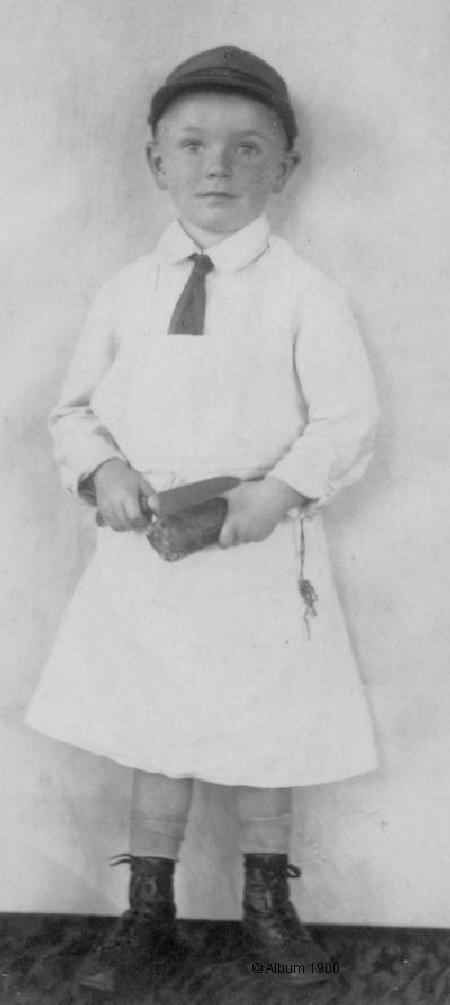
Figure 1.--This German boy is posing as a butcher boy. I wonder if his father was a butcher. Maybe is a fancy dress for a party. I's say the salami looks too realistic for a fancy dress ball, but we just don;t know the circumstances of the photograph. The back of the portrit has an inscription, "Heinz Winkelmann, November 15th, 1927, 8 years old, town: Witten-Ruhr, Germany." Image courtesy of the BP collection.
|
|
German boys in the medieval era mostly worked on fedual estates. Very few boys received a formal education. As in the rest of Europe, some boys worked as aprentices under the guilds which became an major institution in economic and social life. We do not yet have information specifically on German apprentices, although some information is available on guild appretices in general. After the decline of the guilds, boys continued to work as aprentices, although the arrangments were less regulated. Other boys were sold into indentured servitude. With the advent of the industrial revolution, many German boys as elsewhere in Europe worked in the factories that appeared in the growing cities. Their maegre earnings were often required to support the family. The conditions were described by Dickens and other English authors. Presumanly German authors also addressed the topic of child labor and urban slum life, but I am not familiar with the German literature. One institution that seems uniquely German is the Schwabenkinder. This began before the industrial revolution, but continued into the 20th century.
Feudal Estates
German boys in the medieval era mostly worked on fedual estates. Very few boys received a formal education. The feudal system did not end in all of Germany in the 17th and 18th century as was the case as some other Wesern European countries. It should be remembered that until the 1870, Germany was divided into many different separate states. These states were highly varied, both in economic and social terms. In the early 19th century some were entering the industrial revolution. Others like Prussia still had areas even in the early 19th century with large landed estates that were still essential feudal, over seen by a military caste--the Junkers. It was that caste led by Prussian King Wilhelm and a Prussian Junker, Otto von Bismarck, that eventually succeeded in unifying Germany and impressing Prussian values on the German Empire. Ironically, the German workers on Varzin, his estaste, were gradually replaced by Polish workers. And after World War II it would become a Polish state farm.
Guild Apprentices
As in the rest of Europe, some boys worked as aprentices under the guilds which became an major institution in economic and social life. We do not yet have information specifically on German apprentices, although some information is available on guild appretices in general.
Later Apprentices
After the decline of the guilds, boys continued to work as aprentices, although the arrangments were less regulated.
Indentured Servitude
German boys were sold into indentured servitude.
Most German children as elsewhere in Europe were primarily involved in agricultural labor until industrialization in the 19th century. Even then large areas of Germany were rural meaning that children cointinued to be involved in agricultral labor. This was especially true in eastern Germany where the land was held in large estates oprrated with landless peasant labor. In the l9th century, Poles began to replace German workers. Germany was a leader in free public school education. Here Prussia in particular put an emphasis on public schooling. We are not sure at this time to what extent the Germans passed compulsory attendance laws which required children, including farm children, to attend school. This is a little complicated because even after unification, the different states cointinued to be responsible for education. We do know that as late as the early 20th centuyry, that rural children did not commonly attend secondary schools. This was a concern with the NAZIs because Aryan boys from rural families often did not have the educational preparation for secondary schools, let alone university education. This was an especially touchy issue because children judged to be mentally retarded under the T4 eutenasia program were being killed. Children in Germany are still involved in rural labor, almost entirely on family farms. The desparity between urban and rural education has been closed in modern Germany.
Child Industrial Labor
With the advent of the industrial revolution, many German boys as elsewhere in Europe worked in the factories that appeared in the growing cities. Their maegre earnings were often required to support the family. The conditions were described by Dickens and other English authors. Presumanly German authors also addressed the topic of child labor and urban slum life, but I am not familiar with the German literature. I am not sure yet when child labor laws were passed in Germany. Industrialization occurred late in Germany than in Britain and this probably affected the use of child labor. Germany under Bismsarck in fact became a European leader in progressive social legislation.
One institution that seems uniquely German is the Schwabenkinder. The term Schwabenkinder means literally "Swabian children". This practice began before the industrial revolution, but continued into the 20th century. There were markets at Wangen, Ravensburg, Bad Waldsee, Tettnang, and Friedrichshafen in Württemberg, in Baden in Pfullendorf and Überlingen and in Bavarian Allgäu in Kempten. The biggest was in Ravensburg. Sometimes up to 5,000-6,000 children would go under direction of a preacher over the Alps, to work at farming houses from spring to autumn as shepherds boys or cowboys or when being a girl as housemaid. They did get some money and were clothed new, because they came there mostly only in rags. It was mostly poverty that forced their family to do this. They were from 7-14 years old, but sometimes children even as young as 5 year olds were sent. They are first mentioned in 1626 and continued until 1921 in some cases even until the 5oies. In 1836 Württembergian new regulations required children had to attend school, therefore the German Schwabenkinder had to be replaced with foreign children.
HBC

Navigate the Boys' Historical Clothing Web Site:
[Return to the Main German activities page]
[Return to the Main country work page]
[Introduction]
[Clothing styles]
[Activities]
[Chronology]
[Clothing styles]
[Countries]
[Photography]
[Bibliographies]
[Contributions]
[FAQs]
[Glossaries]
[Satellite sites]
[Tools]
[Boys' Clothing Home]
Created: January 23, 2003
Last updated: 8:18 PM 7/14/2009