|
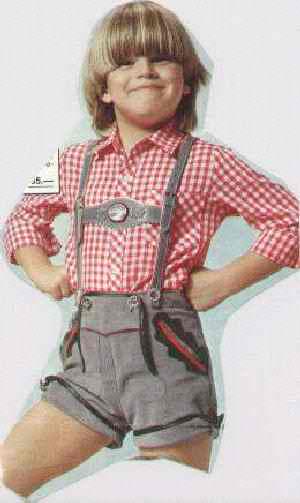
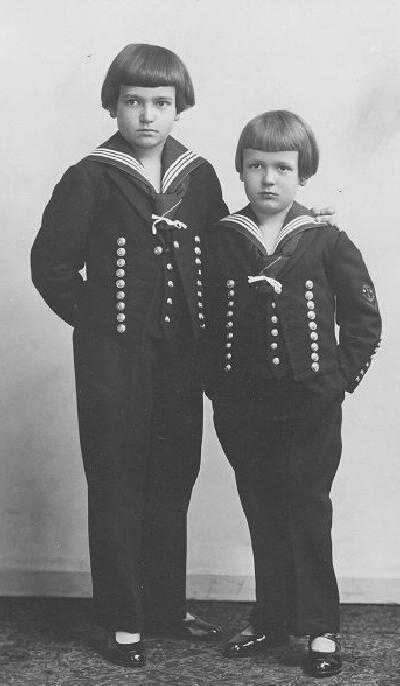
HBC has developed extensive information on German boys clothes. Our historic information on the 19th century is still fairly limited, but we know a great deal about the 20th century. Germany is one of the countries that have a major impact on dashions, including France and England and America in the 20th cenrury. In America we tendto see England and France as the principal fashion influences, but in Central and Eastern Europe, Germany was very imprtant. A major factor beginning in the 19th century was the large German garment industry. But the Germans seem to have used basic styles developed elsewhere rather yhan developed their own styles. We see some fashion influences from England and France. There do not appear to have been a lot of boys' clothing styles that are distinctibely German. The one exception appears to be Lederhosen, a folk style. But these and other thracgt styles have not spread to any great extent outside of Germany. One of the most popular styles in Germany was the sailor suit which was commonly worn by German boys until the 1940s. This if course was an English style, but enthusiastically adopted in Germany. German boys like most Europen boys commonly wore knee pants in the late 19th century and short pants from the 1920s through the 1950s. We have much more informnation on the 20th century. The sailor suit was an especially popular style. Younger boys wore over the knee stockings during the winter and some older boys had long pants in the colder weather. Sailor suits continued popular, even for relatively older boys through the 1940s. Few schools had uniforms. Boys in Bavaria and other places might wear leather shorts lederhosen) during the summer. As in France, styles changed substantially in the 1960s and most boys now wear jeans and other long pants. Styles are now much more casual. Many boys do not even have suits as there are so few occasions for wearing them. Modern German boys have adopted the pan-European style of jeans, sweat shirts, sneakers, and other casual clothes.
Various terms have been used to describe Germans. This has been complicated by the fact until the late-19th cenntury there was no united German state. Even Chancellor Bismarck saw himself as more of a Prussian than a German. In addition large numbers of Germans lived outside of the boundaries of the German states, some as far east as the Volga. This became a major issue in Germany after World War I and one the NAZIs played upon. Today in Germany citizenship is open to anyone who can show German ancestry.
Caesar conquered Gaul (1st century BC), but was assasinated before he could expand Rome east accross the Rhine in force. Augustus' attempt was stopped by the Germanic tribes in the Turtonberg Forest (9 AD). Thus Germany east and west of the Rhine developed differently. This cultural divided lasted until World War II. The Germanic Tribes overwealmed the Western Empire (5th century). Only in Britain, however, did they displace the local population. Germany during the Dark Ages dominated Europe. They became the ruling class throughout the West. Ironically Germany did not overwealm Europe culturally. It might have been thought that given the size ad power of Germany that German would become the dominant European language. Ironically it was English that would emerge as the lengua-franca of Europe ad much of the word. This was because a conflict between the pope and emperor made it impossible to a centalized German state to devlop, unlike other European states. In addition, Germany was in the center of Europe and thus surrounded by hostile neighbors, restructing its expansion. Germany's medieval hitory is complicated. German nationalism was a factor in the Reformation. But it was not until the French Revolution and Napoleonic Wars that Germans nationalism grew. The Revolution also inspired a demand for unifiction. After Napoleon's defeat, the fight for the soul of Germany began. The 1848 Revolutions had the prospect of a liberal, democratic German state. But the Russian Army helped put down the liberals. The question then became whether Prussia or Austria would unite Germany. This question was answered by Prussian miitary force. And the Prussian militaristic, authoritative model became Germany's united future. State involvement in industrial development helped make Germany in the early 20th century the dominant European power. Germany's cutural and scietific achievements were impressive. German leders embarked on two disastrous attempts to dominate Europe militarily. They played a major role in launching World war I and were stopped in large measure by a failure to appreciate the rise of the United States as a major power. Germany was solely responsible for launching World War II. The NAZI desire to dominate Europe was fueled by a toxic mixture of nationalism and racial hatred. They were stoped by a grand coaltion of Britain, the Soviet Union, and the United States. The Anglo-American alliance later in the 20th century would ironically save Germany from Soviet domination. America not only saved Germany from totalitrian communist dictatorship, but promoted the development of Germany into a democratic country, fully integrated as a peaceful member of Europen society.
Germany is the heart of Europe in both a geographic and economic sence. Germany as part of the European Union is goday the driving force in the European economy. The Germany economy since the fall of Rome has been important, but vnot dominant in the European economy. Germany was prevented from dominating Europe when during the medieval Europe unlike surronding ststes, a unified German state did not coalese because of differences between the imperial government and the papacy which empowered thecGerman princes to establish their own nation states. This politicial division had economic consequences. After the Napoleonic Wars as Germany moved toward unification, the industrial revolution which fundamentally transforned Britain began to take hold in Germany. This led to a period of rapid growth, especially in western Germany centered on the Ruhr Valley. Rapid economic growth and associated social transformatiion brought with it some destabilizing consequences. Germany transsformed it self from a conservative agrarian society to a modern industrial society. This change occurred on a regiojnal basis. Much of Germany, particularly eastern Germany remained agrarian and traditional. The industrial revolution proceeeded differently in Germany than Western Europe, especially Britain and America. There was a much greater level of government control and regulation. The economic outlook which developed in Germany as a result of the greater government role has shaped modern German policies and played a role in German support for international economic integration. Even before political unification, the German states began moving toward economic union through the Zollverein and customs unions. The Zollverein was in fact the first critical step toward German unification. It was crucial stimulant for economic development as Germany wasindustrializing. It helped created need markets for expanding industrial firms. German was unified by Prussia and the Hohenzollerns. This meant that the ruling elite included Germans with many traditioinal values, including Prussian militarism. And the industrial power of Germany gave the conservative German elites with values different than the emerging democratic states to the west enormous power. At the same time, the German working class was being radicalized with Marxist doctrine. This created substantial social disparities between modern cities and conservative small towns and rural areas. Unification and the establishment of Imperial Germany (the Second Reich) to standardize trade regulations on a national basis, although the Germn states still retained considerable authority. A national currency system, the Deutches Mark based on the gold standard, was a another key step. One economist writes, The German states �cleared a path to an international currency unification on the gold basis, which for the whole period up to the World War proved of the greatest importance for the rapid expansion of world trade.� The German imperial monarchy influenced by the Prussiam military tradition chose to convert a Balkan crisis into a world war (1914). The War demolished the evolving European economic system. German economic instability after the war (1920s), partially due to the punative Versailles Treaty and the Depression (1930s) led to another German military attempt to dominate Europe, this time with horrendous racial goals. In the aftermath, tghe future of Germany and Europe itself was at issue. The choice was between the Soviet totalitarian, Marrxist model and the American democratic capitalist model. The issue was decided by the free market policies adopted by German politicans and American occupation authorities. The result was the German Economic Miracle (1950s) and the move toward European unification (1960s) which had led to the European Union.
The following basic chronology is available on German boys' clothes. There have been times that boys clothong had many similarities througout Europe. At ther times there were destinctive national styles. Germany has never been considered a focal point of fashion. The country was in fact was in fact one of the more important counties affecting boys's fasgions, but this hasd varied significantly over time. At this time, HBC has only limited information on the 19th century. Hopefully our German readers cam help develop information in this era. As we have observed in other other European coubties, there has been a destinctive bluring of national styles beginning in the 1960s. Even so, some German styles have enfured. We have begun to collect, however, considerable information on 20th century styles. HBC has been developed primarily through assessing available images, in part because HBC has not yet found any historical accounts addressing German boys' clothes.
Some basic information is available on the garments worn by German boys. HBC has at this time very limited information on 19th century German boys' clothes. German boys do not seem to have worn Fauntleroy suits as much as boys in Frace and other neighboring countries. The garment most widely associated with German boys is lederhosen, but they are no longer commonly worn. Perhaps no other garment was more commonly worn by German boys as sailor suits. Like English boys, German boys never wore smocks to any great extent as was th case in France, Italy, and several other European countries.
German boys commonly wore short pants in the early and mid-20th century like many other European boys. Kneesocks were common and boys wore white kneesocks on drress occasions. Many boys wore shorts year round. Long stockings were worn with shorts during the winter months.
The great majority of images on HBC are single shot portraits or snapshots. We have a few sections where we have a set of images on the same boy or family to see how fashions varied over time. What we do not have, however, is how the various garments intereacted with each other. Getting dressed is a relatively simple matter today. Earlier it was more complicated. Here in this section we also see how children got dressed. Children might wear button on clothing. There were also undewaists to hold up pants and stocking supporters to hold up long stockings. Underwear also used to be different and without central heating a more important part of a child's wardrobe. We thought it might be useful to take a family with five children and show all the steps in getting dressed. We will do this over time. The children are Klara (almost 1 year old), Friedrich (4 years), Margarete (5 years), Charlotte (10 years), and Hans (12 years). We have chosen a middle-class family living in a ??? city under comfortable circumstances. As a historical tool we also add images of how the children might have dressed if they were not from a middle-class family. We will show how the children dressed at different stages from underwear to overcoats. Our intention is to show this during decades to illustrate how the process of dressing and the fashions would have changed over time. We are using HBC as a source of information for the garments illustrated.
Paris and London were perhaps the two most important centers of the fashion industry in Europe. Berlin and Vienna were, however, in the early 20th century also of considerable prominance. Jewish clothing designers and manufacturers were prominent in both Germany and Austria. Jews also owned some of the most prominent department stores. The NAZIs even claimed that the department stores were a threat to German industry. Less prominent Jews owned countless retails establishments both making and selling clothes. The NAZIs changed the character of the German fashion and clothing industry forever. The first major action taken against the Jews in Germany was a well planned boycott of German businesses which Propaganda Minister Goebbels announced on April 1, 1933. The NAZIs began the boycott in every city and town at 10:00 AM. Uniformed, often armed Stormtroopers were placed in front of store or business owned by Jews. The boycott was not aimed at the clothing industry specifically, but it was one of the industries most affected. Clients were often stopped from entering. The names of those people who continued buying from Jews was posted in city newspapers. Patronizing Jewish shops became grounds for divorce. Stormtroopers were also placed at the offices of Jewish lawyers and doctors. The NAZIs in May 1933 established the Association of German Aryan Clothing Manufacturers (ADEFA) in Berlin under the Reich Ministry of Economy to oversee the Aryanization of the German fashion industry. The ADEFA label in German clothing certified that the garment had been manufactured "by Aryan hands only." Aryanization was the forced transfer of Jewish-owned businesses to German "Aryan" ownership. The NAZI Aryanization process had two stages. First there was "voluntary" stage, from which Jews were excluded from German economic life. Even during this stage Jewish owners would arrive at their business as simply be told that they no longer were the owners. The compulsory stage that began immediately after Kristallnacht. In this final stage, Jewish-owned businesses that had not already been "Aryanized " were liquidated within a few weeks and transferred to The NAZI government "trustee". Jews who fled Germany had rgeir property confiscated. For the most part, even after World War II, the Jews who survived were never compensated for their business that were taken from them. The exclussion of the Jews had the impact of ending the the fashion prominence of Berlin and Vienna, a prominence that has still not been recovered.
|
HBC has at this time only limited information on hair styles worn by German boys. Virtually no information is available on early 19th century styles. In the late 19th century, many school boys appeared to have had their hair shaved. The long hair styles worn by some French and American boys do not seem to have been as popular in Germany. In the early 20th century, Dutch boy bangs (probably called page boy cuts) were popular for younger boys. This style appeared again in the 1970s--perhaps one of the many cultural impacyts of the Beatles.
We have noted that many German mothers liked to dress their children in identical outfits. This practice seems to have been especially popular in Germany, We do not have any sustantiation of this yet, but we have noted numerous photographs of brothers and sisters wearing identical or coordinated outfits.
Here we will follow family fashions over time. HBC has decided to also gather information on entire families. One of the limitations of HBC is that too oftn we just view boys' clothing without the context of with what the rest of the family was wearing. This means not only siblings of different ages and gender, but also the parents. Family images are ca very useful way of approaching this. Family portraits as wellas snapshots exist in large numbers. Without the parents, one can not definitively establish what a juvenile fashion was as opposed to general fasshion trend. The prents also help to establish sicial class origins. Thus comparing boys' clothing with that worn by mothers, fathers, and sisters can yield aide rage of fashionn and societal insights. These images will help show show differences in both age and gender appropriate clothing. Here we are still beginning to collect information. As HBC grows we are extending both the chrobnological range of this section as well as the number of images, important to be able to reach valid conclusions. Eventually we may able to make some regional assesment about trends within Germany.
HBC has collected information on a variety of activities in which German boys have participated in over time. Many of these activities involve specialized costumes. Other activities suich as play activities involved boys wearing their regular clothes. This helped fiollow clothing trends in German boys' clothing over time. Some of the activities include choir, choir, dance, games, music, religious observation, school, sport, youth organizations and many other activities. The various activities seem similatr to those activities pursued by boys in other countries. Music and school seems especially important in Germany. Youth groups als were very important until after Worlod War II. We often do not fully understand the activities in available images, but here our German readers have assisted us.
Germany is a predominantly Protestant country. The Reformation was born in Germany with Marin Luther posting his "95 Thesis. The resulting religious wars devestated Germany, especially the 30 Years War. Luthernism is the primary Protestant denomination. There is, however, a very sunstantial Catholic minority, especially in southern Germany. Boys of course dress up to go to church. Often new suits
are bought for First Communion and Confirmation. In southern Germany, but mostlty Austria, there is also Firmung. Boys wear a variety of dress outfits for relious events ceremonies associated with formal religious events. Cathiloic boys often have special suits for first communion or seerve as altar boys. Protestant boys may get new suits for communion or confirmation. Boys may also have costumes for weddings, serving either as the ring bearer or ushers.
Germany until very recently was divided into a number of destinct states with sibstantial social, cultural, political, and religious differences. Only in 1870 was a unified German Empire formed and even then substantial differebnces remained among member states. It was not until the Wimar Republic and even more sp the Third Reich that the destinct legal and cultural differences of the German states began to breakdown. HBC at this time has only limited information on the extent tio which these differences were reflected in clothing. We know that lederhosen were more common in Bavaria than other areas of Germany. We know that clothing styles in Alscae-Loraine differed from France, but we do not know how common German styles were. [Alscae-Lorraine is now part of France, but in 1871-1919 and 1940-44 were annexed by Germany.]
Germany has several ethnic sand religious minorities. There were an especially large number of Poles because Germany (Prussia) participated in the partition of Poland. There were, however, other ethnic groups including Czechs, Gypsies, Jews, Serbs, and others. There were once large numbers of ethnic populations within Germany, especailly the German Empire (1871-1918). German policies toward these groups have varied over time. German Jews were highly assimilated. Other groups less so. Many of these groups wore destinctive costumes, at least for special events and celebrations. Several developments after World War I (Treaty of Versailles, NAZI ethnic policies and the Holacaust) and the redrawing of boundaries after World War II all acted to reduce the population of ethnic minorities in Germany, but some remain. And new minorities have migrated to Germany. Some have assimilated, others seem more resistent to assimilation. We are insure to what extent these minorities celebrate ethnic festivals, and wear ethnic clothing as is common in America. We know that the Sorbs do, we are unsure about the other ethnic minorities. Ethnic costumes in Germany are generally thought as the various costumes worn in Germany by basically people all ethnically German and all speaking German, albeit with different accents and dialects.
Folk or ethnic costumes are now somewhat romanticized versions of clothing styles that were once worn in Germany. The lederhosen outfits worn in Bavaria are probably the most widely recognized Herman folk costume. There are, however, many different outfits worn in the ifferent regions of Germany. Before modern communication and mass media there were significant differences between different regions. Note that this section deals with folk costumes and not differences in ordinary clothing and fshion conventions within Germany.
HBC has largely focused on clothing and fashion, but another fascinating topic is manners and culture. Just as clothing in the 19th and early early 20th century were more formal, so were manners. Girls courtseyed and boys bowed and doughed their caps. Not only were social conventions more formal, but there was a much more static social class structure. This was not just a matter of the still powerful aristoicracy in Imperial Germany, but prospects for working-class children were relatively limited. Most working-class children attended primary school, but relatively few went on to secondary schools. There were no formal restructions. But few working-class children had the money to afford further education. And as there parents were not well educated, their academic preparation was also lsacking as well as parental support for further education. Substantial changes occurred after World War I. The War largely invalidated the clame of Germany's ruling class of competency. (The same occurred in other Eiropean countries.) This War had been a factor in promoting informality in clothing. We suspect the same is true of social formalities as well. It also created a rising demand for political power and a loosening of class barriers by the working class. In Britain and France the same process caused a rise of democratic parties demanding social change. In Germany and Italy it led to the rise of Fascism.
We do not know much about German girls fashions in thr 18th century, but have acquired quite a bit of information beginning in the 19th century. Girls wore dresses and skirts in the 19th century and much of the 20th century. This was a pattern observeable throughout Europe, although the time line varied from country to country. There was a wide range of different dress styles. Sailor styles as with the boys were especially popular in Germany, but were only one of many different styles. Some garments, especially hosiery and footwear was the same or identical. We first see girls wearing other garments in the early-20th century when girls began wearing bloomer and romper outfits for school gym classes. We later see girls wearing short pants for Hitler Youth athletic activities, but the offocial uniform was a blouse and skirt. It was not until after the World War II that we see girls wearing shorts or long pants, but this was only for casual or play activities. World War I and II had a huge impact on fashion in America and Britain, primarily because of war mobilization, many women entered the indistrial work force for the first time. This was less true of Germany. Even during World War II, the NAZIs resisted using adult women in the industrial work force, instead using slave and forced labor from the occupied countries. For the most part, German girls continued wearing skirts and dresses into the 1960s. The popularity of Jeans in the late-1960s and 70s was was a major factor in changing girls clothing trends. We have not yet have much information on German girls' fashions. We have archived large numbers of images of German girls in the HBC boys section. We have not yet, however, assessed the fashion trends depicted there. We note German sisters in the 1920s. Dressing sisters in identical dresses was very common in Germany, but varied from family to family.
Germany in the 20th century is one of the countries most associated with pgotography. We have much less information on the 19th century. The first available commercil photographic process was the Daguerreotype which was developed in France at the end of the 1830s. We note large numbers of dags, mostly in cases from the 1840s and 50s in America. And by the 1850s other processes like anbrotypes appeares. We have not yet found substantial numbers of German dags or ambrotypes. We are sonewhat confused by this as surely there must have been mny dags made as although Germany was not yet united, it was one of the more prosperous areas of Europe. We do note large numbers of CDVs in Germany beginning with the 1860s. The CDVs basically made dags and ambrotypes obsolete. Most families of any affluence would have a DDV album, sometimes several, in the parlour. CDVs seem to gave been the principal formt form most of the late 19th century. Cabinent cards do not seem to have been as popular in Germany as they were in America. Most studio portraits were CDVs. We note large numbers of snapshots after the turn of the 20th century. Photography seems to have been more popular in Germany than in any other European country. Families through World War II would combine albums. Some times children would put together their own albums. Snapshots were pasted on blacl paper sheets. Germany became a leader in photography, including color photography. Agfa was more common in Europe than Kodak. World War II changed that.
HBC has begun with only limited information on German artists who have painted interesting works illustrating boys' fashions. BNutb over time with the help of our German readers have acquired a respecyable liost. One of the most interesting was Winterhalter, a favorite of Queen Victoria. An given the imprtance of the Royal Family in fashion, making a valuable contribution. His portraits, however did not concentrate on Germans. Also imprtant was the many German artists focusing on genre and histyorical acenes. We have also noted a few paintyings that are not attributed to specific artists, but are dated. With the German artists, nationality can be complicated. There were a large number of German states with the Holy Roman Empire and klater the German Confederation. There were also German speakers living outside Germany oproper, especially in Switzerland. Before the 19th century, some of these artists may have looked in themselves as Germans. Ther was also Austria which after the Ausrtro-Prussian War (1866) was exccluded by Bismarck from Geramny, but where many which historically has been an essential part of Germany.
We have begun to collect information on German institutions careing for children. Our informnation is very limited, but we have begun to archive some information. The most obvious is schools. We notice a variety of instutions unique to Germany although we see similar facilities in some other European countries. They seem to have been related to the schools. The children during the summer or other school vacations went on group outings to various vacation spots. Group homes were established there for the children. There were also charity institutions, although here our information is limited. We are not sure about work houses as was the case in America and Britain. We do know that there were orphanages. Here there was a substantial need after the two world wars, especially World War II. There were also health facilities like sanotariums. Another type of institutional facility were reformatories for youth offenders.
|
Movies made in Germany provide some insights into contemporary boys clothing. Because of the language barrier, these films have not been widely circulated in the United States. I know little about the movies, but they do provide useful glimpses into clothing trends.
One interesting question is the use of color in clothing. We are begiining to address this question, but it is a question HBC cannot easily answer because we rely so heavily on photography. And until the 1970s, color photography was very limited. There are some useful sources of information. There are a few color photographs. Another highly reliable source of information is vintage clothing. There are colorized photographs, although they are ot as reliable as actual color photographs. Catalog provide some useful information. Drawings, paintings, and magazine illustrations also provide some color informations. Postcard were very popular in the early-20th century and mahy were colored, but they are not reliable sources of color information. Each of these sources of information provide useful information, but readers need to be aware of the limitations and reliability of each. We do not at this time know much about the use of color in German children's clothing. Our information at this times comes largely from colorized photographs. We have found some colorized photigraphs which provide some information. We are unsure as to the accuracy of the color depictions. Some of the best examples we have noted of early tinted photographs are German. We note German costumes, presumably children in a family. We also note a German mother and daughter. Another example is a German brother and sister (about 1885). And we see a beautifully done portrait of a German family (1890s).
There is a great deal of fashion information in literature. As it is literature and not actual history, the comments on clothing have to be taken with caution. Authors vary as to how accurately they write about fashion and other historical cultural matters used to flesh out their plots and characters. Of course the most reliable fashion references are those in contemprary works. There are various types of literature of interest to HBC. We note useful information in both novels and children literature. Of special interest to HBC is the large number of boy characters in British literature. Of course one helpful aspect of many books are the often fascinating references or even discussions of clothing.
A great deal of information is available from clothing catalogs. The earliestappeared in the late 19th century, although magazines illustrations appeared eralier. These catalogs help provide very useful time-line data. While not as realistic as a photograph, they often provide helpful dscriptions indicating sizes (which help explain the age range the garent was made for), color, material, and notable features of the garments.
German became a European leader in both film and cameras. This was not the case in the early phase of the photofraphic industry. Much of the ground work for photography was developed in France. We see very few early photographic types (like Dags and Ambros) in Germany. There must have been some, but we see more in Britan and France and especially America. Germany was one of the countries that quickly embraced the new process. We do not have a great deal of information on photography in Germany. As far as we know it developed along the same lines as in other European countries. We note a few beautifully colorized German portraits even in the 1890s. And example is a portrait of an unidentified Thorn family. As far as we know these were painted black and white portraits. We do not note similar portraits in other countries. We do know that German was a leader in color photography. This probably reflects in part the importance of the German chemical industry. Agfa became a leader in color photography. Photography played a role in the rise of the NAZIs. And German soldiers took cameras to war and left a huge body of images about the war. There was also a Propagandakompanien der Wehrmacht (Armed Forces Propaganda Company - PK). Much of Germany's photographic industry and international market share was undone by the NAZIs in World War II and Kodak became the dominant world photograpy leader.
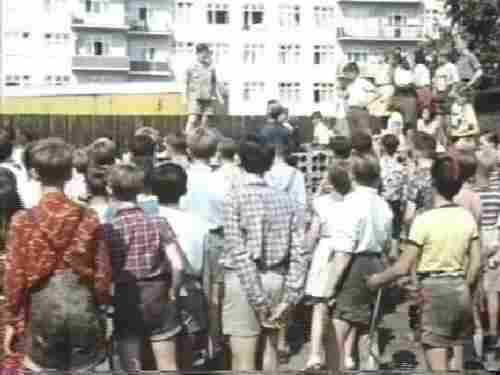
Germans are noted for their high-quality cameras, at least until the advent of digital photography, and the photographic record shows how popular photgraphy was in Germany. These photographs provide a wealth of information about German children and German society in general. Most of these images are fairly easy to assess, especially with the hrlp of our German readers who have provided their insights. Some images are less easy to assess. One aspect that has confused us somewhat is a large number of snapshots of unidentified groups. Some groups are easy to idebtify: families, school classes, sports teams, anf youth groups. Some of these images do not see, to fall into any of these categories. HBC also occassional comes accross some images which totally mistify us. We archive German images here that we simply can not explain. These are images we know to be German. We can also often date them--we just can not explain what is being depicted. Hopefully our German readers can help explain what is happening in these images.
HBC has received a few accounts about German boys or foreign boys in Germany. These accounts provide a great deal of useful information needed to build our German section. Hopefully German readers will provide some additional accounts. Unfortunately we have at this time few accounts from German boys in Germany. We have noted a great many German visitors to HBC and we hope that some will eventually submit some personal accounts.

Navigate the Boys' Historical Clothing German pages:
[]
[German choirs]
[German movies]
[German school uniforms]
[German royalty]
[German youth groups]
[German sailor suits]
[Lederhosen]
[Ethnic]
[Tights]
[Long stockings]
Navigate the Boys' Historical Clothing Web Site:
[About Us]
[Introduction]
[Activities]
[Bibliographies]
[Biographies]
[Chronology]
[Clothing styles]
[Countries]
[Bibliographies]
[Contributions]
[FAQs]
[German Glossary]
[Images]
[Registration]
[Tools]
[Boys' Clothing Home]