
German Boys' Headwear: Peaked Military Caps
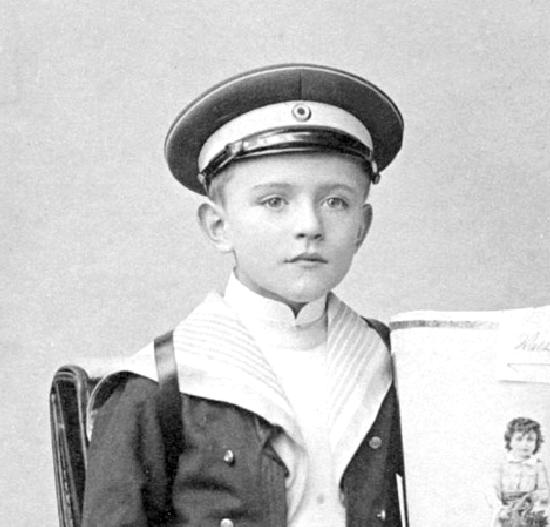
Figure 1.--This boy, probably in the 1900s, was photographed for his first day of school. He wears a peaked army-style cap with a sailor suit. This cap looks more military that many we have noted. The cap was clearly for schoolwear. We think this was a generalized school cap purchased for fashion rather than a style set by the school. For more information on their first day of school, click on the image.
|
|
We note some German boys wearing peaked military-style. This was especially common for boys schoolwear. We have noted quite a few imaages of German boys wearing these caps, especially to school. These caps were called "schülermütze". This translates as student (schüler) and cap (mütze). The military style had a leather brim. I believe it appeared in the 1910s. By the 1930s it was going out of fashion. The color pattern of the cap indicated the year of secondary school that a boy belonged. The cap came in various colors. One German reader reports a dark green Schülermüze with a orange and yellow band and a black brim. There were quite awide range of styles. Some look destinctly like modern garison caps. There were manu other styles. They all had flat crowns, but the sides varies greatly in shape and highth. These caps have a distinct army look to them. Even so, we note that these caps were often worn with sailor suits. Sailor caps were more common, but quite a number of boys wore these caps. This was particularly common in Germany.
Popular German Style
We note some German boys wearing peaked military-style. These peaked caps were not an exclusive German style, but the great bulk of the images that we have noted are German. They are in fact so German thatvtgey help to identify photographs that do not have inscriptions. These caps along with sailor styles seen the most popular styles for boys' headear in the early-20th century.
These caps were worn by German boys in the 19th century. While German school boys did not wear uniforms, often they did wear uniform caps. While we have noted numerous images of German boys wearing these caps, unfortunatly few are dated. We have very few 19th century images. Most of the photographic image we have are from the eraly 20th century. They were populatr in the 1900s and 10s. Many of these images are from First Day of school portraits. We also note them being commonly worn in the 1920s, especially before 1925. We still see them in the 1930s, but much less commonly.
Origins
HBC had thought the origins of these caps may have been the student caps German boys wore in the 19th century. There may well have also been mikitary or other uniformed group origins. A German reader tells us, "The cap seen here looks more like a postmaster´s or railway attendant´s cap than military. But all were very similar and all of them should give the impression as if somebody very important and representative for the state is approaching you. Boys liked (and still do) to copy this for themselves."
Terminology
I'm not sure what the German term was for these caps. A German reader suggests Schülermüze. This means just school cap without any special reference to the style. The srtyle was so common for school wear that it was undersrood. Tge same was true on Britain for the traditional peaked school cap worn there.
These peaked military caps for boys were first and foremost school caps--Schülermütze. Many schools, we think mostly secondary schools, had caps with specific styles and band colors to identify the school. We note relatively few portaits with these caps where the boy is not dressed for school. Not all of these caps were school caps styled for wear at specific schools. German schools did not have unforms, but they did have uniform caps. Other caps were done in a generalized school style and band colors may have been done more to match the suit. The generalized caps were worn mostly by primary school children, but not styles set by their school. While primarily a school cap, we notice some caps styled a little differently that may not be school caps, although this is not always easy to tell from the available photographic record. One reader thinks that they may been worn by messenger boys.
This was especially common for boys schoolwear. A far as we can tell, this style of cap was used primarily for school. We note relatively few portaits with these caps where the boy is not dressed for school. We have noted quite a few impages of German boys wearing these caps for school. These caps were called "Schülermütze". This translates as student (schüler) and cap (mütze). While in the 19th century, a school might have destinctive student cap styles, we believe that many of the boys we have noted were not weaing a cap adopted by a specific school. We could be wrong about this, but believe this is the case, especially for primary-age boys. Rather these caps were simply reminissent of school cap styles, a kind of generalized school cap. This was particularly true of primary school childeren. Secondary schools apper to have had specu=ial styles and color combinations. I am not sure that boys were required to wear these school caps. Some may have been worn more for special occassions.
Other
While primarily a school cap, we notice some caps styled a little differently that may not be school caps, although this is not always easy to tell from the available photographic record. One reader thinks that they may been worn by messenger boys.
Age
We still have only a limited number of images with these caps. A range of German schools had school caps, including primary schools, secondary schools, and universitites. There may have been different styles for the different levels. The style here we have seen in many primary school portraits. They were very common, for example, for first day portraits.
Details
The military style had a leather brim. I believe it appeared in the 1910s. By the 1930s it was going out of fashion. The color pattern of the cap indicated the year of secondary school that a boy belonged. The cap came in various colors. One German reader reports a dark green Schülermüze with a orange and yellow band and a black brim.
Styles
There were quite awide range of styles. Some look destinctly like modern garison caps. There were many other styles. Most had flat crowns, but the sides varies greatly in shape and height. They all had leather peaks or bills done rather like patent leather in black. The hwas bands were done in variety of colors which helped identify schools or even classes. We believe that some schools had very specufic cap styles. But other boys wore more of a generalized school cap style rather than a specific style sey by the school.
Pins/Crests
These caps were worn with pins or crests. Notice the circular pin here (figure 1). It is done in the red, white, and black color device of Imperial Germany which of course helps to date the portrait. This was the same device used by the German Army. We have noticed other pin styles on these caps. No all caps had these pins, but many did.
Accompanying Clothes
These caps have a distinct army look to them. Even so, we note that these caps were often worn with sailor suits. German boys also wore sailor caps and hats with their sailor suits. The peaked caps, however, were very commonly worn with sailor suit by younger boys. Sailor caps were more common, but quite a number of boys wore these caps. This was particularly common in Germany. We are not sure why an army style cap became so popular to wer with sailor suits. I believe that they were worn because they were a traditional student cap style, not because they were an army style. Except for saoilor suits, these caps were worn with regular clothing styles, not military styles. An exception of course was cadet uniforms at military schools.
HBC

Navigate the Boys' Historical Clothing German pages:
[Main German headwear page]
[German art]
[German catalogs]
[German choirs]
[German movies]
[German royalty]
[German youth groups]
[German school uniforms]
[German sailor suits]
[Lederhosen]
[Ethnic]
[Tights]
[Long stockings]
Navigate the Boys' Historical Clothing Web Site:
[Introduction]
[Activities]
[Biographies]
[Chronology]
[Clothing styles]
[Countries]
[Bibliographies]
[Contributions]
[FAQs]
[German glossary]
[Images]
[Links]
[Registration]
[Tools]
[Boys' Clothing Home]
Created: November 15, 2002
Last updated: 3:30 PM 12/24/2010