
German Boys' Garments: Collar Types--Lace Collars
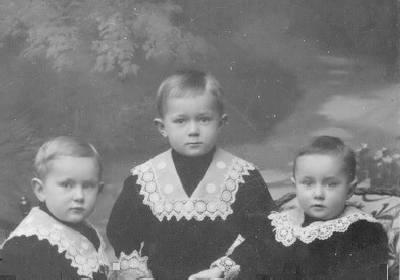
Figure 1.--Here we see three German brothers wearing elegant lace collars about the turn-of-the 20th century. The CDV portrait was taken by Fritz Hartmann in Dittersbach, Germany. Lace collars do not seem to have been as popular for German boys as they were for American boys. This was also true for Fauntleroy suits which seem rather rare in Gernany.
|
|
The Fauntleroy style was not as popular in Germany as in many other European countries. We seen some boys wearing lace collars, but they were not as popular as in America, Britain, and France. It is a little difficult to assess the popularity of the lace collar, but a good indivator is its presence in the photographic record and here it is clearly less common than in America and several other countries. I'm not sure what a Fauntleroy collar was called in German. Most of the examples of lace collars we have found have been from the very late-19th century and the early 20th century before World War I. Many of the lace collars we have found were pin-on styles and not fancy Fauntleroy blouses. We note different types of lace. This includes both proper lace and eyelet lace. They were worn by both boys and girls, but to date we have found more images of boys wearing them. Most of the images of boys show younger boys up to about 10 years of age. We also note the collars done in various shapes.
Fauntleroy Styling
One element of Fauntleroy styling was the lace collar. The Fauntleroy style was not as popular in Germany as in many other European countries. I'm not sure what a Fauntleroy collar was called in German.
Popularity
We seen some boys wearing lace collars, but they were not as popular as in America, Britain, and France. It is a little difficult to assess the popularity of the lace collar, but a good indivator is its presence in the photographic record and here it is clearly less common than in America and several other countries.
Chronology
Most of the examples of lace collars we have ound have been from the very late 19th century and the early 20th century before World War I. We have very few German images before the 1860s so we do not know how common lace collars were. After World War I we have an extensive archive and we know thatv lace collars were not very common. In between we do see lace collars, but vthey do not seem very common for boys, even duung the Fauntleroy era.
Collar Types
Many of the lace collars wee have found were pin-on styles and not fancy Fauntleroy blouses. We also note the collars done in various geographic shape. The pin-on collars seem especially common in Germany, but this is just a preliminary assessment.
We note different types of lace being worn by German boys. This includes both proper lace and eyelet lace. Proper lace could be very expensive. This lace in America was often called Belgian lace because it was imported from Belgium. There was a very important lace industry in Belgium. It was the same expensive lace women wore on their dresses. I do not know if Germany had a lace industry or if it was imported from Belgium and other countries. Eyelet lace was a less expensive altrnaive. Here holes were cut out of fabric and often embrodered. I am not sure what the German term for this was.
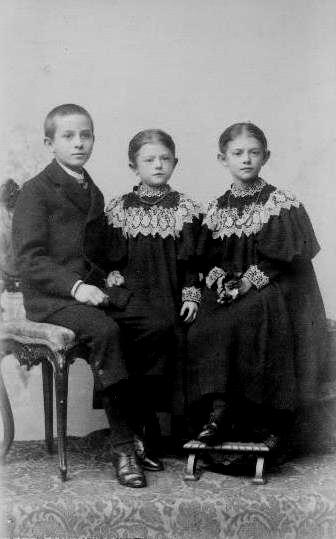
Figure 2.--Here we see a CDV portrait of three German children, we assume siblings. The portrait is not dates, but we would guess was taken in the early-1890. in part because of the dress styles, especially the sleeves. The dresses also have large lace collrs/ . The two younger children are probably girls, here the center hair part is an indicator. Although the hair in this case is very short. The portrait was taken in Reichenbach, Germany
|
|
Both German boys and girls wore lace collars in the 19th century. We see boys and girls wearing all kinds of different lace collars done in a variety of shapes. We have archved several mimages of German boys with lace coillars, modst dating to the 19th century. Lace cillars do not, however, seem as popular for boys in Germant as they were for American boy. To date we have found more images of girls with lace collars than boys wearing them. A factor here is that thec Funtleroy stylewas not as popular in Gernany as it was in America and several other European countries. Our 19th century German archive is still limited so it is difficult to draw any firm conclusions. And we have the additioinal problem tht children re often not identified in period portaits which means that we are often not sure about gender. Here we think the children wearing dresseses with lace clooars are probbly girls, although we are not entirely sure (figure 2).
Age
Most of the images of boys show younger boys up to about 10 years of age. We have not noted many German boys wearing lace collars, but we have noted some. An example is German brothers in the 1880s. We have noted several different styles of lace collars among those we have noted.
HBC

Navigate the Boys' Historical Clothing German pages:
[Main German garment page]
[German choirs]
[German youth groups]
[German school uniforms]
[German royalty]
[German sailor suits]
[Lederhosen]
[Ethnic]
[Tights]
[Long stockings]
Navigate the Boys' Historical Clothing Web Site:
[Return to the Main German Collar Type Page]
[Return to the Main National Lace Collar Page]
[Introduction]
[Activities]
[Biographies]
[Chronology]
[Clothing styles]
[Countries]
[Topics]
[Bibliographies]
[Contributions]
[FAQs]
[German glossary]
[Images]
[Links]
[Registration]
[Tools]
[Boys' Clothing Home]
Created: 2:16 AM 10/29/2007
Last updated: 2:04 AM 9/11/2011