
German Boys' Dresses: Chronology
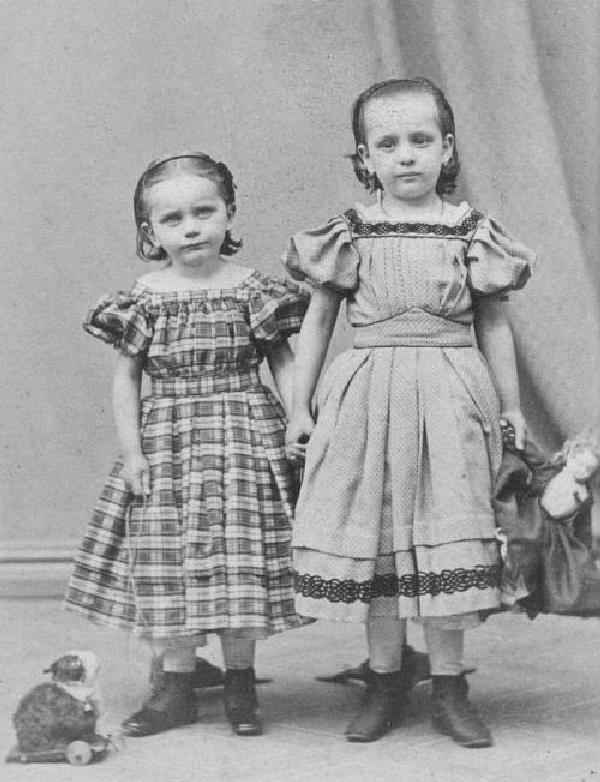
Figure 1.--One of the problems in assessing 19th century trends pertaining to dresses is that many are unidentified. Of course they usually look like girls. Often they are, but this is not always the case as boys in many cases also had long hair. Thus we are left with the problem of attempting to determine the gender of the children. This is often quite difficult. Both children here are probabl. This includes the child on the right. Notice the center hair opart and cat pull toy. .
|
|
We have just begun to develop information on chronolgical trends concerning the dresses worn by German boys. Our preliminary assessment is that the German pattern differed somewhat from the rest of Europe. We do notice images of German boys wearing dresses, but it does not seem to have been as common in Germany as in some other European countries. Of course are assessment is complicated some wgat because until 1871 there were many independent German states before the German Empire under Prussian leadership was created. We suspect, for example, there may have been differences between Prussia and other German stastes like Bavaria. Hopefully as our information expands we will be ablevto more accuratelybunderstand German trends.
The 18th Century
We do not yet have any information concerning German boys wearing dresses in the 18th century. We know that the convention existed in the 18th century, but we are not at all sure about the prevalence pr sovial-class trends. Nor do we know about regional differences. Germany ws not yet unified. Prussia and Austria were the major states, but there were quite a number of other important states..
The 19th Century
Our information on German boy wearing dresses is also limited during the 19th century, especially the early-19th century. We know more abojt the second half of the century, primarily because of the invention of photography (1939). Only with the apoerance of the CDV, however, do we see large numbers of images (1860s). Anothr major development was Prussia's unification of Germany (1871). The resulting German Empire did not erse the many German states, but created a federal empire. Thus regional differences remained albeit the former Preussian monarchy and Prussian culrural nirms increased in importabce thriughout the Empire. Our preliminary assessment is that as in other European countries, younger German boys did wear dresses. This varied from family to family. Our preliminary assesment is that this convention was less prevalent in Germany than manu other countries, but this needs to be confirmed.
Early-19th Century (1800-40)
We do not have many images of German boys wearing dresses in the early-19th century. This would of course mean paintings as photographyn had notb yet been invented. We note a portraitb of Johanna and Wilhelm Fischer painted by Ludwig Aumont in 1838. We do not know which child was Ludwig. We initially thought it was the younger child, but now belive it is the older child at the left pf the portrait.
Avaialble information shows that German boys were wearing dresses in the mid-19th century. We do not, however, have sufficent images to assess whether this widely practiced custom in Europe differed in Germany to any appreciable extent. With the invention of photography (1839) much more information becomes available on fashion, but not immediately in Germany. Germany was not a leader in photography at this early stage, despite its subsdequent involvement. We do not yet have any German examples of early photographic types like Dags and Ambros among others. Some undoubably exist, but they are less common than in Britain and France and especially America. We begin to see mpre pgotographic images with the popularity of CDVs (1860s). We note an early CDV, certainly from the 1860s, with two Flensburg siblings. The boy wears a very simple black dress.
We note some small German boys wearing dresses in the late 19th century. Almopst all are very young boys, most with their hair already cut short. We notice far more boys in America, England, France, Italy, Spain, and other countries wearing dresses, especially older boys commonly to 4 or 5 years of age. This suggests to us that by the late 19th century that German boys were being breached earlier and having their hair cut short earlier. This is stull a preliminary assessment, but as we acquire more and more images, this is the pattern emerging. We do not know yet, however, how this pattern varied within Germany. We also are not sure as to just why this was, but suspect the very aggressive masuline ethos of Prussia was a factor. Germany was of course unified around Prussia as a result of the Franco Prussian War and Prussian values and customs thuis had a significant imapxt on the new German Empire. Hopefully our German readers will have insights to offer here.
The 20th Century
The convention of dressing boys in dresses had largely passed by the 20th century. We do note very young boys wearing dresses in the 1900s, but even this was rarely seen after World War I (1914-18). This was most common among aristoicratic and rich families. After the War by the 1920s we rarely see German boys wearing dresses, even quite yoing ones.
HBC

Navigate the Boys' Historical Clothing German pages:
[Return to the Main German dress page]
[Return to the Main national dress page]
[German choirs]
[German youth organizations]
[German school uniforms]
[German royalty]
[German sailor suits]
[Lederhosen]
[Ethnic]
[Tights]
[Long stockings]
Navigate the Boys' Historical Clothing Web Site:
[Introduction]
[Activities]
[Biographies]
[Chronology]
[Clothing styles]
[Countries]
[Topics]
[Bibliographies]
[Contributions]
[FAQs]
[Glossaries]
[Images]
[Links]
[Registration]
[Tools]
[Boys' Clothing Home]
Created: 6:52 PM 1/10/2005
Last updated: 6:07 PM 8/25/2015
|