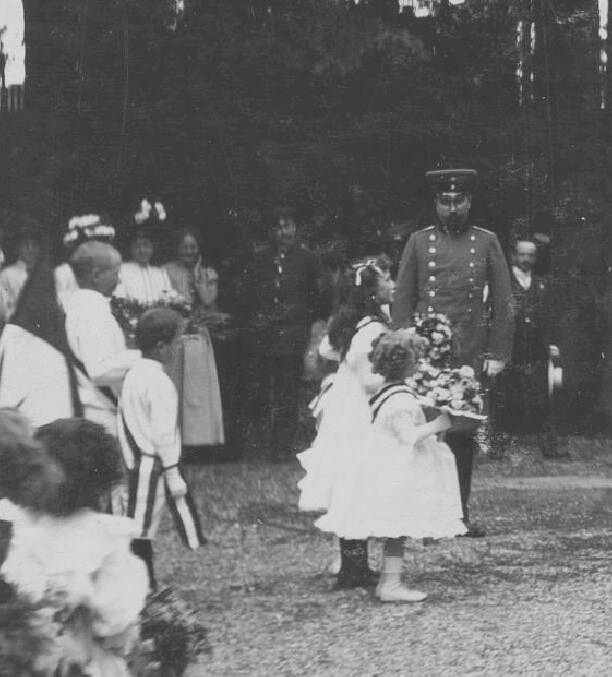
Figure 1.--Here children are welcoming the governor and his wife in Altkirch (Elsass) during 1909. In Imperial Germny Altkirch was German. Put your cursor on the image to see the govenor and his wife. |

|
HBC has largely focused on clothing and fashion, but another fascinating topic is manners and culture. Just as clothing in the 19th and early early 20th century were more formal, so were manners. Girls courtseyed and boys bowed and doughed their caps. Not only were social conventions more formal, but there was a much more static social class structure. This was not just a matter of the still powerful aristoicracy in Imperial Germany, but prospects for working-class children were relatively limited. Most working-class children attended primary school, but relatively few went on to secondary schools. There were no formal restructions. But few working-class children had the money to afford further education. And as there parents were not well educated, their academic preparation was also lsacking as well as parental support for further education. We suspect that the greater informality in manners was at least partially affected by the increasingly aseriveness of the working class. Substantial changes occurred after World War I. The War largely invalidated the clame of Germany's ruling class of competency. (The same occurred in other Eiropean countries.) This War had been a factor in promoting informality in clothing. We suspect the same is true of social formalities as well. It also created a rising demand for political power and alosening of class barriers by the working class. In Britain and France the same process caused a rise of democratic parties demanding social change. In Germany and Italy it led to the rise of Fascism. Many arustocratsand conservatives turned to the NAZIs to preserve the old order, Ironically it was the NAZIs much more than the Socialists of the Weimar Republic that would put an end to the old order.
HBC has largely focused on clothing and fashion, but another fascinating topic is manners and culture. Just as clothing in the 19th and early early 20th century were more formal, so were manners. Girls courtseyed and boys bowed and doughed their caps. We do not very many images illustrating manners, but we are looking for them in the photographic record. The image here is agood example of a public reception in Imperial Germany (figure 1). This seems similar to what would occur througout Europe and perhaps more informally in America. When the NAZIS seized power in Germany a new feature was added to appropriate manners--the Heil Hitler salute (1933). Instead of saying "Good morning" or "Good day", people were instructed to say "Heil Hitler!" and give a NAZI salute. We note NAZI news reels beginning in 1933 instructing Germans as to the social refinements. Just how common this became in Germany we are not sure.
Not only were social conventions more formal, but there was a much more static social class structure. This was not just a matter of the still powerful aristoicracy in Imperial Germany, but prospects for working-class children were relatively limited. Most working-class children attended primary school, but relatively few went on to secondary schools. There were no formal restructions. But few working-class children had the money to afford further education. And as there parents were not well educated, their academic preparation was also lsacking as well as parental support for further education. We suspect that the greater informality in manners was at least partially affected by the increasingly asertiveness of the working class. Substantial changes occurred after World War I. The War largely invalidated the clame of Germany's ruling class of competency. (The same occurred in other Eiropean countries.) This War had been a factor in promoting informality in clothing. We suspect the same is true of social formalities as well. It also created a rising demand for political power and alosening of class barriers by the working class. In Britain and France the same process caused a rise of democratic parties demanding social change. In Germany and Italy it led to the rise of Fascism. Many arustocratsand conservatives turned to the NAZIs to preserve the old order, Ironically it was the NAZIs much more than the Socialists of the Weimar Republic that would put an end to the old order.
German society as was generally the case throughout Europe was very formal in the 19th and early 20th century. Some by the 20th century had begun to question the formality and sharpclass divisions. Other began to question the complexity of the modern live style. Such questions were particularly prevalent among the artistic community, but certainly not limited to it. Large numbers of Germand during the late 19th century moved from farms to seek jobs in Germany's expanding industrial economy. This shift from rural to urban life was unsettling to many Germans. One result after the World War I was political movements like the NAZIs which preached the simple virtues of agrarian Germany and attachment to the land. Himmler was a strong believer in virtues of agrarian life. Another result was cultural movementd like Lebensreform (life reform). This is a term used for various movement in Germany and Switzerland between the mid 19th and early-20th centuries. There were similar mocements in other countries as well. In Germany these movements continued to influence some communities after World War I. Lebensreform was very critical of industrialization, and had the motto "Zurück zur Natur" (Back to Nature). It influenced the health care, diet, and clothing. These movements often found inspiration in ancient cultures, especially the Greeks. They promoted the Freikörperkultur (free body culture, i.e. nudism) and comfortable clothing. An example here is the
Proppe family about 1920.

Navigate the Boys' Historical Clothing Web Site:
[Return to the Main German page]
[Introduction]
[Activities]
[Biographies]
[Chronology]
[Clothing styles]
[Countries]
[Essays]
[Bibliographies]
[Contributions]
[FAQs]
[Glossary]
[Images]
[Links]
[Registration]
[Tools]
[Boys' Clothing Home]