|
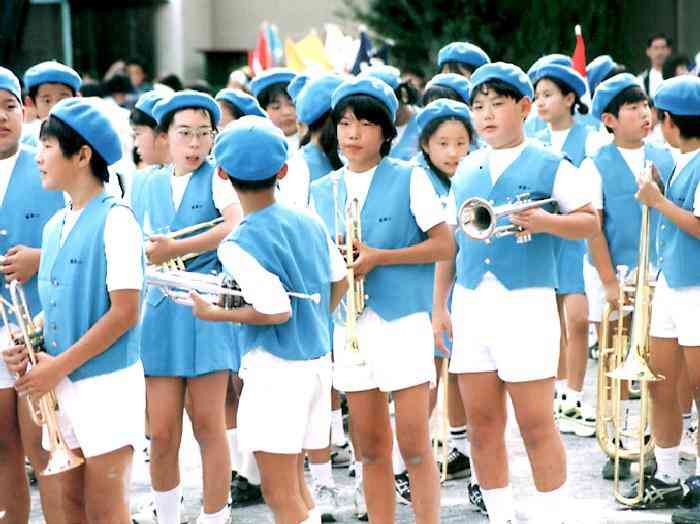
We have just begun to develop information on the clothes worn by Japanese boys involved in various activities. In most instances Japanese boys wear the same garments and styles associated with these activities as are common in the West. There are some activities in which traditional dress is worn. Sports outfits are virtually identical, primarily because the sports themselves have been imported from the West. Sports are popular in Japan, but the very rigorous academic program means that Japanese children have less time for sport than Western children. And the schools do not emphasize sports like mny American schools. The primary exception to the Western sports tradition is of course sumo wrestling which is somewhere between a Western sport and a Japanese cultural ritual. There are also the martial arts, but unlike sumo, martial arts have become popular in the West. One fascinating topic is the many festivals in Japan. They are very popular and the participants dress up in a wide-range of colorful costumes, including the children. Here the boys seem more involved than the boys. The arts are another important area. We note boys wearing Western garments with a destinctive Japanese look for some fine arts avtivities, especially music. We do have pages on music in Japan, both information on choirs and bands. The music children seem involved in appears to be mostly Western music. We have noted a Japanese popular music group, but do not know much about them.
We know virtually nothing about Japanese dance at this time. It seems to be performed nore by girls and women, but we may be mistaken by this. Our information is very limited at this time. Hopefully our Japanese readers will provide us some information. We do notice boys involved in dance at some of the festivals. In particular we notice boys performing the traditional Lion Dance. It is not just for boys, but boys can be involved. It appears like so many Japanese traditins to be a fussion of Buddhist and Shinto beliefs. Elaborate costumes are involved.
An especially interesting activity in Japan is a wide range of traditional festivals. We note many festivals in Japan. Every city and town as well as small villages appear to have festivals, often more than one. Some are seasonal in nature. Others are more religious in nature. Many festivals have religious origins. Many festivals have Shinto elements, but Budhism seemsly blended into Japanese society so both religions are important. Often there are both seasonal and religious themes combined. There are some activities in which traditional dress is worn. This seems to have been particularly the case before World War II. We note both boys and men as well as the girls and women wearing traditional clothes. The boys commonly wore their school caps with traditional clothes. We do not, however, have much information on Japanese festivals at this time.
We have very little information on the gmes played by Japanese children. We see them playing many of the same games played by Western children. We assume that there were also a range of traditional Japanese games, but we know nothing about them at this time. Hopefully our Japanese readers will provide more information.
There are many traditional Japanese holidays. We have mentioned some of them in the Japanese section, but have not yet created pages on them. Several include honoring relatives. Children's day is a holiday of special interest to HBC. Interestingly several holidays likr Chikdren's day relate to age. Almost all are uniquely Japanese. We hope to create separate pages as HBC develops. One is the same as Western holidays, such as New Years. Other Western holidays such as Christmas are not really celebrated, but are used by merchants in advertising. One Japanese holiday, Labor Day is essentially the same as the Western holiday, but observed on different days. Other holidays (Constitution Day and Green Day) are of recent origins, created since Japan's defeat in World war II. The Emperor's birthday is still celebrated, but not as important as it once was. Unlike the holidays in many countries, religion is not a major factor in holiday celebrations.
We have very limited information on music in Japan. We note boys wearing Western garments with a destinctive Japanese look for some fine arts avtivities, especially music. We do have pages on music in Japan, both information on choirs and bands. The music children seem involved in appears to be mostly Western music. We have noted a Japananese popular music group, but do not know much about them. One traditional Japanese music form we note are the Japanese ritual drums, but we do not yet know anything about them.
Japan has some lovely urban parks. We fo not yet have much information as to when these parks were created or conventions about their use. We note families using them for recreation. Some photographs show families wearing suits and other formal clothes rather than casual clothes when visitging these parks. We also notice a number of intersting traditional activities. One such tradition is a children's theater somewhat similar to Punch and Judy in the West. This is called "kamishibai", kind of theater in a box. There are also many revered temples and shrines scattered around the country. Some times the families or some of the members wear tradition clothes when visiting the shrines.
We do not know much about how Japanese children played. We haber jusdt begun to collect information on this topic. We do know that Japanese children, especially city children grew up in heavily urbanized areas where few homes had yards of any size. This of course affected play. Japanese cities had beautiful parks, but we are not sure tht there were small nrigborhood paerks the children could use to play. We also think thast thedre were fewer sports facilities for children. Some children masy have used school playgrounds. And by the time the children were old enough to seriously engage in sport, their school work became so demanding that they had little time for sport. We have little information on popular games. there are popular traditional games for the younger children, including tag and chase games. There are some destinctively Japanese forms of play. Perhaps the best known is origami (decorative paper folding). Kite flying is also very popular, but also enjoyed in China and other countries.
Religion is not as important in Japan as it is in many other countries. Most Japanese people are not deeply committed to religion. Normally religious observation occurs only for occassional ceremonies such as (birth, weddings, and funerals). Japanese families may visit a shrine or temple on New Year and participates at local festivals (matsuri), most of which have religious origins.
Shinto and Buddhism are the two major religions. These two religions have co-existing in Japan for centuries. Unlike religions in other countries, these two religions seem to have complemented each other. Most Japanese people will identify themselves as Buddhist or Shintoist. Some will say they are both.
Japan's over its history has been influenced by several religions.
Shinto is the one religion that has been a part of Japanese culture since recorded history. Buddhism came later and arrived in the 6th century AD. Buddhism seems to have had an impact on Shinto practices as Shinto has influenced
Buddhist beliefs. This interaction can be seen, for example, in honji suijaku, in which shinto kami came to be seen as the incarnations of Buddhist deities.
Japan has also been influenced by Confucianism and Taosim. Although not conquered by The Chinese, Japan was significantly influenced by Chinese culture. Confucianism in particular affected ethical and political philosophy.
The influence of Taoism can be seen in the use of the Chinese calendar and fortune-tellers. Christianity spread with the arrival of European traders in the 16th century. It was supressed, but appeared again with the 19th century opening to the west. Assessing the impact of religion is very complicated. One easily obserable imapct is aesthetics, especially the graceful Shinto shrines and Buddhist temples.
Many of the Western sports are played in Japan. Sports outfits are virtually identical, primarily because the sports themselves have been imported from the West. Sports are popular in Japan. Baseball is especially popular. Japan seems to be one of the few countries where soccer is not the most popular sport. The very rigorous academic program means that Japanese children have less time for sport than Western children. They may play games in gym class, but do not have a lot of free time to actively pursue sports. And the schools do not emphasize sports like mny American schools. The primary exception to the Western sports tradition is of course sumo wrestling which is somewhere between a Western sport and a Japanese cultural ritual. There are also the martial arts, but unlike sumo, martial arts have become popular in the West. Japan of course has played a key roll in the development of the martial arts.
We have been able to find very little information on Japanese summer camps. There was a Boy Scout movement in Japan during the inter-War era so you would think there may have been some camping. And we see what look like camps run by the Army engaged in military training. We know nothing about these camps such as how extensive they were and how the boys were selected. We note boys from what look like all the teen years. We do not see any summer camps. We do not know if there were any girl guide camps. Nor do we see any mixed-gender camps. Aftter the war we begin to see some images indicating that summer camps were organized. The first camps seem to have been single-gendr camps, but eventually by ar least the 1960s we begin to see mixed gender camps. We have been unable to find much information about these camps. From what little we can tell, the camps seem more expensive and tightly organized than American camps. One report tells us, "The Japanese do not view summer camp as an opportunity to simply relax and have free time. Their time at camp is short, and Japanese camps are very expensive. So the participants want to get the most out of their time at camp, and there is a busy schedule planned. There will be a lot of children at camp -- up to 1,000 at some camps! -- and many will be young children on their first trip away from home. With so many young campers, and given the Japanese tendency to plan everything super-well, you will probably find Labo camp to be much more strictly organized than camps in North America, with set times for certain activities, and little room for changes from the schedule." Hopefully Japanese readers will provide us some more information.
We do not know much about Japanese toys which is a little strange because most of my favorite toys (except ny British red coat toy soldiers) were made in Japan. This was the 1940s-50s, but I think this was also common in the inter-War era nefore World War II. Toys at the time were low-tech, perfect dor a country with a still fairly limited industrial establishment. The toys I remember, however, were toys the Japanese amse for America. We are unsure what toys Japanese children played with, at least before the Pacific War. We suspect they were basically the same as Western children, perhaps with some differences. We do note Japanese children playing with kites, but there were differences. Some of the Japanese kites were not at all like the standard trapazodal Western kites--sort of two different sized triangles fused together. And particularly notable is the umbreallas the Japanees kids brought along to fly kites. I don't recall umbrellas and kites ever mixing in America. Kites seem particularly popular with boys in both Japan and the west. We suspect making toys for export helped popularize Wrestern toys in Japan.
Most Japanese children until the late-19th century worked. Only aristocratic children, mostly boys, were educated in schools. Here or information is limited, but most children worked. And because the country was larfely agricultural, most boys worked in the fields with their fathers. Other boys learned trades at the side of their father, After the Meiji Restoration and the end of the Shiogunate (1867), the new Imperial Government founded a European-sty;le education system (1870s). Gradually compulsory attendance laws and child labor laws began restricting child labor. This was at first primarily implemnented in urban areas. We do not have details on child labor in the 19th and early-20th century. We believe that child labor was extensive, especially in rural areas. One report indicates, "In 1894, Japan exported 50 million pounds of tea, three-fourths of which came to the United States .... The labor of picking of this immense crop is performed largely by children ..." Japan's post-World War II democratic constitution bans child labor (Article 27).
We have found some images that we do not understand. They clearly involve some activity, but we do not know just what one. We will archive them here in the hope that HBC readers will be able to help explain them. Here we need the hlp of our Japanese readers.

Navigate the Boys' Historical Clothing Web Site:
[Introduction]
[Activities]
[Biographies]
[Chronology]
[Clothing styles]
[Countries]
[Bibliographies]
[Contributions]
[FAQs]
[Glossary]
[Images]
[Links]
[Registration]
[Tools]
[Boys' Clothing Home]
Navigate the Boys' Historical Clothing Japanese pages:
[Return to the Main Japanese page]
[Return to the Main country page]
[Choirs]
[Department store catalogs]
[Monarchy]
[Music recitals]
[School uniforms]
[Youth groups]