|
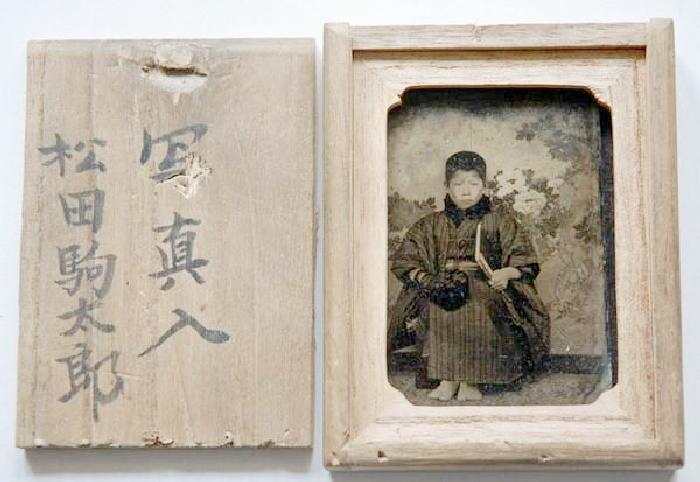
Photography began in Europe and America with the opening of Daguerreotype studios (1840s). Very little of this or other Western technology filtered into Japan as the Shogunate kept the country closed to the West. There was only a small Dutch trading post in Nagasaki where foreign trade and contacts were allowed under extremely limited conditions. It was here that the Japanese saw their first photographic portraits--Daguerreotypes. It is believed that a Dutch photographer took the first photograph in Japan. His identity and when he took that photograph appears lost to history. Only after Japan was opened to the West by Commodore Perry (1853) did modern refinements like photography begin to filter in to the country. Here because of their existing contacts, the Dutch helped introduce photography to Japan. Other foreigners soon were involved in this process. As this began to occur in the 1850s we see processes like the Ambrotype entering Japan. Thus most early Japanese photographs are Ambrotypes rather than Daguerreotypes. In fact there are very few Japanese Daguerreotypes. The cased photographs in Japan were done in wood. Within a few years Japanese pioneers like the physician Matsumoto Jun (1832-1907) began to study photography with a Dutch colleague. Much of the earliest work occurred in Nahasaki. His adopted son, Uchida Kuichi (1844-1875), studied photography under Ueno Hikoma in Nagasaki and opened a studio there. Many Japanaese city did not have photographic studios until the 1860s. Uchida moved his studio to Yokahama near Tokyo and acquired the reputation as the best photographer in Tokyo. He was granted a royal commission to photograph the Emperor Menji (1872). Most early photographers were foreigners. A particularly important one was the Venetian-British photographer, Felice Beato (1840-1904), who took beautiful images illustrating the Japanese lifestyle. Most Japanese photographers in the 19th century was more focused on portraits. We are not sure when the first albumen print was made, but surely it must have been during the 1860s. Even so, we notice ambrotypes still being made in the 1880s. The Ambrotype process in the West was displaced by albumen CDVs and cabinent cards in the 1860s. The number of Japanese photographers gradually increased and there were soon many Japanese studios (1870s). Japanese studios gradually replaced the Europeans (1880s). With the development of simple, inexpensive cameras, amateur photography became a popular hobby as was the case in the West.
Photography began in Europe and America with the opening of Daguerreotype studios (1840s). Very little of this or other Western technology filtered into Japan as the Shogunate kept the country closed to the West. There was only a small Dutch trading post in Nagasaki where foreign trade and contacts were allowed under extremely limited conditions. It was here that the Japanese saw their first photographic portraits--Daguerreotypes. It is believed that a Dutch photographer took the first photograph in Japan. His identity and when he took that photograph appears lost to history. Only after Japan was opened to the West by Commodore Perry (1853) did modern refinements like photography begin to filter in to the country. Here because of their existing contacts, the Dutch helped introduce photography to Japan. Other foreigners soon were involved in this process. As this began to occur in the 1850s we see processes like the Ambrotype entering Japan. Thus most early Japanese photographs are Ambrotypes rather than Daguerreotypes. We are not sure when the first albumen print was made, but surely it must have been during the 1860s. Even so, we notice ambrotypes still being made in the 1880s. The Ambrotype process in the West was displaced by albumen CDVs and cabinent cards in the 1860s. The number of Japanese photographers gradually increased and there were soon many Japanese studios (1870s). Japanese studios gradually replaced the Europeans (1880s). With the development of simple, inexpensive cameras, amateur photography became a popular hobby as was the case in the West.
Photograph was a Western invention. Wethus notice the same types of photographs as were common in the West. We notice very few Japanese Daguerreotypes. There are more ambrotypes. This was rather an accident of history. The opening of Japan bu Comodore Perry (1853) ocurred at about the same time that the ambrotype process appeared. And not requiring a metal plate was a striong advantage in Japan. Both were done as cased images. The cased photographs in Japan were done in wood. Japan had few natural resources, but one they did have was wood. Of course American cases were made in wood, but they were always covered with leather or gutta perca and had brass or other metal frames inside. Albumen prints appeared (1860s). We have been able to find few Japanese 19th century CDVs and cabinet cards. We are not yet sure just how common CDVs and cabinet cards were in Japan. We do note cabinet cards being made at least into the early-1930s. Cabinet cards at the time were no longer being made in the West. We notice a huge surge in photography after World War II as part of both the prosperity arising from the Japanese economic miracle.
Our interest in photography is primarily to help date undated images. We can estimate the dates by the fashiions shown, but we want some way of confirming the dates and our assessment of the dates based on the fashions. Thus dated vimjages arev particularly useful. And if we know the dates of particular styles of cases, mounts, amd frames this can information can help date the undated images. Cases and mounts refer to 19th century photograph types (Dags, Ambros, and albumen photographs--CDVs and
a cabinet cards). We have, however, archived very few Dags and Ambros and only a small number of albumen portrsits. We begin to see silver nitrate portraits after the turn-of-the 20th century. And studio prints often came in paper frames. We have archived quite a number of these and most are undasted. Snapshots also appeared at the turn-o-the 20th century. And differences in the white margins and edges can provide some dating insights. (Almost all snapshot prints had white margins until the 1970s.) So we are looking to acquire as many dated portraits as possible. The more we have, the better we can date the undated images and the fashions depicted. This is very useful in confirming our assessments of the fashions.
Within a few years Japanese pioneers like the physician Matsumoto Jun (1832-1907) began to study photography with a Dutch colleague. Much of the earliest work occurred in Nahasaki. His adopted son, Uchida Kuichi (1844-1875), studied photography under Ueno Hikoma in Nagasaki and opened a studio there. Many Japanaese city did not have photographic studios until the 1860s. Uchida moved his studio to Yokahama near Tokyo and acquired the reputation as the best photographer in Tokyo. He was granted a royal commission to photograph the Emperor Menji (1872). Almost all the 10th century photography is studio photography. Early Japanese photographers took little interest in capturing images of Japan outside the studio. Most early photographers were foreigners. And it was foreigners who took an interest in capturing images of Japanese life outside the studio. A particularly important one was the Venetian-British photographer, Felice Beato (1840-1904), who took beautiful images illustrating the Japanese lifestyle. Also interesting is Herbert Geddes, a Canadian businessmen, who captured beautiful images of Japanese life and landcape during the early-20th century.
Most Japanese photographers in the 19th century was more focused on portraits.

Navigate the Boys' Historical Clothing Web Site:
[About Us]
[Introduction]
[Activities]
[Biographies]
[Chronology]
[Clothing styles]
[Countries]
[Bibliographies]
[Contributions]
[FAQs]
[Glossary]
[Images]
[Links]
[Registration]
[Tools]
[Boys' Clothing Home]
Navigate the Boys' Historical Clothing Japanese pages:
[Return to the Main country photography page]
[Return to the Main Japanese page]
[Return to the Main country page]
[Choirs]
[Department store catalogs]
[Monarchy]
[Music recitals]
[Scouts]
[School uniforms]