Cuban History
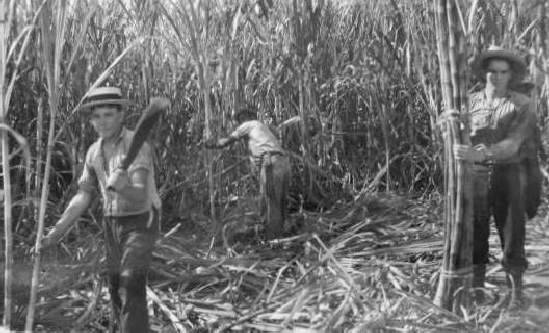
Figure 1.--Much of the history of Cuba is associated with one crop.--sugar. This crop made even small Caribbean islands valuable. Africans were imported as slaves as a labor force. Cuba is one of the countries with an ideal climate for the crop. Castro claimed that an economy based on Cuba allowed capitalist countries to explot Cuba. Then he changed his mind and focused a hufe national effort to produce 10 million tons. To support the Cuban economy, the Soviets bought huge quantities of sugar at above market prices. This is a post card mailed from Havana in 1937.
|
|
Cuba's written history began with Columbus' discovery of the island on his first voyage (1492). The Native Americans the Spanish encountered on the island were enslaved and largely exterminated. Africans were imported as slaves to replace them as a work force. Cuba spent most of its national life as a Spanish colony. An extended struggle for independence in the 19th century finally resulted in the defeat of the Spanish when the United States intervened as part of the Spanish-American War (1898). Cuba after independence was a country influenced, but not controlled by the Unites States. It was a country because of the four centuries of Spanish rule and slavery, a country with a elite and middleclass of European ancestry and a poor rural work mafe up of recently freed slaves of African ancestry. The Platt Amendment, a constututional control, was repealed by the Roosevelt Administration (1934). Subsequent Cuban history has been politicized by Castro and the Communists, just as it is in every totalitarian country. Basically totalitarians fear truth. The Cuban Communists claim that the Cuban Governments before the Revolution, especially the dictatorial Batista regime was corupt and that there were terrible social inquities which attracted organized crime and tourism. This is essentially correct, especially the criticm of Barista. What they do not mention was that Cuba was also prosperous with a growing economy and a middleclass committed to democracy. Castro's Revolution committed Cuba to a Soviet-style planned economy and dictatorial totalitarianism with like the Soviet Union, the trappings of egaltarianism and social justice, including racial equality. The problem for Cuba is the danger of having a leader able to make decisions without limitations. If the leader is wrong he can do terrible damage. And Castro was terribly wrong. Rather than totalitarian Socialim, the future lay with democracy and free markets. Socialism while it has had a role in humanizing capitalist states has proven a basically inefficent economic sysyem. The result is that Castro's Socialist Revolutuin has turned Cuba from one of the most prosperous Latin American countries to one of the poorest. As a result, the reforms such as free health care have proven indffective because Cuba is to poor to fund health care. Castro has ended the inquities in Cuban basically by making everyone poor. Castro has remained popular in left-wing circles in large part because of confrontation with the United States. Interestingly he accomplished this in part by making Cuba a part of the Soviet bloc. The collapse of the Soviet Union was a shocking experience for Castro. He allowed minimal free market reforms, including tourism which Castro once described as national prostitution. The basic economic problms remain. Cuban Communists have found a new economic sponsor--Chavez in oil rich Venezuela. The economic failure of Communist Cuba continues to require a foreign sponsor. Ironic because it is foreign involvement that is Castro's primary justification for the Revolution.
Native Americans
Cuba was inhabited by different groups of Native Americans. As they were pre-literate socities and the Spanish essentialy whiped them out, our knowledge of these people is limited. We know there were different groups because Columbus reported that the indigenous people in the west could not understand the language spoke in the east. Historians now believe that Native Americans arived in Cuba in different waves explaining the different peoples and languages. There is still considerable debate about Caribbean native American peoples. Some anthopologists speculate that there were three groups or tribes on Cuba: Guanahatabetes, Ciboneys and Tainos.
The group first group ppears to have been the Guanahatabetes who dominated western Cuba. They seem to have come from Florida (around 2000 BC). The Guanahatabete culture was based on fishing and shellfish collection. They also harvested fruit. It is sometimes called a shell culture because they made tools from the shells of the lrger molusks that they hsrvested. The culture has many similarities with the culture of the Native Americans on the Florida Keys.
The Taino are believed to have been related or a subgroup of the wider Arawak people who originated in South America.
The Taino-Arawak peoples were the latest arrivals in Cuba. They originated in the Orinico region of South America and moving along the Antillen Arc until reaching Cuba. The Tainos were the most advanced of the Cuban Native Americans. They conquered the Ciboneys. The Taino
practiced a live style still partially dependant on hunting and fishing. They were, however, alsp ursuing basic agriculture, including the cultivation of corn, peanuts, peppers, squash, tapioca (casaba), and yucca. These were crops developed by the peoples of the South American mainland. They also grew fruit and tobacco. The Taino lived in small villages, building "bohíos"--round shelters. The Taino were sophisticated enough to make ceramic jars and other pottery. They also made a variety of different objects from both shells and stone. The men wore little or no clothing. They used dugout canones to fish and travel for trading purposes. The Native American population of Cuba at the time of conquest is believed to hve been about 0.1 million people.
Discovery
Admiral Christopher Columbus reached Cuba, sailing around the northeastern coast (1492). He christened the land "Juana," in honor of Prince Don Juan, Prince of Asturia (1478-97). Don Juan was eldest son of King Ferdinand and Queen Isabella and expected to inherited the crown of a united Spain. He died unexpectdly on a few years later leaving no surviving children. Thus with his lin ended, it was the native name "Cubanacan" that came into use. The Admiral Slowly the name Cuba was adopted by the Spanish. Cuba is a lengthy island and Columbus did nit at first realise it was an island. The size of the island and geographic diversity led him to believe that it was the coast of Asia. He explored the southern coast during his second voyage at which time he realised that Cuba was an island (1494). Cuba became Spain's principal foothold in the New World. Columbus was suprissed to find that the indegenous people were separated in different tribal and linguistic groups. The natives from eastern Cuban who he employed as guides could not speak the language of the natives in western Cuba. It was from its Cuban colony that the Spanish Conquistadores launched conquest of the Americas. Cortez sailed from Cuba to begin the Conquest of Mexico from Cuba.
Conquest
Columbus established the forst Spanish settlement on Hispaniola. King Ferdinand appointed Diego Columbus (son of Christopher) as the first governor-general of Hispaniola. Diego commissioned Diego Velasquez to conquer Cuba. When the Admiral sailed along Cuba on his second voyage, the Native Americans were friendly and hospitable with the Spanish. .
Velasquez thus did not anticipate any difficulty conquering the island. The Spanish on Hispaniola had brutally treated the natives on the island. Hatuey, one of the chieftans, fled Hispaniola. He explained to the Cuban natives what the Spanish were planning to do on Cuba. Diego Velasquez and his 300 men landed on Cuba (1511). The Cuban natives fiercely resisted the conquest. As on Hispaniola, however, they were no capable of resisting superior Spanish weapnos. And the conquest occurred so rapidly that they could not develop approprite tactics. The Spanish burned Hatuey at the stake when he refused to devulge the source of gold (1512). When offered the Cross and an opportunity to convert anf go to Heaven, Hatuey replied, "If Christians go to heaven, I do not want to go to Heaven." After Hatuey was executed, resistance to the Spanish collapsed.
Spanish Colony
The Spanish after defeating the Native Americans (1511-12) began to settle the island. Velasquez had established six small settlements (by 1515). This included Havana which became the principal settlement. Cuba and it soon eclipsed Hispaniola, becoming the most important Spanish bastion in the Caribbean. The settlers raised cattle and tobacco, but the most important crop became sugar. The Native American population was desimated soon after the conquest, The Spanish enslaved the Native Ameicans surviving the conquest, but they oerished as a result of mistreatment and exposure to European diseases. The Panish imported African slaves to work their ranches and plantations. Slavery was not abolished until late in the 19th century (1886). Sugar came later to Cuba than much of the Caribbean, but in the 19th century, the sugar industry became the mainstay of the island's economy. As a colony, Spain tended to run Cuba as one vast sugar plantation. Manufacturing or any diversification was discouraged. In fact, there was very little effort to even do anything with the sugar harvested beyond exporting raw sugar. Astonishingly, the first important distillery was not opened in Cuba untill a Spanish emigrant, Facundo Bacardi, founded a small distillery in Santiago (1862). [Gjelten] Bicardi proved an innovative businessman. He pioneered a new distilling technique which produced a light, mixable rum that proved popular in the United States and other export markets.
Most of Spain's American colonies achieved independence during or after the Napoleonic Wars of the early 19th century. Spain held on to Cuba and and Puerto Rico after defeats in South and Central America. Cubans began their struggle for independence at mid-century. The first major armed action was the War of the Ten Years (1868-78). A poorly equipped army of 8,000 Cubans fought a valiant struggle against aell-armed Spanish army which suffered some 80,000 casualties. The revolutionaries which failed to fight a centrally organized campaign finally had to give up with the Pact of the Trench, although General Antonio Maceo issued the protest of Baraguá. A second insurrection was organized by Jose Martí (1895). The Army of Liberation was better organized than in 1868 and was commanded by General Maximum Gómez. The Army of Liberation eventually fielded about 50,000 men, but only about half were armed. They were organized into six Army Corps with 14 divisions, 34 brigades and 84 regiments, of which 34 were of cavalry and 50 were infantry and other forces. The organizational structure structure reflected the territorial distribution rather than the number of troops. The Spanish commited an army of about 250,000 men. The still the Spanish held on. In the campaign they suffered about 71,000 casualties and the war proved a major drain on the Spanish economy. The Spanish Army was able to hold on to the major cities, but most of the countryside was in rebel hands. The Cubans did not have the military force need to take the cities and the Spanish did not have an adequate force to pursue the rebels into the countryside. Thus an uneasy deadlock developed. The American press began covering the conflict, siding with the rebels.
The abolition of slavery in Spain's last Western Hemishphere colonies is a complicated matter. Spain signed a treaty with Britain to end the slave trade (1817). There was a grace period involved. Spain while agreeing to end the slave trade, in fact took no real actions to do so. Enforcement was largely left to the limited abilities of the British Royal Navy. After the treaty came into force, slavers continued to deliver slaves to Cuba and to a lesser extent Puerto Rico. One account estimates that between 1821 and 1831 more than 300 slave ships brought an estimated 60,000 slaves to Cuba. Spanish authorities on Cuba made no real effort to stop this. Spain abolished slavery south of the equator (1820). Spain at the time, however, had lost or was losing its South American colonies, leaving it only with Cuba and Puerto Rico which were well north of the Equator. Following the defeat of Spain in a series of wars in South America and Mexico, Cubans began to organize an independence movement (1820s). A spanish census on Cuba found a slave population of 287,000 (1827). Most of Cuba's slaves worked on 1,000 sugar plantations (ingenios). Sugar planter Carlos Manuel de Céspesdes freed his slaves, issuing the Cry of Yara (Grito de Yara). A wave of slave liberations followed (1868). The wars of liberation against Spain were impaired by the slave question. Planters were concerned that independence would lead to abolition. The Spanish Government proclaimed the "Free Market Law" which freed slaves over age 60, those born after September 17, 1868, and all slaves who fight under the Spanish flag (1870). The last slaver landed Africans in Cuba (1873). Spain finally abolished slavery (1886). This meant the end of slavery on the two remaining Spanish colonies in the Western Hemisphere--Cuban and Puerto Rico.
The Cuban independence struggle was deadlocked when the United States declared war on Spain. The Spanish held the cities and the guerillas the countryside. Neither was strong enough to defeat the other.
The United states was drawn to intervene, in part because of lurid press reports of brutal Spanish military operations in Cuba and ultimtely the mistaken belief that the Spanish had attacked the batteship USS Maine which blew up in Havana harbor. The result was the Spanish American War (1898). Yje United Stated declared war (April 1898). The United States did have the military force to seize the cities from the Spanish. General Calixto Garci'a and the Army of Liberation cooperated with the Americans. The U.S. Navy also defeated the Spanish at sea blockaded the island. The United States also seized Puerto Rico, the other Spanish colony in the Caribbean. There were also military actions against Spain the Pacific. The United States proceeded to occupy Cuba. There waslittle or no press coverage of Spanish colonial policies in the Philippines, but the United State Navy also engaged the Spanish Pacific fleet in Manila Bay. Spain quickly relinquished control of its colonial possessions to the United States with the Treaty of Paris (December 1898).
The United States was not sure what to do with its new possessions in the Caribbean and Pacific. We do not at this time have extensive details about the discussions in Washington concerning what to do with Cuba. One has to be careful when assessing the American occupation because views of this era commonly reflect an author's ideology more than a disapassioned assessment of fact. It is true that the United states was concened about leaving an independent Cuba. Various factors were at play here. One is geography. Cuna was only 60 miles from Florida. Race was another factor. Cuba had a large black/muklatto population, about half the total population. It is difficult to assess the precise concerns of American policy makers. Some appear to have thought that Cuba was incapable of self rule. Southeners were uncomfortable with a racially mixed country so close to the UnitedStates. Even so, often loss in this discussion is the fact that the United States did grant independence, albeit with restrictions. This is not what other countries were doing. The other colonial powers (Austria-Hungary, Belgium, Britain, France, Germany, Italy, Japan, the Netherlands, Portugal, and Russia) were doing. They were still activelly acquiring colonies in competitiin with each other, in fact this competition actually sparked World War I. No other country granted a colony independence until after World War II with the exception of the British dominions. The United States during the beief occupation made improvements in the island's infrastructure. The United States also suppressed yellow fever--a very important accomplishment. American investors began making substantial investments which were important in developing the moribund economy which at the time of independence was one of the poorest islands in the Caribbean. Cuba in fact was the fuirst country voluntarily granted independence after four centuries of European imperialism begun with Columbus' discovery of the Americas. The United States withdrew its military forces, ending the military occupation (1902). The 1901 Platt Amendment allowed the U.S. to intervene in Cuba's affairs and it did so four times after the withdrawl (1906-1920). The Platt Amendment was finally terminated (1934).
Independence (1902)
The United States ended the occuption and granted Cuba independence (1902). A provision of the new Constitution known as the Platt Amendment gave the United States the right to intervene to preserve Cuban independence and stability. The Roosevelt Administration as part of the Good Neighbor Policy repealed the Platt Amendment (1934). The two countries reaffirmed the 1903 agreement leasing the U.S. Guantanamo Bay naval base.
Good Neighbor Policy
The United States withdrew its military forces, ending the military occupation (1902). During the brief American era, the United States suppressed yellow fever. American investors began making substantial investments which were important in developing the moribund economy which was one of the poorest islands in the Caribbean. The 1901 Platt Amendment allowed the U.S. to intervene in Cuba's affairs and it did so four times after the withdrawl (1906-1920). The amendment was finally terminated (1934). The first Cuban Congress convened (May 5, 1902). This was the first representative assembly in Cuban history. It assumed the responsibility for governing the country (May 20). Thus May 20 is considered Independence Day. Thomas Estrada Palma was selected as the first President of the Republic. A revolution occurred (July 1906). President Taft intervened and set up a provisional government. The Americans restored civil order. President Staff appointed Charles Magoon govenor The United States handed power back to the Cubanst (1909). The Cubans elected José Miguel Gómez (1909). He was followed by Mario García Menocal (1913). Cuba's principal crop was sugar. The new country prospered because of the high price of sugar on the world market. This began to change after World war I when the prices of agricultural commodities including sugar began to decline (1920). Cuba experienced a financial crisis. The United States provided a $50 million loan which helped stabilize the economy.
Alfredo Zayas was eklected president after the price of sugar began to fall (1921). Opposition to him became wudespread and include widespead civil disorder. Independent Cuba was obstensibly a democratic republic. The country was, however, during the republican period ruled by authoritarian political and military figures supported by wealthy lndowners and businessmen.
General Gerardo Machado was elected president (1925). He was re-elected (1928). He proved to be Cuba's first real dictator. As a result of increasing opposition, Machado during his second term declared martial law. Supporters in the Cuban Congress permitted him to suspend civil liberties, including freedom of speech, press and assembly. Fulgencio Batista, an army sergeant, staged an unusual non-commissioned officer coup overthrowing President Machado (September 1933). Given Machado's unpopularity, there was little resistance. Machado fled the country. Batista at first controlled the country behind the scenes. He was elected president (1940), but lost the presudency later (1944). He did not run in the next election (1948). Batista decided to run again, but deciding he would not win an ekection, he seized power in anotger coup (1952). He suspended the election and began ruling by decree. Cuba polticans abd various civilian governments demanded the reinstatement of the 1940 Constitution and a return of democratic rule. The Batista era was notable for extreme levels of corruption. Fidel Castro who had entered politics befor Batista's coup staged an attack on the on the Moncada army barracks in Santiago (1953). He was arrested and tried and then went into exile in Mexico.
Cuba and Puerto Rico had been the last remaining Spanish colonial ouposts in the Americas. As such, the Cuban economy languished as a colonial outpost of a poor, backward European country. Further problems resulted from the independence struggle which by the 1890s left the Spanish in effective control of only the major cities in Cuba. The United States during the 19th century developed trade ties with Cuba, complicated by Sopanish colonial policies. Cuba at the the time of the Spanish American War was like much of the Caribbean, deperately poor. As a result of the Spanish Ameican War (1898-99), four centuries of Spanish rule ended. Cuba finally achieved independence (1902). Much expanded American investment followed. Much of that investment flowed into the sugar and tobcco industry and subsequently tourism. American investment also financed the development of natural resources like nickel. One source estimates estimates that by 1926, American investors owned 60 percent of Cuba's sugar industry. In an era of high tariffs, the United States granted Cuban exporters preferential access to the U.S. market. The United States imported 95 percent of the Cuban sugar harvest. [Thomas, p.336.] Castro after seizing power in Cuba constantly stressed the degree of American investment in Cuba. What he did not mention and the Cuban Government does not allow to be mentioned today is the how that investmrent changed Cuba. The country's moribund economy under Spain bloomed in the new free market environment. Incomes rose and Cuba developed for the first r=time in its history a substantial and prosperous middle class. In little more than half a century, Cuba became not only the most prosperous Caribbean islnd country, but one of the most prosperous countries in all of Latin America. The era from independemce (1902) to Castro's revolution (1959) was the most prosperous in Cuban history measured in terms of per-capita invome and other key economic indicators. It is true that the prosperity was not well distributed, but the propsperity is undeniable. America in short bfrought prosoperity and economic developent to Cuba for the first time and what was to prove, the only time it its history.
Democratic Revolution
Batista's authoritarian, criminal rle rule fueled discontent, primarily among the urban middle class which wanted an honest democratic government andthe rule of law. This created the base for aevolutionary movement. Therewas no other way to oppose Batista. Any ine who critcised him was either arrested or in many cases murdered. hile in Mexico, Castro organized the 26th of July Movement with the goal of reestablishing democratic rule in Cuba. He and a group of fighters returned to Cuba on a small yacht, the Granma (1956). Considerable opposition existed to Batista. And although not commonly mentioned by the Castros, the U.S. Government rather than supporting Batista not only cruticized him, but weakened his dictatorship by imposing an American arms embargo. After a 2-year insurrection including both rural and urban action, The Revolution was essentially a middle-class movement fought primarily by people with a democtatic vision for Cuba's future. There were large number of idealistic students as well as individuals within the Cuban establishment. José 'Pepín' Bush personally donated $38,500 (1950s dollars) and other members of the Bacardi family played prominant roles. [Gjelten] Batista linked to a corrupt and largely ineffective military, dispirited by a U.S. Government arms embargo, and rising public revulsion at his brutality and authorianrian rule, fled Cuba, leaving his supporters in the lurch (January 1, 1959). Fidel Castro and his supporters entered Havana admist aopular celebration. He seizing control of the Government and began executing Batista's supporters in public stadiums.
Guerilla leader Fdel Castro seized control of Cuba (January 1959). Relations between the United States and Castro soon began to deteriorate as the Revolutionary Government began expropriating U.S. properties and moving closer to the Soviet Union. It is not clear whay Castro's planswee for Cuba at the time he seized power. He subsequently announced to Cubans that he was and had neen a committed Communist. This may or not be true. What we know for sure was that he was no democrat and had no desire to work through a democratic process and the rule of law--what most of the 26th of July Movement desired and joined with Castro to achieve. Castro in contrast made no effort to institute a democratic reforms. He would like to blame everything on the United States. But America hd little impact on Castro or his policies. From the very beginning he proceeded to etablish a personal dictatorship. He set up kangaroo courts and negan executing peopl in public events. He also began setting up a secret police force and arresting people who critcized him or question the lack of steps toward a democratic Cuba. This and the exporopriations began to elicit criticism by American officials and in the American press. Criticism was something Castro was not about to permit. He wanted to be a dictator. Now it is true that his desire to be a dictator do not seem to be the venal motives of Batista or a long list of other Latin American dictators. He thought he understood both economics and the direction of the Cold War. He may or may not have been a Communist, but thereis no doubt that he was heavily imbued with left-wing ideology which dominated most Latin America universities. He believed that socialism and Soviet-style central planning would convert Cuba into a worker's paradise and that foreign investment was a negative influence. He also knew that the Soviet Union not only had no problem with dictators, but actually inisted on setting up secret police forces and dictators in its stellite puppets. This was not unusual at the time. Major figures in the Third World had reached the same conclusion. At the time it looked like the Soviet Union might well win the Cold War. What we now know about the effiency of Socialism and central planning was not well known at the time. As it begame clear that Castro was moving toward a Communist dictatorship, the United States imposed an embargo (October 1960) and, in response to further provocations, broke diplomatic relations (January 1961). The United States failed in a half-hearted invasion at the Bay of Pigs (1961). So Castro had his opportunity to restructure the Cuban economy and create a worker's paradise. What resulted surprised him. He turned one of the welthiest economies in Latin America to one of the poorest. He did achieve one of his goals to eliminate the disparities between rich and poor. Tragically for Cubans, he did this by making everyone except the Comminist and military elite poor--the same result in every Communist country. Of course, Castro argues it wa all the impact of America and the embargo. But this is absurd. Castro central theme since taking power was that America exploits Cuba and other countries. But if this was true, severing economic relations with an explotive country could have only benefitted, not hurt Cuba. As with other Communist countries, economic failure was the result of the inherent inefficiencies of Marxist doctrine.
Sources
Gjelten, Tom. Bacardi and the Long Fight for Cuba: The Biography of a Cause.
Khrushchev, Nikita. Edward Crankshaw, intro, commentary, and notes. Strobe Talbott, trans. and ed. Khrushchev Remembers (Little Brown: Boston, 1970), 639p.
Thomas, Hugh. Cuba : The Pursuit for Freedom.
CIH

Navigate the Children in History Website:
[Return to the Main Caribbean history page]
[Return to the Main Latin American history page]
[Return to the Main Latin American page]
[Return to the Main countries page]
[Introduction]
[Biographies]
[Chronology]
[Climatology]
[Clothing]
[Disease and Health]
[Economics]
[Geography]
[History]
[Human Nature]
[Law]
[Nationalism]
[Presidents]
[Religion]
[Royalty]
[Science]
[Social Class]
[Bibliographies]
[Contributions]
[FAQs]
[Glossaries]
[Images]
[Links]
[Registration]
[Tools]
[Children in History Home]
Created: 1:55 PM 12/24/2007
Last updated: 1:42 AM 10/9/2014