|
Boys engage in a variety of activities from choral singing to athletics. Other major activities include dance, music, school, Scouting, summer camp, and much more. Athletics seems to have been less important in the Netherlands than in America and England, in part becaise of the more academic orientation of the school system. The national holiday in the Netherlands is Queen's day, April 30. The most important holiday seaon for children is of course Christmas. The most special day during the Christmas season is Sinterklaas (St. Nicholas Day) December 5. For most children more important and exciting than Christmas day itself. All of the Netherlands is close to the North Sea or batious bodies of water such as the Zuider Zee. Thus sea outings are popular activities, especially sailing. Tere are also popular beach resorts, although the beches are better to the south in Belgium. The water can be rater brisk. The Netherlands is a very developed country. Thus there is very little wildreness area available for recreational activities. The major Dutch youth groups have been the Scouts and a nationalist group during the German occupation which was based on a pre-War right-wing group. There is not much to report on the modern Netherlands. Many of these activities have destinctive clothing or even uniforms. HBC has begun to collect information on these activities and the clothing associated with them over time.
Many countries of Western and Central Europe have a long tradition of church boys' choirs dating back to the medevil era. Unfortunately I have virtually no information on Dutch choirs. With the Reformation the choirs that had existed were all dipanded. The current boy choir tradition in the Netherlands is thus a Protestant tradition. Like Protesant choirs in other European countries, since World War I sailor suits have been popular choir costumes. Dutch choirs as they are organized by various churches. A such, they commonly perform in liturgical robes. The saiolor suit also appears to be a popular style for choirs in the Netherlands. In fact it may have been the Netherlands where the sailor suit was first adopted by boys' choirs, even though the sailor suit is now most associated with the Austrian choir the the Wiener Sangerknaben --Vienna Choirboys.
We have only limited inforjmation on Dutch holidays at this time. As in all countr\ies, there are New Year celebrations. The national holiday in the Netherlands is Queen's day, April 30. The most important holiday seaon for children is of course Christmas.
The most special day during the Christmas season is Sinterklaas (St. Nicholas Day) December 5. For most children more important and exciting than Christmas day itself. That's od course when they receive their presents. Small presents and candy has been given each day one week before. The children would put their (wooden) shoes in front of the fire place and each morning they would find something in there. In return they would put some hay for Sinterklaas' horse before they would go to bed. Saint Nicholas was supposed to ride on his schimmel (grey horse) on the roof of the house, accompanied by Zwarte Piet (Black Peter), his Moorish servant he had brought with him from Spain. Zwarte Piet carried the big sack with the presents and another one to take with him the naughty child that had not behaved. The children would sing some of the numerous Sinterklaas Liedjes (Songs), also at school where they would celebrate. So Sinterklaas is very important to Dutch children.
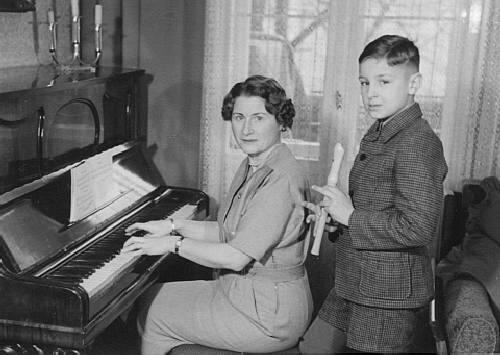
We do not know much about Dutch children and music. Dutch composers are not among the great composers. We are not entirely sure why. Of course, the Netherlands is a small country. We believe that many Dutch children learned musical instruments. It was considered part of being a cultured person. Learning a musical instrument before World warII was largely a family matter. I do not believe Dutch schools had musical programs. Children learned musical instruments at home or parents paid for lessons. This of course meant that working-class chldren did not have the same opportunities to pursue music. This was the general pattern throughout Europe. Both boys and girls pursued instumental music. I am not sure what the most popular instruents were, but probanly the piano and violin were the most important. A Dutch reader writes, "You got it right what you wrote about Holland. We never got any music education at school. We did sing however, but that was all. It is true that there are no Dutchmen among the great composers. But of course this is the case for much of Europe. German superiority in classical music is overwhelming. The Dutch genius expressed itself in painting, etching and drawing, So, musical training and education was private in Holland. The country did produce some excellent musicians and the Amsterdam Concert Gebouw Orchestra is famous, but unfortunately the schools are not much help in this respect."
We don't have much informatio on Dutch boys outings yet. City children might enjoy outings to the local parks. Younger children enjoyed walks with their parents, often their mothers and grandmothers. Older children might go for hikes or bike rides. All of the Netherlands is close to the North Sea or batious bodies of water such as the Zuider Zee. Thus sea outings are popular activities, especially sailing. There are also popular beach resorts, although the beches are better to the south in Belgium. The water can be rater brisk. The Netherlands is a very developed country. Thus there is very little wilderness area available for recreational activities.
We do not yet have much information on play activities enjoyed by Dutch boys. As far as we can tell they were similar to those of other western European countries. Both board and party games are enjoyed in the Netherlands and are mostly those played in other countries and the United States and will be familiar to most readers. Examples aew: sack-racing (Zaklopen), egg-races (Eierlopen), and pin the tail on the donkey (Ezeltje prik). Games of uniqiely Dutch origin are not as commonly played today. An example of these is Hul Gul meaming 'What's in your hand?' the game is traditionally olayed using buttons, but any small items will do as well. There can be mukltiole payers. Normlly the players begin with 10 items each. The first player chooses the number of his 10 items to hold. He holdes his closed hand. The next player asks 'Hul Gul?' The first player replies 'Hands ful'. The other player tries to guess how many of the items are in the first players hands. If he guesses right, he wins all of the items. If he guesses wrong he nust give up the difference between her hand and the first players hand. The winning player is who ever all the items first. Nor do we know much about the toys Dutch boys played with. What we have noticed in the phitographic record are blocks, music (drums and trumpets), pull toys, sail boats, teddies, and toy cars. Our archieve, however, is limited and this we can make no defintive statemens at this time. The Netherlands was one of the more affluent European countries, but had only a small population this affected tge size of tge photographic record and our ability to acquiure images. Thus we are just beginning our assessment of Dutch play activities.
Most Dutch people are Christians, mostly Protestants. There are also Catholics and other religions such as Islam brought by immigrant groups. Religion has featured prominently in the history of the Netherlands, in many ways one of the principal reasons that the Dutch wanted an independent country. The Netherlands developed a tradition of toleration in relgious matters. After Soain expelled the Jews in 1492, many came to the Netherlands. This acceptance of religious and cultural differences was an important factor in the vibrant intelectual, economic, and cultural life of the Netherlands and conversely the supression of such differences was a major factor in the decline of Spin in the 16th and 7th centuries. As late as the early 20th century religion was still very important in Dutch life. Most people attended church and dressed in their best clothes. Important events in the lives of Dutch children were First Communnion and Confirmantion. Church attendance in the modern Netherlands has fall off significantly.
HBC at this time has relatively limited information on Dutch schoolwear. We believe that trends are similar to those in Germany. We believe that few Dutch schools required uniforms, perhaps some private schools. Unlike England and France, we know of no destinctively Duch schoolwear or uniform items. Rather Durch schoolwear appears to be simply a reflection of the clothing styles that were popular at the time.
The Netherlands was one of the European countries in which the Soap box Derby was most popular. The event attracted lots of spectators as in America. One problem in the Netherlands is that the country is very flat and there are not a lot of hills. As a reslt, in the Dutch races, the cars were often pushed by other boys. Of ourse this often put more of a premium on the strength of the pusher than the design of the car. When there was a real hill available, the original American races were used. The cars as in America were made by the boys themselves, sometimes with help from their fathers. The winners were honoured like real sportsman.
Sports are very popular in the Netherlandsand and \not just watching sports. This is a fairly modern phenomenon. Modern sports did not begin to become pooukarvuntil after Workd War I. Abd as in other countrues, the sport that dominated all others was football. At first it was onky biys, but after World War II gurls began to take more interest. The level of participation today is very high. As is commonly the case in Europe, participation is through sports clubs rather than schools. Schools and universitues tend to have limited sports programs. More than 25 percent of the population belongs to one of 35,000 sports clubs. And it is not just the young people who are active. One study shows that some two-thirds of the population older than 15 years of age participate in some kind of sports activity weekly. Football as is thecase throughout Europe is by far the most popular sport. Interwestingly field hockey and volleyball are the next most popular team sports. Popular individual sports include tennis, gymnastics and golf. There are also several native Dutch sports, including fierljeppen (Polsstokverspringen), beugelen, kaatsen, klootschieten, kolven and korfball. Several modern sports have relatively early origins. Sports on the Continent tended to develop later. We see Dutch groups bginiing to organize sports during the late-19th century. The close association with the British affected the development of Dutch sports. Pim Mulier, a key figure in Dutch sports, founded the first rugby and football club (1879). The Netherlands has many canals and waterways. Skating was thus a sport that developed in the medieval era. And it was one with chikdren participated in from an early age, bith boys and girls. Some call iceskating the national pastime. One of the counbtry's mostbpopular events is the Elfstedentocht or Eleven Towns race. Irvis conducted over frozen canals that link 11 towns. Just as the Scandanavians commonly compete in skiiing competitiions, the Dutch commonly compete in both speed skating and long-distance skating events.
At about the same time, we begin to see federations for sports. The earliest was the speed skating federation (1882). With all the waterways, skating was very popular in the Netherlands. The federations helped to develop rules abnd stabdands.
Soon sports clubs were appearing all over the country. With the esrtablishment of the modern Olympic Games, the Dutch orgnized a National Olympic Committee (1912).
The major Dutch youth groups have been the Scouts and a nationalist group during the German occupation which was based on a pre-War right-wing group. There is not much to report on the modern Netherlands. Holland now lacks the plethora of scouts and scout-like movements
of France, Belgium, and Germany. There were five associationsm but they were united in 1973. There is now but one movement, Scouting Nederland, and I believe it has discarded uniforms long ago. A Dutch contributor to HBC reports, "I haven�t noticed a single scout uniform since I came to live in my home country." The Germans promoted a Nordic youth movement during the World War II occupation. There was also Hitler Youth units for german boys living in the Netherlands.some of which have religious foundation.

Navigate the Boys' Historical Clothing Web Site:
[Return to the Main Dutch page]
[Introduction]
[Activities]
[Biographies]
[Chronology]
[Clothing styles]
[Countries]
[Bibliographies]
[Contributions]
[FAQs]
[Dutch glossary]
[Images]
[Links]
[Registration]
[Tools]
[Boys' Clothing Home]
Navigate the Boys' Historical Clothing Dutch pages:
[Maiken Island]
[Dutch boys bangs]
[Dutch choirs]
[Dutch school uniform]
[Dutch catalogs]
[Dutch post cards]
[Dutch royals]
[Dutch youth groups]
Navigate the Boys' Historical Clothing national pages:
[Return to the Main countries page]
[Australia]
[Belgium]
[England]
[France]
[Germany]
[Ireland]
[Italy]
[Japan]
[Korea]
[Mexico]
[Netherlands]
[Scotland]
[United States]