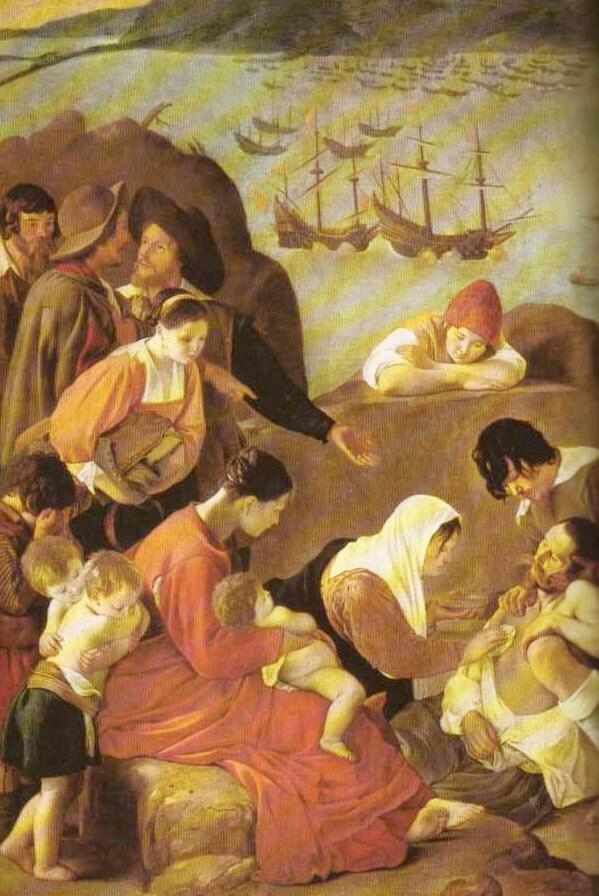
Figure 1.-- Dutch investors commited considerable funds. A succession crisis in Portugal led to a personal union under the Habsburg King Philip II of Spain--the Iberian Union (1580). This meant that Portugal and Brazil became involved in the Dutch War of Independence. Philip II prohibited trade with the Dutch (1581). The Dutch with investments in Brazil struck back by seizing coastal cities in the northeast. Here is a detail from a painting about the Spanish retakeing Bahia (1625). The Dutch continued the fight to retain a hold on Brazil for several decades. The Dutch finally departed after the Spain made peace (1648) and the Portuguese paid a war debt (1661).
Brazil is the largest country in Latin America, comprising half the area of South Aamerica. It is also has the largest population in Latin America and one of the largest in the world--about 150 million people. The population is still largely found along the coast where cities like Sao Paulo and Rio dominate the country. Brazilan history is less known than that of the more dramatic history of the former Spanish colonies. It was in Brazil that the Atlabtic slave trade began and Brzail was the final country in the mesisphere to abolish slavery. While the slave system was extrodinarily brutal, the racism underlying slavery was less pronounced in Brazil. As a result Brazil has the most racially mixed population in the hemisphere. The country does not have a long democratic tradition. There was a long period of military rule or rule by military-controlled civilian governments. There was also a bloody Communist insurection which was brutally supressed by the military. Brazil appears to be bebefitting from a combination of free-market reforms and democratic rule. The economy is now one of the fastest growing in the world. Given the country's size, its future will largely determine that of South America.
Native Americans
There is some difference of opinion among historians as to the size of the Native American population in the Amazonian basin. One estimate suggests a Native American population of about 7 million people.
The tribes have been described as peripatetic. We have noted varying assessments of the level of development of the tribes. They have been described a having only basic agricultural trchnology. Other reports suggest a much more developed agricultural society which largely shaped the flora and fauna of what is now modern Brazil. There are reports of high levels of intra-tribal warfare and canibalism. There was no monumental archiecture as was the case of the Andean peoples. Thus there is little physical evidence to assess these cultures. There are today in the jungle areas of the deep Amazon a number of surviving tribes with a population of about 0.2 million. Their culture is very primitive. There is evidence that the Native American tribes in the Amazon Basin at the time of the Conquest were more advanced. The primitive people today are commonly thought to be a surviving artifact of pre-Conquest Native Americans. An increasing number of scholars are coming to the conclusion that these primitive people are Native Americans who were forced to forego settled agriculture and adopt a more primotive life-style to escape from Portuguese slavers.
The Conquest
The Portuguese who for a century were moving south alonh the coast of Africa discovered Brazil after Columbus had shown that there was land to the west. The leading Portuguesr conquistadoer was Pedro Cabral (1500). Other Portuguese explorers followed in Cabral's wake. The nature of the Portuguese Conquest in Brazil was different from that of the Spanish in the rest of South American and Mexico. The Portuguese with considerable experience along the coast of Africa was primarily interested in trade. There was less concern with actual conquest. The Portuguese made little attemp to move inland and the interior was largely unexplored. Many early settklers were common sailors who lived on subsistence agriculture. The early Portuguese found little of value among the Native Americans. One item of value they found was the pau do brasil (brazil wood tree) which could be used to produce a valuable red die. from which they created red dye.
Colonial Development
Portugal at the time of the conquest was a country just emerging from feudalism with an impoverished peasantry. Brazil offered land. The Dutch, an important 17th century naval power, seized Bahia for a brief period. One impact of their presence was a boost to the sugar industry, a hugely valuable commodity at the time. The economics of sugar meant that it became the leading crop in Brazil. Dutch investors commited considerable funds. A succession crisis in Portugal led to a personal union under the Habsburg King Philip II of Spain--the Iberian Union (1580). This meant that Portugal and Brazil became involved in the Dutch-Portuguese War (1581-1648). Philip II prohibited trade with the Dutch (1581). The Dutch with investments in Brazil struck back by seizing coastal cities in the northeast. The principal result was that when the Dutch were finally expelled, they brought sugar industry technology to the Caribbean. The Native American population was desimated by European diseases. Portugal with trading posts all along the African coasts had access to a ready supply of labor which laubched the Atlantic slave trade. While slavery in Portuguese Brazil was an extrodinarily brutal system, there were cultural differences with slavery in Hispanic America and subsequently the French and British colonies. There was a degree of intermarriage unprecedented in the other colonial empires. A range of factors seem to have been at play here. The Portuguese were more familiar with Africa, The Portugese settlers were mostly men with relatively few women. In addition, the Portuguese had a long historical expeience with Moors from North Africa. The Portugesre not only intermarried with the African slaves, but also Native Americams. There was also intermarriage between Africans and Native Americans. This has resulted to a much more racially mixed population than elsewhere in the America. This is not to say there was not racist ordering of society. It is to say that there was aoderation of racist thought in Brazil as aesult of a degree of mixing and the historical experience. The discovery of gold in south-central Brazil brough a movement into the interior for the first ime (1690s). The gold proved to be much more limited than at forst thought and the settlment of Brazil continued to be mostly coastal (18th century).
Brazil had the largest slave population in the world, substantially larger than the United States. The Portuguese who settled Brazil needed labor to work the large estates and mines in their new Brazilian colony. They turned to slavery which became central to the colonial economy. It was particularly important in the mining and sugar cane sectors. Slavery was also the mainstay in the Caribbean islands with economies centered on sugar. Estimates suggest that about 35 percent of captured Africans involved in the Atlantic slave trade were transported to Brazil. Estimates suggest that more than 3 million Africans reached Brazil, although precise numbers do not exist. Brazil had begun to turn to slavery in the 15th century as explorers began moving along the coast of Africa. With the discovery of the Americas, the Portuguese attempted to enslave the Native American population as well. This did not prove successful. The Native Americans died in large numbers, both because of slave rading, mistreatment, and the lack of resistance to European diseases. The Portuguese found captured Africans to be a valuable trading commodity as Europeans began to settle the Caribbean islands. They also began transporting Africans to their Brazilian colony. Portuguese Prime Minister Marqu�s de Pombal abolished slavery in Portugal (February 12, 1761). The Portuguese action, however, did not address slavery in the colonies. Slavery was widely practiced. Brazilians of all classes owned slaves. Slaves were not only owned by upper and middle class Brazilians, but also by lower class Brazilians. There were even slaves who owned other slaves.
Napoleonic Wars
Portugal for a time was Britain's only ally on the continent. This made the country a target for the French. The British landed a small army comanded by Wellington, but it was not large enough to resist a French inbvasion forcehand had to be withdrawn. The French moved on Lisbon. The Prince Regent departed seeking refuge in VBrazil (1807). Dom Joao established Rio de Jneinro as the temporary capital of the Portuguese Empire. Napoleon's defeat in Russia (1812) fatally weakeb=ned France and the French had to withdraw from Iberia (1814). Napoleon was finally defeated at Waterloo (1815). Dom Joao did not return to POrtugal, however, until several years later (1821).
Brazilian Empire (1822)
Dom Joao left his son Dom Pedro in charge of Brazil when he returned to Portugal (1821). Dom Joao attempted to resume the traditional system of colonial rule. Dom Pedro decided to declare Brazuil's independence from Portugal and his independence from his father (1822). Brazil's economy changed significantly in the 19th century as coffee became an ibcreasingly important crop. There was considerable Europeam immigratiin in the 19th century, especially from Italy.
Coffee
Brazil's economy changed significantly in the 19th century as coffee became an increasingly important crop.
War of the Tripple Alliance (1864-70)
The War of the Triple Alliance, also called the Paraguyan War, was the bloodiest conflict in Latin-American history. It was a war fought by Paraguay against aan alliance of neighboring states (Argentina, Brazil, and Uruguay). Only Bolivia among the countries bordering Paraguay did not enter the War.
The countries between Argentina and Brazil (Bolivia, Paraguay, and Uruguay) struggled in the 19th century to retain their independence and territory against their more powerful neigbors. Arggentiba during the War for Independence attempted unsuccessfully to include what becamme Paraguay and Uruguay in their new nation. Even after independence, a range of issues, especially boundaries were left unresolved. Argentina and Brazil claimed territory that Paraguay also claimed. Uruguay was also a bone of contention. Brazilian Emperor Dom Pedro II intervened in Uruguayan politics and assisted the leader of Uruguay's Colorado Party to overthrow the Blanco Party (1864). Paraguayan Dictator , Francisco Solano L�pez, saw this as a prelude toward Brazilian interference in his country. He declared war on Brazil (1864). L�pez had conducted a massive buildup of a 50,000-man army. It was the largest army in South America. Bartolom� Mitre, president of Argentina, concerned about Paraguay's military buildup, saw this as an opportunity to obtain long-saught territoiry, organized an alliance with Brazil and Colorado-controlled Uruguay (the Triple Alliance). They declared war on Paraguay (May 1, 1865). Many Latin Americans when the War began saw Paraguay as the agressor and a threatening nation. As the War went on and went against Paraguay, sentiment shofted and began to be seen as Mitre's war of conquest, even in Argentina. The Emperor gsve command of the Brazilian forces at the end of the War to his French son-in-law, the Count d'Eu.
Immigration
There was considerable Europeam immigration in the 19th century, especially from Italy.
Brazil was a major desination of the Atlantic slave trade. Brazil justsout into the Atlantic and was thus a much shorter run for the slavers. Brazil had the largest slave population in the world, substantially larger than the United States. Pedro II was a ruler of conservative mindset. He came to see slavery, despite its economic importance to Brazil as inherently evil. Pedro began a series of measures liberating Brazilian slaves. He was posed to entirely abolish slavery. His measures against slavery met oposition from major landowners and the military, the leadership of which was drawn from the landed elite. The Emperor was on a trip to Europe when his daughter, Princess Isabel serving as regent, issued a decree abolishing slavery (May 13, 1888). This essentially did away for the last bastion of slavery, although forced labor cotinued for some time, in the Western Hemishere and ended what remained of the the African slave trade. Princess Isabella's decree is known as the Golden Law. It was widely praised in Europe. Abolishing slavery was the last major action taken by the Brazilian royal family. Brazil proved to be the last Western Hemisphere country to abolish slavery.
Republic (1889)
The Brazil monarchy was praised in Europe for the Golden Law. It was seen in a far different light by the Brazilian political elite. Conservative forces in Brazil were horrified with the abolition of slavery. As this was the the monarchy's primary source of support, it mortally wounded the monarchy. The coffee planters organized to oppose the monarchy. Revolts broke out in the important cities. There was some support for the opposition by republican regimes in Uruguay and Argentina. Insurgents proclaimed a republic (November 16, 1889). Coffee planters became the dominant force in Brazil. They backed a military coup (1889). The Emperor fleed the country. A Republic was proclaimed.
Coffee (1840-1930)
Brazilian agriculture benefitted from many imported agricultural commodities. One of these was coffee which originated in Africa. Coffee became a prized commodity in Europe during the 17th century. Coffee did not become important in Brazil until the second half of the 19th century. Brazil's coffee industry developed in S�o Paulo a southern state. Coffee was an important element in S�o Paulo becoming the primary businsss center of Brazil. The city is now one of the largest cities in the world. High coffee prices resulted in the rapid expansion of coffee plantations in Brazil. Coffee became the center of the Brazilian economy fueling economic growth in the 19th century. Coffee came to be Brazil's most important export cmmodity. The increased production from Brazil and other areas ultimately resulted in a fall in coffe prices.
An essential industrial commodity is rubber. Brazil imported sugar and coffee which became important agricultural commodities. Rubber trees, on the other hand, originated in the Amazon. They were discovered by Native Americans who collected latex and used open fires to create rubber. There is an ongoing debate among scientists studying Native Americans as to how much they shaped the Amazon. It was noted by Europeans after the conquest, but was not a particularly valuable commodity. Only after the industrial revolution was well underway in the 19th century did the industrial potentual of rubber becomes increasingly realized. These were limited, however, because of the difficulty working with the material. This changed dramatically when Charles Goodyear developed the vulcanization process. The result was a very sharp increase in the demand for rubber. The large scale production of rubber began in Brazil. The economy of the Brazilian Amazon boomed. The Government regulated the industry. Those individuals who obtained the right to collect latex from the Amazon became fabulously rich. There were no rubber plantations a the time. Only rubber trees growing wild in the tropical rain forrest. The latex itself was actually collected by serengeiros (rubber tappers). Everyone bebefitted from the rubber boom with its hifg prices, even the serengeiros. The rubber barind became favulously rich. Manaus was the center of the Brazilian rubber boom. Suddenly there were opersat houuses and fancy rstaurants in what had been a sleepy backwater Amazonian town. The boom was premised on the fact that Brazil was the only place in the world that rubber coyld be obtained in large quatities. The Government attempted to prevent the export of both seeds and plants. Henry Wickham, a British individual, managed to smuggle rubber seeds out of Brazil (1876). The Brazilians have labeled this an act of biopiracy. The British attempted to grow rubber in various places in the Empire. Southeast Asia was particularly conducive to rubber. The British founded rubber plantations which could produce rubber more efficently than collecting latex from wild trees in the Amazon. There were limitations on developing rubber plantations in Brazil because of the plant diseases and insects which had developed in the Amazon.
The rubber boom brought Braziiians into the Amazonian basin for the first time in large numbers. The country's population, however, continued to be concentrated along the coast.
Brazii's economic development during the 19th and early 20th century was largely agricultural. It is not altogether clear why this did not occur, but probably relates to the fact that economic and politcal power was in the hands of the large land owners. It also relates to the Portuguese and Spanish Catholic tradition of supressing free thought and innovation. This was the pattern throughout Latin America. There was no serious effort to industrialize as was occurring in Europe and North America at the time. Economic development was not shared throughout the country. This meant both regionally and socially. Development and growth were concentrated in the southeast based in large part based largely on coffee and other agricultural commodities. The southeast became the most developed and richest part of the country. The Amazon Basin experienced a rubber boom, but this failed after the British smuggle out rubber seeds and buuilt plantations in Southeast Asia. Brazil's arid northeast continued to stagnate, with its population living essentially at the subsistence level. Brazil was one of the countries which attracted European immigration. Most of the immigrants came from southern Europe (Italy, Portugal, and Spain). There were also some Germans. The freed slaves made little economic progress. Racial attitudes were not a polarized as in America, but still the freed slaves did not progress economically.
World War I (1914-18)
Brazil was the only one of the four major Latin American countries that actually declared war on Germany. Brazil like the other Latin Americans countries benefitted by war orders and increased exports. As with the United States, the major issue became German submarines. German U-boats sunk several Brazilian ships as the War progressed. The Brazilian press was outraged when the Germans sank the Rio Branco which was named after a famed statesmen (May 1916). The newspapers quieted down when news emerged that no one was killed and the ship was registered in Britain. Te Brzilian Government warned German diplomats that diplomatic relations could continue only if Brazilian ships were not attacked. A German U-boat sank the Parana off the French coast (April 5, 1917). Brazilians were outraged when reports emrged that the U-boat fired into te ship even as it was sinking resulting in three deaths. Mobs in the capital of Rio de Janeiro attacked German businesses. President Wenceslau Braz expelled German Ambassador von Pauli (April 11). Despite this action, the Government declared its neutrality in the war between America and Britain (April 25). There was sympathy for the Allies. Ruy Barbosa headed the League for the Allies. Barbosa wanted Foreign Minister Lauro Muller fired, citing his German origins. The President did fire Barbosa and replaced him with Nilo Pecanha who announced a new pro-Allied policy. President Braz released a statement, "Brazil should adopt the attitude that one of the belligerents forms an integral part of the American continent, and that to this belligerent we are bound by traditional friendship and by a similarity of political opinion in the defense of the vital interests of America and the principles accepted by international law." Attacks occured on German ships that were in Brazilian ports. The Government proceeded to seize 46 German ships, in part to protect them. The Government revoked its neutrality declaation (June 1917). American and other Allied escorts began guarding Brazilian ships. This did not prevent German attacks. The Germans sank four more Bralian ships an took a Brazilian ship maser prisioner. Brazil declared war (October 26, 1917). The Brazilian presss aplauded the action. The Congress enacted the War Law (November 1917). The Govenment seized German assets in Brazil, mainly banks and insurance companies, in additin to the 46 ships that had been impounded earlier. The president was given the authority to declare any area "under siege". This was largely seen as necessary because of the large number of Germans in southern Brazil. Brazil did not play an important part in the War, but the declaration was more than an empty geture. Authorities expressed an interest in committing troops to fight the Turks in Mesopotamia where the climate was seen as more appropriate for Brazilian soldiers. Transporting troops was a main obstacle. Brazil did send small military and naval missions to Europe. Some units saw combat. Brazil also dispatched Airmen to Italy for training. The Brazilian Navy was committed for anti-Uboat patrols in the South Atlantic. This included mine-sweeping off West Africa. The major limitation on Brazilian involvement was the war ended only a year after Brazil entered the War. Hd the War lastd longer, the Brazilian contribution to the Allied war effort would have been larger. The country's most important contribution was food shipments (beef, beans and sugar). The 46 seized German merchant ships also aided the Allies.
Tenente Movement (1922-27)
A dissent movement within the Brazilian military. Many younger officers objected to the domination of Brazil by the planter families. Many of young officers involved came from poor, backward states which were not as economically vibrant. (THis was not unlike the importance of southern officers in the American military.) Young officers staged a revolt at the Copacabana Fort in Rio de Janeiro (1922). In the resulting fighting, 16 young officers were killed. While the revolt was put down, about 1,000 tenentes fled into the the country's interior. They managed to evade pursuing troops on a 15,000 mile pursuit from Rio Grande do Sul to the Northeast and back again to the interior. This continued for several years. Finally the remnants went into exile in Bolivia, Paraguay and Uruguay (1927). One result was that the tenente leaders (Siqueira Campos, Jo�o Alberto Lins de Barros, Djalma Dutra, Oswaldo Cordeiro do Farias and especially Luis Carlos Prestes) become popular national heroes.
Depression (1930s)
The Worldwide Depression of the 1930s adversely affected Brazil. Its economy was based on exporting agriculttural and raw materials. Thus the country was significantly affected by economic trends in the United States and Europe which were the primary markets for Brazilian exports. Coffee was particularly important and the demand for coffee plumeted. It also meant that Brazil hd only limited options in dealing with thee Depression because its economy was so tied to exports.
Latin American countries were not involved in World War II until the Japanese attack on Pearl Harbor (December 7, 1941). Within weeks of Pearl Harbor, each of the Latin American countries, except the southern cone countries (Argentina and Chile), either broke relations with the Axis countries or declared war. Of these by far the most important was Brazil. This country is half of South America. It also has an emense Atlantic coast and adopted an increasingly anti-German policy, primarily because of German U-boat attacks.
Brazil had declared war on Germany in World War I and was preparing to send soldiers to France when the War ended. Brazil in World War II again adopted a firm pro-Allied position. Brazil allowed the United States to set up air bases along the northeastern coast. Recife was especially important. These basees and instalations played an important role in the campaign against the U-boats in the South Atlantic. They also helped set up air connections with Allied forces in Africa. The loss of Malay and the Dutch West Indies to the Japanese (1942) created shortages of rubber, a critical war material. Brazil became a key source of rubber for the Allies. This time, Brazilian units did reach Europe. They participated in the Italian campaign.
Post-War Era
The Depression of the 1930s had destabilized the Brazilian economy. World war II brought a degree of economic recovery. The Depression began, however, an era of political instability. Brazil was plagued with
a weak economy, social unrest, a Communist insurgency, and military coups. The Government attempted to develop the interior of the country. The capital was moved from Rio tp a new capital built from scratch in the interior--Brazilia. The generals finally oversaw a return to democracy.
Democracy (1989)
Brazil held its first democratic election in decaded (1889). The first choice of president, Fernando Collor de Mello, proved to be a poor one. Mello's dministration was plagued with corruption. And little progress was made in addressing the country's social problems are improving the economy. The peaceful transition exhibited a new stability in Brazilian political life and the country has made impressive economic progress in recent years.
Portuguese Language
Brazil has acquired the Portugese language from its former colonial mother country. The language has been infuenced by the various people with their languages that make up the Brazilian ethnic mix--Native Americans, Africans, and other Europeans (primstily Italian). And Brazil is now the dominant force in the Portuguese language, largely because the Brazilian population is so much larger than that of Portugal.