
Brazilian Religions
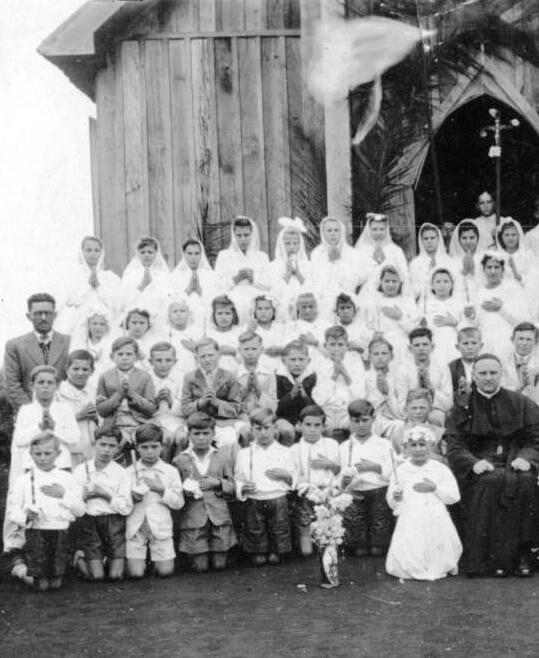
Figure 1.--This photograph was taken in "Bratislava em Cambé", a village 13 km west of Londrina (Paraná State, Brazil). It shows shows a group of children on the day of their First Communion. The second one shows three siblings. The younger two had the First Communion. The church building is very plain too. Probably it was a rural place. Put your cursor on the image to see the rest of the group.
|
|
The Catholic Church has been an important influence on Brazil. As with the Spnish, the Portuguese made the creation of Catholic colonies a goal of the conquest. Colonial Brazil was thoroughly Catholic. The Inquisition operated there and Protestants were not permitted. The many Africans imported as slaves brought with them their own religions. The slaves were prohobited from practicing their religions, but many maintained their beliefs and traditions. The Africans not only affected Brazilian Catholocism, but eventually founded actual religions. Slaves from Nigeraia founded Candomble. Slave masters and the Church forbid slaves from practicing Candomble. The slaves got around the prohibitions by coupling their deities with Jesus important Catholic saints. This apeased both the slave masters and the Church. The slaves while outwardly celebrating Catholic saints were actually worshiping their own traditonal dieties. The slaves identified Oxala, the god of procreation and harvest with Jesus. The masters and Church believesd that the old African traditions would eventually die out, but they have not. The overthrow of the monarchy brought a new republic (1889). This brought a new constitution which guaranteed religious freedom. As a result, Catholocism is no longer the only religion in Brazil. This meant it was possible for Protestants to operate in Brazil. Other churches, including Pentecostal, Episcopal, Methodist, Lutheran, and Baptist, exist in Brazil, but are relatively small. There are over a million and a half Spiritists or Kardescists who follow the doctrines of Allan Kardec. These Spiritists believe in reincarnation. There are followers of the Church of Jesus Christ of Latter Day Saints. There are also small numbers of Jews, Muslims, Buddhists. More numerous are followers of Candomble and Umbanda. Umbanda is Kardescism and related to Candomble, but with an admixture of Christianity and Spiritist (animistic) beliefs. The great proprtion of the population, however, has remained Catholic and continue to be so today. The population is culturally Catholic, but actual church attendance is relatively low.
As in other Catholic countries, a child's First Communion was an important event in their childhood. Families that could aford to do so commonly bought the child a new suit or special costume.
The Catholic Church has been an important influence on Brazil. As with the Spanish, the Portuguese made the creation of Catholic colonies a goal of the conquest. Colonial Brazil was thoroughly Catholic. The Inquisition operated there and Protestants were not permitted. The overthrow of the monarchy brought a new republic (1889). This brought a new constitution which guaranteed religious freedom. As a result, Catholocism is no longer the only religion in Brazil. This meant it was possible for Protestants to operate in Brazil. Other churches, including Pentecostal, Episcopal, Methodist, Lutheran, and Baptist, exist in Brazil. Beginning from a relatively small base, Prottestantism in Brazil has grown to become an increasingly important minority. There are followers of the Church of Jesus Christ of Latter Day Saints. The great proprtion of the population, however, has remained Catholic and continue to be so today. Brazil appears to be largest Catholic country in the world. It is difficult, however, to assess just what this means. The population is culturally Catholic, but actual church attendance is relatively low. Thus while Catholic church attendance is low, Catholic iconography is everywhere, such as Jesus mud flaps in the omipresent trucks which ply Brazilian highways.
As in other Catholic countries, a child's First Communion was an important event in their childhood. Families that could aford to do so commonly bought the child a new suit or special costume. Protestants today have grown to an estimated 20 percent of the population and are dominated by the Pentacostal churches. Unlike the Catholics, Protestants to attend church in large numbers. And theire cultural conservatism appears to be stopping socialist politicians from moving more aggresively on social issues like abortion and gay rights. Conservative Catholic bishops have made common cause with them. They appear to have forced former Marxist guerrilla, Dilma Rousseff, into a run-off election rather than an unanticipated first round win. [Lyons, p.11.]
African Religions
Portuguese Brazil was a major destination of the Afraican slave trade. Brazil's slave system playrd a major role in the country's development. Brazil's colonial economy was based on slave labor and the country had the largest slave population in the worls. The many Africans imported as slaves brought with them their own religions. The slaves were prohobited from practicing their religions, but many maintained their beliefs and traditions. The Africans not only affected Brazilian Catholocism, but eventually founded actual religions. Slaves from Nigeraia founded Candomble. Slave masters and the Church forbid slaves from practicing Candomble. The slaves got around the prohibitions by coupling their deities with Jesus important Catholic saints. This apeased both the slave masters and the Church. The slaves while outwardly celebrating Catholic saints were actually worshiping their own traditonal dieties. The slaves identified Oxala, the god of procreation and harvest with Jesus. The masters and Church believesd that the old African traditions would eventually die out, but they have not.
Spiritualists
There are over a million and a half Spiritists or Kardescists who follow the doctrines of Allan Kardec. These Spiritists believe in reincarnation. There are also small numbers of Jews, Muslims, Buddhists. More numerous are followers of Candomble and Umbanda. Umbanda is Kardescism and related to Candomble, but with an admixture of Christianity and Spiritist (animistic) beliefs.
Judaism
The Inquisition attempted to prevent Jews from reaching Portugal's Brazil colony. But over time a small some Jews managed to reached the colony, although they had to hise their faith for centurirs. Brazil as a result has a small Jewish population. It was increased by about 30,000 Western European Jews who managed to find refuge in Brazil from rising anti-semitism in Europe after World War I. One reports indicated that 27 Jewish schools were operating in the country. The Government adopted a strict immigration policy, largely to restrict Jewish immigration (1930s). Rabbi Isaiah Raffalovitch of the Jewish Colonization Association (JCA) attempted to organize Jews, but this proved difficult because of their diversity in political, social, and religious outlook. The Brazil Government began an assimilation effort (1938). The Government closed both the Yiddish newspapers and Jewish organizations, including both Jewish secular and religious organizations. A range of anti-Semitism acts followed. Several editions of the Protocols of the Elders of Zion were published in Brazil. Bolivia, Brazil, Chile, Paraguay, and Uruguay agreed not to accept Jewish immigrants that had not legally immigrated from their countries of origin (November 1941). This essentially meant that these countries were demanding Jews get NAZI exit permits in the middle of the Holocaust. There were, however, no coordinated attacks on Brzilian Jews. And the Brazilian Government, unlike neigboring Argentina, was not sympathetic to the Fascist powers. Brrazil declared war on NAZI Germany and played a modest role in World War II. Brazil adopted a new, more democratic constitution (1945). This allowed organized Jewish religious and secular activities to resume. Brazil supported the partition of Palestine and for the creation of a Jewish state in the United Nations General Assembly vote (1947). Another wave of Jewish immigration saw more than 3,500 North African Jews fleeing persecution in Arab countries to Brazil (1950s). The 1969 census reported about 140,000 Jews in Brazil. Almost all lived in the mahor cities: Rio de Janeiro (50,000), Sao Paulo (55,000), Porto Alegre (12,000), Belo Horizonte (3,000), Recife (1,600) and Belem (1,200). Jewish communal life has been largely was uneventful in the post-War era. The anti-Semitism notable in Argentina did not manifest itself in Brazil. A rare exception was the right-wing Catholic organization Tradicao, Familia e Propriedade (Tradition, Family and Property). There is a wide range of Jewish religious believes in Brazil from the secilar, non-observant to the Orthodox. There are both Sephardi and Ashkenazi cultural influences. Brazil's current Jewsish population is about 150,000. This is the largest in Latin America, but only about 0.1 percent of the country's population. About 8,000 Brazilian Jews have moved to Israel since the country's ccreation. There are over 40 active synagogues in Brazil. The principal threat to Brazilian Jewery seems to be inter-marriage and assimilation.
Islam
Sources
Lyons, John. "Brazil vote's winners: Evangelicals," Wall Street Journal (October 29, 2010), p. A11.
HBC

Related Chronolgy Pages in the Boys' Historical Web Site
[The 1880s]
[The 1890s]
[The 1900s]
[The 1910s]
[The 1920s]
[The 1930s]
[The 1940s]
[The 1930s]
[The 1940s]
[The 1950s]
[The 1960s]
[The 1970s]
[The 1980s]
Related Style Pages in the Boys' Historical Web Site
[Smocks]
[Long pants suits]
[Knicker suits]
[Short pants suits]
[Socks]
[Eton suits]
[Jacket and trousers]
[Blazer]
[School sandals]
[School smocks]
[Sailor suits]
[Pinafores]
[Long stockings]
Navigate the Boys' Historical Clothing Web Page
[Return to the Main Brazilian country page]
[Return to the Main national religion page]
[Introduction]
[Activities]
[Biographies]
[Chronology]
[Clothing styles]
[Countries]
[Bibliographies]
[Contributions]
[FAQs]
[Portuguese glossaries]
[Images]
[Links]
[Registration]
[Tools]
[Boys' Clothing Home]
Created: 9:38 PM 1/13/2008