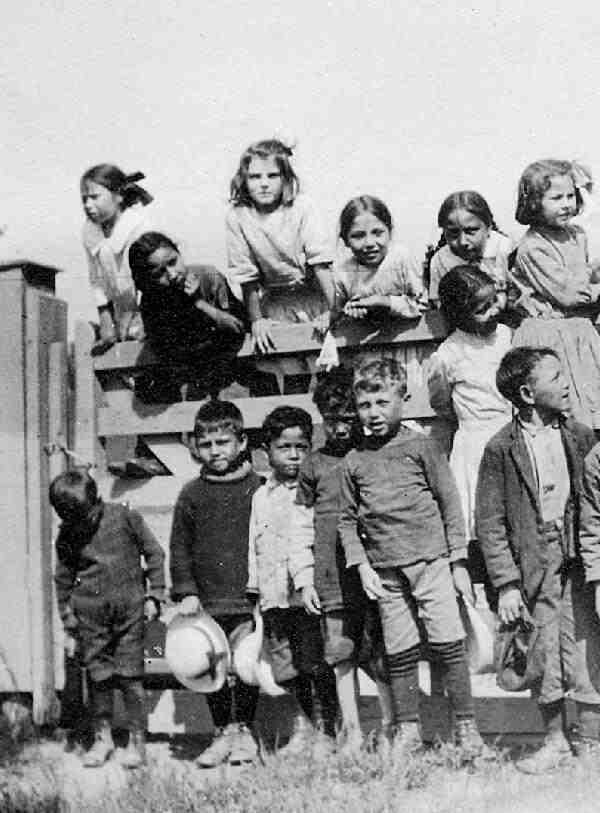
Figure 1.--Here we see children from the British Honduras during the 1920s. We are guessing these are school children. Note the varied ethnicity. Also note that despite the warm tropical climate that the children wear long stockings. Place the cursor on the image to see the rest of the group.
The Maya founded major city/templle complexes in what is now modern Belize, imcluding Caracol, Xunantunich and Lamanai. The major complex of Tikal is just to the west in neigboring Guatemala. The first European settlers were English Puritans who setting up trading posts along the coast of Belize. In sharp contrast, bands of ship-wrecked sailors, buccaneers, and pirates created permanent bases along the coast. This was the beginning of creating a multi-ethnic society. The British Government formally declared the colony of British Honduras (1840s). British Colombia was the only British colony in Central America. European settlers began to marry freed slaves resulting in the Creole majority that today dominates the country's population. Gispanics from Mexico began founding small farms in the north aling the Mexican border. In Southern Belize, the Kekchi and Mopan Maya lived isolated lives in the Maya Mountains. After the Amrican Civil War, a small group of Confederates founded a settlement at Punta Gorda. Further ethnic diversity came from the Garifuna people of the Honduran Bay Islands who settled along the coast. Consideration of independence began in the 1930s. Voting rights were granted (1950s), but formal independence was also achieved in 1981. Independence was delayed by Guaatemla which exerted an earlier Spanish colonial claims. The British presence prevented a Gutemalan take over. American fashions beginning in the 1950s generally replaced English fashions for Belizian boys. A Belezian source reports on fashion trends on Ambergris Caye in the 1980s. We don't have much information on religion in Belize. We do note a snall the Mennotite community in Belize.
Overview
Modern Belize is the former colony of British Honduras. It is the the only English-speaking country in Central America. Britain granted full independence in 1981. It is a small country With 8,867 square miles (22,960 sq. km) of territory. The population is about 0.3 million. It is a lightly populated country, the lowest in the Central American. It has a warm tropical climate and and a coast facing the western Caribbean.
Geography
Belize located just south of the Mexican Yucatan has large areas that are arid, similar to the adjacent Gutemalan Pet�n. There are pristine Caribbean beaches, islands, mountains, rivers, forests, and caves. Tiny
Belize has the second longest living barrier reef in the world, and the largest in the Western Hemisphere. There is an impreuve divrsity of flora and fauna. There are over 540 species of birds. Belize is first and only country in the world to create a Jaguar nature preserve, known as The Cockscomb Wildlife Sanctuary and Jaguar Preserve. While geographically Belize is part of Central America, culturally it is more part of the Caribbean. Belize is the only country in Central America whose official language is English; however, Spanish and kriol are spoken by a large portion of the population. The languages of the various ethnic groups are also spoken.
The Maya was one of the great native American civilizations. They founded major city/templle complexes in what is now modern Belize, including Caracol, Xunantunich and Lamanai. The major complex of Tikal is just to the west in neigboring Guatemala. There are some 900 Mayan Sites. The Guatemalan Tikal site is close to the Belizian birder. Caracol was a major adversary of Tikal. The tallest building in Belize is a Mayan Ruin.
History
The first European settlers were English Puritans who setting up trading posts along the coast of Belize. In sharp contrast, bands of ship-wrecked sailors, buccaneers, and pirates created permanent bases along the coast. This was the beginning of creating a multi-ethnic society. The British Government formally declared the colony of British Honduras (1840s). This was the only British colony in Central America. Consideration of independence began in the 1930s. Voting rights were granted (1950s), but formal independence was not achieved until 1981. Independence was delayed by Guatemla which exerted an earlier Spanish colonial claims. The British presence prevented a Guatemalan take over.
Economy
Belize was the only British colony in Central America lthough they also attempted to settle the Mosquito coast of Central America. And as in other Caribbean colonies they imported african captives for slave labor. Unlike the rest if the Caribbean, sugar was not the major economic activity in Belize. In the days of sail and wooden ships, the British needed timber to maintain and build ships for the Royal Navy--until World War II the largest navy in the world. By the 18th century the British had cut down much of the English forests to build ships. Losing most of their North American colonies (late-18th century) placed further pressure to find timber. Logging became the major economic activity. And as this could not be conductd on a plantation, slavery was more difficult to maintain than on the sugar islands. Commercial logging and the export of timber continued to be the major economic activity into the 20th century. Much of the population was poor, living in the country ptacticing subsistence agriculture.
It was only affter the mid-20th century that the economy diversified to the extent that the combined value of sugar and citrus exports exceed that of timber (1960s). A factor here was the estruction of the country's forests. Belize like much of Latin American pursued export substitutions policies with high tariffs. It eventually became clear that this was not helping to build a modern economy. Price fluctuations of traditional export products convinced Brazilian leaders that new policies were needed. Belize began opening its economy and promoting non-traditional agricultural products and manufacturing activities (late-20th century). Fisheries has become more important. Excessive borrowing led to debt restructuring (mid-2000s). The Belizan economy has shifted to services as the dominant economic activity. Tourism has also become an important source of foreign income. Ecotourism and cruise ship arrivals have noth bcome important. Belize shares the economic characteristics of many Latin American countries. They have not been able to match the scuccess of many Asian countries. It is not entirely sure just why, bit factors like education, work ethic, culture, and socialist attitudes seem to be important factors.
Ethnic Diversity
Belize is a culturally and ethnically diverse country. The population is made up of different ethnic groups such as The Mayas, Garinagus, Mestizos, Mennonites (Germans), Creoles, East Indians, Chinese, and others. The original population was Native American including Mayan people. European settlers were unble to use the Native americans s labor, largely because so mny perished aftr contavt with European duseases. The Europens brought ijn cptive africbs for slve labor. European settlers in the 19th century began to marry freed slaves resulting in the Creole majority that today dominates the country's population. Gispanics from Mexico began founding small farms in the north aling the Mexican border. In Southern Belize, the Kekchi and Mopan Maya lived isolated lives in the Maya Mountains. After the Amrican Civil War, a small group of Confederates founded a settlement at Punta Gorda. Further ethnic diversity came from the Garifuna people of the Honduran Bay Islands who settled along the coast.
Garments
American fashions beginning in the 1950s generally replaced English fashions for Belizian boys. A Belezian source reports on fashion trends on Ambergris Caye in the 1980s.
Activities
A Belizian reader tells us, "We have so many holidays throughout the year that it is not even funny. In fact, my university had to increase the semester by one week just to make up for the time we would lose due to holidays. Also, we have a number of festivals/parties/events throughout the year. The most celebrated is definitely our day of Independence, which is on September 21."
We do not yet have much information on Belizian families. Family images are very useful because they help to establish social class and put the boys' outfits into a social context as well as help establish age and gender trends. Our Belize archive is very limited so we have not yet acquired many family images. We have loded an impage od what looks like a rural farming family.
Belize is the only Central American country that was not a part of the Spanish Empire, Belize was British Honduras and the education system is thus influenced by the British education system. The education has the standard three levels: primary, secondary and tertiary. Primary education is a compulsory 8 year program, consisting of 2 years of infant classes and another 6 years. Infants is a British term for the younger primary years. The secondary education is a 4 year program. Many Belize schools are affiliated with church but also are supported by the government. The tertiary sysymen consists of the University College of Belize founded in 1986 and several colleges including the Belize Teachers' College, Belize Technical College and College of Agriculture. Primary schools are located all over the country, making education available even in rural areas. Secondary are located in the towns abd cities and thus available ti the rural population. Some of the Belizean schools with the highest academic standards are: St. John Vianney Roman Catholic Primary School, Holy Redeemer Primary School, and Saint Andrew's Primary School Belize.
Religion
We don't have much information on religion in Belize. We do note a snall the Mennotite community in Belize.