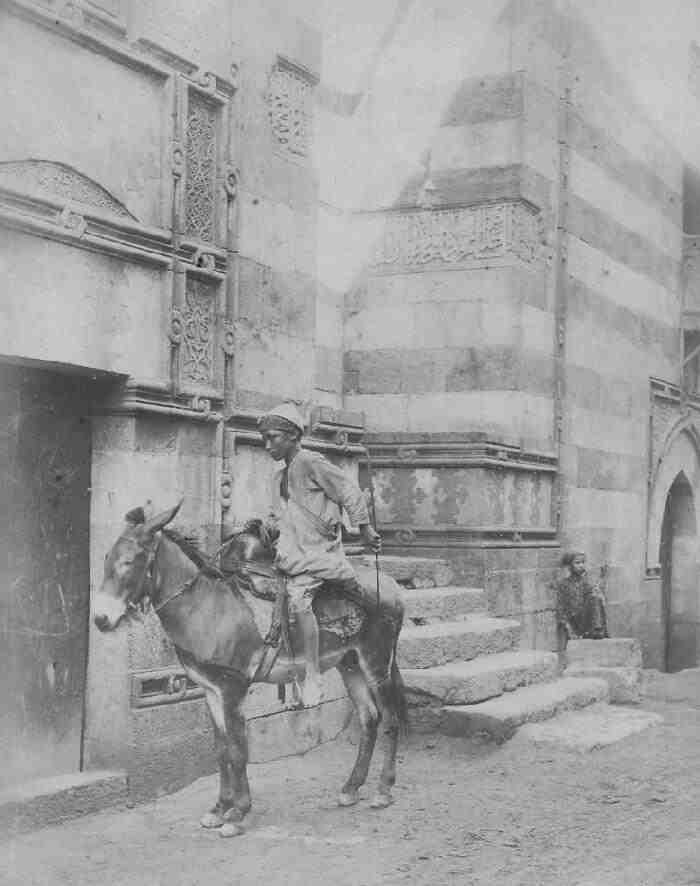
Figure 1.--Here we see an Egyptian boy on a donkey. The photograph was probably taken in the 1870s by a European photographer named Lekegian. We are not sure just where in Egypt the photograph was taken. Notice the Arabic language decoration. These early photographic images of Egypt probablycould have been taken centuries earlier.
Egypt is essentially a plateau divided by the Nile Valley into the Western and Easten Dessert. About 95 percent of the population lives in the Nile Valley and Delta. Egypt and the Nile are of course an important foundation of Western civilization. We have done some work on Ancient Egypt, but have virtually no information about modern Egypt. Egypt was conquered by the Arabs in the 7th century. At the time Egypt was largely Coptic Christian. The country was gradually Islamicized. Egypt is the most populace country in the Arab world. Traditional clothes appear to be still widely worn in Egypt, especially in rural areas. Until after World war II, traditional clothes were almost universally worn. Western clothes have gradually become more common, especially in urban areas. We hope that Egyptian readers will help provide some information on Egyptian clothing styles. As far as we know, traditional clothing are generalized Arab and not specificlly Egyptian styles.
Egypt is a country dominared by two geographic features, the vast Saharan Desert and the slender ribbon of the Nile River which slices through the desert. It is the water of the Nile tht is the lifeblood of Egypt. The Nile is Egypt's only renewable source of water. Egypt receives a mere 2.5 centimeters of rain annually. The Nile water varies seasonally. The Nile rises in the summer because of raims in the countries to the south like Ethiopia. The resulting floods in Egypt cover the river's valleys not only with water, but with nutrient-rich sediments which make Egypt one of the most fertile agricultural counries in the world. Egypt is commonly divided into two sections: Upper Egypt in the south and Lower Egypt in the north. Egyptian history is often a conflict between these two areas. The Upper and Lower names result from south to north. The river ultimately empties into the Mediterranean Sea. Egypt is essentially a plateau divided by the Nile Valley into the Western and Eastern Desserts. Southern Egypt consists of low mountains and desert. Northern Egypt has wider valleys long the Nile and desert to the east and west. North of Cairo is the Nile feeds into the extensive triangular Nile River Delta. This fertile agricultural land has thus been covered with farms for millenia. About 95 percent of the population lives in the Nile Valley and Delta. There are, however, small populations in the Eastern Desert (Sinai) and Western Desert (eastern Sahara) which wre trdiditionll nomadic Bedouins. Egypt is thus in a very real way synonamous with the Nile. It was here that Egyptian civilization developed and where the population is still largely concentrated. The Nile is the longest river in the world, originating in East Africa and running through the desert before emptying into the Mediterranean. The regularity of the seasonal rise and fall of the Nile provided the basis for the development of agriculture and as a result the great civilization of Ancient Egypt. Demands for the Nile water are invreasingg, including the upstream countries where the Nile origintes. And while the profuctivity of the Nile could fed the Egyptian pople and allow for exports, the Nile can no longer feed the emense modern population of Egypt.
Egypt and the Nile are of course an important foundation of Western civilization. We have done some work on Ancient Egypt. Mesopotamian civilization seems to predate Egyptian civilization. but the two developed in contact. Yje earliest known written date comes from an Egyptian calendar--4241 BC. Ancient Eguptian is divided into 30 dynasties, organized into the Old, Middle, and New Kingdoms (3400-332 BC). Menes united Upper and Lower Egypt establishing a united kingdom or the first time creating the first centralized Egyoptian state (3400 BC). He established the capital at Memphis. The decline of the Old Kingdom (25 century BC) resulted in an Egyptan dark age. The Middle Kingdom began with the XIth Dynasty which restored the unity of Egypt. The new capital was Thebes. The Middle Kingdom reached its peak of power about 2000 BC. The mysterious Hyskos conquerred the Middle Kingdom (1788 BC). They are a poorly understood people, perhaps of Semetic origins from the East. Egyptians rose up and expelled the Hyskos, establishing the New Kingdom (1580 BC). Internal divisions allowed the Nubians to seize power (712 BC) and there was abrief period of Assyrian dominance. Egyptiansgain exerted control (663 BC). The Persian Emperor Cambyses conquied Egypt (525 BC). Egyptians again exerted control (405 BC). After smashing Persian armies, Alexader seized control of Egypt with little opposition (312 BC). After Alexanders meteroic career, his generals divided his empire. Ptolemy established an Egyptian kingdom based at Alexanfria. Octavian after the Battle of Actium, annexed Egypt to the Roman Empire. After the rise of Christianity, Egypt became Coptic Christian. At times Byzantium exerted cointrol over Egypt. The Arabs conquered Egypt (639-642 AD). The country was gradually Islamicized. The Fatimite family seized control of Egypt who made Cairo the new captal (10th century). Saladin founded the Ayyubite Dynasty during which the Mamelukes seized control of Egypt (1250). The Ottomans conquuered Egypt (1517), but by the 18th century was only nominal. Napoleon invaded Egypt to sever British links with Indua (1798). The French were expelled by Anglo-Turkish forces (1802). Mohammed Ali rose to power as the Ottoman Pasha (governor) (1805), butvgradually exerted independence from the Ottomans. He founded a dynasty that ruled into the mid-20th century. The construction of the Suez Canal by a British-French group made Egypt of great strategic impotance. The British made Egypt a protectorate. British military forces during World War I fought off an Ottomon offensive (1915) and then launched an offensive into Palestine thatv helped destroy the Ottoman Empuire. After the War, the Wafd Party agitated for independence which the British granted (1923). Faud I was Egypt's first constitutional monarch. An Anglo-Egyptian Treaty addressed the comolete withdrawl of the British (1936). This was delayed by World War II and an Italuan invasion (1940). The Western Desert became an important battlefield of the War with the entry of the German Afrika Korps. The British defeated the Afrika Korps at El Alemaine (Octover 1942). There was consideravle support for the Axis among Arab natioinalists. Egypt did not declare war on Germany until late in the War (February 1945) and after the War offered refugeton NAZI war criminals. After Isrrael declared independence, the Egyptian Army invaded and Egyptians were shocked with Israel's ability to resist. Army officers expelled King Farouk I (1952) and G.A. Nasser soon exerted his dominance. Nasser seized control of the Suez Canal. The British, French, and Isreali response is called the Suez Crisis. Egyptians were again shocked with the Isrealis defeated the Egyptian Army in the Siani.
The Egyptian economy has been based on agriculture and centered on the Nile. Agriculture generated on civilization in the Mile Valley and was based on grain. In modren times cotton became an agricultural mainstay. Land is very expensive because of the large population and limited area of arable land outside the Nile Valley. The country had a very high population growth rate--over 2 percent annually (2003). As a result, Egypt which used to be a major grain exporter, mow has to import food. The government has developed the petroleum, services, and construction sectors, but for the most part Egyptian industry is unproductive. The basic problenm is that most industries are government-owned are controlled. This is in part the consequences of Egypt's experiment with Arab socialism on which Nasser embarked. There have been efforts to liberalize the economy, but it has made only limited progress. Despite resources committed to indusry, at the expense of agriculture, the country indusrial sector is inefficent and uncompetive. Another major problem is the country's huge beaureacracy which consumes a large share of available resources. Egypt has obtained foreign aid from both the Soviet Union nd the United States. The Gulf states which and the United States rewarded Egypt for helping to form the First Gulf War coalition. There are also foreign exchange earnings from Suez Canal traffic, tourism, and the remittances of Egyptians working abroad. Despite this Egypt has made little progress in developing a modern economy. Despite bering the largest Arab nstion and a substantial educational system, Egypt produces few scientific papers and achieves no medical advancment. Nor is their an industrial sector capable of competing on the international market.
Egypt has one of the longest recorded histories of any country because it was one of the original river valley civilizations. The Nile Valley was, however, settled before the development of civilization an recorded history. One source of information on this ealy era is the etnicity of the Egyptin people. We are sure, for example, jusy how the indeginous people of the Nile Valley differed from those of Mesopotamia. DNA research opens up newv avenues of resaerch. The population of Egypt is highly concentrated in Nile valley and the delta. The population there is largely homogeneous which includes the indigenous population of ancient Egypt mixed with the Arabs folloewing the Islamic invasion (7th centurry). Modern Egyptians define themselves as Arab, but this is more of a cultural and linguistic afinity than ethnic similarity. There is some variation in the northern delta cities like Alexandria. Here foreigners (Persians, Romans, Greeks, European Crusaders, Turks, and Circassians) have mixed with the indigenous population. This can be seen in individuals with blond and red hair, blue eyes, and lighter complexions which are more common than in the general Egyptian population. The rural population or fellahin are less likely to have been affected by the foreigners in the northern delta. Throughout the Nile Valley the population is relatively similar. The Sa'idi (Upper Egyptians) live in the area south of the Delta, from Cairo to Aswan. They are ethnically and culturally little different from the people of Lower Egypt (south of Aswan). In the extreme south, Nubians do differ etnically and cultutally from other Egyptians. They have ethnic features of sub-Saharan Africa. Here there are many variatiojs. The Nile is an important transportation route ans thus there has been considerable mixing of population. This is why the general Egyptian population is so homogeneous. The Saharan Desert extends from the Nile west to the Atlantic. In Egypt it is referred to as the Western Desert. The Western Desert includes an ethnically destinct people. They were once nomads, but many have now settled down. There is also an even smaller population in the Sinai. Some of these people are of non-Arab ethnic groups, but many are ethnic Atabs whose ancestry date from the Arab conquest.
Modern Egyptians are a fusion of many different people. There is the original Egyptian people centered on the Nile Valley. Africans, Berbers, Greeks, Jews, Persians, Romans, and other mixed in relatively small numbers with the large Nile Valley population. After the Islamic invasion (7th century), Arabs and to a lesser extent Turks added to the Egyptian ethnic base which is today culturally and ethnically relatively homogeneous. There are some minority groups, but not all are ethnic minorities. Some are linguistic and religious minorities. The most important are the Christian Copts who are under increasing pressure from the Muslim Arab majority. There was a small Jewish minority which predated the Islamic era. Egypt expelled it Jews after Six Day War (1960s). Two other linguistic minorities are small communities of Armenians and Greeks, mostly located in Cairo and Alexandria. There is a Bedouin minority centered on the oases of the Western Desert and to a lessert extent the Sinani which is under pressure from the governmebnt to assimiate into the country's settled population. Many have done so in recent years. Nubians live in the cities of Lower Egypt and in villages along the Nile of Upper Egypt.
Few countries have a longer history than Egypt. And a great deal is known about clothing in Egyptm, even in ancient clothing. In fact we known more about clothing in ancient Egypt than during the Islaic period until modern times. Clothing in ancient Egypt was almost always linen which is made from flax. Clothes were made of linen because flax was the only plant growing in Egypt that was used for clothing. The actual weaving of linen fabric was done on a loom, usually by women. Textile manufacture and dressmaking were actually the only areas of the economy that remained predominantly in female hands. White linen needed constant washing. It was washed in the river or canal, rinsed, then pounded on a stone, and, bleached in the sun. Linen clothes needed to be repleated every time they were washed. Important Egyptians were often depicted with pleated skirts. Only high status individuals had pleated clothes because the pleating process involved so much labor. Pleating required pressing the linen into grooves on a wooden board and letting it dry. The most interesting feature of Egyptian clothes is that styles changed so little over the long sweep of Egyptian history. Since there were no new styles, Egyptians took great pride in keeping themselves and their garments immaculately clean. Of course clothing is affected by climate. We do not know much about clothing during the early Islamic period. As best we can tell, however, the ankle-length robes commonly worn in Egypt even today date from medieval times. After the Arab conquestt and the onset of the Islamic period, clothing becomes more difficult to follow because od the Koranic prohibition on pictoral depictions. These garments seem little changed for more than a millenia. With the spread of photographuy into the Middle East we begin to learn more about Egyptian clothing (late-19th century). We begin to see Western dress among the affluent in the cities during the early-20h century. Traditional clothing continues to be very common.
Egypt is the most populace country in the Arab world. Traditional clothes appear to be still widely worn in Egypt, especially in rural areas. Early photographic images of Egypt in the 19th century suggest a country where fashion was little chnged for centuries. Traditional clothing was essentially the same for men and boys without age detinction. This is indicative of a society thast was little changed. This despite the fact that the 19th century was a time of dynamic change in Europe. This is more than a fashion curiosity. One must ask why Egyptian society along with that of the wider Arab world did not change for centuries. Traditional clothing is in effect a way of viewing pictorially deepler trends in society. Arab nationalists want to blame the West rather than look at their own society, but in Egypt Britain did not install a protectorate until the 1880s. Traditional dress still doiminated Egypr in the early-20th century, but we do begin to see some Western dress, almost entirely among the upper classess. This was favilitated by the opening of schools based on modern, largely Western curriclum. Until after World War II, traditional clothes were almost universally worn in rural areas. We see Western dress being more commonly worn in the cities and the mniddlke class. Western clothes have gradually become more common, even with the lower-classess. Today we see many children wearing Western clothing, even in rural areeas. We hope that Egyptian readers will help provide some information on Egyptian clothing styles. As far as we know, traditional clothing are generalized Arab and not specificlly Egyptian styles.
We have very limited information on activities pursued by Egyptian boys. Until recently the Egyptian population was primarily rural. And the primary activity in which children were involved with was rural farm work. Early photographic images of Egypt mostly show children working. Relatively few boys went to school until after World war II, Few boys and almnost no women were educated. The only schools that seemed to have functioned until the 20th century were Islamic madrrassas. Our information on Egyptian education, however, is very limited. Large number of Egyptian children and youth are now being educated, but standards are very low. We note large numbers of Egyptian youths receiving university degrees, but we notice no output of scientific literture or other indicators of actual scholarly achievement or technological accomplishment. The results are extroninarily high unemplyment rates among university graduates. There is a small Scout movement, but we know very little about other youth groups.
Egypt over milenia developed one of the most significant and enduring religious systems in history. It did not, however, spread outside the Nile valley. Egyptian religion continues to fascinate historians more than any other religious system. Egypt was conquered by many foreign sarmies, but the traditional religion enfured into the modern era. It did not begin to disappear until after the Roman conquest when Christianity became the religion of the Empire. Christian religious concepts began widely accepted in Egypt as the Coptic Church formed. The Copts were at odds with Byzantine orthodoxy. Byzantine religious anbd civil authorities attempted to stamp out what was seen as heresy. This is one reason why Arab armies were able to defeat the Byzantines in Egypt (640-42 AD). At the time, the Coptic Church was very widespread. Over time Egypt became Islamicized. Over 90 percent of the Egyptian population is Muslim. There is a Christian minority of about 5 percent of the population. There was also a small Jewish population, but since the Isreael-Palestine wars, the Egyptians expelled the Jewish population, first stripping them of their property and valuables. The dominant strain of Islam is Sunni.
We do not have much information on Egyptian families yet. We have some information on ancient Egypt, but then vurtually nothing until Europeans brought photography to the Middle East in the second half of the 19th century. They set up in the cities and thus you see portraits of the urban population including Europeans who settled in Alexandria and Cairo. Many urban Egyptian families adopted Western dress. We do not see many portraits of the rural population -- Fellahin. They were the great bulk of the Egyptian population. They were both fully Islamicized and retained many conservative traditional values. We see families that show no sign of change since the days of the medieval Caliphate. Few ever entered a photographic studio, especially with their families. Some of the early European photographers took posed ethnographic photographs for sale in Europe. We begin to get some more family photographs with the appearance of the anapshot (20th century). Most at first were taken by tourists. And we gin to see more studio portraits, but at first only of the rather modern looking urban population. The countryside and the familes there appear little changed. We only begin to see subtantial changes well after World War II.
Enviromental Issues
Egypt's population in recent years has skyrocketed. The population at the end of World War II was less than 20 million people. While Arabs like to blam the West for their ills, Westrn tchnology has significantly reduced the death rate in Arab countries. And as a result, Egypt's population is now approaching 90 million people and will soom be 100 million. Despite this increase, the Egyptian economy as an independent country hs not expanded. Political and religious leaders have focused on what they see as Western imperialism and the West. After dallying with the NAZIs, President Nasser moved toward the Soviets and Arab socialism. both were failures. And the Egyptian economy little changes from ancient Egyot is based on the bounty of the Nile. The great bulk of the population lives in tge Nile Valley or Nile Delta. Many farmers continue to use methods dating back to ancent times. Thus crop yields have not changed to fed a burgoning ppulation. Egyot which was once the bread basket of the Mediterranean, now has to import food to feed its people. Unlike neigboring Israel, Egypt has not adopted technologies to turn arid regions into productive land. They have not even adopted the technologies developed by Israel. And if all of that is not bad enough, the situation in Egypt is likely to get even worse. Soil compactation and saltwater intrusion are both affecting Egyptian agriculture. To the south, overfishing and illconceived devlopment projects are affecting the Red Sea ecosystem. Efforts to expand agriculture into marginl land have unlike Israel, used poorly conceived, unsustainable methods. The result has been soil erosion an expanding desertification. And even worse further south, other countries with which Egypt shares the Nile are planning to take a greater share of the water before the river reaches Egypt. Egyptian Hovernments have largely ignored these problems are responded inefectully.
Within months of Louis Daguerre announcing the invention of photography (1839) two Frenchmen, Horace Vernet and Fr�d�ric Goupil-Fesquet, were making daguerrotypes in Egypt. They focused on the great archeological monuments. It was not, however, until the development of the almumen process, that we see ny number of Egyoptian photiograophs (1860s).
The first important Egyptian photographer was the Armenian immigrant, G. Lekegian. He created msany important images depicting Egyptian life in the late-19th century. Zangaki, a Greek photographer active in Cairo, roiduced nany ethnographic imnages during the 1860s-80s. The Bonfils are also noted for ethonographic photography.
We have not found many early oportraits. Many early photographers focused on archeological and ethnographic photographs. In an age before movies, television, and magazines printing photographic imnages, there was a market for images of foreign coyntries. Egyotian images were sought after because of its fascinating history. With the 20th century we begun to find many studio portraits often oprrated by Europeans. Quite a few studios used a paper with a matte finish that had an irregular finish. We are not sure just what to call this portrait paper. It was also populsr un Greece nd Yugoslavia.
Art
Egypt has a rich artistic tradition. We know a great deal about ancient Egypt because of the ancient art work left in tombs and other places. This art work is some of the earliest representations of clothing and other cultural artifacts. The artists are unnamed, but their accurate depictions are extremely detailed.
There is also art from the Roman period. This artistic tradition was ended with the Islamic invasion (7th century). Islam brought new art forms like caligirophy. Islamic prohibitions on human representations meant that Islamic art provide no real information about clothing and life style for more than a miklenium. European artists provide some 19th century images. A good example is English artist Frederick Goodall.
Individuals
We do not yet have much information on individuals in Egypt. We incourage Egyptian readers to write to us about their boyhoods so we can archive accounts here. We do note a book published in France about a boy named Faouzi in the 1960s.