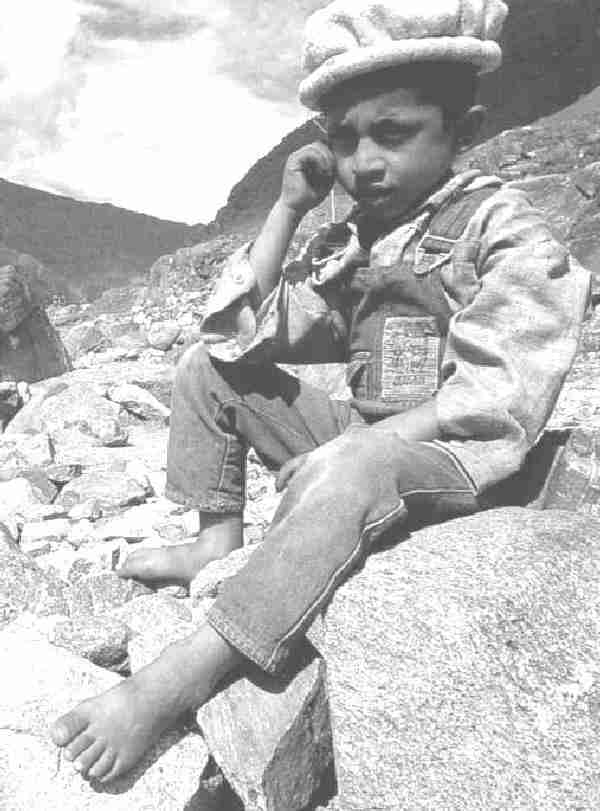
Figure 1.--One often seens a mixture of clothing in Pakistan today, bnioth Western and tarditional styles. This boys wears a traditional cap with Western overalls. |

|
We have few details about Pakistani boys' clothing at this time. We do note boys in the rural areas, especially in the tribal areas along the Afghan border wearing caps like those worn in Afghanistan. I'm not sure what these caps are called. British fashion have been influential in Pakistn, especilly among the more affluent and in the larger cities. American fashion also has had an impact, especilly jeans. The resurgence of fundamentalism has had some impact on fashion. Even in remote areas, however, we often note a mixture of traditional and western styles. One tradition garment is the three piece salwar kameez. The kameez and vest are often beautifully embroidered. They are commonly made in various colors, including pale blue, khaki, chocolate and grey. Styles vary especially the length of the vest. Hopefully our Pakistani readers will provide us more detailed information on boys' wear in their country.
Pakistan lies along the northeast Arabian Sea, the western arm of the Indian Ocean. The country in the north reaches to the Paamirs and Hindukush. The country is built around the rivers that runs down from these mountains to the Arabian Sea. This means the Indus River and its tributaries. The Indus of course is the river than gave India ts name. The Indus is was one of the four great river valleys that gave rise to civilization, in this case Harappan civilization. Much of the land that the Indus runs through is arid. Pakistan may look small on the maps compared to larger neigbors, but is considerably larger than mostly European countries. The major regions are: 1) the western offshoots of Himalayas divided into several smaller regions (north), 2) the Balochistan plateau (west), 3) The Punjab, and 4) the Sindh (south). The Indus plain which cuts through the center of the country is the most fertile and densely populated area of the country. The Indus empties ino the Arabian Sea near Karachi, the country's largest city. Pakistan has a varied climate, primarily based on alditude. The moutaneous north covers north and north western high ranges. The climaate is cold in the winter with very pleasant summer temperatures (April-September). The plains created by Indus valley can be very hot in summer with a cold and dry during winter. The southern coastal strip has a moderate climate. There is generally low precipitation rates throughout the country. Pakistan relies on the Indus running down from the mountains for its rivers. The rains that feed the Indus and its tributaries are monsoonal aand heaviest late in summers. The monsoon is the seasonal wind of southerrn Asia blows from the southwest in summer, bringing heavy rains, and from the northeast in winter. The towering Himalayas block the wind and catches the humidiity and resulting rainfall from the Indian Ocean.
Pakistan is a modern creation, one of the two succesor states to follow the British Raj (1947). Pakistn was formed as a Muslim state. The history of the Indus Valley and Islam on the sub-continent goes much further back. The Indus Valley is one of the great centers of civilization (2500-1700 BC). The Indus Valley was isolated by the Himalyas, but there were sea contacts with great Middle Eastern civilizations. Alexander's army entered the Indus Valley and it was here the Army forced Alexander to stop his conquests. A Helenistic influebnce was added to the areas cultural heritage. A series of foreign invaders (Aryans, Persians, Greeks, Mogols, Arabs, Turks, and others) controlled the region for over a millenia. Islam was introduced (711) and competed with the majority Hindu religion. A Mongol people estanlished the Mogul Empire and many became Muslims, especially in thr north eastand west (modern Pakistan and Bangledash. The Mogols ruled most of the subcontinent (16th-17th century). With the arrival of he French and British, Mogol power was already declining. The British became the dominant power and after the failed Sepoy Revolt seized control of the administration of the sub-continent (1857). This period became known as the British Raj. The British built a modern infrastructure and an educational system which provided the leaders of the independence movement. Gradually an independence movenment dominated by the Congress Party developed. Congress included all elements of Indian society, including Hindus, Muslims, Sikhs, and others. Muslim elements in Congress were concerned about their minority status. This had several roots. Muslims had ruled India for centuries and were concerned about life in a majority Hindu state. Islam is a religion that evolved in socities where Muslims controlled political power. In addition. conversion to Islam had been most successful among lower-class Indians who faced descrimination in an India governed by caste-conscious Hindus. This dymamic led to the formation of the nationalist Muslim League by Mohammed Ali Jinnah (1906). The independence movement let by Ghandi put increased pressure on British authorities. The rising influence of the Labour Party in Britain pushed self rule and eventual independence. The Muslim League supported Britain in World War II. Conress under Nehru and Gandhi while refusing to rise against the British, refused to support the British war effort. After World War II, Britin decided to grant India independence. Congress wanted a united Indi--all of the former Raj. Jinnah and the Muslim League demanded a separate state. Eventually to avoid comunal rioting Cngress acquiesed in partition along religious lines (August 1947). Jinnah was appointed governor-general. The partition of Pakistan and India along religious lines resulted in the greatest mass-migration in human history, involving 17 million people and unfortunally the communal violence Congress had hoped to avoid. And a series of wars between India and Pakistn over Khasmir followed (1949, 1965, 1971, and 1999). Pakistan declared a republic with Maj. Gen. Iskander Mirza as the first president. This began an era of military rule, in part because of the on-going military confrointation with India. Military rule prevailed for the next two decades. Tensions between East and West Pakistan existed from the creation of Pakistan ad finally outset and finally Begali nationalists declared independence (1971). Limited representative government was restored (1988). Bhutto's daughter and long-time Zia opponent, Benazir Bhutto, became Pakistans prime minister, a novely in a Muslim state. Political instability followed, in pat because of the rising influence of Islamic fundamnentalists. Gen. Pervez Musharraf seized control and formed another military government (1999). Pakistan today is increasingly seen as a failed state with rising levels of violence and abject poverty. The poverty and failed economy of Pakistan stands in sharp contrast to the rapidly expanding economy of modern India which has embraced democracy, plurlism, free market, and the rle of law. Islamic fundamentalists in defiance of the obvious evidence claim that Pakistan's failure is the result of insufficent devotion to Islam and this appears to resonate with many young Pakistanis.
Modern Pakistan is a South Asian country that was established in 1947. Its is suronded by India, Iran, Tajikistan, Afghanistan, and China. It also has an Arabian Sea (Indian Ocean) coastline. The interior is dominanted by the Karakoram and Pamir mountains in the northern and western highlands of the country. This includes K2 and Nanga Parbat which are counted among the highest peaks in the world. The major cities are Quetta, Gawadar, Peshawar, Sialkot, Multan and Faisalabad. Agriculture dominates the economy amf most of the arable land is in the Indus River valley. This was the center of the little known Indus Valley civilization. We have little economic information on these people or the many kingdoms which followed until the conquest ofvthe area by the Moguls led by Barbur (16th century). This was about the same time that the first European traders reached the sub-Continent. The Mpgul Empire was incredibly wealthy and productive. The early Mogul emperors were open and tolerant, the economy and trade thrived. The Miogul Empire was richer than any European country and on a compatavle economic plane. The greatest Mogul ruler would prove to be Baber's grandson Akbar, one of the great statesmen of world history. The Moguls brought Islam to Hindu India, but a tolerant, open version in which trade and scholarship flourished. The enlightened tolerant Mongul rule ended with Aurangzeb (17th century). He was intolerant of other religions and in the wars that followed, the Mogul Empire receeded as did the economy of the sub-Continent, allpwing the Europeans, especially the British to seize control. And what became known as the Raj became technologically backward. The British helped developed modern infranstructure and schools. Sibce achieving independence, Pakistan has made little progress in developing a modern economy. This has been impaired by both nationalist disputes with India over Khasmir and Islamic religioous fanaticism. Pakistan's leaders persist in military adventures and now terrorist attacks to revover Khasmir. Like the later Moguls, Islamic fanaticism and intolerance has proven terribly distructive. Pakistan has, as a result, failed to enter the modern world. Technology is almost completely imported from the West. And for some reason few Pakistanis asked themselves why this is. Education is poorly developed and often consisting of religious indoctrination. As a result there are no Pakistanis that can report any scientific achievements, unless they leave the country to sudy amd/or work in the West. Little girls who dare to speak openly are shot in the head--Malala Yousafzai. There is vurtually no foreign investment because of the high level pf violence and religious fanaticism. Pakistani businessmen seek markets in the West, utilizing the low wages prevalent in the country, but at the same time many harbor virulently anti-Western views and the country harbors terrorist like Osama bin Laden. Workers unable to find work in their own country flee to more modern countries and support their families through remitences. And what is truly amazing is that most Pakistanis have no idea that they lived in a failed coury or why. Most cling to blamin Britain or America or the lack of Islamic devotion.
Pakistan as originally constituted consisted of two parts (1947). There was West Pakistan and East Pakistan which were located in the northwestern and northeastern corners of the Indian subcontinent. This occurred because these were Muslim majority areas. They were separated from each other by more than 1,000 miles (1,610 km) of Indian territory with Hindu morities. East Pakistan as a result of the Civil War became the independent state of Bangladesh (1971). West Pakistan became the
current state of Pakistan and is composed of four provinces: Baluchistan, Khyber Pakhtunkhwa (formerly known as the North-West Frontier Province), Punjab, and Sind. They are basically historic regions. While this is the bulk of the country, the regional makeup is a little more complicated, first because of the largly autonomous tribal areas (in the Khyber Pakhtunkhwa). There are also two federal territories. One is the capital at Islamabad. The other is a federally administered grouping known as the Tribal Areas along the central Afghanistan border. The Tribal Areas are essentially autonomous, with limited centrl government presence. They are governed largely by tribal traditions and traditional councils. Pakistani-controlled Kashmir is divided into the Northern Areas (Gilgit-Baltistan) and Azad Kashmir.
Pakistan is the world�s sixth most populous country, but a minor country in terms of area. The population has surpassed the 200 million person mark. The land area, however, is only 0.8 million km2, making it merely the 36th largest in the world. This makes Pakistan one of the most debsely populated countries in the world.
This is especially the case as large areas of the country are extremeky arid or rugged mountains, making thepopultion more dnse in the more favorably endowed areas. Pakistan is only relatively small sliver of the Indian subcontinnt, but is the cradle of several ancient cultures, the most important being the Indus Valley people. Pakistan's geographic location neans that is mny diffrent people settled in or passed through b its territory. It was a connectuon point foe the Middle East, Asia, bd the Sub-continent. The gamed Lyber Pass through the mointains is located in Pakistan. This explains a diversity of language and ethnicity.
Pakistan has been ruled by several dynasties and empires including Mauryan, Achaemenid, Mongol, Mughal, and Delhi Sultanate. There are over 60 languages spoken in the country. Urdu is the official national language, and a symbol of national unity understood by 80 percent of the population. There are six major ethnic groups and several other small minorities. Yhe Punjabi people are the largest ethnic group, constituting nearly 45 percent of the population.
We have few details about Pakistani boys' clothing at this time. We do note boys in the rural areas, especially in the tribal areas along the Agghan border wearing caps like those worn in Afghanistan. I'm not sure what these caps are called.
British fashion have been influential in Pakistn, especilly among the more affluent and in the larger cities. American fashion also has had an impact, especilly jeans. The resurgence of fundamentalism has had some impact on fashion. Even in remote areas, however, we often note a mixture of traditional and western styles. One tradition garment is the three piece salwar kameez. The kameez and vest are often beautifully embroidered. They are commonly made in various colors, including pale blue, khaki, chocolate and grey. Styles vary especially the length of the vest. Hopefully our Pakistani readers will provide us more detailed information on boys' wear in their country.
We have little information on boys activities in Pakistan. Religion is a very important factor in the lives of many Pakistanis. The country is a predominsately Muslim country. We have very little information about the fine arts. We do note an ancient tradition of the dancing boys of Peshawar. Sport is not as popular in Pakistan as in many other countries. This is oftren the case in predominately Muslim countries. There is some interest in cricket. This seems most common with Pakistanis more affected by British traditions. We have developed some limited information about Pakistani schools. One concern in the war on terror is the Islamic madrassas which education large numbers of Pakistani children.
Pakistan has an imprtant textile and clothing industry. It is one of the largest employers in the country and a major export industry. Pakistani companies are agressive exporters and have contacted HBC concerning many of the clothing items we discuss on our website. Concerns have been expressed with the industry for both the use of child labor as well as various enviromental issues. Some industry representatives are concerned about the industry's future. The industry has failed to address Western concerns over child labor and environmental problems. The industry has also been slow to upgrade technology. Some individuals are also concerned about the World Trade Organization (WTO).
The Scientists' Club organized a seminar (June 2004) during which Dr. Abdul Hayee Qureshi, a scientist at the Pakistan Agricultural Research Council told participants that the expectations with which developing countries like Pakistan held for the WFO may be achieved after the final termination in 2005 of Multifibre Agreement (MFA). The Agreement on Textiles and Clothing (ATC) was scheduled to replace the MFA in four stages over a 10-year period. Dr Qureshi charges that the categories of items whose exports might have benefited the developing countries were left out almost completely. Qureshi is concerned that after MFA expires that developed countries might try to impose a myriad restrictions in the name of environment, labour standards, child labour, human rights, eco-labeling etc. He noted that Pakistan still lacked accreditation laboratories in this regard. Dr Qureshi expressed concern over the havoc played by indiscriminate application of pesticides, especially in cotton farming, which have already poisoned our environment to the point where many species of beneficial organisms and birds had been wiped out almost completely. [Iqbal] Industry sources object to pressure from developed countries to address such environmental issues and child labor, there appears to be little domestic commitment to addressing them.
HBC has corresponded with a number of Pakistanis have have been astounded by the level of ignorance and support for territism prevalent in the country. And here we are not talking about those radicalized by the madrassas, but English speaking Pakistanis that have been educated in state and private schools, many active in the business community. Many have contacted HBC with an interest in exporting to America. Yet when questioned they express a deep-seated hatred for America. We have decided to load their hate-filled messages here to provide a window on Pakistan for those of us in the rest. And keep in mind that the people here are the same who will tell you that Islam is a religion of peace and tolerance.
We do not yet have much information on individual Pakistanis. We do know of one brave little Paistani hero girl--Malala Yousafzai.
Iqbal, Asig. "Textile exports future bleak", Textile News & Updates June 2004.

Navigate the Boys' Historical Clothing Web Site:
[Introduction]
[Activities]
[Biographies]
[Chronology]
[Cloth and textiles]
[Clothing styles]
[Countries]
[Topics]
[Bibliographies]
[Contributions]
[FAQs]
[Glossaries]
[Images]
[Links]
[Registration]
[Tools]
[Boys' Clothing Home]
Navigate the Boys' Historical Clothing national pages:
[Return to the Main countries page]
[Afghanistan]
[Bangladesh]
[China]
[India]
[Iran]
[Kazakstan]
[Kyrgystan]
[]
[Tajikistan]
[Tibet]
[Turkmenistan]
[United Arab Emirates]
[Uzbeckistan]
[England]