|
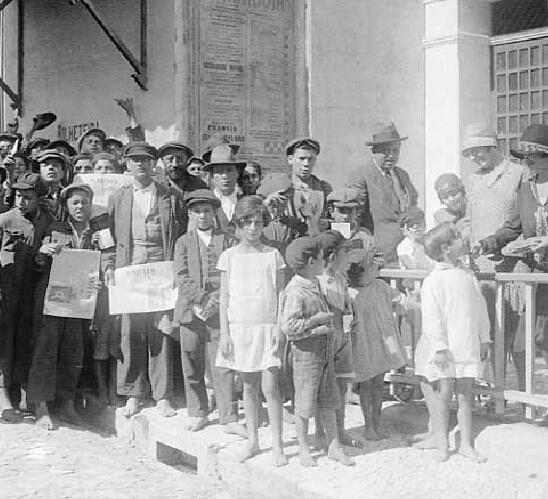
HBC has been unable to acquire much information on Portugal. We assumed that the was considerable similarities with Spain. One HBC reader reports visiting Portugal in the 1960s and was surprised how the country contrasted with Spain. He felt that the children were not as well looked after or as well dressed as in Spain. The boys wore long shorts or long trousers. One reader reports tht it was very common for Portuguese boys to go barefoot. This presumably reflected the fact that for much of the 20th century, Portugal was a very poor country. The Lisbon town council in 1928 forbade going barefoot in the city. In the photo here we can see a free dispensation of canvas shoes, in order to encourage the use. However a lot of Lisbon inhabitants ignored the town council decree for many years, especially the women and the children. Out of the capital, especially in villages and in the country, the children (and sometimes also the women) went usually barefoot until some decades ago. An Italian reader tells us, "I visited the north of Portugal in September 1979. Except in the towns (Porto and Braga) all the children were barefoot." Since Portugal has joined the European Community, there has bee tremendous economic growth. We suspect that clothing styles are now very similar to those in the rest of Europe. Hopefully our Portuguese readers will provide us some information so we can expand our coverage. We do, however, have a Portuguese-language glossary. We do not have a Portuguese art page yet, but we note one Portuguese artist, Carlos Reis.
HBC has been unable to acquire much information on Portugal. Hopefully, Portuguese readeers will provide us some information to develop this page.
Portugal's geography is dominated by the Atlantic Ocean and is the reason why Portugal became an ocean-bound country setting the stage for centuries of European sea adventure and discoveries. Portugal shares the Iberian Peninsula with Spain. Much of Iberia's Atlanic coast is Portuguese. There are considerable cultural and linguistic affinities. We assumed that the was considerable similarities with Spain. One HBC reader reports visiting Portugal in the 1960s and was surprised how the country contrasted with Spain. He felt that the children were not as well looked after or as well dressed as in Spain. The boys wore long shorts or long trousers. One reader reports tht it was very common for Portuguese boys to go barefoot. This presumably reflected the fact that for much of the 20th century, Portugal was a very poor country.
Portugal is one of the two modern countries that has emerged from the many small kingdoms that appeared on the Iberian Peninsula after the fall of the Roman Empire and the Germanic invasions. The situation was further complicated by the Morrish invasions of the 8th century and the 600 year war between and among Moorish and Christian kingdoms which did not end until the fall of Grenada in 1492. Portugal in fact was born from this struggle to reconquer Iberia from the Moors and the first Portuguese king was the son of a French nobel. Portugal in the 15th century burst on the European stage as the country leading the great European voyages of discovery. Here Prince Henry the Navigator was a leading figure in making Portugal a leader in maritime technology. This allowed Portugal to acquire great wealth through trade and an create an expansive empire. The corosive impact of the Inquisition on thought and discourse including the expulsion of the Jews caused a long period of decline during rich Portugal became a European backwater and one of the poorest countries in Europe.
We do not know much about the Portuguese economy in ancient times. All of Iberia was part of the Roman Empire. After the fall of Rome, the Iberian Peninsula was overwealmed by the Germanic tribes and became part of the Visagoths (Germanic tribe) seized control of the region as the Roman Empire fell (5th century). Portugal at the time did not exist as a separate kingdom but was just part of the Visigothic kingdom. We do not know much about the economy under the Visigoths. The Visitogothic ruling class lived apart and heavily taxed the Hispano Roman population. The Moors overwealmed the Visigoths (8th century). Again the economic picture is not fully understood. As the Reconquista began (8th century), the Iberian Peninsula is often described as an economic and cultural bright spot of Europe. We are not sure about Portugal specifically. As European maritime techhnology and geographic understanding grew, Portugal as the most westerly country in Europe had a great advantage. The same Islamic outburst that brought the Moors to the Iberian Peninsula, had created the Caliphate in the Middle East and later the Ottoman Turks. This imposed Islamic states between the East and the West, curtailing trade. Prince Henry the Navigator championed a maritime outreach to reestablish trade with the East. Success came with the Portuguese rounded the Cape of Good Hope (late-15th century). The result was great wealth and a vast colonial empire. At roughly the same time this occurred th Jews were expelled and the Protestant Reformation rocked Europe. The Portuguese response like that of Spain was to intensify the Inquisition. The resulting supression of intelectual thought led both Portugal and Spain to become European backwaters just at the time that intelectual fermant and economic expansion was remaking Western Europe. Both Portugal and Spain beneffitted from overseas empires, both the expanding trade and resources of the colonies. Spain obtained large quantities of gold and silver. The Portuese did not find the bullion they soufght, but in addition to the expanding trade with the East they were able to obtain slaves, sugar, and other goods. Neither country (Portugal or Spain) profited as one might expect. Here the Inquisition and stifeling of free thought was a factor. Funding overseas voyages abnd building empires was expensive. The Crown and others in both countries had to borrow heavily from banks in Italy and Germany. While the loans from Jews could be canceled by eliminating the Jews, this was not possible with Christian bankewrs. And large quantities of the income from empire was used to buy goods from northern Europe where the quickening intelectual environment and the development iof capitalism was creating manufacturing industries. Portugal itself remained lasrgely unchanged, basically a rural agricutural country. Thus while the English and Dutch envied the Portugese and Spanish their vast empires, in the end these countries benefitted indorectly through trade. And Portugal remained a basically arrarian society into the 20th century. A Socialist Revolution showed some hope of reinvigirating the country (1975). Portugal joined the European Union gaining access to extensive delopment funds (1986). Portugal with these funds seemed to prosper, but this was largely illusionary. EU aid has proved no more effective in modernizing Europe than it has in modernizing former Europeabn colonies in Africa. Socialist governments created welfare state, but not a strong economy to support the various entitelents. The Portuguese today are the least educated in Europe. Less than 30 percent have complete high school. And the dropout rate is the highest in Europe. [OECD] The public school system is a failure and the country's impending debt crisis will make it very difficult for the Government to take needed steps to improve it. [Forelle, p. A1, 14.] Some industries prospered with low wages, but these industrites like textiles have been undercut by Asian producers. The entry of the much better Eastern Ruropean countries with a population anxious gto shake off Socialist economics has further undercut Portugal. Portugal has borrowed heavily to finance welfare payments, but lenders are increasingly reluctant to lend and the EU willm probably have to bail Portugal out. It is unclear to what extent the Portuguese people will accept the austrity the EU will demand. One primeminister trying to introduce austerity has already lost an election (March 2011)
.
Our Portuguese archiove is very limited. We atre not yer able build a chribological section because we have such limited unformation on Portugal. We do not of any specifically Portuguese styles. As far as we know, the chronological trends in Portugal are essentially the same as those of neighboring Spain. The styles and trends are generally similar to wider European styles, although the poverty of Portugal was a majopr factor. Despite the wealth earned suring the era opening trade with the East and a substantial empire, Portugal as a result of the Inquisition and a system restricting free thought and innovation failed to participate in the Industrial Revolution and related European developments like capitalism and democracy. Thus while Portugal generally followed European fashion trends, many of its people weeeither outside the money economy or such low earners that they could not afford much in the way of modern fashions. This has changed since the Revolution replacing long-time dictator Salazar (1975) and Portugals entry into the European Union (1986). While conditions improved, Portugal has still not developed a modern, prosperous economy which continues to affect clothing and fashion.
We do not yet have much information on the specific garments worn by Portuguese boys. We believe that it was similar to those worn by boys in the rest of southern Europe. Sailor suits seem to have been a popular style. Climate was a factor. We do not note Portuguese boys wearing heavy suits as common in northern Europe. Sailor suits seem to have been popular, often worn with bloomer knickers or knee pants. Smocks were worn as a school garment, but seem less common for everyday wear. We do not notice long stockings as commonly as in many other European countries. Because of the poverty in the early 20th century, many children went barefoot. The Lisbon town council in 1928 forbade going barefoot in the city. In the photo here we can see a free dispensation of canvas shoes, in order to encourage the use. However a lot of Lisbon inhabitants ignored the town council decree for many years, especially the women and the children. Out of the capital, especially in villages and in the country, the children (and sometimes also the women) went usually barefoot until the economy began to improve after World War II. some decades ago. An Italian reader tells us, "I visited the north of Portugal in September 1979. Except in the towns (Porto and Braga) all the children were barefoot." Since Portugal has joined the European Community, there has bee tremendous economic growth. We suspect that clothing styles are now very similar to those in the rest of Europe. Hopefully our Portuguese readers will provide us some information so we can expand our coverage.
We have very limited information on Portuguese boys' activities at this time. Many activities were probably very similar to other European countries, especially neighboring Spain. One factor that made growing up in Portugal different than other countries was the endemic poverty in the country dating back to the time Portugl changed from being a European leader to its decline as the Inqyuisition and intolerance became firmly entrenched in national life. Portugal is a Catholic country and thus religious ceremonies like First Communion and serving as altar boys were of some importance. A factor in Portugal was the relstive poverty of the country. This impeded the ability of Portuguese children to participate in activities enjoyed by children in more affluent European countries. We do have some information on Poruguese schools. We know little about Portuguese choirs. Nor do we have much information on hiliday celebrations in Portugal. We have some information on Christmas. Portugal is one of the poorer countries in Europe, although conditions have improved since the country entered the European Union. The country was primarily agricultural and children traditionally worked on farms. Boys might also work as shepherds. Sport has become more popular as economic condir\tions improved. Soccer is by far the principal sport.
We have some limuted information on Portuguese orphanages.
A very useful section on HBC is the family section. Here we can see how all the members of the family dressed. This provides insights on the clothing associated with various styles of boys clothes over time. The family images also provide useful sociological insights concerning family size, demographics, social class , and other factor. Here we include both formal portraits and snapshots all of which offer interesting insughts.
We do not yet have much information on minority groups in Portugal. We do have page on Jews who played an important role in the country's medieval history, but were expelled at about the same time as Spanish Jews. The expulsion was some what diffeent than in Spain because many Portugese Jews were firced to convert..
Portugal is commonly divided into seven regions. These include five mainland regions Porto and North, Coimbra and Central, Lisbon, Alientiejo, and Algrave) and and two autonomous insular regions (Azores and Medeira). The Mainland and the Azores face or are located in the Atlantic. The mainland regions are located along the western coast of the Iberian Peninsula, wedged between Spain which one annexed the country and the Atlantic Ocean.
Porto and North includes the historic port of Oporto and the mountenous northeast. Opotto includes the Costa Verde (Green Coast). There are lush valleys and mountains with a cover of green. The region is home to some spectacular buildings, beaches and vineyards. Porto, Braga and Viana do Castelo are some of the well known cities of this region. In the northeast there are spectacular views of the hills. Visitors enjoy trekking and enjoyong the beautiful scenery. Vila Real, Braganca, Castelo Branco and Viseu are important attractions.
Coimbra and Central features the Costa de Prata (Silver Coast). Traditional Portuguese architecture has been preserved throughout the region. There are many places of religious and historic interest. Major attractiins include Coimbra, Leira and Aveiro.
Costa de Lisboa or Lisbon Coast: is the area around the capital. This region is steeped in culture and history.
Alientiejo includes Planicies (the Plains). Notable places include Tomar, Alentejo, Santarem, Portalegre and Monsaraz. There are important historical sites, including castles and churches. The Roman temple is one of the most interesting historical site.
The Algarve in the south is perhaps the best known regions of Portugal. It has long, beautiful streaches of golden beaches. Tourists visit the Akgrave from all over the world,especially northern Europe. The climate allows the tourist economy to operate yearrond. There are also interesting castles, rivers, fishing villages, and the local cuisine.
The Azores are located well out into the Alantic, west of southern Portuga. Madeira is located to the southwest off the coast of Morocco.
We do not yet have a good assessment of Portuguese folkwear, but have begun to collect information. The clothes could still be seen in the miod-20th century to somne extent, but are no longer commonly worn, except for festive occassions or weddings and other family celebrations. Tey are also worn in folk dancing. Some garments stand out like the red and the green stocking cap. One source said this was a style worn by Alentejo cattleman. I thoughtthis was morr of a fishermen's styles. Some had poms. The samarra is a short jacket with a collar made of fox fur. It was popular in the northern Minho province. Other garments include berets, baggy shirts and trousers. We also see medium brimmed hat with flat tops. Drawings, suggesting older styles, show shoes which turn up at the toes. We are not sure who awould have worn these shoes. Boys of course would be most likely to go barefoot, prtly because Portugl was such a poor country. We are not sure where these were worn. The men's garment s were often black and white and usually less colorful than the brightly colred dresses the women wear. The colorful long dresses often had regional styles. Shawls were popular. They can still be seen to alimited extent in Madeira.
We do have a Portuguese glossary. It is not as well developed as some of our other glossaries, but it includes some basic clothing terms. A knowledge of cloyhing terms is essential in using Portuguese-language terms. And often a dictionary does not accurately clothing terms and usage. Our Portuguese glossary is primarily based on usage in Portugal. Wecare unsure how usage varies in Africa and Brazil. We incourage reades to add useful terms.
We do not have a Portuguese art page yet, but we note one Portuguese artist, Carlos Reis. Unlike Spain, we have been unable to find many Portuguese artists.
One useful source of information about early 20th century fashions is post cards. They were, however, commercial and thus they are not reliable depictions of what the average child was wearing. They do depict garments that were worn, but often how mothers wanted to dress their children rather thasn how they actually did. Another problem is that post cards were widely sold in Europe and the cards available were mot always made in the countries where they were sold. Portugal did have a national post card industry, but we are unsure how important it was.

Navigate the Boys' Historical Clothing Web Site:
[Introduction]
[Activities]
[Biographies]
[Chronology]
[Clothing styles]
[Country]
[Photography]
[Bibliographies]
[Contributions]
[FAQs]
[Glossaries]
[Images]
[Links]
[Registration]
[Tools]
[Boys' Clothing Home]
Navigate the Boys' Historical Clothing Polish pages:
[Portuguese choirs]
[Portuguese movies]
[Portuguese orphanages]
[Portuguese school uniforms]
[Portuguese sailor suits]
[Portuguese youth groups]
Navigate the Boys' Historical Clothing Web Site:
[Return o the Main European country page]
[Return to the Main country page]
[Australia]
[Canada]
[England]
[France]
[Germany]
[Ireland]
[Italy]
[New Zealand]
[Poland]
[]
[Scotland]
[United States]