|
The history of the Czech Republic is somewhat complicated because because of the many different political changes over time. The existence of an independent Czech state is a relatively recent political phenomenon. It began with the Czech-Slovak state after World War I--Czechoslovakia (October 28, 1918). The history of the Czech people goes back much further. The Czechs while a realitively small population have played a role at the center stage of history. The were early converts to Lutherenism during the Reformation. It was in the 20th century, however, that the Czechs were at the center stage of history. They were Hitler's first foreign target (1938). The Czechs later attempted to soften the face of Communism, but were brutally supressed by the Soviets (1968). After 75 years of unity, the Czechs and Slovaks peacefully decided to form two separate states (1993).
The Czech lands are centered on Bohemia. The name appears to have originated with the Boii, a Celtic people. They were replaced by Slavic (Czech) migrants (1st-5th centuries AD). They were subjegated by the Avars and later by the Moravians. The Czechs were Christianized by Saint Cyril and Saint Methodius. Bohemia became a duchy of the Hily Roman Empire under St. Wenceslaus ( - 936). The dukes of the Premysl dynasty added Moravia and much of Silesia to their dominions.
Ottocar I assumed the title of king (1198). Ottocar II achieved further conquests, but subsequent Bohemian kings could not defend many of the conquered provinces. The Ptemyslide royal line went extinct (1306). Under the Lumembourg dynasty, Bohemia and the Czechs experienced their golden age. The most Emperor Carles IV's golden bull gave the kings of Bohemia the rank of electors within the empire.
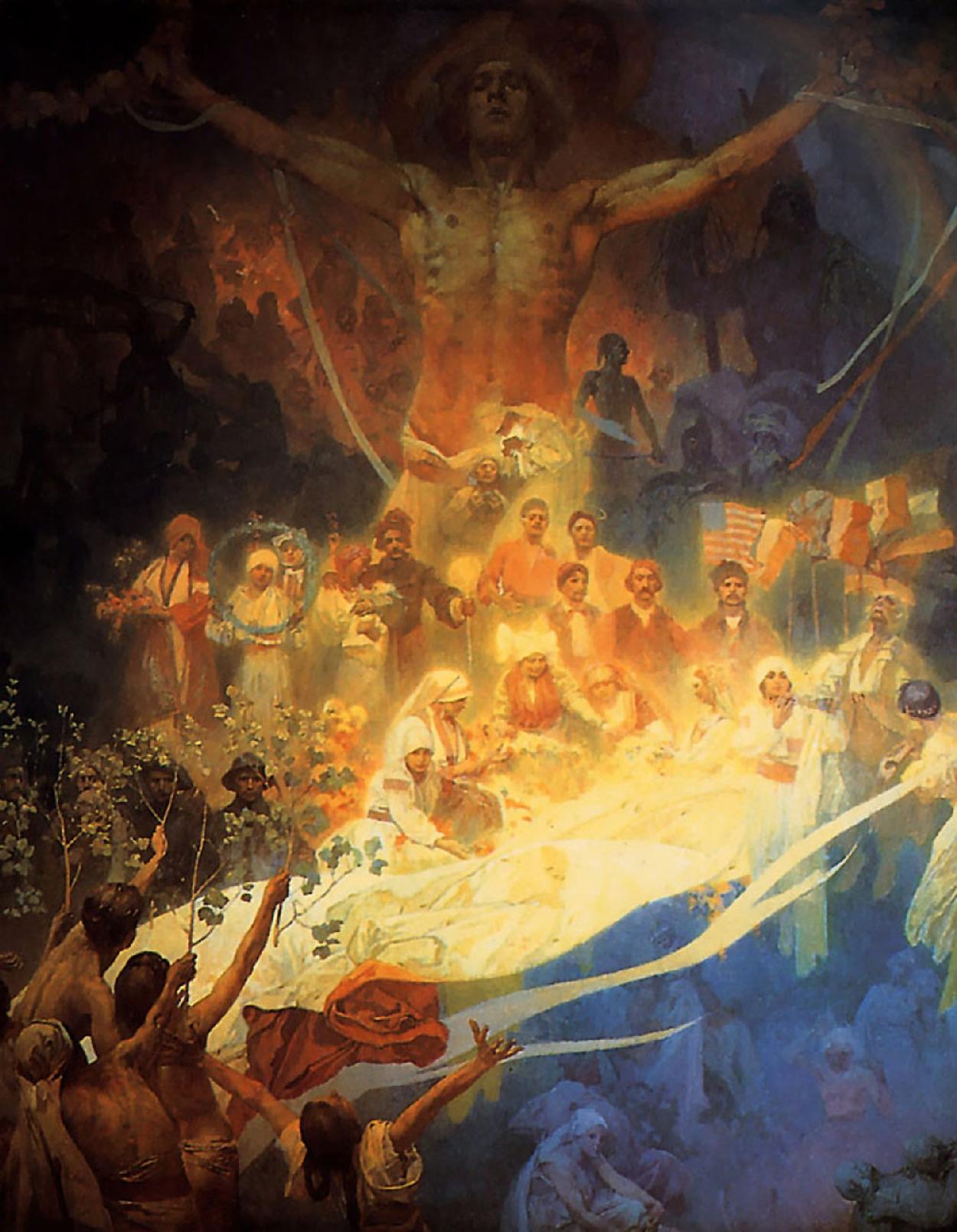
A precurosor to Luther was Jan Hus, a scholar at the University of Prague. Hus began to preach critical sermons at the Bethlehem Chapel (1402). In many ways he continued the traditions of English reformer John Wycliffe. The sermons endeared him to the common people but brought him into conflict with the Roman Church. The Hussite movement was transferred into a revolutionary character by the execution of Hus by order of the Council of Constance. He was burned at the stake in Germany (1415). The resulting Hussite Wars were perhaps the first major event in modern Czech histoy. They anticipated the Reformation by a century. The Husseite Wars are also sometimes referred to as the Bohemian Wars. Popular uprisings broke out (1419). Prague priest Jan Želivský played a key role. A Prague mob threw the city councillors from the windows of the New Town Hall in what has become known as the first Defenestration of Prague. The military phase occured in Bohemia (1420-34). Jan Žižka led the largely peasant Husseite forces and defeated the Roman Catholic King (later emperor) Sigismund at nearby Vítkov Hill. As in the Reformation, both religion and nationalism were intertwined. The wars proved inconclusive. It was, however, aturning point in European warfare. The heavily armored and mounted knights which had dominated warfare for centuries were held off by the largely Hussite infantry armed with gun powder weapons. It was a major step in ending European feudalism. Mucha devoted three pannels of "The Slav Epic" to the Hussite Wars. George of Podebrad ( -1471)restored order, but he was the last native Czech leader for five centuries.
Bohemia had been severely weakened by the Husseite Wars. The Czech crown passed first to the Hungarian (Jagiello) monarchy. The Ottomans defeated and killed Hungarian King Ludwig/Louis at the Battle of Mohács, ending the Jagellon line (1526). As a result, the Austrian Hapsburgs inherited Bohemia and the Czech lands. They would rule the Czechs until the collapse of the Austro-Hungarian Empire in the wake of World War I.
The Reformation which began in Germany (1519) quickly spread to Bohemia and converted many Czechs. The Reformnatioinin may ways built uppn Hussite thinking. The Hungarian monrchy was rather weak and was unable to impede the spread of Protestanyism. The Ottomans victory and death of Hungarian King Ludwig replaced the Jagellon lie with the Hapsburgs (1526). The Hapsburgs monarchy was a stronger force and moved to control the Czech nobility and check Protestant influence. The Hapsburg led the Counter Reformation's forces. Ferdinand I strengthened the position of the monarchy and moved to support Catholocism in Bohemia, although Protestatism continued to have wide appeal among the Czechs. He invited the Jesuits to Bohemia. Hapsburg Emperor Rudolf II's successor Matthias moved against the Protestants in Bohemia. He renounced his predecors grant of religious freedom (1618). Most of the inhabitants of Bohemia were Lutheran, Calvinist, or members of one of the Hussite sects, but the Catholic minority with Habsburg support was growing. The mostly Protestant Bohemian nobles were opposed to the encroachment by the Catholic Hapsburgs. This resulted in another Protestant uprising. the Bohemian nobels staged a revolt against Imperial officials (May 23, 1618). This began with the Second Defenestration of Prague. Another Prague mob threw several Matthias' governors out of a window of the Prague Castle. They famously landed in a dung and garbage heap and survived). The Protestant protests led to the Battle of the White Mountain (bitva na Bílé hoře) (1620). The Protestants were severely defeated by the Habsburgs. Warfare spread to Germany where the Protestant nobility continued to resist. The fightong in Bohemia essentially sparking the devestating Thirty Years' War (1618-48). Hapsburg officials executed 27 Protestant leaders on the Prague Old Town Square (1621). This decisevely ended the Reformation in the Czech lands. Authorities banned all religions except the Catholic faith. Hapsburgh authorities also supressed the Czech language in an effort to destroy national consciousness. This period in Czech history is coomonly referred to as the Dark Age (doba temna).
The French Revolution of 1848 inspoired a succession of liberal and national revolts throughout Europe. Europeans wanted liberal democratic reforms and an end to autocratic moinsrchial government. One of tghe countries racked by demonstrations was the multi-ethnic Austro-Hungariam Empire. The Empire had many restive minorities. Emperor Ferdinand I (1835–1848) promised to reorganize the empire on a constitutional, parliamentary basis. Czechs in the Bohemian Kingdom were ruled by the Hapsburgs as instituionally the Emperor becamne the Bohemioan king. Nationalist sentiment had been growing in Bohemia since the French Revolution. It was, however, differentthan in Polabd. The nobels were Germans or Germanized Czechs. Nationlist thoughtv thus came from the peasahtry and middle class. Liberals formed a National Committe that included Germans and Czechs. Bohemian Germans favored, however, joining a Greater Germany, adding German-speaking territories to a new unified Germany. Bohemian Germans thus withdrew from the Committee, This was the beginning of the Czech-German conflict that would so mar subsequent history. František Palacký (1798-1876) was a Czech historian and politician and the leading voice in the Czech National Revival, sometimes called 'Father of the Nation'. He proposed a constitutional approach for Czech nationalism--Austro-Slavism. He saw the Austrian Empire as a buffer against absorption by either the German and Russian Empires. He wanted to federalize the Empire, dividing it on an ethnographic basis. Thus he would unite the Bohemian Germans with Austria keeping them separatte from Bavaria and even future German state. The Czechs and Slovaks coiuld be united in another province. Palacky seeing that the various Slavic peoples although divided into national groups, taken together were a majority. He wanted to form a political unit so they could promote their common interests. The Czechs convened the first Slavic Congress in Prague to discuss the possibility of political consolidation of Austrian Slavs, including Czechs, Slovaks, Poles, Ruthenians (Ukrainians), Slovenes, Croats, and Serbs (June 1848). Ultimately the liberal efforts in both Praguecand Hungary were supressed by the Russian Army which came to the aid of the Austriuan monarchy.
Both Czechs and Slovaks participated in the extensive emigration from the Austro-Hungarian Empire that occurred in the late 19th and early 20th centuries. About 1.5 million Czechs and Slovaks had emigrated to the United States. [turn of the 20 century] There were no restrictions on wht yhy said and published. And thery were more universally criticl of the Austro-Hungarin Empire than the population at home. Minority groups emigrated for a range of reasons. Poverty, limited economic oportuity, and military conscription were leading factors. As a result, there are Czechs and Slovaks that make up part of the American mekting pot. They also went to other countries like Canada. These minorities were a factor in America support for national self-determination following World War I.
The Czechs were the most nationlly orientd people in what was to become Czzechoslovkia (turn of the 20th century). Czechoslovakism are the idea of a united Czechoslovak nation was growsing in popularity. But there wre different visions. And the there wre differences along political, ethnic, and religious grounds. Czech national movement tended to be ofrinted on the idea of federalization nd the expnsion of the Hasburg Dual Monarchy in an effofrt to achieve Bohemia’s historic state rights and an equal sttus with Austria and Hungary. [Mamatey and Luza, p.4.] The idea of creating an independen Czech nation was not their dominant view before World War I. National independence became an increasingly popular idea as the War progressed. This was particularly notable nong th immigrant popultion in Americ. This movment was led the Czech leader Tomáš Garrigue Masaryk. He becme an ardent advocte for dissolving the Austro-Hungarian Empire and create an indepndent state for Czechs and Slovaks. This movemernt founded the National Council of the Czech Lands in Paris. Their goal was to gain support from ythe Allies (Entente powera) and to help organize and gain the support from the vzrious national communities abroad. [Mamatey, p.65.]
The Czechs and Slovaks when World War I broke out were part of the Austro-Hungarian Empire. They were two of several restive minorities within the Empire. As Slavs they were not enthusiastic to fight with the Austrians, Germans and Hungarians against fellow Slavs (Russians and Serbs). Many Czechs and Serbs on the Eastern front defected from the Austrian-Hungarian Army and formed the Czechoslovak Legion to fight with the Russians. Thomas Masaryk who emerged as a leader in the Czech independence movement went to western Europe with his American-born wife to promote the the idea that the Austro-Hungarian Empire should be disolved after the war and the new nation of Czechoslovakia created. The Allies resisted at the time because the Russians still fighting on the Wastern front were a multi-national empire not well-disposed toward national self-determination in Eastern Europe. Masaryk along with fellow Czech Eduard Benes and Milan Stefanik (a Slovak war hero), established the Czechoslovak National Council. Masaryk went to America to promote the idea. Benes worked in in France and Britain. The Russian Revolution and the entrance of America into the War changed the political situation. President Wilson in his 14 Points had embraced national self-determination. Britain and France hesitated because they were involved in secret talks with Austrian Emperor Karl I (1916-18) who had replaced Emperor Franz Josef. They hoped to convince the Emperor Karl to make a separate peace. When this failed, the Allies recognized the Czechoslovak National Council (summer 1918). as the supreme organ of a future Czechoslovak government. The German German Western Front began to crack under British and American offensives (September 1918). German and Austrian officials began making peace feelers (early October). Masaryk from America declaraed Czechoslovak independence (October 18). As in other Eastern European countries, borders became a controversial issue. Many areas included mixed ethnic populations. Masaryk wanted Czechoslovakia to be built around the historic Bohemian Kingdom, but include the German-populated Sudetenland. As the Austro-Hungarian Empire began to desintegrate, German deputies from the Sudetenland joined other German and Austrian deputies in the Austrian parliament and declared a new German-Austrian state (October 21). Emperor Karl abdicated on the same day the armistice on the Western Front went into effect (November 11). Czech troops also occupied the Sudetenland (November 11). The Slovaks to the east had the Hungarians to deal with. Hungary officually withdrew from the Austro-Hungarian Empire (November 1). Count Michael Karolyi formed a liberal-democratic government. This Government attempted to retain control over Slovakia. The Czechs gained Allied approval and occupied Slovakia. The Hungarians withdraw. The Czechs and Allies agreed on the Danube and Ipel' rivers as aborder between Hungary and Slovakia. This meant that in the west there would be a German minority and inthe east a substantial Hungarian minority.
Independent Czechoslovakia was formed at the end of World War I. Thus the history of Bohemia became the history of Czechoslovakia which merged Bohenia with other Slavic areas (Slovakia, Moravia, and others smaller provinces). U.S. President Woodrow Wilson strongly promoted the creation of nation states based on national/ethnic identity. There were tensions within the new state which included minority groups, especially the Germans in the Sudetenland. The major tension was differences between the two main groups, the Slovaks and Czechs. Both were Slavs and shared a desired for independence from the Hapsburgs. There were, however, cultural differences between the two. The Czechs and Bohemia was the more developed part of the country. Slovakia was more rural and less industrilized. There was also an educational gap between the two. Czechoslovakia was by the time of the rise of the NAZIs (1933), the only real democracy among the countries emerging from the Hapsburg Empire. The freedom and opportunity of Czexhoslovakia resulted in economic progress in both the Czech and Slovak areas of the country. But the rise of the NAZIs in Germany resulted in increased restiveness from the German minority. The NAZIs helped promote the problems which developed, including financing Sudeten NAZIs and encouraging Slovak separtists.
S.
Neville Chamberlain, the British Prime Minister mused how terrible it was that war should be threatened by a "... quarel in a far away country by people of which we know little." A prominent member of the British parliament displayed even more ignoramce when he told the press, "Why should we bother with those gypsies in the Balkans?", meaning the Czechs who were of course not located in the Balkans. It looked in September as if war was imminent. Chamberlain appealed to Hitler for a conference in a last minute effort to prevent war (September 28, 1938). The conference was held at Berchegarten, Hitler's mountain top refuge. Hitler and his ally Mussolini met with Primeminister Chmberlain and Premier Daladier. The Czechoslovak government was neither invited nor consulted about the discussions. The British and French gave in to Hitler's demands. The result was the Munich Agreement which was signed by Germany, Italy, France, and Britain (September 29). The Czechoslovak government, deserted by its allies, capitulated the following day and agreed to abide by the agreement forced upon (September 30). Chamberlain flew back to London and stepping off the plane waved the agreement signed by Herr Hitler which he assured the waiting repoters guaranteed "Peace in our time." Churchill was apauled. The British and French people were releaved. One European leader, Soviet Marshall Stalin, who was not invited to attend the conference drew the inescapable conclusion that the British and French could not be trusted as potential allies against Hitler.
Hitler remiliatized the Rhineland (1935) and conducted the Anschluss bringing Austria into the Reich (April 1938). Hitler's next target was the Sudetenland. The Czechs were prepared to fight. The British and French were not. British Primeminister Nevil Chamberlin delivered the Sudetenland to Hitler at the Munich Conferece (October 1938). The Sudetenland was incorporated into the Reich. Slovakia suceeded and a pro-NAZI regime seized power. Hitler ordered the Wehrmacht to seize the rest of the country (March 1939). Here Hitler step over another milestone, for the first time he seized control of non-Germans. NAZI policies varied depending on the area of Czecheslovakia (the Sudetenland, Bohemia and Moravia, and Slovakia). We note that some Czechs were forcibly removed from the Sudentenland, but we have few details at this time. NAZI policies in Bohemia and Moravia were much more begin that later implemented in Pland, but vecame more secere as the occupation progressed, especially after the appointment of Teynhard Heydrich as Governor. The Czechs as the first occupied country, were the first to be drafted for forced labor in Germany. The Czech arms industry played an importan role in the German war effirt. Hitler convinced that the Czeches were being treated to lightly, appointed Reinhard Heydrich to replace the first NAZI governor. His assasination by British-trained patriots resulted in horendous reprisals by the SS.
The Red Army liberated most of Czechoslovakia from the NAZIs. Civilians in Prague rose up against the Germans (May 1945). Russians fighting with the Germans played a role in driving the SS out of Prague. Patton's 3rd Army reached Pilsen and other areas in western Bohemia. After the German surrender, the pre-War Government-in-exile returned to Prague and set up a post-War government. From the beginnining, however, the Edvard Beneš Government did not have control of the police and security forces. Security was from the beginning in Soviet hands, the NKVD and Red Army. President Beneš issued a decree expelling ethnic Germans. Under the Beneš Secrees about 2.9 million ethnic Germas were expelled. These of course were mostly the Sudeten Germans that had demanded to be reunited with the Reich. Czechs hoped that after liberation from the Germans that they would be able to rebuld a democratic nation. They were, however, occupied by the Red Army which meant that the security services were in the hands of the Soviets. Some Czechs optimistically saw their country as a bridge between East and West. The country held its first democratic elections since the German occupation (Spring 1946). The democratic elements were led by President Beneš. The Czechoslovak Communist Party (CCP) won 38 percent of the vote. The took most of the key positions in the new government. The Communists aided by Soviet security forces gradually neutralized anti-communist forces. Some democratic politicans disappeared. Others were intimidated into silence. Here Stalin moved slower than in other Soviet occupied countries, but the same process was pursued. The United states offered to include both the Soviet Union and Soviet-occupied Eastern Europe in the post-War recovery Marshall Plan. The Beneš Government hoped that Czechoslovakia could participate in the Marshall Plan. Stalin refused to participate and ordered his Eastern European satellites to refuse as well. The CCP seized power (February 1948). The Soviet inspired action made Stalin's designs on Europe crystal clear. This shocking development was a primary factor in Anerica and Western Europe forming the North Atlantic Treaty Organization (NATO) (1949). Just as Czechoslovakia was at center stage in the lead up to World War I. It was at center stage in the outbreak of the Cold War.
The Soviets enginered a coup in Czechoslovakia in February 1948. Czechoslovakia was the last Eastern European country occupied by the Soviets that had any semblance of a democratic government. Stalin was not interested in bridge building. He wanted a reliable, compliant Czechoslovakia like the other satellite states of Eastern Europe. The Communists armed their supporters and staged street demonstragtions. They were supported by th police because the Ministry of the Interior was in the hands of the Communists. The army might have supoorted the Government if President Benes had decided to resist, but he believed that Soviet troops would intervene. Czecholslovakia at the time was almost entire surounded by Soviet satellites or Soviet occupied eastern Germanya nd Austria. He therefore yielded to the Communists and the country soon had a Stalinist Government. The Soviet takeover of Czecheslovakia in 1948 had many unintended consequences for Stalin. After the 20th Party Congress (1956), the capricious nature of Stalinist terror was regularized, but Czechoslovakia and the other Soviet Eastern Europeans satellites contunued to be governed as a police state, strictly controlling people's lives. Fear gradually diminished and social and artistic freedoms increased in Czechoslovakia during the 1960s. This led to increasing discussion of political freedom. The Prague Spring (Pražské jaro) refers to a brief period of political reform and liberalization began in Czechoslovakia (1968). Czech Communistl leader Alexander Dubcek who came to power January 5, 1968 initiated a series of liberal reforms. Dubchek replaced hard-line leader Antonin Novotny as First Secretary of the Czech Communist Party. In the end, the Soviet settled the debate--with Red Army tanks. The Prague Spring ended with and the invasion of 650,000 Soviet and Warsaw Pact troops (August 20, 1968). The period following the Prague Spring and Soviet invasion is known as the period of "normalization". The Soviets reinstalled the hard liners in power. They acted as apologists for the Soviet invasion. Any opposition to the reintroduction of Communist orthodoxy was quashed. The political, social, and economic life of the country stagnated. The first inkling of opposition to the Communist orthodoxy was Charter 77. More than 250 human rights activists signed the Charter 77 manifesto (January 1, 1977). They criticized the Communist government for failing to implement human rights provisions in several different commitments, including the United Nations \Charter an the Czechoslvakian constitution. Charter 77 was unsucessful in changing the nture of the Czech Communist government, but gradually police state tactics were softened, allowing a degree of discent and discussion as long as it was not to public.
Gorbechov's reforms in the Sviet Union had repercussions in the Soviet Eastern European satellites. Communist leaders attempted to maintain Communist orthodoxy through police state actions. The Communist regimes were, however, clearly crumbling when Gorbechov signalled that the Red Army would not be used to keep the regimes in power. This essentially undercut the regimes because they had little domestic support. The Czech communist police violently broke up a peaceful pro-democracy demonstration and brutally beat many student participants (November 17, 1989). Charter 77 and other groups united to create the Civic Forum.
The popular support afforded the Civic Forum was such that the Czechoslavkian Communist Party, with virtually no popular support, essentially collapsed. Husak and party chief Milos Jakes resigned (December 1989). Havel was elected President (December 29). The transition was a starteling transformation and occured along with similar changes in East Germany. The lack of violence resulted in it being named the
Velvet Revolution.
Slovak demands for greater autonomy brought the daily functioning of the federal government to a halt (1992). Václav Klaus's Civic Democratic Party in the resulting election won decisively in the Czech lands (June 1992). He ran on an economic reform platform. Vladimir Meciar's Movement for a Democratic Slovakia dominated the voting in Slovakia. He centered his campaign on demands for autonomy. Those committed to federalism, like Václav Havel, were unable to reverse the growing political devisiveness. President Havel resigned (July 1992). Klaus and Meciar hammered out an agreement for the disolution of Czechoslovakia and the formtion of two separate states. After 75 years of unity, the Czechs and Slovaks formally separated (1993). Members of the Czechoslovak federal parliament divided along national lines. Thir last act was to pass the law officially separating the country (December 27, 1992). The Czech Republic and the Republic of Slovakia were simultaneously and peacefully created (January 1, 1993). There were minor sqabels over the division of federal property and the national debt.
Mamatey, Victor S. Czechoslovakia, Crossroads and Crises, 1918–1988 Ch 14 ‘The United States and Czechoslovak Independence’ (London: Macmillan, 1989).
Mamatey, Victor S. Mamatey and Radomir Luza. (Eds.) A History of the Czechoslovak Republic, 1918–1948. (Princeton, New Jersey: Princeton University Press, 1973.

Navigate the Children in History Website:
[Return to the Main European history country page]
[Return to the Main Czechoslovakian page]
[About Us]
[Introduction]
[Biographies]
[Chronology]
[Climatology]
[Clothing]
[Disease and Health]
[Economics]
[Freedom]
[Geography]
[History]
[Human Nature]
[Law]
[Nationalism]
[Presidents]
[Religion]
[Royalty]
[Science]
[Social Class]
[Bibliographies]
[Contributions]
[FAQs]
[Glossaries]
[Images]
[Links]
[Registration]
[Tools]
[Children in History Home]
Navigate the Boys' Historical Clothing Web Site:
[Return to main country page]
[Australia]
[Canada]
[England]
[France]
[Germany]
[Ireland]
[Italy]
[New Zealand]
[Scotland]
[United States]