|
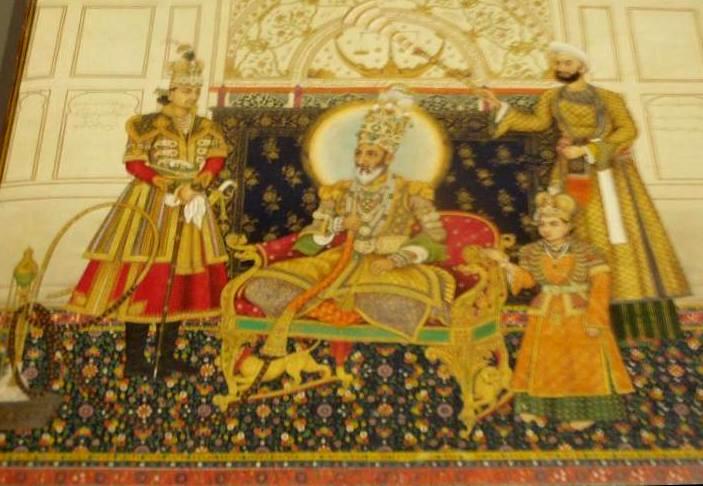
Curiously when the Mongols in the 13th century exploded upon China, the Middle East and Euope, they left the Indian sub-continent unscathed. It was a later Mongol invasion that overwealmed India. Baber or Zahir ud-Din Mohammed (1483-1530), a descendents of Genghis Kahn and Tamerlanre, was a child warrior King at age 11. He began raids into India
for booty (1519-24). He defeated the Sultan of Delhi, taking both Delhi and Agra (1526). Baber founded India's famed Mogul dynasty (1526-1707). He greatly expanded the dominions that had been held by the Sultan of Dwlhi. The Moguls were an Islamic dynasty which governed India for more than 200 years. The Moguls reformed government and promoted the arts. One of their major accomplishments was uniting India. The greatest Mogul ruler was Baber's grandson Akbar (reigning 1556-1605). Akbar significantly expanded the boundaries of the Empire. India was a great challenge for the Islamic Moguls. The subcontinent was populated by a largely Hindu people. Not only did the Mogul's encounter a largely alien religion, but dizzing variety of languages and traditions. Akbar's genius was not only his military conquests but his his toleration toward Hindus, and Christians. Akbar also promoted the arts and learning. The resulting artistic flowering is one of the glories of India, expressed in painting, glass, and carpets. The last of the Mogul rulers was Aurangzeb ( -1707). Unlike Akbar Aurangzeb was intolerant of other religions, resulting in Hindu uprisings which drained the royal treasury.
Medieval India was dominated by the Choula in the south nd the Rajputs in the north. The most important dynasty during the medieval rose in southern India away from the Indus Valley in the north where civilization first appeared during the ancient era. The Cholas unlike other mahor dynasties (the Chalukyas, the Pallavas, the Pandyas or the Rashtrakutas) were a native dynasty not an invaduing force. The Deccan region was in chaos. The Deccan Plateau comprises much of southern Asia. The Cholas reduced the Pallavas to the status of minor vassals. The Rashtrakutas had declined, but a resurgent branch of the Chalukya family (the later Chalukyas) became an imortant regionalpower in the western Deccan. The Deccan region was contested by the later Chalukyas, the Yadavas in Devagiri (northern Deccan around Aurangabad), the Kakatiyas of Warangal (Andhra Pradesh) and the Hoysalas of Dorasamudra (Mysore). It was Cholas whonultimarely merged as unchallenged authorities in the south (900-1100 AD). After the death of Harsha the Rajputs rose in northern India. The Rajput period in the north was as in medieval Europe was an age of chivalry and feudalism. The Rajputs constrantly warred with each oither. This weakened, they were unable to resist Turkic invader from Afghanistan from gaining a hold on nothern India where they established the Delhi Sultanate (13th century).
The Mongols played an enormously important role in world history. Although a relatively small population, the Mongols established the most extensive empire in history, streaching from Korea to Eastern Europe. The Mongols proved to be military masters,defeating larger more advanced civilizations. Their enemies came to call them the Mongol Horders. In fact the Mongols odren won battles against largeer more heavily armed ;pponents. Only the Japanese, Vientamese, and the Indians, for a time, suceessfully defied the Mongols. The Mongols conquered and influenced many of the major world powers, China, Russia, Persia, and evenbtually India. The Mongols defeated the Poles and were set to move into Western Europe. Only the death of thir great leader, Geghis Khan prevented this. Curiously when the Mongols in the 13th century exploded upon China, the Middle East and Euope, they were unable to penetrate the Indian sub-continent. They were blocked in a series of battles by the forces of the Delhi Sultanate.
The Delhi Sultanate is a generic term for five, Delhi based kingdoms or sultanates, in northern India during the medevial era. They were founded by rulers of Turkic origin invading from Afghanistan. in medieval India. The sultanates ruled from Delhi establishing the idea of Selhi as a kind of Indian capital. The five dynasties included the Mamluk dynasty (1206–90); the Khilji dynasty (1290–1320); the Tughlaq dynasty (1320–1414); the Sayyid dynasty (1414–51); and the Lodi dynasty (1451–1526). Qutb-ud-din Aibak, a former slave (Mamluk) of Muhammad of Ghor in modern Afghanistan was the first sultan of Delhi. He abd his successors conquered large areas of northern India. The Khalji dynasty added areas of centak India to the Sultanate. They failed,however, to unite the entire Indian subcontinent. The Sultanate in military terms managed the rare accomplishment to defeat Momgol armies on several occassiins, preventing the Mongols from adding the Subcontinent to their empire. The Sultanate generated a period of cultural renaissance. This was the beginning of Islamic culture on the Subcontinent. The Indo-Muslim cultural fusion left a major cultural imprint which included architecture, music, literature, religion and clothing. Linguistic scholars believe that the Urdu language (meaning 'horde' or 'camp) developed in the Delhi Sultanate mixing the Turkic dialects of the invaders with that of the local population (Sanskritic Prakrits). Immigrants speaking Persian, Turkic and Arabic under the Muslim rulers added to the mix. The Delhi Sultanate is notable as the only Indo-Islamic empire to have include a female ruler--Razia Sultana (1236–1240). The Delhi Sultanate was finally destroyed by the Moguls under Babur. He began raids into India for booty (1519-24). Strengthened by tht booty, he finally invaded with a major army. He defeated Ibrahim Lodi, the last Sultan of Delhi, at the First Battle of Panipat. He took both Delhi and Agra (1526).
Babur founded India's famedMugal/Mogul dynasty (1526-1707).
The name of the Empire comes from Mogul/Mughal which is simply the Persian word for Mongol. This reflects the Persian cultural orientation. While Barber was of Mongol ancestry, many of his followers were Persian and Turkic peoples. Babur and his successors would inject Islam and Persian culture into the siuthern Asian Subcontinent. Babur in a stunning military campaign greatly expanded the dominions that had been held by the Muslim Sultan of Delhi/Dwlhi. The Mouguls eventually dominated the sub-continent, except the extreme south and Ceylon (modern Sri Lanka).The Moguls were an Islamic dynasty which governed India for more than 200 years. The Moguls reformed government and promoted the arts. One of their major accomplishments was uniting India. The Dynasty included some remarably skilled rulers over the course of seven generations. The dynasty was especially notable for its efforts not to simply impose Islam on a culturally diverse Subcontinent, but tolerantly integrate Hindus and Muslims into a united Indian state. Some of the most prominent Mogul rulers were the founder, Babur (1526–30); his grandson Akbar (1556–1605), and Shah Jahan. Under Aurangzeb (1658–1707) the empire reached its greatest extent. Aurangzeb divergence from the toleration of earlier Mogul emperors would be a xmajor factor in rhe Empire's subsequent decline.
The name ‘Mughal’ became synnomanous with both wealth and opulence. The wealth of the Mughals is a matter of legend. And the word entered the English language meaning an important, powerful, or influential person. The Mughal Empire at its peak encompased Pakistan and most of modern India except for the far south. A significant area of land areas were brought under the control of a entities like the Suris, the Lodhis or the Mughals. The Grand Trunk Road was built as well as the Taj Mahal and the Fatehpur Sikri. Substsantial urbanization began. India nationalist see the Mugal Empire as the Golden Age of India. The country was prosperous and productive. Queen Elizabeth I for good reason envied the wealth of Empire and wrote to the Emperor Akbar anxious to begin trade (1583). The seat of power of the Mughal empire was the "Peacock Throne." It had in it background an image of a peacock with an expanded tail wrought in gold and precious stones. It is difficult making precise comparative estimates. We suspect that Akbar was the wealthiest man on earth. Whether his subjects were better off than Europeans we are not sure, they may well have been. The Indian economy supported a population of 100-150 million people. [Habib] At the time Englnd had a population of about 4 million and France, historically Europe's most populace country, perhaps 20 million. India It was like all countries at the time an agricultural economy, but it looks like there was more manufacturing in India than in Europe. Agricultural technology was comparable to that of Western Europe. Several analysts suggests that even small sale subsistence peasant got a reasonable return and overall living standards were comparable to the West. One analyst writes, "... at its peak, it is conceivable that the per capita product was comparable with that of Elizabethan England.” [Maddison, p. 18.] Other authors provide similar assessments. [Moreland] There is no doubt that India large and skilled manufcturing labor force. They produced not only cotton textiles, and metal products, but also luxuries and beautiful buildings for the for the Mugul ruling class. As a result revenue collected by the Muguls was astonishing.
After Aurangzeb died, the Mughal Empire rapidly declined, weakened by breakaway Hindu provinces and rebellious Sikhs. While the individual Leter Moguls are little know and their territory steadily declined, collectively they ruled almost as long as the Great Mogul rulers. The subsequent emperors are thus called 'the Later Moguls'. The "Later Mughals", lacked the power and wealth of the early emperors. The Mogul Empire began to decline in the 18th century with the rise of the Sikhs and Mahrattas groups which had been driven to rebellion by Aurangzeb. This was the India that the British and French encountered. It was a deeply divided country with a large number of independent principalities. There was no strong central authority capable of effectively resising the Europeans. The Mogul rulers till existed in the north, but only effectively controlled the area around Deli--scsreky an Empire. The British prevailed in a series of land engagements and by the late-18th century and were in a dominant position. The last Mogul was Bahadur (Muḥammad) Shah II, who began his reign during 1837. the Empire had already broken up, a process that was hastened by dynastic warfare, factional rivalries, and the Iranian conqueror Nādir Shah’s brief but disruptive invasion of northern India (1739). After the death of Muḥammad Shah in 1748, the Marathas overran almost all of northern India. Mughal rule was reduced to only a small area around Delhi, which passed under Maratha (1785) and then British (1803) control. The last Mughal, Bahādur Shah II (reigned 1837–57). He was drawn into the Sepoy Mutiny (1857). The British deposed him and exiled him to Rangoon (now Yangon) in Burma.
The East India Company (EIC) was the cental institudion in British colonization of India. From modest beginnings it became a massive export company. The East India Company developed over 150 years. It ws able to receice favorable treatment from the British government by paying lucrative bribes to members of parliament and other officials. Before the Industrial Revolution dramatically lowered the cost of producing cotton textiles, the East India Company profited by the sale of South Asian silk, cotton, and other products in Britain. This adversely affected domestic British manufacturers. Finally Parliament demanded that the EIC beginto pay £0.4 million annually to the British Exchequer (1767). Gradually the British seized control, first from the French, then from native princes. The EIC to protect their vast holdings created a private army of 200,000 nostly South Asians officered by 40,000 British soldiers. The Asian Indian) soldiers were called Sepoys. Many of the EIC soldiers were Muslims.
Historians report growing Indian discontent with British rule during the mid-19th century. A primary cause of the discontent was the political expansion of the East India Company (EIC) seizing the lands and properties of the native princes and of the Mughal court in Delhi. Both Hindu and Muslim princes were affected by the actions of the EIC.
The EIC also pursued harsh land policies, affecting more humble Indians. The policies were pursued by by Governor-General Dalhousie and his successor, Lord Canning Canning. Many traditional-minded Indians were also disturbed by the rapid introduction of European technology and culture. Many were offended by the introduction of foreign culture and ideas challenging centuries old traditions. Sahib Nana Sahib (1821- ) who would become a leader in the Mutiny was the leader of the Marathas. The British denied himk his titles and pension (1853). The British also decided that the Mugul in Delhi would be the last of the Mughal emperors. They informed the elderly Bahadur Shah II that his dynasty would end with his death. The Swapoys were also becoming dissatisfied. Pay was one issue. Regulations were another. Some began to see a British effort to force them to convert to Christianity. with their pay as well as with certain changes in regulations, which they interpreted as part of a plot to force them to adopt Christianity. This belief was strengthened when the British furnished the soldiers with cartridges coated with grease made from the fat of cows (sacred to Hindus) and of pigs (anathema to Muslims).
Revolt
The Seapoy uprising was called for many years the Seapoy Mutiuny by the British. In our world of political correctness, some historians have ciomne up with other terms such as the Seapoy War, the Seapoy Rebellion, or the Indian Nutiny. Readers can choose what term tonuse. Here at HBC we are more prone tonuse traditional terminology rather use ideological constructs to color historical developments. The 1857 Mutiny was a rebellion against British rule by a large part of the Sepoy Army in Bengal. The mutiny, which was confined to the north, especially Bengal. It constituted the most serious threat to British rule in India during the 19th century. . The British were introducing the new Enfield rifles. The Sepoys noticed the grease used to protect the cartridges. Rumors spread that they the grease was animal fat which it apperently was. This horrified both Muslims and Hindus for opposite reasons. Lard or pig fat was taboo to Mudlims. Beef fat infuriated Hindusho revered the cow. The British quickly replaced the cartridges when the cultural mistake was realized. Suspicion among the Sepoys, however, persisted. Sepoy units refused to use the cartridges in several incidents (February 1847). Those that disobeyed orders were shackled and imprisoned. Outrage quickly became mutiny. Their outraged comrades mutinied and shot their British officers at Meeru (May 10, 1857). They then marched on Delhi. The initial mutiny was spontaneous. Tthe Sepoy Mutiny began t (May 10, 1857). The initial spontaneous mutiny quickly became a more organized revolt against the British. The Sepoys were able to seize Delhi and proclaimed Bahadur Shah II the emperor of all India. The mutiny spread rapidly through northcentral India. The Sepoys of Nana Sahib took Cawnpore (Kanpur) (June). A virtually independent dynasty of the Nengal nawabs roise to power in Bengal. One of those nawabs attacked the British enclave in Calcutta and cramed the British he was able to seize in an airless underground cellar--the Black Hole of Calcutta. Other Seapoys beseiged Lucknow. The British moved quickly to supress the Mutiny. Here they were auded by two factors. First, Seapoys in the Punjab remained loyal. Sikhs there did not want Mughal rule restored. Second, the south remained largely passive. The British offensive was commanded by Generals Colin Campbell Campbell (1792–1863) and Henry Havelock Havelock (1795–1857). The British recaptured Delhi (September 20, 1857). Lucknow was abandoned (November), but retaken (March 1858). The rebellion was marked by atrocities on both sides. The Seapoys treated captured British, both military and civilians viciously. The Black Hole of Calcutta became the symbol of the Mutiny. The British took savage reprisals for the massacres perpetrated by the rebels. The British dealt harshly with the mutineers. There were reports of unarmed sepoys who were captured being bayonetted. Others were sewn up in the carcasses of pigs or cows. And some were fired from cannons.
Bahadur Shah II (1775-1862)
Bahadur Shah II was the last of the Mughal emperors in India. He was born (October 24, 1775), the son of Akbar Shah II and his Hindu wife Lalbai. When his father Akbar Shah II died (1838), Bahadur Shah inherited the Mughal throne. He had four wives.
The Empire Bahadur Shah II inherited was a far cry from the Great Mughal Empire of Akbar. Bahadur Shah is seen as one of the Later Mughals. His Empire was little more than the city of Delhi and its environs. At the time, India was composed of a dizzeying complexity od small principalities. The najor forces on the sub-Continent werre the British, the Sikh Empire in the Punjab and Kashmir, and the Maratha Empire. Bahadur Shah was totally subordinated to British. He received a pension and allowed to collect some taxes. He was permitted to maintain a small force, essentially palace guard. Bahadur Shah II was no emposing political figure. He did not have exceptional political schools or any buring desire to be a great leader. His on talent in fact was poetry and his poems are tofay admired by Indian nationalists. Mutinous Seapoy regiments arrived in Delhi soon after the Mutiny began. It was clear that the Mutiny needed a leader that could inspire both Muslim and Hindu soldiers. They settled on Bahadur Shah because of his position as Emperor which has a historic image in India. The nutineers hoped that the many small Indian principalities could unite to defeat the British. Bahadur Shah was acceptable because he was so passive and poweless. The other princes did not see him as a threat. Thus Bahadur Shah was more acceptable than a more powerful Indian prince. When the British reentered Delhi, Bahadur Shah II and took refuge in Humayun`s Tomb at the outskirts of Delhi. British Major William Hodson surrounded the tomb and arrested him there (September 20). Major Hodson on his own authority executed his sons, Mirza Mughal and Khizar Sultan, and his grandson Abu Bakr while Bahadur Shah looked on at the Khooni Darwaza (Bloody Gate) near Delhi Gate. Bahadur Shah reacted with shocked silence. His wife Zeenat Mahal was apparently pleased, believing that her son was now the heir. The three detached heads were offered him on platters instead of food. He replied, that this was the way that the sons of Mughals came to their fathers -- "with their heads in red". The British exiled him to Rangoon in Burma with his wife Zeenat Mahal and the other members of the royal family. Thus ended the Mughal Empire. He died in Rangoon (1862). Bahadur Shah's title of emperor was given to Queem Vicoria (1877). This was Disreli's idea and the Queen was enchanted by it, taking an interest in all things Indian--including Indian servants.
The Mughals dominated India for over two centuries and almost conquered the entire Sub-continent. The Mughal Empire at ists peak was the most powerful in the world measured in military and economic power-rivaled only by Ming China--cerainly not Europe. About all a quater of all world wide manufacturing occurred in India. [Dalrymple, p. xxvi.] And inevitably the economy is a major driver of the arts. The Mughals had a powerful impact on the the thoughts and arts of India. The artistic flowering under Akbar is one of the glories of India, expressed in painting, glass, and carpets. And of course one of the architectural treasures of all time is the Taj Mahal near Delhi. The Mughal Empire in the mid 16th century was arguably the greatest empire in the world. Shah Jahan commissioned the Taj Mahal (1630–1653). It was built at Agra as a tomb for his wife Mumtaz Mahal. She died giving birth to their 14th child and Shah Jahan never fully recovered. Art during this era, art was not limited to Mughal forms. India had an amazingly diverse society. The Mughals invaded India (16th century). The uninially tolerant Mughals came close to comquering the entire sub-continent). More austere Islamic emperors caused a reaction anf increasing Hindu resitance. The Mughals had a major impact on Indian art. They were at first less doctrinare about human depictions. The most famous early Indian paintings date from the modern era -- Mughal paintings. They were minatures displayed in books rather thn painted on or hung on walls. This was a painting tradition resulting from a fusion of the Persian miniature with ancient Indian traditions (16th century). It is a rare devloped painting tradition from a Muslim-dpminated society which as a result of Koranic teachings prohibited the depiction of the human form. Mughal art, however. is noted for the many beautiful mimatutres with human depictions. The minature was an established Indian art form before the Mughals. The Mughals adopted the minature, but did not follow musical set convention of Ragamaka painting. We suspect that the minature was perfect for the Mughals, allowing them to enjoy neautiduk art, including human depoctions, without showin the violation of Koranic prphibitios through public art. This style spread throughout India as a result of Mughal conquests, nearly uniting India (17th century). It was adopted by the Indian princely courts of all religions and developed into an Indian style with many destinctive local diffrences. An important type of Ibdian painting. are the Ragamaka, sets of miniature paintings depicting different musical modes. The Ragas dominated north Indian music abs art. Tewere not Amyghal, but they influenced Nughal art. The minature became a major Mughal artistic style. While not originated by the Mughals, it is during the Mughal era that the Ragamaka reached its peak of artistocratic aristocratic expression. And as Mughal power declined (18th century), Hindu art forms expanded despite increasing Europran (British) power and influence.
The Moguls by the 16th century were adherents of Islam. Babur anf his successors thus introduced Islam into the predominately Hindu society of India, creating the diverse religious and cultural mix that is today modern India.
Akbar became notable for his tolerance--a rare example at the time. The last of the Great Mogul emperors was Aurangzeb ( -1707). Unlike Akbar Aurangzeb was intolerant of other religions. Aurangzeb was a devout Muslim and he sought to force all his subjects to convert to Islam. He destroyed many great works of art because he daw them as idolutrous. The result was Hindu uprisings which weakened the Empie by draining the royal treasury. As a result, Aurangzeb was the last of the great Mogul emperors.
The Mugahal hd a huge, sophisticted cotton textile indistry. It was aindustry.
The Britsh and French contested control over India in the 18th century. The issue was largely settled by the dominance of the Royal Navy. British victories in Indua diring the Seven Years War essentially ousted the French from the sib-continent. Gradually India expanded its control over all of India as well as modern Pakistan, Bangladesh, and Burma. The British accomplished all of this with an incredibly small military force. This was in part because they were largely replacing Muslim rulers who India's Hindu massess saw as juat as foreign as the English. India was by far Britain's most important colony--the jewel in the Crown. Tensions between Hindus and Muslims were kept in check by the British Raj, altjhough the British also played on this division in administering India.
Madison, Angus. Class Structure and Economic Growth: India and Pakistan since the Moghuls (George Allen and Unwin: London, 1971). Reprinted by Routledge in 2013.
Moreland, W.H. India at the Death of Akbar (A Ram: Delhi, 1962). Moreland provides a insightful description of Indian living conditions at the end of the 16th century.
Rizvi S.A. The Wonder that Was India (Rupa, 1993).

Navigate the Children in History Website:
[Return to the Main Indian history page]
[Return to the Main Pakistani history page]
[Introduction]
[Biographies]
[Chronology]
[Climatology]
[Clothing]
[Disease and Health]
[Economics]
[Geography]
[History]
[Human Nature]
[Law]
[Nationalism]
[Presidents]
[Religion]
[Royalty]
[Science]
[Social Class]
[Bibliographies]
[Contributions]
[FAQs]
[Glossaries]
[Images]
[Links]
[Registration]
[Tools]
[Children in History Home]
Navigate the Boys' Historical Clothing national pages:
[Return to the Main countries page]
[Australia]
[Belgium]
[China]
[England]
[France]
[Germany]
[India]
[Indonesia]
[Ireland]
[Italy]
[Japan]
[Korea]
[Malaysia]
[Mexico]
[The Netherlands]
[Pakistan]
[Portugal]
[Scotland]
[Spain]
[United States]